Hardware

764 views
Skip to first unread message

Fabian Tollenaar

unread,
Oct 1, 2014, 9:16:18 AM10/1/14
to sig...@googlegroups.com
Hi guys,

A Dutch OEM guy contacted me about what we're doing. He's having similar concerns as Jeffrey regarding open source, but I think in his case that's also because it's all still very.. alpha. However, forgetting about software for a moment, he had some good ideas re hardware. Most important IMO: MFD. I'd love a good and cheap water and weather proof touchscreen, that can be connected to anything using HDMI and USB. Is that something anybody else is interested in? Maybe he'll be more inclined to fabricate it on scale if he knows that there is market. 

Apart from that, I opened this new thread for anything related to hardware. It might not be entirely relevant yet, but if thing ramp up could go quickly!

Cheers!

Teppo Kurki

unread,
Oct 1, 2014, 9:24:59 AM10/1/14
to signalk
Ask him to join the list & start a thread?
Or if he prefers a non-public discussion share connection info on the list.

I for one am interested in MFD, or let's say skip the MF because I*ll provide those myself, but a marine display as you said.

--
You received this message because you are subscribed to the Google Groups "Signal K" group.
To unsubscribe from this group and stop receiving emails from it, send an email to signalk+u...@googlegroups.com.
For more options, visit https://groups.google.com/d/optout.

Fabian Tollenaar | Starting Point

unread,
Oct 1, 2014, 9:27:07 AM10/1/14
to sig...@googlegroups.com
On 01 Oct 2014, at 15:24, Teppo Kurki <t...@iki.fi> wrote:

Ask him to join the list & start a thread?
Or if he prefers a non-public discussion share connection info on the list.
I tried, but he seems very.. private for now. I’ll ask him again or if it is okay if I can share his info!

I for one am interested in MFD, or let's say skip the MF because I*ll provide those myself, but a marine display as you said.
Haha, good point. Let’s just say the multifunction is more of a “bi-function”: display and touchscreen. 

Onno Harders

unread,
Oct 1, 2014, 10:10:47 AM10/1/14
to sig...@googlegroups.com
I am the guy ! not that scared by the way!
First we need wanted specs for the Marine Display?

a: i was thinking MD with controller so it would be connected with Lan or Wlan, if you would use HDMI the cable with connectors will be a hard issue! USB on your ship is a NO! (my opinion use USB on board only on USB powered stand alone devices)
   USB means also drivers and converters, the needed data speed for a display over USB doesnt help either in this environment!

b: it would be possible that cheap "industrial" android tablets will enter the market soon, at the Cebit (march 2015) i could check the status. (industrial will mean highbrightness, waterproof)
a tablet with highbrightness will do, we could make it waterproof with nanotechnology.


Fabian Tollenaar

unread,
Oct 1, 2014, 10:12:23 AM10/1/14
to sig...@googlegroups.com
Hi Onno!

Welcome to Signal K!

Fabian

Op woensdag 1 oktober 2014 16:10:47 UTC+2 schreef Onno Harders:

rob...@42.co.nz

unread,
Oct 1, 2014, 3:50:27 PM10/1/14
to sig...@googlegroups.com
Hi Onno,

You are just what we need! The ideal unit in my view is a waterproof andriod tablet with sunlight viewable display. It should connect with WIFI to the server and possibly offer ethernet for backup, since you could then do power over ethernet too. Some nice screw holes so it can be properly attached-or maybe a robust holder.!

Just generic hardware - no need for sensors/gps/etc - but its probably hard to avoid them. Its the waterproof sunlight readable display thats currently missing.

Rob

j...@jtaylor.ca

unread,
Nov 26, 2014, 2:12:34 PM11/26/14
to sig...@googlegroups.com
What about a simple waterproof e-ink display as an instrument data repeater or for replacing various boat-gauges?
A 6" panel with 200dpi (1024x758) in black and white would reproduce most any data that isn't active chartplotting.
Waterproofing such a panel should be almost trivial.
I could fit 4 of them in my sea-hood's instrument pod; they could be bulkhead-mounted in the cockpit or pretty much anywhere.
E-ink's power requirements are orders of magnitude lower than LCD­ and refresh rates can be around 120ms which is good enough for speed, wind and depth displays along with trend lines­: https://www.youtube.com/watch?v=0DVlGZ3_d3Q

Cheers,

/Jason

Tim Mathews

unread,
Nov 26, 2014, 2:25:57 PM11/26/14
to Signal K Mailing List
Jason,

Have you seen the Weimar Nautipad? It’s exactly what you describe. I sent an email to Ben at Panbo about it a while ago, but never heard back. I was really hoping he’d do an article on them.

Anyway, they’re made by Weber Marine (wemar.com) and use panels from Visionect (http://www.visionect-epaper.com/). Visionect has a nice E-ink developer kit, which I was about to order when I clicked a link to Weber Marine and lo and behold, there was my product idea fully realized (http://shop.wemar.com/category.php?id_category=15). I may still order a dev kit, because I’d like to see one which understands Signal K.

Visionect's blog has more and better information than their main website: http://www.visionect-epaper.com/blog/high-performance-epaper-platform/


j...@jtaylor.ca

unread,
Nov 26, 2014, 3:18:47 PM11/26/14
to sig...@googlegroups.com, t...@signalk.org
Now that is interesting.  The Weimar stuff is a little pricey and probably power hungry with that back end server.
The visionect dev kit is 239euros which isn't bad.  I have some reading up to do to see if it can fit my needs.
I don't like their "minimum requirements of a 2GB Core2Duo class backend server, though.  That kind of defeats the purpose of the ultra-low power panels.

/Jason

Alex Wetmore

unread,
Nov 26, 2014, 4:45:22 PM11/26/14
to sig...@googlegroups.com, t...@signalk.org

From my research the cheapest way to get a waterproof eInk display is to hack one of these to run Linux:

http://www.kobo.com/koboaurah2o


It isn't clear if someone has already done the hack.  Other Aura models do have Linux or Android ports.


They aren't waterproof when a cable is connected, but it seems like that could be solved by permanently attaching the power cable with a little sealant.


I'm also on the pre-order list for the Earl eInk waterproof tablet, but it is looking more and more like vaporware.


alex


From: sig...@googlegroups.com <sig...@googlegroups.com> on behalf of j...@jtaylor.ca <j...@jtaylor.ca>
Sent: Wednesday, November 26, 2014 12:18 PM
To: sig...@googlegroups.com
Cc: t...@signalk.org
Subject: Re: Hardware
 

Fabian Tollenaar | Starting Point

unread,
Nov 26, 2014, 5:36:37 PM11/26/14
to sig...@googlegroups.com, t...@signalk.org

rob...@42.co.nz

unread,
Nov 26, 2014, 6:35:57 PM11/26/14
to sig...@googlegroups.com, t...@signalk.org
Alex,

They look really good! - decent size, decent resolution - daylight readable. I think that some hacking would confirm they run android or some linux flavour underneath. Theres no point in these manufacturers re-inventing the wheel on low cost devices so most just adapt android etc. Probably add screen driver, custom UI, and backend into their cloud.

If we could get one set up for web based instruments, using signalk over wifi, that would be a big win.Wonder if they have a decent web browser built in, thats all you really need.

Could also double as a book on those long night shifts...

Rob

Practical_Pirate

unread,
Nov 26, 2014, 9:22:36 PM11/26/14
to sig...@googlegroups.com
Hackaday covered a rooted Nook instrument repeater from a tomato'ed Asus router from professor Holden's lab that also is home to FrankenPilot. A broken tiller pilot brought back to life!

http://hackaday.com/2012/09/07/adding-epaper-navigation-data-to-a-sailboat/

His page has picture and descriptions, links to code etc.

Now about that nanotech waterproofing...Liquipel only quotes 80% of spills and other liquid hazard although they mention "brief shallow immersion" which seems a good thing. Usual disclaimers about not using DIY stuff for mission critical human occupied vehicles...blah blah blah... nothwithstanding. Any real life experiences in this group?

blue

unread,
Nov 27, 2014, 5:14:46 PM11/27/14
to sig...@googlegroups.com
Are PixelQi screens still available?  

I actually got a couple of 10.1" displays/controllers of ebay, and was hacking them up to use as wired slaves for mast displays (usb to HDMI, separate 12v power).  While not as power efficient as e-ink, they are dual mode and have the benefit of displaying colour if you want.  

It wouldn't take a lot to layer a touch screen on them and connect them to a linux box - also on my list of hacks.

Practical_Pirate

unread,
Nov 28, 2014, 12:09:31 PM11/28/14
to sig...@googlegroups.com
This guy built a waterproof pi/TP-link/plex media server driven shower proof media screen with UPS for elegant shutdown. Nice build. Looks like a few tweaks would give you an color MFD or rather BFD as a it were. Not touch screen though. He mentions wet touchscreens don't work. Anyone have experience with touch in wet environment?

http://www.jfwhome.com/2014/05/01/raspberry-pi-powered-waterproof-plex-media-centre/


Fabian Tollenaar | Starting Point

unread,
Nov 28, 2014, 12:13:28 PM11/28/14
to sig...@googlegroups.com
Depends on the type: capacitive won't work, but pressure shouldn't matter


Sent from my iPhone


On 28 Nov 2014, at 18:09, Practical_Pirate <mfo...@gmail.com> wrote:

This guy built a waterproof pi/TP-link/plex media server driven shower proof media screen with UPS for elegant shutdown.  Nice build. Looks like a few tweaks would give you an color MFD or rather BFD as a it were. Not touch screen though. He mentions wet touchscreens don't work. Anyone have experience with touch in wet environment?

http://www.jfwhome.com/2014/05/01/raspberry-pi-powered-waterproof-plex-media-centre/


Manfred van der Voort

unread,
Aug 24, 2015, 5:37:58 AM8/24/15
to Signal K
To catch up this thread about (more) suitable marine hardware for SignalK and the announcement of the roadmap to a first stable release, some information about an Dutch tinkerer initiative.

I've just finalised the global design of a Maritime Instrument & Display Controller (MIDC), based on a brand new Single Board Computer. The design goals for this MIDC are quite extensive:
  • suitable for small crafts (22" +) as well as bigger ones
  • low power consumption (< 12 W - based on 10' display)
  • sunlight readable screen ranging from 10' - 15'
  • multi touch user interface possibility
  • keyboard & mouse support still possible for non touch environments (like OpenCPN on Linux)
  • large temp. range -20 / +60 Celcius
  • electric interfaces for serial RS232, RS422, USB, RS485 and CAN (NMEA2000)
  • Bluetooth LE
  • dual OS: Linux and Android
  • On board Wifi and AP capable
  • AIS reciever optionally integrated
  • DIY to be built under € 500 with a 10' touch display sunlight readable
  • future proof platform for marine Internet of Things (whatever that exactly may become)
Reagarding application software, there must be support minimally for SignalK, OpenCPN and NMEA (0183) multiplexing kplex alike, parts of Freeboard, (reversed engineered) NMEA2000 and Seatalk -> NMEA conversion. Plus the option to wireslessly feed on board mobile devices with navigational data, including chart plotting + current position) Not neccesarilly simultaneously, but selectively based on what's suits the needs of the user best. So a modular approach and moving target as integration and coexistence of the closed NMEA2000 world and the open world of SignalK is now move in the good direction.

Although it looks like quite simple to build such a MIDC thing with existing hardware components, I know it isn't. The heart of this MIDC will be UDOO Neo which is due to be released on pre order in October this year. I'm patiently waiting for this device to become available. The Italian Open Saling Processor initiative also makes use of UDOO (quad or dual) and I read there are opting to incorporate SignalK in their Fairwind software. I think it's not a coincidence they are using another UDOO currently, obviously because of the Italian roots of UDOO.

It's my intention to share the design information through SignalK when the first prototype has been built and proofed to be working (more or less) in practise. I expect this will be in late autumn this year.

The topolocial system design has been visualised and can be seen here: https://www.lucidchart.com/documents/view/fd2bef70-7c8d-4d0b-9677-b08a61a67b3c
The enclosure of the outside "rugged" waterproof can be seen here in 3D (use a modern Web-browser like Firefox, Chrome or Edge to fully enjoy 3D): https://skfb.ly/FOXY

A lot of my research for this adventure has been documented. Just to give an example: how to get a Ubuntu 14.04 working with a LVDS touch screen based on a eGalax touch interface board? If there are people out there interested in cooperation, I'm open for it. The main current challenges are:
  • the non standard LVDS integration between standard touch screens and UDOO Neo, including I2C,
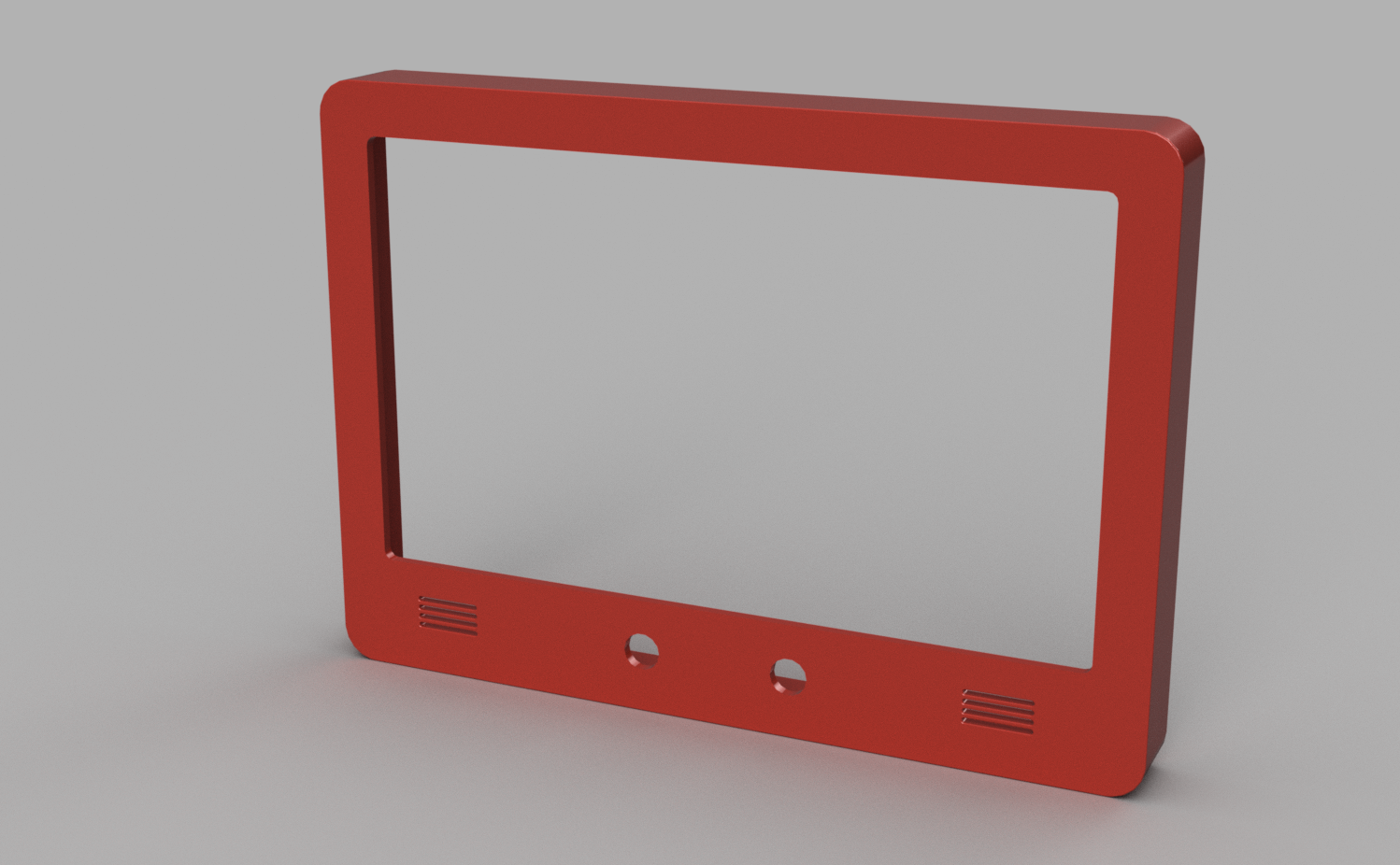
  • a good mechanical enclosure for the cockpit display part (rugged, waterproof, speakers and switches) and
  • making the (simple) hardware plus software part for Seatalk - NMEA 0183 instrument interfacing


Manfred van der Voort

https://nl.linkedin.com/in/manfredvandervoort


Op vrijdag 28 november 2014 18:13:28 UTC+1 schreef Fabian Tollenaar:

Manfred van der Voort

unread,
Aug 29, 2015, 11:59:19 AM8/29/15
to Signal K
For those interested in this initiative, I've published the most important information. Please have a look at https://www.hackster.io/mvandervoort/maritime-instrument-display-controller

Op maandag 24 augustus 2015 11:37:58 UTC+2 schreef Manfred van der Voort:

Manfred van der Voort

unread,
Sep 14, 2015, 3:53:40 AM9/14/15
to Signal K
On https://www.hackster.io/mvandervoort/maritime-instrument-display-controller you now can notice the progress on my MIDC. The first wooden display enclosure has been build. On http://www.cruisersforum.com/forums/f134/12vdc-marine-computers-39751-31.html#post1913467 there is discussion about building this part.

Manfred van der Voort

unread,
Sep 20, 2015, 7:06:15 AM9/20/15
to Signal K

With the general release of UDOO Neo coming close, there is quit a lot of progress te report on the (partly) open source MIDC project. Most notably might be the fist image of a design study for the IP65 classified display enclosure. For more information and possible cooperation, have a look at https://www.hackster.io/mvandervoort/maritime-instrument-display-controller


Op maandag 14 september 2015 09:53:40 UTC+2 schreef Manfred van der Voort:

Mike Bremford

unread,
Sep 20, 2015, 8:14:19 AM9/20/15
to sig...@googlegroups.com
Hi Manfred

Just reading your blog I see you're struggling with IP65 switches. I ended up using buttons instead - my reasoning was they're lower profile so not likely to catch or break, they have a much longer mechanical lifetime, they're easily available in IP68 and you can get them with an integrated LED. You can see the sort I mean here: http://www.ebay.co.uk/itm/Metal-LED-Illuminated-Latching-16mm-Power-Push-Button-Switch-Car-Dash-12V-/201407464700. I actually ordered a batch of 40 from China to my specification, which was that they LED had no serial resistor and was bicolour (red & green). This allows me to indicate status with the LED (i.e. "on" or "fault") and to use them with 12V, 5V or 3.3V as required. They were cheap, about $2 a unit from memory.

The catch with buttons is whether they're on or off can't be determined by just looking at them (discounting the status LED). I eventually realised this was an advantage, as it meant I could have a secondary switch to also control the circuit - like a dual lightswitch in a hallway. Not so useful on a 22' boat I know, mine's 33', but my second swtich is electronic: these are the main switches on my fusepanel, and it means I can turn circuits on or off from the computer as well as by pressing the button.

Thought I'd mention it as I went through the same process. I'm interested in how your touchscreen works out, I suspect I'm going to use a tablet as my primary display, but I haven't ruled out a permanent screen so will be watching your progress with interest.

Cheers... Mike


--

Practical_Pirate

unread,
Oct 19, 2015, 9:16:40 AM10/19/15
to Signal K
Kickstarter in its last 3 days. Glyph.

Glyph is a wifi-connected e-paper sign. It is housed in an elegant wooden frame, and can be updated from anywhere in the world using a simple Web interface.

He is offering wood housed versions (~195 USD) and electronics only versions. (~125 USD)

3D printed waterproof housing anyone?

https://www.kickstarter.com/projects/304702265/glyph/description

Matt

Ben Ellison

unread,
Oct 19, 2015, 12:00:41 PM10/19/15
to Signal K, t...@signalk.org
Hi Tim,

I did eventually write about the Nautipad, which seemed impressive, and the whole system was apparently for sale to someone else who'd like to give it a go in the marine world:


Best, Ben  

Teppo Kurki

unread,
Oct 19, 2015, 12:16:05 PM10/19/15
to sig...@googlegroups.com
3d printed things are usually not water/gas proof.

Manfred van der Voort

unread,
Oct 19, 2015, 12:41:21 PM10/19/15
to sig...@googlegroups.com
Low quality home made 3D Printings still isn't feasable for harsh Marine environments. High quality professional 3D Printing definitely can be. However this is too expensive for small scale (>25) manufacturing.
 

Met vriendelijke groet,
Kind regards,

Manfred van der Voort
e-mail: mvande...@microcost.nl
-
Creator of the flexible and powerful Maritime Instrument & Display Controller
-
Initiator of the ICR3ATE Digital Maker Lab
-
Simon Vestdijkstraat 35
6708 NW  WAGENINGEN
The Netherlands

--
You received this message because you are subscribed to a topic in the Google Groups "Signal K" group.
To unsubscribe from this topic, visit https://groups.google.com/d/topic/signalk/q-5IMcEHqO4/unsubscribe.
To unsubscribe from this group and all its topics, send an email to signalk+u...@googlegroups.com.

Alex Wetmore

unread,
Oct 19, 2015, 12:51:27 PM10/19/15
to sig...@googlegroups.com

However it isn't too hard to machine IP-rated enclosures to work in the marine environment.  Small scale CNC is inexpensive.  A basic CNC routers are under $1000, a basic CNC milling machine that can also cut metals is under $2000, and large scale industrial CNC vertical milling centers with tool changers and all of the other fun bits can be acquired for scrap value (around $10000).


I have a small Taig CNC mill that I've used for modifying Bud NEMA enclosures:

http://www.budind.com/view/NEMA+Boxes/NEMA+4x

They just announced this enclosure which looks perfect for these types of projects:

http://www.budind.com/view/Plastic+Boxes/Tablet+Enclosures


I've done a lot of work on upgrading a scraped Hurco BMC30M VMC to run on LinuxCNC, but that is way overkill for this type of project.


That Kickstarter kit looks interesting, but it would be good to know what the latency and max refresh rate are on the display.  His intended use (a sign for his kid's door) doesn't care about latency at all, where latency matters a lot for showing boat instrumentation (especially wind information on a sailboat).


alex


From: sig...@googlegroups.com <sig...@googlegroups.com> on behalf of Manfred van der Voort <mvande...@microcost.nl>
Sent: Monday, October 19, 2015 9:41 AM
To: sig...@googlegroups.com
Subject: Re: Hardware
 

Mike Bremford

unread,
Oct 19, 2015, 1:38:30 PM10/19/15
to sig...@googlegroups.com
True, although this looks interesting: http://www.stratasys.com/materials/fdm/asa - yes it's a Stratasys-only product for now, but it's still FDM. Getting something made up in that fairly soon I hope, will be on deck and will take a beating so we'll find out if it's up to the job.

Manfred van der Voort

unread,
Oct 20, 2015, 3:29:30 AM10/20/15
to sig...@googlegroups.com
Thanks for the suggestion. I hadn't noticed already until now. Yeap the ASA material looks very interesting. I roughly checked my favourite professional grade 3D Printing service provider Materialise.com. It looks like ASA isn't available right now.

Met vriendelijke groet,
Kind regards,

Manfred van der Voort
e-mail: mvande...@microcost.nl
-
Creator of the flexible and powerful Maritime Instrument & Display Controller
-
Initiator of the ICR3ATE Digital Maker Lab
-
Simon Vestdijkstraat 35
6708 NW  WAGENINGEN
The Netherlands

Mike Bremford

unread,
Oct 20, 2015, 5:12:08 AM10/20/15
to sig...@googlegroups.com
There are a few on 3Dhubs that will do it - to quote one of the printers I was talking to about it:

I got some ASA testprint outdoors for testing UV/water/dirt abrasive. Since today it looks and feels like a day old. Its outdoors stored about one year. Beware printing ASA is not easy and it might take 2 or 3 trys to get a nice perfect print.

Manfred van der Voort

unread,
Oct 20, 2015, 6:36:04 AM10/20/15
to sig...@googlegroups.com
Beware printing ASA is not easy and it might take 2 or 3 trys to get a nice perfect print.

This sentence might be the reason a high profile comapny like Materialise needs some time to optimise 3D Printing production and post processing! I checked your suggestion on 3D Hubs. Found 2 in the US with exeptional price differences (my enclosure $ 300 / $ 3000 for one piece). For me that is a sign of the currently pioneering stage of this yet very promissing 3D Print material. Thanks for the tip, I'll apreciate that.

Met vriendelijke groet,
Kind regards,

Manfred van der Voort
e-mail: mvande...@microcost.nl
-
Creator of the flexible and powerful Maritime Instrument & Display Controller
-
Initiator of the ICR3ATE Digital Maker Lab
-
Simon Vestdijkstraat 35
6708 NW  WAGENINGEN
The Netherlands

Manfred van der Voort

unread,
Dec 27, 2015, 4:57:49 PM12/27/15
to Signal K
After months of waiting for both the UDOO Neo SBC board to arrive, plus time to work further on the MIDC project, I'm happy to announce good progress.


In short: the bare basics of OpenCPN, NMEA 0183 sensor, AIS receiver and a non touch display running all on Lubuntu functions.

Have a look a the Hackster project log for more information and some photo's.

Obviously there are some issues to resolve. In 2016, I'll catch up and move on to the more difficult part: sunlight readable touch display on Linux and some wireless addons. Plus a waterproof enclosure. Design is already done. And for this group the holy thing: SignalK stack running on it.

To be continued.

Op zondag 20 september 2015 13:06:15 UTC+2 schreef Manfred van der Voort:

Onno Harders

unread,
Dec 30, 2015, 5:29:33 AM12/30/15
to Signal K
Hi All,

I have not forgotten this thread, but was busy whit my BoatController that is my first priority.
In the meantime things changed in our favor as expected.
The display is back on my list because of the Raspberry pi Zero ,now I can reduce the costs significant!
I have spoken to Manfred yesterday, we are discussing the possibility to join forces to find and or develop and or produce a good moneyworth/cheap  sunlight readable display.
As he uses the UDOO for his project I use the Raspberry pi for my BoatController my aim is to use the BoatController as a stand allone router, gateway, multiplexer and multi-instrument I do not want to abuse it extra with graphical processing.
So for my display i still needed a good cheap extra controller, now he is available for probably around € 5,- (I have a sample and ordered few for €8,95 at this time) as the Rpi Zero.
The most important and costly part Manfred and I are missing is the display/panel itself with compatible converter to HDMI. 
We have briefly discussed some options and will try to work these out, we will keep you informed.

Sailoog

unread,
Dec 31, 2015, 6:07:23 AM12/31/15
to Signal K
Hi Onno,

I just found out your project. It seems really interesting and really similar to OpenPlotter project :)
It is so similar that many of your future features are already implemented in OpenPlotter v0.6.0beta3 (sensors, switches, alarms...). I suppose all this is a natural evolution.

Is your project open-source hardware/software? How do you share your hardware/software sources? Do you have english info?
If so, I would be glad to exchange goals materials and code.

Best, Roberto.

El dimecres, 30 desembre de 2015 11:29:33 UTC+1, Onno Harders va escriure:

Onno Harders

unread,
Jan 4, 2016, 4:13:49 AM1/4/16
to Signal K
Hi Roberto,

Yes it looks like there are a lot of similarities! You are doing a great Jop!
First of all my software is not open, I am thinking about it but not convinced yet. (maybe we have to, some parts used are open source)
My hardware will not be "open" that is my income.
In my business case I have no resellers (one world) but maybe we can figure out something to exchange, (example: software for hardware, or buying and building together) 
To exchange goals would be preferable anyway!

The English support was our intention but is not functional at this moment, our blog is out of date because I wait for our next release.

I was already planning to put my own hardware modules/pcb's separate in my shop they will be interesting for you and your software users, I will inform you when ready.
In the mean time I will test your software and will discuss this with my engineers.


Onno Harders

unread,
Jan 4, 2016, 4:19:55 AM1/4/16
to Signal K
PS: @ Roberto, @Manfred,

It looks like that we all 3 have the same interest for the marine display.

Sailoog

unread,
Jan 5, 2016, 7:06:27 AM1/5/16
to Signal K
Hi again Onno,

I really wish we could work but I am afraid it will be difficult.

As open-source evangelists, we do not feel comfortable collaborating with proprietary software, actually we work against it. In most cases, you can use open-source software with commercial purposes (OpenPlotter allows this) but it is mandatory to reference the original author in a visible place and publish the source code and your improvements. You must release your product under the same license terms too. So if you are using open source software in your project, be careful and follow all the obligations or you might have problems. We open-source developers take this seriously.

Regarding the hardware, from the beginning of OpenPlotter project we set 3 basic principles: open-source, low-cost and low-power; and a golden rule: always satisfy 2 of them. Assuming that your modules will be low-power, we could recommend your devices if they satisfy the low-cost principle. We prioritize using standard modules in order to avoid brand dependencies and we will design some of them as open source but we will be watching you in case we can exchange resources in this area :)

Despite our different motivations, I wish you the best and if you ever change your mind, please do not hesitate to contact.

Thanks!

R.

El dilluns, 4 gener de 2016 10:13:49 UTC+1, Onno Harders va escriure:

Sailoog

unread,
Jan 5, 2016, 7:11:46 AM1/5/16
to Signal K
Open-source and low-cost? yes. I assume low-power won't be possible :)

El dilluns, 4 gener de 2016 10:19:55 UTC+1, Onno Harders va escriure:

Manfred van der Voort

unread,
Jan 5, 2016, 7:29:22 AM1/5/16
to sig...@googlegroups.com
After a hunt for more than 4 months, I'll think that I'm talking right now with a Chinese supplier of touch screens which can fullfill all the needs. That means roughly:
  • ~10' size
  • Sunlight readable
  • > 600 Nits brightness measured after cover glass treatment
  • 1280 x 800
  • Single channel LVDS
  • Touch
  • Multi touch
  • Touch driver board with USB/I2C connector
  • Linux drivers available
  • AG/ AR treatment
  • Hardenened glass cover, optical bonded
  • Temp range: -20 / +60 Celcius
  • Power consumption: ideally not more than 10W

On https://www.hackster.io/mvandervoort/maritime-instrument-display-controller-2b3736 the background info about is documented.

This company is a manfucturer which delivers small batches on a very specific manner (on request to maximize their production efficiency, not the clients delivery time). Nevertheless, there are MOQ which are quite high. Therefor I'll move on with it after:
  • colloboration with some othe ones looking to make a HDMI/LVDS Maritime touch display or
  • after I decided to commercialize my MIDC and succeeed with a crowdfunding campaign.

--
You received this message because you are subscribed to a topic in the Google Groups "Signal K" group.
To unsubscribe from this topic, visit https://groups.google.com/d/topic/signalk/q-5IMcEHqO4/unsubscribe.
To unsubscribe from this group and all its topics, send an email to signalk+u...@googlegroups.com.

Onno Harders

unread,
Jan 5, 2016, 11:19:12 AM1/5/16
to Signal K
@ Manfred, Nice! And now the big question, the costs?

@ Roberto, I expect we could "help" each other without any problems, watch my fair prices and I am very "open" minded! :)   

@ Everybody,
In this thread I see a lot of subjective terms:
Low cost
Low power
Waterproof
Sunlight readable

We need to specify what "we" want for a MFD /Plotter?
Low cost what would be a reasonable price what do you expect to get for it?
Low power, will depend mostly on the brightness.
Sunlight readable, will depend on brightness, used touchscreen, type finish(glossy (glass) or anti-reflective), filters (if used), bonded or not, etc.

All specs will have influence on the price!

I did a lot of practical testing with displays in 2010 used for the pcnautic 1210


 I found out that with my not bonded anti-reflective hardend Acryl a 500 nits display without touch was brighter then a FreeTechnics 1000 nits glass bonded display with touch.
You also have to specify how far you want to be able to dim for night vision and test it

I think we have a lot to discuss!

Manfred van der Voort

unread,
Jan 5, 2016, 11:41:16 AM1/5/16
to sig...@googlegroups.com
From https://www.hackster.io/mvandervoort/maritime-instrument-display-controller-2b3736

The design goals for this MIDC were quite extensive:

  • suitable for small crafts (22" min) as well as some bigger ones
  • low power consumption (<= 12 W - based on 10' display)
  • sunlight readable screen ranging from 10' - 15'
  • on board electrical interfaces for serial RS232, RS422, USB, RS485 and CAN (required for NMEA2000)
  • DIY to be build under € 500 with one 10' touch display sunlight readable

Regarding the application software (stacks), there must be support minimally for:

  • (future) SignalK,
  • current OpenCPN 4.x.x (Linux),
  • new OpenCPN 4.1.x (Android) - 4.1.915 now in Google Play
  • NMEA (0183) multiplexing (kplex alike),
    Objected price for MIDC is mentioned. That's SBC, Wireless KB & Marine Display. Currently I'm quite well on target with still approx. €60 above.
     
    As soon I have a collab partner for the Display and volumes are growing to a substantial amounts, the objected price is in reach. the Display is in design as a LVDS one, not HDMI. That's too expensive for MIDCs target. HDMI can be added quite easily and that might be of interest for a possible collaborator. LVDS currently isn't the standard for a lot of SBCs. Convertor solution are availble as standard components.

    Met vriendelijke groet,
    Kind regards,

    Manfred van der Voort
    e-mail: mvande...@microcost.nl
    -
    Creator of the flexible and powerful Maritime Instrument & Display Controller
    -
    Initiator of the ICR3ATE Digital Makers Lab
    -
    Simon Vestdijkstraat 35
    6708 NW  WAGENINGEN
    The Netherlands

    --

    Mike Bremford

    unread,
    Jan 5, 2016, 1:46:56 PM1/5/16
    to sig...@googlegroups.com
    Ah, you did some testing. One question I could never really get an objective answer to is how many nits you need to actually see a display in typical sunlight? I know that depends - horizontal display at midday in the tropics is going to be a bit different to northern hemisphere, but I'd be curious to know what your conclusions were for, lets say. a typical sailing day in Europe.

    I ask because I'm debating using a commodity tablet in a waterproof case, and squinting as required. There's a lot of data on existing tablets at http://www.displaymate.com/iPad6_ShootOut.htm. There's a lot of data there - iPad Air is 449 nits - and while I know it's not as good, I can't get a feel for whether it's good enough. Would be interested to hear your thoughts on this.

    Cheers... Mike


    --
    You received this message because you are subscribed to the Google Groups "Signal K" group.
    To unsubscribe from this group and stop receiving emails from it, send an email to signalk+u...@googlegroups.com.

    Alex Wetmore

    unread,
    Jan 5, 2016, 2:10:37 PM1/5/16
    to sig...@googlegroups.com

    I've had problems with the iPad 1 and 2 (I didn't try an Air and no longer have one) overheating and shutting down when used in direct sunlight.  A waterproof case would make it even worse.  I also found the displays of the 1 and 2 unreadable in bright sunlight (419 nits according to the same site that you mention below).  


    I think that there will be a decent market for an outdoor touchscreen display that is waterproof and includes basic hard buttons including a small joystick and rotary encoder.  This would allow one to build an open source version of something like a Raymarine e-series or B&G Zeus 2.


    The hard buttons are essential for use in rough conditions since touchscreen displays don't work so well when coated in salt water or when the user is wearing thick waterproof gloves.


    From: sig...@googlegroups.com <sig...@googlegroups.com> on behalf of Mike Bremford <mi...@bfo.com>
    Sent: Tuesday, January 5, 2016 10:46 AM

    To: sig...@googlegroups.com
    Subject: Re: Hardware
    Ah, you did some testing. One question I could never really get an objective answer to is how many nits you need to actually see a display in typical sunlight? I know that depends - horizontal display at midday in the tropics is going to be a bit different to northern hemisphere, but I'd be curious to know what your conclusions were for, lets say. a typical sailing day in Europe.

    I ask because I'm debating using a commodity tablet in a waterproof case, and squinting as required. There's a lot of data on existing tablets at http://www.displaymate.com/iPad6_ShootOut.htm. There's a lot of data there - iPad Air is 449 nits - and while I know it's not as good, I can't get a feel for whether it's good enough. Would be interested to hear your thoughts on this.
    iPad Air 2 and iPad mini 3 Conclusions: One Major Innovation and One Major Disappointment… The primary goal of this Display Technology Shoot-Out article series has ...

    Al Thomason

    unread,
    Jan 5, 2016, 3:03:58 PM1/5/16
    to sig...@googlegroups.com

    I am glad to see someone mentioned damnability of a display, not all underway are during bright sunlight!


    A common issue I have had with consumer displays is the inability to adjust them to a point where night vision is not compromised.   And perhaps even adding  (scope creep I know) a low cost ambient light sensor to allow some level of auto-adjustment is one thing to perhaps consider.


    -al-


    Viking Star

    45' Monk Sr. / McQueen

    mvVikingStar.blogspot.com


    Manfred van der Voort

    unread,
    Jan 5, 2016, 3:23:53 PM1/5/16
    to sig...@googlegroups.com
    A lot of debate. Well great. Some answers/ statements from my experience and knowledge on this topic.
    1. Consumer devices are not going to work for multiple reasons. The most important ones are lack of waterproofness obviously and lack of being rugged. Appying an Ottrerbox or whatever waterproof box will create 2 problems as a result of overheating: very rapidly shorten battery life and decreasing performance and completely fail out. Not very handy while navigating :-) Replacing a consumer tablet battery is financially very unattractive!
    2. Regarding brightness the following. In general I'll keep 500 Nits as the absolute minimum, 600 as preferable and >750 as excellent in all light conditions. These numbers are the effective numbers measured when cover glass is applied! Most screen specs "forget" about this, so you get a substantial lower brightness when the AR/AG cover is bonded on the screen
    3. The type of sunglasses you're wearing has a direct positive/negative effect of the readability of a screen. For the MIDC, the requirements are being used to have minimally a fair to good and sometimes excellent readability with your sunglasses on.
    4. The MIDC requirements also keep in mind wearing gloves. The touch sreen must be usable with gloves on and in wet conditions.
    5. All these considerations and my extensive experience with coastal sailing on a small (22") cabin cruiser and navigating with tablets and phablets, have led to my project. I'll repeat: consumer devices will not going to work on small yachts. A dedicated device is what's needed.
    6. In Phase 2 on the roadmap there are the specific radio buttons like someone mentioned in this thread to allow one to build an open source version of something like a Raymarine e-series or B&G Zeus 2

    I'll keep this group udated about the progress. Also have a look at https://www.hackster.io/mvandervoort/maritime-instrument-display-controller-2b3736 There a build logs published quite regularly.


    Met vriendelijke groet,
    Kind regards,

    Manfred van der Voort
    e-mail: mvande...@microcost.nl
    -
    Creator of the flexible and powerful Maritime Instrument & Display Controller
    -
    Initiator of the ICR3ATE Digital Makers Lab
    -
    Simon Vestdijkstraat 35
    6708 NW  WAGENINGEN
    The Netherlands

    --
    You received this message because you are subscribed to a topic in the Google Groups "Signal K" group.
    To unsubscribe from this topic, visit https://groups.google.com/d/topic/signalk/q-5IMcEHqO4/unsubscribe.
    To unsubscribe from this group and all its topics, send an email to signalk+u...@googlegroups.com.

    Alex Wetmore

    unread,
    Jan 5, 2016, 3:46:03 PM1/5/16
    to sig...@googlegroups.com

    Does a multitouch screen technology exist that works with any gloves and in wet conditions?  I've never encountered such a touch screen, and would guess that Raymarine and Navico would use them if they did.


    alex


    From: sig...@googlegroups.com <sig...@googlegroups.com> on behalf of Manfred van der Voort <mvande...@microcost.nl>
    Sent: Tuesday, January 5, 2016 12:23 PM

    To: sig...@googlegroups.com
    Subject: Re: Hardware
    A lot of debate. Well great. Some answers/ statements from my experience and knowledge on this topic.
    1. Consumer devices are not going to work for multiple reasons. The most important ones are lack of waterproofness obviously and lack of being rugged. Appying an Ottrerbox or whatever waterproof box will create 2 problems as a result of overheating: very rapidly shorten battery life and decreasing performance and completely fail out. Not very handy while navigating :-) Replacing a consumer tablet battery is financially very unattractive!
    2. Regarding brightness the following. In general I'll keep 500 Nits as the absolute minimum, 600 as preferable and >750 as excellent in all light conditions. These numbers are the effective numbers measured when cover glass is applied! Most screen specs "forget" about this, so you get a substantial lower brightness when the AR/AG cover is bonded on the screen
    3. The type of sunglasses you're wearing has a direct positive/negative effect of the readability of a screen. For the MIDC, the requirements are being used to have minimally a fair to good and sometimes excellent readability with your sunglasses on.
    4. The MIDC requirements also keep in mind wearing gloves. The touch sreen must be usable with gloves on and in wet conditions.
    5. All these considerations and my extensive experience with coastal sailing on a small (22") cabin cruiser and navigating with tablets and phablets, have led to my project. I'll repeat: consumer devices will not going to work on small yachts. A dedicated device is what's needed.
    6. In Phase 2 on the roadmap there are the specific radio buttons like someone mentioned in this thread to allow one to build an open source version of something like a Raymarine e-series or B&G Zeus 2

    I'll keep this group udated about the progress. Also have a look at https://www.hackster.io/mvandervoort/maritime-instrument-display-controller-2b3736 There a build logs published quite regularly.

    A powerful Maritime Instrument & Display Controller, based on UDOO Neo, acting as a navigator, chart plotter, wireless NMEA multiplexer & ?. Find this and other ...


    Manfred van der Voort

    unread,
    Jan 5, 2016, 3:53:28 PM1/5/16
    to sig...@googlegroups.com
    The short answer: yes. The long answer: it took me more than 4 months hunting before I found a supplier which could fulfil these demanding requirements at a acceptable price livel. I'm now in conversation with them to get 2 samples here in my lab in The Netherlands. I'll disclose the information as soon as I'm convinced that what they promise in a spec sheet, will work in reality. Too often discovered that there is a gap between those :-)

    Manfred van der Voort

    Mike Bremford

    unread,
    Jan 5, 2016, 5:26:42 PM1/5/16
    to sig...@googlegroups.com
    Guys, thanks - that's extremely useful information and has all been filed away.

    Speaking for myself I'd be more interested in seeing a "dumb screen" as a product - either a computer functioning as a display running only a full-screen browser (effectively a kiosk running Chromium), or just a screen with HDMI and USB for touch. I'd rather have the "brains", and the associated nest of cables, in a separate unit where it can be upgraded or modified as technology, and the software, evolves, while the screen remains fixed and unchanged. Thanks to the wonders of open source I'm confident this will be possible by flashing the device, but thought I'd mention it just in case. Either way I'll be keeping a close eye on your progress.

    Incidentally until just now I'd also believed wet-condition multi-touch was impossible: I was under the impression that resistive screens are single touch, and  capacitive doesn't work in the wet. How nice to hear that I was wrong! I hope your tests work out well.

    Cheers... Mike

    Alex Wetmore

    unread,
    Jan 5, 2016, 6:07:11 PM1/5/16
    to sig...@googlegroups.com

    From: sig...@googlegroups.com <sig...@googlegroups.com> on behalf of Mike Bremford <mi...@bfo.com>

    Speaking for myself I'd be more interested in seeing a "dumb screen" as a product - either a computer 
    > functioning as a display running only a full-screen browser (effectively a kiosk running Chromium), 
    > or just a screen with HDMI and USB for touch. I'd rather have the "brains", and the associated nest of 
    > cables, in a separate unit where it can be upgraded or modified as technology, and the software, 
    > evolves, while the screen remains fixed and unchanged. 

    An alternative implementation that I'd prefer is one where the monitor's enclosure has enough room in the back for a single board computer.  This could be a 25mm deep space behind the display (25mm behind a 10" display is a lot of room) and standoffs for installing a mounting board for the single board computer.  It would then be trivial to put a Raspberry Pi, Beaglebone, Galelio, or whatever other option there.  The display could use LVDS or whatever is both common and cheap.  A couple of cable glands can be provided for getting NMEA 2000, NMEA 0183, power, and other protocols in and out.

    The difficult part of building marine hardware is the display, HID interface, and waterproof enclosure.  Providing a single solution for those challenges that looks nice and which is flexible in compute implementation would be a really neat product.

    alex

    Mike Bremford

    unread,
    Jan 5, 2016, 6:43:59 PM1/5/16
    to sig...@googlegroups.com
    So far I've overheated both a Pi and my previous favourite option, the Hummingboard i2ex. I managed to get the eMMC flash disk on the Hummingboard to an astonishing 114° according to the SMART readout, which explained why it would randomly hang. I guess that's why I'm a little nervous about the processor being bundled with the screen in an airtight enclosure - many of these single board units aren't typically tested in that sort of environment. That, and the fact that there seems to be an advance in compact computing every week.

    For what it's worth I'm now running a Fit-PC4. It's more expensive, but in terms of bang for buck it's a few orders of magnitude more capable than the Pis, Beaglebones etc. I'd been using previously. It has a very nice hardware design (8 first-class USB ports, rather than 4 through two internal hubs like the Pi), takes unregulated 10-15V power, comes with a secure wall mount and also has very decent thermal characteristics. If anyone is shopping for more power I'd very highly recommend it.

    The difficult part of building marine hardware is the display, HID interface, and waterproof enclosure.  Providing a single solution for those challenges that looks nice and which is flexible in compute implementation would be a really neat product.

    Certainly agree with that statement. 

    -----------------------------------------------------
    Mike Bremford - CTO                   mi...@bfo.com
    Big Faceless Organization             http://bfo.com

    --

    Alex Wetmore

    unread,
    Jan 5, 2016, 7:03:14 PM1/5/16
    to sig...@googlegroups.com

    " That, and the fact that there seems to be an advance in compact computing every week."


    A generic empty space to put the single board computer into solves that problem.


    I agree with you that heat may be a concern.


    The Fit-PC4 has quite high power consumption compared to other options, a general downside of more powerful and flexible solutions.  If I'm building a replacement for my Raymarine e7d then I also want to get power consumption similar to the e7d (around 8-10 watts with the sonar on and display on full brightness). 


    I understand the desire to separate the CPU and display.  I think it's pretty reasonable and nice, especially if display power and signal can all be sent over a shared and easy to route connector (some flavor of waterproof usb-C would be awesome).  Of course a display with a little space in the back for custom electronics would allow you to make the CPU remote (by putting in a LVDS to HDMI controller) and allow me to try and put a Beaglebone back there if I prefer.


    alex


    From: sig...@googlegroups.com <sig...@googlegroups.com> on behalf of Mike Bremford <mi...@bfo.com>
    Sent: Tuesday, January 5, 2016 3:43 PM

    To: sig...@googlegroups.com
    Subject: Re: Hardware

    rob...@42.co.nz

    unread,
    Jan 5, 2016, 7:25:07 PM1/5/16
    to Signal K
    If the enclosure backing plate was alloy or contained a heatsink that might help a bit, especially if you can connect the hotspots to it thermally. eg mount the board cpu side down, and use an aluminium block and thermal paste to touch the backing plate.

    My own RPi lies in the open in a jumble of cable on the chart table - so no problem with heat for me :-)

    Rob


    On Wednesday, January 6, 2016 at 1:03:14 PM UTC+13, Alex Wetmore wrote:

    " That, and the fact that there seems to be an advance in compact computing every week."


    A generic empty space to put the single board computer into solves that problem.


    I agree with you that heat may be a concern.


    The Fit-PC4 has quite high power consumption compared to other options, a general downside of more powerful and flexible solutions.  If I'm building a replacement for my Raymarine e7d then I also want to get power consumption similar to the e7d (around 8-10 watts with the sonar on and display on full brightness). 


    I understand the desire to separate the CPU and display.  I think it's pretty reasonable and nice, especially if display power and signal can all be sent over a shared and easy to route connector (some flavor of waterproof usb-C would be awesome).  Of course a display with a little space in the back for custom electronics would allow you to make the CPU remote (by putting in a LVDS to HDMI controller) and allow me to try and put a Beaglebone back there if I prefer.


    alex


    From: sig...@googlegroups.com <sig...@googlegroups.com> on behalf of Mike Bremford <mi...@bfo.com>
    Sent: Tuesday, January 5, 2016 3:43 PM
    To: sig...@googlegroups.com
    Subject: Re: Hardware
     
    So far I've overheated both a Pi and my previous favourite option, the Hummingboard i2ex. I managed to get the eMMC flash disk on the Hummingboard to an astonishing 114° according to the SMART readout, which explained why it would randomly hang. I guess that's why I'm a little nervous about the processor being bundled with the screen in an airtight enclosure - many of these single board units aren't typically tested in that sort of environment. That, and the fact that there seems to be an advance in compact computing every week.

    For what it's worth I'm now running a Fit-PC4. It's more expensive, but in terms of bang for buck it's a few orders of magnitude more capable than the Pis, Beaglebones etc. I'd been using previously. It has a very nice hardware design (8 first-class USB ports, rather than 4 through two internal hubs like the Pi), takes unregulated 10-15V power, comes with a secure wall mount and also has very decent thermal characteristics. If anyone is shopping for more power I'd very highly recommend it.

    The difficult part of building marine hardware is the display, HID interface, and waterproof enclosure.  Providing a single solution for those challenges that looks nice and which is flexible in compute implementation would be a really neat product.

    Certainly agree with that statement. 

    -----------------------------------------------------
    Mike Bremford - CTO                   m...@bfo.com

    Big Faceless Organization             http://bfo.com

    On 5 January 2016 at 23:07, Alex Wetmore <al...@phred.org> wrote:

    From: sig...@googlegroups.com <sig...@googlegroups.com> on behalf of Mike Bremford <mi...@bfo.com>

    Speaking for myself I'd be more interested in seeing a "dumb screen" as a product - either a computer 
    > functioning as a display running only a full-screen browser (effectively a kiosk running Chromium), 
    > or just a screen with HDMI and USB for touch. I'd rather have the "brains", and the associated nest of 
    > cables, in a separate unit where it can be upgraded or modified as technology, and the software, 
    > evolves, while the screen remains fixed and unchanged. 

    An alternative implementation that I'd prefer is one where the monitor's enclosure has enough room in the back for a single board computer.  This could be a 25mm deep space behind the display (25mm behind a 10" display is a lot of room) and standoffs for installing a mounting board for the single board computer.  It would then be trivial to put a Raspberry Pi, Beaglebone, Galelio, or whatever other option there.  The display could use LVDS or whatever is both common and cheap.  A couple of cable glands can be provided for getting NMEA 2000, NMEA 0183, power, and other protocols in and out.

    The difficult part of building marine hardware is the display, HID interface, and waterproof enclosure.  Providing a single solution for those challenges that looks nice and which is flexible in compute implementation would be a really neat product.

    alex

    --
    You received this message because you are subscribed to the Google Groups "Signal K" group.
    To unsubscribe from this group and stop receiving emails from it, send an email to signalk+u...@googlegroups.com.
    For more options, visit https://groups.google.com/d/optout.

    Manfred van der Voort

    unread,
    Jan 5, 2016, 11:43:09 PM1/5/16
    to sig...@googlegroups.com
    In response to the question of gloves using the MIDC screen. Well in theory it should work, according to the specs. In practise I'll notice some diffculties: Although the screen may support such usage, the UI may prevent to succesfully conduct micro tasks. And to be honest: on a small boat no one will create a route on the MIDC while sailing in rough cold wheather with waves of 1 meter. That's practically impossible. Nevertheless, it all starts with the capabilities of the utilised screen tech. And the objected supplier indicates: "yes, we can". I don't wnat to ruin my reputation, and that's one of the reasons I'll disclose more information after I'm convinced "yes, they can" :-)

    Another remark is a "hidden" design goal of my MIDC which is direcly related to this aspect. The MIDC will be multi headed. That menas that 2+ screens/displays can be used at the same time. And multi headed will be both virtual as well as physical. In practise: you can have a fixed display in the cabin mounted, while simultaneously anaother one in the cabin for the micro tasks, like setting a route. That other one can be physically connected to MIDC through HDMI, as well as being used wirelessly. The last feature is specially attractive for those who want like to use their consumer tablets on board :-) I'm pretty sure that this (virtually) multi headed feature will support the optimized hybrid use case for navigating outside in all sailing circumstances, while being capable to do trip preparation from the comfortable cabin on the same device! So no route data to transfer, you stay on the same thing. Personally, I'll think this is quite unique and for me it's more or less the holy grail :-)

    Regarding having only a thumb display. It's still not decided whether or not the MIDC will be commercialized. Right now it's mainly depending on the screen technology debated before. Listening to the discussions over here, I'm getting the impression there is a demand. When the decission will be made to do so, there is the plan to deliver the MIDC in 3 different editions:
    1. Headless, for those not wanting a fixed cabin based screen and only using wireless access through tablets
    2. Headed with the cabin display in 2 sizes: 10 and ?
    3. Cabin display only, with a HDMI/USB touch interface externally and LVDS internally, for those who want their own unique MIDC built with their favourite flavour of a SBC

    @Alex, the display enclosure will be designed in a way that you can include your preferable SBC (RPI, UDOO, BB, etc.) The design has a integral cooling solution as described by Robert and a simple yet effective solution for cable handling.

    So folks, that it for now. When getting commercialized, I'm pretty sure I can fire off a Kickstarter campaign over here and on http://www.cruisersforum.com/forums/f134/12vdc-marine-computers-39751-32.html

    Met vriendelijke groet,
    Kind regards,

    Manfred van der Voort
    e-mail: mvande...@microcost.nl
    -
    Creator of the flexible and powerful Maritime Instrument & Display Controller
    -
    Initiator of the ICR3ATE Digital Makers Lab
    -
    Simon Vestdijkstraat 35
    6708 NW  WAGENINGEN
    The Netherlands

    --
    You received this message because you are subscribed to a topic in the Google Groups "Signal K" group.
    To unsubscribe from this topic, visit https://groups.google.com/d/topic/signalk/q-5IMcEHqO4/unsubscribe.
    To unsubscribe from this group and all its topics, send an email to signalk+u...@googlegroups.com.

    Onno Harders

    unread,
    Jan 6, 2016, 5:04:46 AM1/6/16
    to Signal K
    First of all I believe in modular systems, I don't believe in all in one systems (only maybe for single handed very small boats) As we now everything breaks down at sea we don't want the whole system down.
    In my vision we are creating a ton of data on board with all our systems, the main purpose for the BoatController is to rout en filter all this data. (your ship your data)
    Secondary we need a display for navigational use, that is why this one needs to be Sunlight readable, waterproof etc. 

    We should focus on the display/panel/frame just bare/dumb  in this thread! All the possible ad ons we can discuss after finding the "panel" 

    Does anyone know or is able to find out what display technology is exactly used in the Nintendo Gameboy Advance SP?
    The closest I come is:
    Game Boy Advance SP: 
    • Light Source : Front light integrated with LCD
    • Size (closed) : Approximately 3.3" height/3.23" width/0.96" depth
    • Screen (diagonal) reflective TFT color LCD
    I read it was produced by Sharp it should be the same as the display from the type advance but the SP added backlight, spec from the advance:

    The Gameboy Advance brought a 2.9 inch reflective thin-film transistor (TFT) color LCD to the table

    The reason I ask it happens to be very good readable in full sunlight, I have never seen a better display in full sunlight!
    I have tested and seen a lot with reflective TFT but they never worked out with high brightness (the reflective layer blocks part of the light from inside to out)
    They most have figured something out?


    Adam

    unread,
    Jan 7, 2016, 9:43:04 PM1/7/16
    to Signal K
    How's this for a display:  http://www.theverge.com/2016/1/7/10733626/panasonic-transparent-screen-display-ces-2016/in/10494251

    It's the future perhaps marine windows can just be switched on as displays!

    Manfred van der Voort

    unread,
    Jan 12, 2016, 3:51:11 AM1/12/16
    to Signal K

    Those following my MIDC project, know finding an appropriate display is one of the most challenging tasks. After hunting for more than 4 moniths, it looks like there is some good progress to mention here. For all kind of reasons I won't publish any details yet. When there is a specific result and the whole process of importing them in large quantities from China is feasable, I'll publish more details.


    Nevertheless there is some good hope a high end display and a good supplier can be found in the course of this quarter. The darks side is that the MOQ (Minimum Order Quantity) is that high that collaboration with some other Makers is a necessity. Otherwise it isn't feasable. To be continued. As Onno mentioned in a previous post, we are up to explore ways of collaborations. Others may join as well, the MOQ is really that high :-)

    Op woensdag 6 januari 2016 05:43:09 UTC+1 schreef Manfred van der Voort:
    To unsubscribe from this group and all its topics, send an email to signalk+unsubscribe@googlegroups.com.

    Manfred van der Voort

    unread,
    Jan 15, 2016, 2:16:56 AM1/15/16
    to Signal K
    I'm in the final stage of the selection of a Marine grade multi Touch Screen. To sum up, here are the main characteristics:
    • ~10' size
    • Sunlight readable
    • AG/ AR treatment
    • > 600 Nits brightness (measured after cover glass treatment)
    • 1280 x 800 Single channel LVDS
    • Touch Projective Capacity (so usable with rain droplets & gloves)
    • Multi touch Touch driver board chipset: EETI with USB connector
    • Linux/Android & Windows drivers available
    • Hardend glass cover, optical bonded
    • Operating temp range: -20 / +70 Celcius
    • Power consumption: ideally not more than 10W
    • MOQ max. 250 pieces/year
    • Price < € 200 net imported The Netherlands including all importing taxes, shipping and handling
    I've learned a lot in dealing with the Chinese business culture. I've experienced that on Web-sites (the trusted ones) everything is possible, in communication about it also, until you want to have the desired object. I will be honest: there were 2 points in time, I thought of quiting the hunt for a good product and supplier/distributor/manufactorer. It was not all that easy.

    Nevertheless, the final stage is here. I haven't been capable to meet the normal manufacturing requirment to work with at least a second source as well. I'm really glad after spending so many hours on this adventure that there is probably one left!

    To put it in the right context. This objected electronic touch screen device can be used for:
    • A thumb display with HDMI/VGA/DVI connector, plus optionally USB touch with HID protocol support and optionally sound through a HDMI audio receiver - who want to join for this?
    • A MIDC display (that's for my project)
    • A full touch display whatever SBC (UDOO, BB, RPI, etc) who want to connect through eiher LVDS or HDMI - this could be a side project for the MIDC
    And to make the whole thing uniqe: the touch screen can be used with for example wool gloves which might be as thick as max. 2 mm. To be honest, a lot of current software implementations don't have a touch UI which make them suitable for being used with gloves on. And I know from personal experience that sailing on a small boat with 5 degrees Celsius and gloves on, isn't the ideal situation to set a track on a touch device! Nevertheless I think this requirement is of great importance for those software implementations that are already natively touch designed of will become. And we all might know that OpenCPN is moving steadily into that direction.

    Right now there are two req. not confirmed:
    • MOQ (Minimum Order Quantity)
    • Gloves support, without customization of standard Touch software

    All other things are confirmed (and I believe it). To be continued.


    Op dinsdag 12 januari 2016 09:51:11 UTC+1 schreef Manfred van der Voort:

    Mike Bremford

    unread,
    Jan 15, 2016, 10:00:52 AM1/15/16
    to sig...@googlegroups.com
    That's a very impressive list of requirements you've manage to meet. At that price I'm in for one, certainly - a general purpose display with thumb or touch would suit my needs. I'd definitely suggest getting the HDMI interface on it, if you can package it somehow as working with the a Raspberry Pi then your MOQ will be much easier to hit.

    As for touch screen with gloves, you could always drop that requirement and just ship with a spool of conductive thread ;-) http://www.instructables.com/id/Making-A-Glove-Work-With-A-Touch-Screen/


    -----------------------------------------------------
    Mike Bremford - CTO                   mi...@bfo.com

    Big Faceless Organization             http://bfo.com
    To unsubscribe from this group and all its topics, send an email to signalk+u...@googlegroups.com.

    For more options, visit https://groups.google.com/d/optout.

    rob...@42.co.nz

    unread,
    Jan 21, 2016, 4:10:27 PM1/21/16
    to Signal K
    Manfred,

    Sounds good - just a thought but a kickstarter for 1,10,100 screens would be a great way to get MOQ volumes at a given price. If you make the MOQ every-one gets their orders, otherwise nothing lost.

    Personally, I have one of these on the way: http://beckystern.com/2008/04/14/body-technology-interfaces/

    Rob
    To unsubscribe from this group and all its topics, send an email to signalk+u...@googlegroups.com.

    Ric Morris

    unread,
    Feb 8, 2016, 10:21:52 AM2/8/16
    to Signal K
    Arrived from China today. 10 inches of big fat double digit + graphics area LCD display!
    d10 lcd 2.jpg
    d10 lcd 4.jpg
    Reply all
    Reply to author
    Forward
    0 new messages