

James M. Kennedy
Dear Mathilde,
Initially *MAT_054 and *MAT_058 (data included), plus *MAT_022, *MAT_055,
and *MAT_059, composite material models were assigned for the composite
tubes, using shell elements, to check which material model is more eff-
ective under the impact loading conditions when compared to the experi-
mental results. Then, using cohesive models (*MAT_185 with data in-
cluded), analyzed the deformations of the composite tubes and compared
with the shell element results and the experimental results. Then, the
effect of post failure parameters and the geometrical parameters (trigger,
SOFT, ERODS, SLIM, and DFAIL) on the composite tubes were studied:
Chatla, P., "LS-DYNA for Crashworthiness of Composite Structures", Master’s
Thesis, Department of Aerospace Engineering, University of Cincinnati,
Cincinnati, Ohio, June, 2012.
https://etd.ohiolink.edu/!etd.send_file?accession=ucin1352993298&disposition=inline
In this paper the low velocity impact response of these structures was
investigated. The current work was based on the application of explicit
finite element software for modelling the behaviour of laminated composite
plates under low velocity impact loading and it explored the impact, post
impact and failure of these structures. Three models, namely thick shell
elements with cohesive interface (*MAT_185), solid elements with cohesive
interface (*MAT_185), and thin shell elements with tiebreak contact options
(OPTION=-3, 4, and 8), were all developed in the explicit nonlinear finite
element code LS-DYNA. For modeling the damage evolution during the impact
of the plate, *MAT_022 and *MAT_054 (data included) were used:
Dogan, F., Hadavinia, H., Donchev, T., and Bhonge, P.S., "Delamination of
Impacted Composite Structures by Cohesive Zone Interface Elements and
Tiebreak Contact", Central European Journal of Engineering, Vol. 2, Issue 4,
pp. 612-626, December, 2012.
https://www.degruyter.com/downloadpdf/j/eng.2012.2.issue-4/s13531-012-0018-0/s13531-012-0018-0.pdf
Some examples:
A comparison of a double cantilever beam with cohesive elements (using
either *MAT_138, or *MAT_185 or *MAT_186) versus tiebreak OPTION=9 contact
(see the different) *DATABASE_SECFORC data created):
http://ftp.lstc.com/anonymous/outgoing/jday/compare_cohesive_to_tiebreak_from_tobias.k
A double cantilever beam illustrating Mode I type bond failure with co-
hesive elements (using either *MAT_138, or *MAT_185 or *MAT_186):
http://ftp.lstc.com/anonymous/outgoing/jday/mat_186_dcb.k
Sincerely,
James M. Kennedy
KBS2 Inc.
April 22, 2021
From: ls-pr...@googlegroups.com [mailto:ls-pr...@googlegroups.com] On Behalf Of l...@schwer.net
Sent: Thursday, April 22, 2021 11:45 AM
To: mathild...@gmail.com; 'LS-PrePost' <ls-pr...@googlegroups.com>
Subject: RE: Cohesive materials for needle insertion
Mathilde –
This is not an LS-PrePost question and would be better posted to the new LS-DYNA Google Group: https://groups.google.com/g/ls-dyna2
Len Schwer (LS-PrePost Google Group Moderator)
Have you look for cohesive element papers in the LS-DYNA Conference archive: www.dynalook.com ?
PS – Votre anglais est assez bon
From: ls-pr...@googlegroups.com <ls-pr...@googlegroups.com> On Behalf Of Mathilde EQUINE
Sent: Thursday, April 22, 2021 12:36 AM
To: LS-PrePost <ls-pr...@googlegroups.com>
Subject: Cohesive materials for needle insertion
Hi,
I am currently a trainee at the biomecanics lab in France (so, excuse my english, i am a french native ;) )
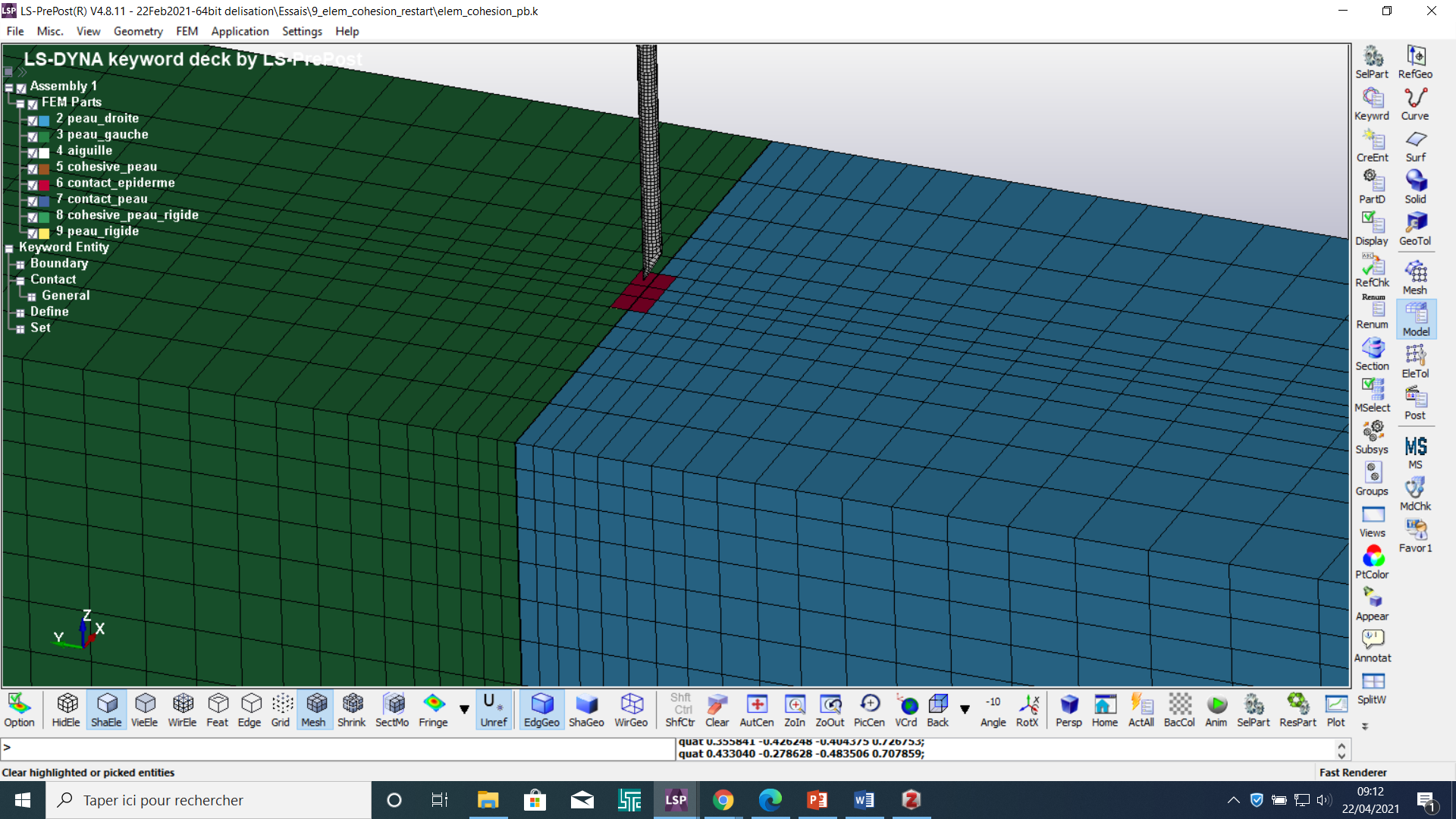
I would like to model the needle insertion with LS-DYNA. I use cohesive materials but i don't manage to use correctly the cohesive elements. When i start the simulation, it fails and the solver often indicates "solid element failed" for the cohesive elements. I don't succeed in the crack propagation. The cohesive elements don't crack properly, and I don't know where are the mistakes (modelling? parameters of materials?)
My model is simple, made of :
- 2 rectangular solids representing the skin (MAT_SIMPLIFIED_RUBBER/FOAM_181)
- between these 2 solids there is a layer of cohesive elements very thin (1e-5 mm) (MAT_COHESIVE_TH_185), the nodes are merged between the 3 layers
- shell contact at the top for the needle interaction between the skin and the needle (MAT_NULL)
- shell contact around the cohesive layer
when i look at the von mises stress at the beginning of the simulation (before it crashs), there is near to 23MPa in the cohesive elements and i put the parameter SIGMAX in MAT_COHESIVE_TH at 10MPa.
I show you several screenshots of my work to give you an idea of my problem.
Thank you very much for your help.
Have a good day !
Mathilde


--
--
You received this message because you are subscribed to the LS-PrePost Google Group | http://groups.google.com/group/ls-prepost
---
You received this message because you are subscribed to the Google Groups "LS-PrePost" group.
To unsubscribe from this group and stop receiving emails from it, send an email to ls-prepost+...@googlegroups.com.
To view this discussion on the web visit https://groups.google.com/d/msgid/ls-prepost/28cd54ff-92e8-4408-a9d7-f6f8158ab374n%40googlegroups.com.
--
--
You received this message because you are subscribed to the LS-PrePost Google Group | http://groups.google.com/group/ls-prepost
---
You received this message because you are subscribed to the Google Groups "LS-PrePost" group.
To unsubscribe from this group and stop receiving emails from it, send an email to ls-prepost+...@googlegroups.com.
To view this discussion on the web visit https://groups.google.com/d/msgid/ls-prepost/002801d73796%24c609c4b0%24521d4e10%24%40schwer.net.