
Dangerous Fine Print in Emir Sanusi’s Prescriptions for Buhari

Farooq A. Kperogi
By Farooq A. Kperogi, Ph.D.
Twitter: @farooqkperogi
Emir Muhammad Sanusi II’s well-publicized December 2, 2016 public lecture on the Nigerian economy has divided Nigerians into two broad camps. In one camp you have the unreasoning, knee-jerk Buhari apologists who can’t brook the slightest criticism of their idol. This camp lashed out—and are still lashing out— at the emir for saying what all sensible people who are unencumbered by political and primordial loyalties already know: that Nigeria is collapsing under Buhari’s watch.
In the other camp you have a motley crowd of Sanusi groupies who are mesmerized by his brilliance and Buhari critics who either didn’t like Buhari from the get-go or who used to like him but have become inconsolably disillusioned by his uninspiring performance so far. This group vigorously defended the emir.
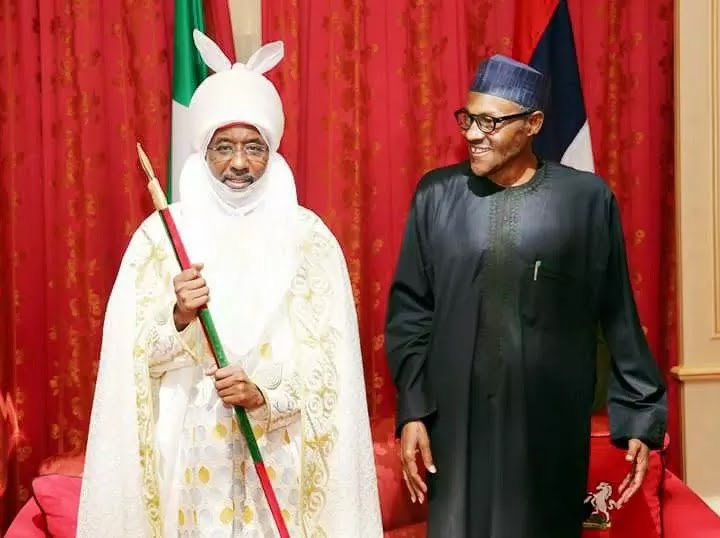
But this is a false, unhelpful binary that ignores the danger the emir poses to all of us. While the emir’s diagnosis of Nigeria’s economic malaise was unquestionably sound, some of his prescriptions were sadly familiar neoliberal, IMF/World Bank deathly pills. You only need to read the PowerPoint slides of his lecture to know this.
For instance, the emir suggested that the government “firmly and unequivocally eliminate fuel subsidies.” But hasn’t the president already done that? How much more must Nigerians pay for fuel before the government can be deemed to have “firmly and unequivocally eliminated fuel subsidies”? Perhaps 500 naira per liter?
In other words, the emir’s grouse with Buhari is that the president isn’t going far enough with his anti-poor, IMF/World Bank-inspired neoliberal policies that have impoverished and continue to impoverish vast swathes of Nigerians. If you take the time to wade through the maze of pseudo-scientific economic gobbledygook in his presentation, you will actually discover that the emir isn’t the hero he is being made out to be by his cheerleaders. His economic template isn’t different from Buhari’s; it’s only more treacherous.
Those of us who are familiar with the emir’s immediate past antecedents aren’t the least bit surprised. He is a thoroughgoing neoliberal theologist who was one the most vociferous enablers and defenders of Goodluck Jonathan’s fuel price increase in 2012. In defending the increase, he protested that it was diesel, not petrol, that powered generators and that Nigerians should stop whining about how the increase in the pump price of petrol would deprive them of electricity.
When his attention was drawn to the fact that only “subsidized” and privileged “big men” like him use diesel-powered generators, he backed down and apologized. As I wrote in 2012, I found it remarkably telling that until 2012, Sanusi had not the vaguest idea that the majority of Nigerians use petrol-powered generators to get electricity for themselves. “Yet it is people like this who make policies that affect the lives of the vast majority of our people who are desperately poor. Why won’t there be a vast disconnect between policies and people when the people who make the policies live in a vastly different world from the rest of us?” I wrote.
In a September 1, 2012 article titled, “Sanusi Lamido Sanusi’s Unwanted 5000 Naira Notes” I described him as “one of the most insensitive, out-of-touch bureaucrats to ever walk Nigeria's corridors of power.”
If you are a poor or economically insecure middle-class person who is writhing in pain amid this economic downtown, don’t be deceived into thinking that Emir Sanusi is on your side. He is not. His disagreements with Buhari have nothing to do with you or your plight. If he has his way, you would be dead by now because the IMF/World Bank neoliberal theology he evangelizes has no care for poor, vulnerable people. So disband those “camps.”
What we should tell the emir and whoever in the world is Buhari’s economic adviser is that no country on earth has ever made economic progress on the basis of World Bank/IMF prescriptions. None whatsoever. As David Held and Anthony McGrew pointed in their book, Globalization/Anti-Globalization: Beyond the Great Divide, “Developing countries that have benefited most from globalization are those that have not played by the rules of the standard [neo]liberal market approach, including China, India and Vietnam” (p. 226).
Yet the emir wants government to basically return to IBB’s SAP era, which entailed rolling back the state (without, of course, rolling back the lavish, unearned privileges of the buccaneers of the state), privatization of public enterprises, retrenchment of workers, devaluation of the national currency, increase in taxes for the poor and middle classes, withdrawal of subsidies, and other obnoxious, suffocating economic policies.
But when the United States went into a recession between 2007 and 2009, it didn’t follow any of these neoliberal prescriptions. The dollar wasn’t devalued. Subsidies weren’t removed. The state wasn’t rolled back. Government didn’t retrench workers. Taxes weren’t raised. On the contrary, government increased expenditure. The financial burden on the populace was eased with lower taxes. Government, in fact, sent lots of money, called tax rebate checks, to lower- and middle-income families so they could have money to spend, since recession is essentially the consequence of people not having enough money to spend. I was a beneficiary of the tax rebate, so I know what I am talking about. Financially distraught private companies (particularly car manufacturers and banks) were bailed out by the government.
These policies fly in the face of the neoliberal canard spouted by the emir and his ilk: that government should step back and leave market forces to regulate society unaided.
Buhari, please just do nothing!
I used to say that it was impossible for any Nigerian president to be worse than Jonathan. That was how much I despised him. So in May 2015, I started out investing enormous hopes in Buhari to transform Nigeria and to build enduring institutions. After waiting 6 months to appoint a predictable, lackluster cabinet, it became clear to me that my hopes were misplaced, that Buhari wasn’t prepared to be president, so I scaled backed my expectations and hoped that Buhari would at least be minimally better than Jonathan.
But when Buhari hiked fuel prices, reversed the few miserly subsidies that sustained the poor, and became prisoner of the “Washington Consensus,” I scaled back my expectations again and hoped that Buhari would be just as bad as Jonathan was.
When his government’s incredibly inept husbandry of the economy continued to deepen the recession it instigated in the first place with its wrongheaded policies, I hoped that Buhari would just be slightly worse than Jonathan for the sake of Nigeria’s survival.
Now with the unceasing rash of counter-intuitive, mutually contradictory, insanely irrational, and thoughtless policy prescriptions from this government every day, the very foundation of the country is tanking before our very eyes, and I just hope Buhari never does anything again till 2019 when his tenure will expire—and with it the torment he is inflicting on Nigeria. A stagnant, do-nothing Buhari is now better for the country than this madness we’re witnessing! Nigeria is fast sinking to the nadir of despair and ruination.
Related Articles:
Sanusi Lamido Sanusi's Unwanted N5000 Notes
Issues in Sanusi Lamido Sanusi's Plagiarism Allegations
CBN Governor Sanusi Lamido Sanusi's Fake Facebook Account
Emir Muhammadu Sanusi II and Vanguard's Internet-Age Junk Journalism
Still on Emir Sanusi II's Fake Twitter Handle and AFP's Editorial Recklessness
School of Communication & Media
Kennesaw State University
Cell: (+1) 404-573-9697
Personal website: www.farooqkperogi.com
"The nice thing about pessimism is that you are constantly being either proven right or pleasantly surprised." G. F. Will

Cornelius Hamelberg
"I was neither at the hot gates
Nor fought in the warm rain
Nor knee deep in the salt marsh, heaving a cutlass,
Bitten by flies, fought.”( T.S. Eliot – awarded the Nobel Prize for Literature in 1948)
Likewise, I belong to neither Professor Kperogi's “knee-jerk Buhari apologists who can’t brook the slightest criticism of their idol” nor to the “motley crowd of Sanusi groupies who are mesmerized by his brilliance” and may I hasten to add that for me this is a North-North affair (Katsina and Kano) and that I admire both gentlemen , i.e. I admire both President Buhari and His Royal Highness Emir Muhammadu Sanusi II – my admiration for the latter going back to the day when he said that Nigerians should be allowed to arm themselves to defend themselves against Boko Haram…
Consonant with what Ogbeni Kadiri /ogunlakaiye pointed out as the woeful bent of “Daily Trust” that, “the well paid columnist in Atiku's owned Daily Trust will never see anything good in Buhari”, I notice that the BBC (Great Britain’s great propaganda mouthpiece) and Great Britain herself is still dragging her feet when it comes to repatriating all the looted cash that belongs to Nigeria - is it any wonder then that the BBC reports that according to one Mannir Dan Ali, editor-in-chief of Nigeria's Daily Trust paper, “the Nigerian president is finding it hard to please anyone.” ?
Now, by no stretch of the imagination am I an economist or an expert on the sorry state of Naija's economy or what should be done about it ( I'm sure that Mr. President has the very best advisers possible, at his beck and call) and so if if we should take what Ogbeni Kadiri has told us about “Daily Trust” seriously, we cannot help but regard Kperogi's latest hack piece as being nothing less than some more gramophone crowing as in “His master's voice”
We can at least credit His Royal Highness Emir Muhammadu Sanusi II with the sort of economic acumen that goes with his former position as Governor of the Central Bank of Nigeria during the good old days of Goodluck Jonathan?
One thing we do know is that Nigeria has weighed the pros and cons of borrowing some money; furthermore we know that there are the usual strings attached to borrowing, some of which is known as “structural adjustment programmes”. So, if anything, Daily Trust and allied voices should have been raised to the point of forcing a national debate ( even through the agency of the Nigerian media) about the wisdom / lack of wisdom in going for a loan and feasible alternatives to such borrowing….

Oluwatoyin Vincent Adepoju
'Buhari, please just do nothing!
I used to say that it was impossible for any Nigerian president to be worse than Jonathan. That was how much I despised him. So in May 2015, I started out investing enormous hopes in Buhari to transform Nigeria and to build enduring institutions. After waiting 6 months to appoint a predictable, lackluster cabinet, it became clear to me that my hopes were misplaced, that Buhari wasn’t prepared to be president, so I scaled backed my expectations and hoped that Buhari would at least be minimally better than Jonathan.
But when Buhari hiked fuel prices, reversed the few miserly subsidies that sustained the poor, and became prisoner of the “Washington Consensus,” I scaled back my expectations again and hoped that Buhari would be just as bad as Jonathan was.
When his government’s incredibly inept husbandry of the economy continued to deepen the recession it instigated in the first place with its wrongheaded policies, I hoped that Buhari would just be slightly worse than Jonathan for the sake of Nigeria’s survival.
--
Listserv moderated by Toyin Falola, University of Texas at Austin
To post to this group, send an email to USAAfricaDialogue@googlegroups.com
To subscribe to this group, send an email to USAAfricaDialogue+subscribe@googlegroups.com
Current archives at http://groups.google.com/group/USAAfricaDialogue
Early archives at http://www.utexas.edu/conferences/africa/ads/index.html
---
You received this message because you are subscribed to the Google Groups "USA Africa Dialogue Series" group.
To unsubscribe from this group and stop receiving emails from it, send an email to usaafricadialogue+unsubscribe@googlegroups.com.
For more options, visit https://groups.google.com/d/optout.

Salimonu Kadiri
Cornelius,
I am at moment knocked down by cold but I can't resist intervening in this discussion. The learned Professor wrote, "As I wrote in 2012, I found it remarkably telling that until 2012, Sanusi had not the vaguest idea that the majority of Nigerians use petrol-powered generators to get electricity for themselves." Our learned Professor wrote as if the normal way of getting electricity in a country is for individual household to acquire generators, diesel- or petrol-powered. Why should Nigeria be importing generator sets for individual household to generate electricity when the nation had, not only Ministry of Power but also, a parastatal to produce electricity for the whole country? Were the imported generators subsidized so that majority of Nigerians could afford it? A supposed defender (supporter) of the impoverished in Nigeria should ensure that the Ministry of Power and the Power Holding Corporation of Nigeria (PHCN) are generating and distributing electricity according to what they are created for.
Our learned Professor wrote further, "But when Buhari hiked fuel prices, reversed the few miserly subsidies that sustained the poor, and became prisoner of the 'Washington Consensus,' I scaled back my expectations again and hoped that Buhari would be just as bad as Jonathan was." Nigeria is among the ten leading crude oil exporters in the world but she is the only member of Oil Producing and Exporting Countries (OPEC) that depends on fuel imports for her domestic needs. The country has four crude oil refineries, managed by Nigerian Professors and Engineers, and designed with installed capacity to refine 445,000 barrels of crude oil per day for domestic needs. Funny enough, our learned Professor is not concerned or worried about the incompetence and failure of his fellow academic colleagues at the NNPC to produce fuel from the 445,000 barrels of crude oil allotted to them per day. While the Professor is taunting Buhari for hiking fuel prices, he is not asking his academic colleagues at the NNPC to account for what they do with the unrefined 445,000 crude oil they receive daily. Fuel subsidy thefts in billions of dollars that were uncovered in 2012 are still pending in various courts in the country today and the self-professed defender of the poor is silent over the unwillingness of Nigerian Judges to conclude the cases of fuel thieves. The fuel subsidies have never sustained poor Nigerians but thieves.
S.Kadiri
Skickat: den 10 december 2016 18:17
Till: USA Africa Dialogue Series
Ämne: USA Africa Dialogue Series - Re: Dangerous Fine Print in Emir Sanusi’s Prescriptions for Buhari
Listserv moderated by Toyin Falola, University of Texas at Austin
To subscribe to this group, send an email to USAAfricaDial...@googlegroups.com
Early archives at http://www.utexas.edu/conferences/africa/ads/index.html
---
You received this message because you are subscribed to the Google Groups "USA Africa Dialogue Series" group.

danoyeoguntola
Dear Kadiri
Sorry about your health. Am sure you will be fine soon. But I wish to draw your attention to the issues in the power sector especially generation at least on an historical level. You will remember after 2007 election, there was the power project probe in the national assembly. Till today, with all the media hypes that goes with that probe nothing has been done to our knowledge to address the misappropriation, looting and corruption that goes with the efforts of Obasanjo's administration to address the issues of power generation and distribution. I think with a ministry of power, we need to do an had historical stock taking going forward. This probe report should be opened and those found culpable brought to book. Yes we may not need generators, but that is only if we are able to generate enough energy to care for our needs. Otherwise we cannot do without those machines. We have been dehumanised to such an extent that on the average Nigerians try to make them selves comfortable by generating their own power, sinking bores holes and securing their environment
Laguda

Okechukwu Ukaga
Dear Laguda,
There is a reason nothing has been done to address the misappropriation and looting associated with the power sector that you mentioned: lack of honest and comprehensive approach to fighting corruption and facilitating sustainable development. And I don't think this is news to you or anyone on this list. It is for the same reason that all other sectors of the economy are also are not functioning and serving the people as they should. I had hoped that things would change for better with the Buhari administration. Recall that Buhari had promised to stop importation of fuel as well as the corrupt subsidy program associated with that, and instead assure that we are able to refine enough of our own crude to meet domestic needs. He also promised to pass the a comprehensive petroleum industry bill required to make the necessary happen in that industry. He also promised to fight corruption without fear or favor. Unfortunately, almost two years into a 4 year term one cannot honestly declare that any of the above has happened. Now, to be fair, he is not the one expected to singlehandedly achieve all these. But he is ultimately in charge of the executive arm and if any part of that is not working he stands to be blamed just like Jonathan and others before him. I am afraid that whatever good intentions he may have had (and probably still have) has been compromised by a combination of: selective war against corruption, a number of appointees who are clearly not able/equipped to help him make positive difference, sycophants and blind supporters preventing him from having a fast and realistic understanding of the prevailing conditions, and stubbornness which is the only way to explain sticking to failed policies that helped put the country in the sad state it currently is in. Hopefully, all of these will change as he learns from experience and muster the courage and right human resources to plan and implement the right policies fairly, comprehensively, effectively, and efficiently. Until then, the blame game and propaganda continue!
OU
Dear Kadiri
Sorry about your health. Am sure you will be fine soon. But I wish to draw your attention to the issues in the power sector especially generation at least on an historical level. You will remember after 2007 election, there was the power project probe in the national assembly. Till today, with all the media hypes that goes with that probe nothing has been done to our knowledge to address the misappropriation, looting and corruption that goes with the efforts of Obasanjo's administration to address the issues of power generation and distribution. I think with a ministry of power, we need to do an had historical stock taking going forward. This probe report should be opened and those found culpable brought to book. Yes we may not need generators, but that is only if we are able to generate enough energy to care for our needs. Otherwise we cannot do without those machines. We have been dehumanised to such an extent that on the average Nigerians try to make them selves comfortable by generating their own power, sinking bores holes and securing their environment
Laguda
On Dec 11, 2016 7:11 PM, Salimonu Kadiri <ogunl...@hotmail.com> wrote:
Cornelius,
I am at moment knocked down by cold but I can't resist intervening in this discussion. The learned Professor wrote, "As I wrote in 2012, I found it remarkably telling that until 2012, Sanusi had not the vaguest idea that the majority of Nigerians use petrol-powered generators to get electricity for themselves." Our learned Professor wrote as if the normal way of getting electricity in a country is for individual household to acquire generators, diesel- or petrol-powered. Why should Nigeria be importing generator sets for individual household to generate electricity when the nation had, not only Ministry of Power but also, a parastatal to produce electricity for the whole country? Were the imported generators subsidized so that majority of Nigerians could afford it? A supposed defender (supporter) of the impoverished in Nigeria should ensure that the Ministry of Power and the Power Holding Corporation of Nigeria (PHCN) are generating and distributing electricity according to what they are created for.
Our learned Professor wrote further, "But when Buhari hiked fuel prices, reversed the few miserly subsidies that sustained the poor, and became prisoner of the 'Washington Consensus,' I scaled back my expectations again and hoped that Buhari would be just as bad as Jonathan was." Nigeria is among the ten leading crude oil exporters in the world but she is the only member of Oil Producing and Exporting Countries (OPEC) that depends on fuel imports for her domestic needs. The country has four crude oil refineries, managed by Nigerian Professors and Engineers, and designed with installed capacity to refine 445,000 barrels of crude oil per day for domestic needs. Funny enough, our learned Professor is not concerned or worried about the incompetence and failure of his fellow academic colleagues at the NNPC to produce fuel from the 445,000 barrels of crude oil allotted to them per day. While the Professor is taunting Buhari for hiking fuel prices, he is not asking his academic colleagues at the NNPC to account for what they do with the unrefined 445,000 crude oil they receive daily. Fuel subsidy thefts in billions of dollars that were uncovered in 2012 are still pending in various courts in the country today and the self-professed defender of the poor is silent over the unwillingness of Nigerian Judges to conclude the cases of fuel thieves. The fuel subsidies have never sustained poor Nigerians but thieves.
S.Kadiri
Från: usaafricadialogue@googlegroups.com <usaafricadialogue@googlegroups.com> för Cornelius Hamelberg <cornelius...@gmail.com>
Skickat: den 10 december 2016 18:17
Till: USA Africa Dialogue Series
Ämne: USA Africa Dialogue Series - Re: Dangerous Fine Print in Emir Sanusi’s Prescriptions for Buhari
"I was neither at the hot gates
Nor fought in the warm rain
Nor knee deep in the salt marsh, heaving a cutlass,
Bitten by flies, fought.”( T.S. Eliot – awarded the Nobel Prize for Literature in 1948)
Likewise, I belong to neither Professor Kperogi's “knee-jerk Buhari apologists who can’t brook the slightest criticism of their idol” nor to the “motley crowd of Sanusi groupies who are mesmerized by his brilliance” and may I hasten to add that for me this is a North-North affair (Katsina and Kano) and that I admire both gentlemen , i.e. I admire both Presi
--
Listserv moderated by Toyin Falola, University of Texas at Austin
To post to this group, send an email to USAAfricaDialogue@googlegroups.com
To subscribe to this group, send an email to USAAfricaDialogue+subscribe@googlegroups.com
Current archives at http://groups.google.com/group/USAAfricaDialogue
Early archives at http://www.utexas.edu/conferences/africa/ads/index.html
---
You received this message because you are subscribed to the Google Groups "USA Africa Dialogue Series" group.
To unsubscribe from this group and stop receiving emails from it, send an email to usaafricadialogue+unsubscribe@googlegroups.com.

profoy...@yahoo.com
From: "'danoyeoguntola' via USA Africa Dialogue Series" <usaafric...@googlegroups.com>
To: "usaafricadialogue" <usaafric...@googlegroups.com>, "Salimonu" <ogunl...@hotmail.com>
Subject: SV: USA Africa Dialogue Series - Re: Dangerous Fine Print in Emir Sanusi’s Prescriptions for Buhari
Date: Sun, Dec 11, 2016 7:55 PM
Dear Kadiri
Sorry about your health. Am sure you will be fine soon. But I wish to draw your attention to the issues in the power sector especially generation at least on an historical level. You will remember after 2007 election, there was the power project probe in the national assembly. Till today, with all the media hypes that goes with that probe nothing has been done to our knowledge to address the misappropriation, looting and corruption that goes with the efforts of Obasanjo's administration to address the issues of power generation and distribution. I think with a ministry of power, we need to do an had historical stock taking going forward. This probe report should be opened and those found culpable brought to book. Yes we may not need generators, but that is only if we are able to generate enough energy to care for our needs. Otherwise we cannot do without those machines. We have been dehumanised to such an extent that on the average Nigerians try to make them selves comfortable by generating their own power, sinking bores holes and securing their environment
Laguda
Cornelius,
I am at moment knocked down by cold but I can't resist intervening in this discussion. The learned Professor wrote, "As I wrote in 2012, I found it remarkably telling that until 2012, Sanusi had not the vaguest idea that the majority of Nigerians use petrol-powered generators to get electricity for themselves." Our learned Professor wrote as if the normal way of getting electricity in a country is for individual household to acquire generators, diesel- or petrol-powered. Why should Nigeria be importing generator sets for individual household to generate electricity when the nation had, not only Ministry of Power but also, a parastatal to produce electricity for the whole country? Were the imported generators subsidized so that majority of Nigerians could afford it? A supposed defender (supporter) of the impoverished in Nigeria should ensure that the Ministry of Power and the Power Holding Corporation of Nigeria (PHCN) are generating and distributing electricity according to what they are created for.
Our learned Professor wrote further, "But when Buhari hiked fuel prices, reversed the few miserly subsidies that sustained the poor, and became prisoner of the 'Washington Consensus,' I scaled back my expectations again and hoped that Buhari would be just as bad as Jonathan was." Nigeria is among the ten leading crude oil exporters in the world but she is the only member of Oil Producing and Exporting Countries (OPEC) that depends on fuel imports for her domestic needs. The country has four crude oil refineries, managed by Nigerian Professors and Engineers, and designed with installed capacity to refine 445,000 barrels of crude oil per day for domestic needs. Funny enough, our learned Professor is not concerned or worried about the incompetence and failure of his fellow academic colleagues at the NNPC to produce fuel from the 445,000 barrels of crude oil allotted to them per day. While the Professor is taunting Buhari for hiking fuel prices, he is not asking his academic colleagues at the NNPC to account for what they do with the unrefined 445,000 crude oil they receive daily. Fuel subsidy thefts in billions of dollars that were uncovered in 2012 are still pending in various courts in the country today and the self-professed defender of the poor is silent over the unwillingness of Nigerian Judges to conclude the cases of fuel thieves. The fuel subsidies have never sustained poor Nigerians but thieves.
S.Kadiri
Från: usaafric...@googlegroups.com <usaafric...@googlegroups.com> för Cornelius Hamelberg <cornelius...@gmail.com>
Skickat: den 10 december 2016 18:17
Till: USA Africa Dialogue Series
Ämne: USA Africa Dialogue Series - Re: Dangerous Fine Print in Emir Sanusi’s Prescriptions for Buhari
"I was neither at the hot gates
Nor fought in the warm rain
Nor knee deep in the salt marsh, heaving a cutlass,
Bitten by flies, fought.”( T.S. Eliot – awarded the Nobel Prize for Literature in 1948)
Likewise, I belong to neither Professor Kperogi's “knee-jerk Buhari apologists who can’t brook the slightest criticism of their idol” nor to the “motley crowd of Sanusi groupies who are mesmerized by his brilliance” and may I hasten to add that for me this is a North-North affair (Katsina and Kano) and that I admire both gentlemen , i.e. I admire both Presi
Listserv moderated by Toyin Falola, University of Texas at Austin
To subscribe to this group, send an email to USAAfricaDial...@googlegroups.com
Early archives at http://www.utexas.edu/conferences/africa/ads/index.html
---
You received this message because you are subscribed to the Google Groups "USA Africa Dialogue Series" group.
Salimonu Kadiri
Dear Laguda and Okechukwu,
May I draw your attention to the simple fact that in the Western World from where we copy our system of government, people become millionaires or billionaires, by manufacturing and producing basic needs of their citizens. In Nigeria, people become millionaires and billionaires by stealing appropriated funds for the development of education, housing, infrastructure and industrialization or by illegally allocating to themselves oil blocks which constitutionally belong to all Nigerians.
Thank you Laguda for recalling the 2007 national assembly power probe which disclosed that Obasanjo spent $ 16 billion on power generation with no single Watt added to our national grid. I am also aware that Yar'Adua/Jonathan regime expended $34 billion on power generation with nothing to show for it. In the beginning, it was Electricity Corporation of Nigeria (ECN) before it was renamed National Electric Power Authority (NEPA). By 1999, Nigeria had 79 generating units with a total installed capacity to generate 6, 000 Mega Watts electricity, but since only 19 out of 79 generating units were working as at 1999, the national grid was generating only 2, 000 MW. Due to their experience Nigerians interpreted the acronym, NEPA, to Never Expect Power Always. At that stage, Nigerian politicians and civil servants at the Ministry of power colluded with the Electrical Engineers at NEPA and decided to do something radical to improve the supply of power from the national grid and they gave birth to Power Holding Corporation of Nigeria (PHCN). With PHCN, the nation was enveloped in constant darkness never experienced before and Nigerians interpreted the acronym PHCN to Problem Has Changed Name!! Thereafter, came Obasanjo's Power Reform Act 2005. Six semi-independent power generation companies were given licence to generate and sell power to the Transmission Company of Nigeria (TCN) at bulk unit cost. The six generating companies were: Kainji/Jebba Hydro Power Business Unit, Shiroro Hydro Business Unit, Egbin Electric Power Business Unit, Delta Electric Power Business Unit, Afam Electic Power Business Unit and Sapele Electric Power Business Unit. Obasanjo built five new power stations across Nigeria at the cost of $10 billion. The power stations were located in Papalanto (Ogun State), Omotosho (Ondo State), Ugheli (Delta State), Geregu (Kogi State) and Alaoji (Abia State). It was aimed that by December 2007, power generation would be 10,000 Mega Watts.
When Yar'Adua took over in 2007, power generation in Nigeria was 3,000 MWs and he promised to increase it to 6,000 MWs by the end of 2009. However, at the end of December 2009, the power generation was oscillating between 2,300 and 2,400 Mega Watts. Therefore, in a new year eve national broadcast instead of the comatose Yar'Adua, Jonathan apologised to Nigerians for the failure of the Federal government to fulfil its promise on the delivery of electricity despite the fact that the Federal Executive Council had in June 2009 approved N384 billion for the execution of projects by the Nigerian Independent Power Projects (NIPPP). When Jonathan became substantive President in 2010, he promised that power generation would increase to 10,000 Mega Watts by the end of 2011 but the promise was never kept till he was voted out of office in 2015. Before Jonathan left office, he dismantled Power Holding Corporation of Nigeria (PHCN) and replaced it with (i) Nigerian Electricity Supply Industry (NESI), (ii) Nigerian Bulk Electricity Trading (NBET) to which every power generated in Nigeria, including GENCO is sold; (iii) Transmission Company of Nigeria (TCN) to which NBET sells generated powers; (iv) and TCN sells to Distribution Companies (DISCO). Beside Nigerian Electricity Liability Company (NELMCO), there is Nigerian Electricity Regulatory Commission (NERC) headed by a Chairman.
With the above narration, I think it will be misleading and unjust to focus only on Obasanjo, Yar'Adua, Jonathan and now Buhari when it comes to the failure of the government to generate adequate electric power in Nigeria. All national institutions and departments in Nigeria are occupied by academically qualified Nigerians. They receive their salaries and allowances every month. When it concerns power sector, the appointed and the employed produce mostly darkness instead of light. Every Nigerian should demand to see the face of academic fraudsters selling darkness to Nigerians after receiving payments for light. Neither Obasanjo nor Jonathan or Buhari is a petrol-chemical Engineer and as such we should beam our searchlight on Nigerian professionals at our national crude oil refineries who collect salaries and fringe benefits for not producing what they are paid for.
Nigerians are passive onlookers at their own exploitations, degradations, and impoverishment which make Buhari's fight against corruption almost impossible. Buhari cannot set up special tribunal to try pilferer of our national patrimony, he must go through the courts. Where judges accept payments from national thieves to acquit them, what can Buhari do? Cases of treasury lootings from 2007 onwards are still pending in courts. Of all the 23 governors that were accused and arraigned in court since 2007, none but one has been convicted. The only one was discharged and acquitted on a 170 count charge in Nigeria but was later convicted in London for money laundering looted in Nigeria. All the looters in Nigeria are on bail. On October 7, 2016, Buhari's government permitted the security agency to raid houses of some High and Supreme Court judges resulting in huge sums of money in local and foreign currencies being discovered. Who is going to judge corrupt judges, their colleagues? Where the President of the Senate is standing trial for criminal offence, what kind of law is he going to make for citizens. On July 14, 2016, the Senate President, Bukola Saraki, read to the Senate a letter from the Vice President recommending Ibrahim Magu to be screened and confirmed as the substantive chairman of EFCC, but the law-makers are openly demanding that Magu should first quash all cases of fraud in courts affecting most of them before he could be screened and confirmed. Magu is yet to be screened and confirmed. In civilised world, the Senate would have been stormed by protesting citizens but not in Nigeria. We should all raise our voices against long outstanding and inconclusive cases of corruption in Nigerian courts so that trillions of naira stolen can be retrieved for common use. In addition, Nigerians should demand that their public servants appointed, elected, selected or employed should henceforth deliver on what they well remunerated to produce.
S.Kadiri
Skickat: den 12 december 2016 11:50
Till: usaafric...@googlegroups.com
Ämne: Re: SV: USA Africa Dialogue Series - Re: Dangerous Fine Print in Emir Sanusi’s Prescriptions for Buhari
To subscribe to this group, send an email to USAAfricaDial...@googlegroups.com
Early archives at http://www.utexas.edu/conferences/africa/ads/index.html
---
You received this message because you are subscribed to the Google Groups "USA Africa Dialogue Series" group.
Cornelius Hamelberg
Dear Ogbeni Kadiri ,
Re – your very painful words: “Yar'Adua/Jonathan regime expended $34 billion on power generation with nothing to show for it.”
That's an awful lot of money, enough to electrify the whole of the Sudan. Where did the money go? And whatever happened with accountability?
A couple of years ago, here was Hon. Minister Louis Farrakhan commenting on corruption in Nigeria
Now, in Saro we have the saying, “Tell fren ( friend) true noh pwell (spoil) fren ( friend)” and as much as I fondly think of you as of “Fearless Fang”, I wonder, how do set about speaking your mind diplomatically/ not so diplomatically to someone as well-intentioned as Hon. Brother Louis Farrakhan about this unpleasant issue known as corruption, that is killing us ? What would you say to him in response to what he says in those video clips?
I thought of Gaddafi's friend Farrakhan as I followed some of the excitement about Trump's nominee for Secretary of State Exxon Chief Rex Tillerson - that during the spectacular campaign we heard Farrakhan say “ That's a wicked woman “ and from the Trump side there were many references to Hillary in connection with getting her fingers burnt in Benghazi and now I guess that we are going to hear at least a little bit about Exxon's great thirst for Libyan oil . The good news is that when Rex Tillerson gets confirmed he should be good for business with Nigeria, not least of all, in the oil sector…
Lissen up : Ata Hamelech ( without the teke-teke & sembene)
Pray for us.
Cornelius
We Sweden
Från: usaafric...@googlegroups.com <usaafric...@googlegroups.com> för Cornelius Hamelberg <cornelius...@gmail.com>
Skickat: den 10 december 2016 18:17
Till: USA Africa Dialogue Series
Ämne: USA Africa Dialogue Series - Re: Dangerous Fine Print in Emir Sanusi’s Prescriptions for Buhari
"I was neither at the hot gates
Nor fought in the warm rain
Nor knee deep in the salt marsh, heaving a cutlass,
Bitten by flies, fought.”( T.S. Eliot – awarded the Nobel Prize for Literature in 1948)
Likewise, I belong to neither Professor Kperogi's “knee-jerk Buhari apologists who can’t brook the slightest criticism of their idol” nor to the “motley crowd of Sanusi groupies who are mesmerized by his brilliance” and may I hasten to add that for me this is a North-North affair (Katsina and Kano) and that I admire both gentlemen , i.e. I admire both Presi
--
Listserv moderated by Toyin Falola, University of Texas at Austin
To post to this group, send an email to USAAfric...@googlegroups.com
To subscribe to this group, send an email to USAAfricaDial...@googlegroups.com
Current archives at http://groups.google.com/group/USAAfricaDialogue
Early archives at http://www.utexas.edu/conferences/africa/ads/index.html
---
You received this message because you are subscribed to the Google Groups "USA Africa Dialogue Series" group.
To unsubscribe from this group and stop receiving emails from it, send an email to usaafricadialo...@googlegroups.com.
For more options, visit https://groups.google.com/d/optout.
Cornelius Hamelberg
Dear Ogbeni Kadiri ,
Re – your very painful words: “Yar'Adua/Jonathan regime expended $34 billion on power generation with nothing to show for it.”
That's an awful lot of money, enough to electrify the whole of the Sudan. Where did the money go? And whatever happened with accountability?
A couple of years ago, here was Hon. Minister Louis Farrakhan commenting on corruption in Nigeria
Now, in Saro we have the saying, “Tell fren ( friend) true noh pwell (spoil) fren ( friend)” and as much as I fondly think of you as of “Fearless Fang”, I wonder, how do you set about speaking your mind diplomatically/ not so diplomatically to someone as well-intentioned as Hon. Brother Louis Farrakhan about this unpleasant issue known as corruption, that is killing us ? What would you say to him in response to what he says in those video clips?
I thought of Gaddafi's friend Farrakhan as I followed some of the excitement about Trump's nominee for Secretary of State Exxon Chief Rex Tillerson - that during the spectacular campaign we heard Farrakhan say “ That's a wicked woman “ and from the Trump side there were many references to Hillary in connection with getting her fingers burnt in Benghazi and now I guess that we are going to hear at least a little bit about Exxon's great thirst for Libyan oil . The good news is that when Rex Tillerson gets confirmed he should be good for business with Nigeria, not least of all, in the oil sector…
Lissen up : Ata Hamelech ( without the teke-teke & sembene)
Pray for us.
Cornelius
On Tuesday, 13 December 2016 21:27:40 UTC+1, ogunlakaiye wrote:
Från: usaafric...@googlegroups.com <usaafric...@googlegroups.com> för Cornelius Hamelberg <cornelius...@gmail.com>
Skickat: den 10 december 2016 18:17
Till: USA Africa Dialogue Series
Ämne: USA Africa Dialogue Series - Re: Dangerous Fine Print in Emir Sanusi’s Prescriptions for Buhari
"I was neither at the hot gates
Nor fought in the warm rain
Nor knee deep in the salt marsh, heaving a cutlass,
Bitten by flies, fought.”( T.S. Eliot – awarded the Nobel Prize for Literature in 1948)
Likewise, I belong to neither Professor Kperogi's “knee-jerk Buhari apologists who can’t brook the slightest criticism of their idol” nor to the “motley crowd of Sanusi groupies who are mesmerized by his brilliance” and may I hasten to add that for me this is a North-North affair (Katsina and Kano) and that I admire both gentlemen , i.e. I admire both Presi
--
Listserv moderated by Toyin Falola, University of Texas at Austin
To post to this group, send an email to USAAfric...@googlegroups.com
To subscribe to this group, send an email to USAAfricaDial...@googlegroups.com
Current archives at http://groups.google.com/group/USAAfricaDialogue
Early archives at http://www.utexas.edu/conferences/africa/ads/index.html
---
You received this message because you are subscribed to the Google Groups "USA Africa Dialogue Series" group.
To unsubscribe from this group and stop receiving emails from it, send an email to usaafricadialo...@googlegroups.com.
For more options, visit https://groups.google.com/d/optout.

Mobolaji Aluko
South Africa[edit]
- Cape Town Refinery (Chevref) (Chevron South Africa) (Chevron Corporation), 100,000 bbl/d (16,000 m3/d)[5]
- Engen Refinery (Enref) (Petronas), 120,000 bbl/d (19,000 m3/d)[5]
- Sapref Refinery (Shell & BP South African Petroleum Refineries) (Sapref), 180,000 bbl/d (29,000 m3/d)[5] Nelson Complexity Index 8.44[4]
- Sasol Refinery (CTL) (Sasol), 150,000 bbl/d (24,000 m3/d)[5]
- Natref Refinery (National Petroleum Refiners of SA) (Total S.A.), (Natref), 108,000 bbl/d (17,200 m3/d)[5]
- Mossel Bay GTL Refinery (PetroSA), 45,000 bbl/d (7,200 m3/d)[5]
Nigeria[edit]
- Kaduna Refinery (NNPC), 110,000 bbl/d (17,000 m3/d)
- Port Harcourt Refinery (NNPC), 210,000 bbl/d (33,000 m3/d)
- Warri Refinery (NNPC), 125,000 bbl/d (19,900 m3/d)
Dear Laguda and Okechukwu,
May I draw your attention to the simple fact that in the Western World from where we copy our system of government, people become millionaires or billionaires, by manufacturing and producing basic needs of their citizens. In Nigeria, people become millionaires and billionaires by stealing appropriated funds for the development of education, housing, infrastructure and industrialization or by illegally allocating to themselves oil blocks which constitutionally belong to all Nigerians.
Thank you Laguda for recalling the 2007 national assembly power probe which disclosed that Obasanjo spent $ 16 billion on power generation with no single Watt added to our national grid. I am also aware that Yar'Adua/Jonathan regime expended $34 billion on power generation with nothing to show for it. In the beginning, it was Electricity Corporation of Nigeria (ECN) before it was renamed National Electric Power Authority (NEPA). By 1999, Nigeria had 79 generating units with a total installed capacity to generate 6, 000 Mega Watts electricity, but since only 19 out of 79 generating units were working as at 1999, the national grid was generating only 2, 000 MW. Due to their experience Nigerians interpreted the acronym, NEPA, to Never Expect Power Always. At that stage, Nigerian politicians and civil servants at the Ministry of power colluded with the Electrical Engineers at NEPA and decided to do something radical to improve the supply of power from the national grid and they gave birth to Power Holding Corporation of Nigeria (PHCN). With PHCN, the nation was enveloped in constant darkness never experienced before and Nigerians interpreted the acronym PHCN to Problem Has Changed Name!! Thereafter, came Obasanjo's Power Reform Act 2005. Six semi-independent power generation companies were given licence to generate and sell power to the Transmission Company of Nigeria (TCN) at bulk unit cost. The six generating companies were: Kainji/Jebba Hydro Power Business Unit, Shiroro Hydro Business Unit, Egbin Electric Power Business Unit, Delta Electric Power Business Unit, Afam Electic Power Business Unit and Sapele Electric Power Business Unit. Obasanjo built five new power stations across Nigeria at the cost of $10 billion. The power stations were located in Papalanto (Ogun State), Omotosho (Ondo State), Ugheli (Delta State), Geregu (Kogi State) and Alaoji (Abia State). It was aimed that by December 2007, power generation would be 10,000 Mega Watts.
When Yar'Adua took over in 2007, power generation in Nigeria was 3,000 MWs and he promised to increase it to 6,000 MWs by the end of 2009. However, at the end of December 2009, the power generation was oscillating between 2,300 and 2,400 Mega Watts. Therefore, in a new year eve national broadcast instead of the comatose Yar'Adua, Jonathan apologised to Nigerians for the failure of the Federal government to fulfil its promise on the delivery of electricity despite the fact that the Federal Executive Council had in June 2009 approved N384 billion for the execution of projects by the Nigerian Independent Power Projects (NIPPP). When Jonathan became substantive President in 2010, he promised that power generation would increase to 10,000 Mega Watts by the end of 2011 but the promise was never kept till he was voted out of office in 2015. Before Jonathan left office, he dismantled Power Holding Corporation of Nigeria (PHCN) and replaced it with (i) Nigerian Electricity Supply Industry (NESI), (ii) Nigerian Bulk Electricity Trading (NBET) to which every power generated in Nigeria, including GENCO is sold; (iii) Transmission Company of Nigeria (TCN) to which NBET sells generated powers; (iv) and TCN sells to Distribution Companies (DISCO). Beside Nigerian Electricity Liability Company (NELMCO), there is Nigerian Electricity Regulatory Commission (NERC) headed by a Chairman.
With the above narration, I think it will be misleading and unjust to focus only on Obasanjo, Yar'Adua, Jonathan and now Buhari when it comes to the failure of the government to generate adequate electric power in Nigeria. All national institutions and departments in Nigeria are occupied by academically qualified Nigerians. They receive their salaries and allowances every month. When it concerns power sector, the appointed and the employed produce mostly darkness instead of light. Every Nigerian should demand to see the face of academic fraudsters selling darkness to Nigerians after receiving payments for light. Neither Obasanjo nor Jonathan or Buhari is a petrol-chemical Engineer and as such we should beam our searchlight on Nigerian professionals at our national crude oil refineries who collect salaries and fringe benefits for not producing what they are paid for.
Nigerians are passive onlookers at their own exploitations, degradations, and impoverishment which make Buhari's fight against corruption almost impossible. Buhari cannot set up special tribunal to try pilferer of our national patrimony, he must go through the courts. Where judges accept payments from national thieves to acquit them, what can Buhari do? Cases of treasury lootings from 2007 onwards are still pending in courts. Of all the 23 governors that were accused and arraigned in court since 2007, none but one has been convicted. The only one was discharged and acquitted on a 170 count charge in Nigeria but was later convicted in London for money laundering looted in Nigeria. All the looters in Nigeria are on bail. On October 7, 2016, Buhari's government permitted the security agency to raid houses of some High and Supreme Court judges resulting in huge sums of money in local and foreign currencies being discovered. Who is going to judge corrupt judges, their colleagues? Where the President of the Senate is standing trial for criminal offence, what kind of law is he going to make for citizens. On July 14, 2016, the Senate President, Bukola Saraki, read to the Senate a letter from the Vice President recommending Ibrahim Magu to be screened and confirmed as the substantive chairman of EFCC, but the law-makers are openly demanding that Magu should first quash all cases of fraud in courts affecting most of them before he could be screened and confirmed. Magu is yet to be screened and confirmed. In civilised world, the Senate would have been stormed by protesting citizens but not in Nigeria. We should all raise our voices against long outstanding and inconclusive cases of corruption in Nigerian courts so that trillions of naira stolen can be retrieved for common use. In addition, Nigerians should demand that their public servants appointed, elected, selected or employed should henceforth deliver on what they well remunerated to produce.
S.Kadiri
Från: usaafricadialogue@googlegroups.com <usaafricadialogue@googlegroups.com> för Okechukwu Ukaga <ukag...@umn.edu>
Skickat: den 12 december 2016 11:50
Ämne: Re: SV: USA Africa Dialogue Series - Re: Dangerous Fine Print in Emir Sanusi’s Prescriptions for Buhari
Dear Laguda,
There is a reason nothing has been done to address the misappropriation and looting associated with the power sector that you mentioned: lack of honest and comprehensive approach to fighting corruption and facilitating sustainable development. And I don't think this is news to you or anyone on this list. It is for the same reason that all other sectors of the economy are also are not functioning and serving the people as they should. I had hoped that things would change for better with the Buhari administration. Recall that Buhari had promised to stop importation of fuel as well as the corrupt subsidy program associated with that, and instead assure that we are able to refine enough of our own crude to meet domestic needs. He also promised to pass the a comprehensive petroleum industry bill required to make the necessary happen in that industry. He also promised to fight corruption without fear or favor. Unfortunately, almost two years into a 4 year term one cannot honestly declare that any of the above has happened. Now, to be fair, he is not the one expected to singlehandedly achieve all these. But he is ultimately in charge of the executive arm and if any part of that is not working he stands to be blamed just like Jonathan and others before him. I am afraid that whatever good intentions he may have had (and probably still have) has been compromised by a combination of: selective war against corruption, a number of appointees who are clearly not able/equipped to help him make positive difference, sycophants and blind supporters preventing him from having a fast and realistic understanding of the prevailing conditions, and stubbornness which is the only way to explain sticking to failed policies that helped put the country in the sad state it currently is in. Hopefully, all of these will change as he learns from experience and muster the courage and right human resources to plan and implement the right policies fairly, comprehensively, effectively, and efficiently. Until then, the blame game and propaganda continue!
OU
Salimonu Kadiri
Nigeria has three refineries at 445,000 bpd, all run at less than 20% by government-owned NNPC - Mobolaji Aluko. We have Nigerian senior and medium executive officers employed and remunerated to run the refineries at hundred per cent (100%). If it is true that the Nigerian managers and directors of our refineries can at best produce at 20% of the total installed capacity, I am curious to know if salaries and allowances of the Executive Officers of the refineries are consequently reduced to 20%. Furthermore, it must be interesting to know what happens to the 80% or 436, 000 barrels per day unrefined crude oil?
You wrote, ''.... Good reasons have been given for the bad situation - but you don't want to hear them, do you?" I don't think there can be good reasons for an elephant to give birth to a mouse and if it were to happen I won't regard the situation as bad but strange and abnormal.
The problem confronting our country is that Nigerians who are elected, selected, appointed or employed to procure for citizens, good healthcare and potable water facilities, descent and standard housing, national carrier aircrafts, electric generation transformers, refined crude oil, and universal primary education for every child of school age, have always stolen funds appropriated for those projects despite the fact that they received their monthly salaries and allowances when due. The pilferers of funds for our national development are preening like peacocks on the national stage far from penitent or shame. Even when they are charged to court, they are granted bails by Judges who connive with the accused to accomplish inconclusive cases through endless adjournments. Since Buhari took over the Presidency, not less than 20 high profile cases of looting have been taken to court where Judges have been delaying justice after granting bails to the culprits. Buhari may not be an Angel, but it will be wise to discuss why the refineries of the crude oil producing Nigeria are dormant, instead of blaming him for the rise in the cost petrol.
S.Kadiri
Skickat: den 13 december 2016 23:27
Till: USAAfrica Dialogue
To subscribe to this group, send an email to USAAfricaDial...@googlegroups.com
Early archives at http://www.utexas.edu/conferences/africa/ads/index.html
---
You received this message because you are subscribed to the Google Groups "USA Africa Dialogue Series" group.

Amatoritsero Ede
Från: usaafric...@googlegroups.com <usaafric...@googlegroups.com> för Cornelius Hamelberg <cornelius...@gmail.com>
Skickat: den 10 december 2016 18:17
Till: USA Africa Dialogue Series
Ämne: USA Africa Dialogue Series - Re: Dangerous Fine Print in Emir Sanusi’s Prescriptions for Buhari
"I was neither at the hot gates
Nor fought in the warm rain
Nor knee deep in the salt marsh, heaving a cutlass,
Bitten by flies, fought.”( T.S. Eliot – awarded the Nobel Prize for Literature in 1948)
Likewise, I belong to neither Professor Kperogi's “knee-jerk Buhari apologists who can’t brook the slightest criticism of their idol” nor to the “motley crowd of Sanusi groupies who are mesmerized by his brilliance” and may I hasten to add that for me this is a North-North affair (Katsina and Kano) and that I admire both gentlemen , i.e. I admire both Presi
--
Listserv moderated by Toyin Falola, University of Texas at Austin
To post to this group, send an email to USAAfric...@googlegroups.com
To subscribe to this group, send an email to USAAfricaDial...@googlegroups.com
Current archives at http://groups.google.com/group/USAAfricaDialogue
Early archives at http://www.utexas.edu/conferences/africa/ads/index.html
---
You received this message because you are subscribed to the Google Groups "USA Africa Dialogue Series" group.
To unsubscribe from this group and stop receiving emails from it, send an email to usaafricadialo...@googlegroups.com.
For more options, visit https://groups.google.com/d/optout.

Olayinka Agbetuyi
Mobolaji Aluko
NNPC spent N151bn on crude oil purchase for refineries
By Michael EBOH
The Nigerian National Petroleum Corporation, NNPC, spent N151.43 billion for the purchase of crude oil for the country’s refineries over a 12-month period, between July 2015 and June 2016.


According to data obtained from the NNPC, 17.46 million barrels of crude oil valued at $772.66 million, an equivalent of N151.43 billion was delivered to the refineries in the period under review.
The crude oil delivered to the refineries was for processing for local consumption, while the remaining quantities that could not be processed by the refineries were either processed offshore or were used for the recently introduced Direct Sales-Direct Purchase (DSDP) arrangement.
Proceeds paid by the NNPC for crude oil deliveries to the refineries and other arrangements were transferred to the Federation Account, after other deductions would have been made by the NNPC.
Specifically, the report noted that
- in July 2015, 3.35 million barrels of crude oil was supplied to the refineries, for which the NNPC paid N34.19 billion ($174.48 million);
- In August 2015, the NNPC paid N21.11 billion ($107.73 million) for 2.4 million barrels of crude oil;
- while NNPC paid N18.83 billion ($96.09 million) for 2.05 million barrels of crude oil delivered to the refineries in September 2015.
For the months of October, November and December, there were no crude oil supplies to the refineries,
- while from January to March 2016, 0.502 million barrels, 1.88 million barrels and 1.89 million barrels of crude oil was supplied to the refineries, costing the NNPC N2.76 billion ($13.91 million), N12.3 billion ($62.75 million) and N14.54 billion ($74.19 million) respectively.
- Furthermore, N21.95 billion ($111.97 million), N12.87 billion ($65.67 million) and N12.91 billion (65.86 million) was expended by the NNPC on 2.605 million barrels, 1.4 million barrels and 1.39 million barrels of crude oil in April, May and June 2016 respectively.
In addition to the amount expended on crude oil deliveries to the refineries, the NNPC report also stated that the corporation purchased 33.38 million barrels of crude oil which it exported in the 12-month period, and which was valued at $1.39 billion, an equivalent of N272.6 billion.
However, 51.5 million barrels of crude oil was purchased by the NNPC for offshore processing arrangements, valued at N424 billion ($2.16 billion), while Direct Sales-Direct Purchase arrangement cost the NNPC N358.32 billion ($1.83 billion) with 43.07 million barrels of crude oil involved.
Continuing, the NNPC said, “In July 2016, 798.33 million litres of white products was supplied into the country through the DSDP arrangements while 1.184 billion litres was supplied in the month of June 2016; only PMS supplied through DSDP in the months of June and July 2016.
“The petroleum products, Premium Motor Spirit, PMS, and Dual Purpose Kerosene, DPK, production by the domestic refineries in July 2016 amounted to 66.70 million litres compared to 331.15 million litres in June 2016.”
It further stated that, “total export revenue of $226.47 million was recorded in June, 2016 representing 21 per cent increase relative to preceding performance. Crude oil export sales contributed $153.011 million, or 67.56 per cent of the dollar transactions compared with $68.89 contribution in previous month.
“Also the export gas sales amounted to $73.46 million in the month of June, 2016. Twelve month Crude Oil and Gas transactions indicate that Crude Oil and Gas worth $3,253.96 million was exported.”
Nigeria has three refineries at 445,000 bpd, all run at less than 20% by government-owned NNPC - Mobolaji Aluko. We have Nigerian senior and medium executive officers employed and remunerated to run the refineries at hundred per cent (100%). If it is true that the Nigerian managers and directors of our refineries can at best produce at 20% of the total installed capacity, I am curious to know if salaries and allowances of the Executive Officers of the refineries are consequently reduced to 20%. Furthermore, it must be interesting to know what happens to the 80% or 436, 000 barrels per day unrefined crude oil?
You wrote, ''.... Good reasons have been given for the bad situation - but you don't want to hear them, do you?" I don't think there can be good reasons for an elephant to give birth to a mouse and if it were to happen I won't regard the situation as bad but strange and abnormal.
The problem confronting our country is that Nigerians who are elected, selected, appointed or employed to procure for citizens, good healthcare and potable water facilities, descent and standard housing, national carrier aircrafts, electric generation transformers, refined crude oil, and universal primary education for every child of school age, have always stolen funds appropriated for those projects despite the fact that they received their monthly salaries and allowances when due. The pilferers of funds for our national development are preening like peacocks on the national stage far from penitent or shame. Even when they are charged to court, they are granted bails by Judges who connive with the accused to accomplish inconclusive cases through endless adjournments. Since Buhari took over the Presidency, not less than 20 high profile cases of looting have been taken to court where Judges have been delaying justice after granting bails to the culprits. Buhari may not be an Angel, but it will be wise to discuss why the refineries of the crude oil producing Nigeria are dormant, instead of blaming him for the rise in the cost petrol.
S.Kadiri
Från: usaafricadialogue@googlegroups.com <usaafricadialogue@googlegroups.com> för Mobolaji Aluko <alu...@gmail.com>
Kenneth Harrow
Dear all
I am not a knee-jerk anything, but the posting below is truly imaginary, that is built on an imaginary Nigeria and an imaginary u..s
The part I am responding to is the radical division of egotism and selfish re nigerian businessmen or govt people, vs the u.s.
It has been some time now that all the members of congress are millionaires. Now we have a billionaire president who has found ways to further enrich himself in conversations with presidents of Taiwan and argentina even before being sworn in. legal legislation, legal rules enable people highly placed in the u.s. govt to profit enormously; and they stay in office to some extent by sending contracts to their districts, exactly as in Africa.
ken
Kenneth Harrow
Dept of English and Film Studies
O O
Salimonu Kadiri
I am not a knee-jerk anything, but the posting below is truly imaginary that is built on an imaginary Nigeria and an imaginary U.S. - Kenneth Harrow.
I will like to be informed by Kenneth Harrow about what is specifically imaginary in the post he referred to. Truly, Nigeria is a real country and not an imaginary one, even though the country is dominated by fictional academics - fictional scientists, fictional engineers and fictional economics - producing imaginary industrial and economic developments for the people.
Legal legislation, legal rules enable people highly placed in the U.S. govt. to profit enormously; and they stay in office to some extent by sending contracts to their districts, exactly as in Africa - Kenneth Harrow.
I will like to know from Kenneth if the contracts sent by highly placed people in the U.S. government to their districts are implemented or not. Do they just collude with contractors or their cronies to share money for the contracts without implementation and without legal consequences? Can Kenneth tell me the name of any highly placed person in the U.S. government that had stolen allocated money for contracts in his/her district and put it in a Nigerian (African) Bank? Well, it is not imaginary that the U.S. company, Halliburton, was involved in a bribe scandal of $180 million to secure contracts for the construction of $6 million NLG plant in Nigeria. A director of Halliburton was jailed in the US for the bribe scandal in Nigeria while the Company pleaded guilty in a French Court and was fined $579 million. Nigerian officials that shared the $180 million bribe have never been investigated not to talk of being prosecuted.
S.Kadiri
Skickat: den 15 december 2016 03:42
Till: usaafricadialogue
Salimonu Kadiri
Olayinka Agbetuyi,
Looters of public funds are mass murderers if we consider consequences of their actions on public utilities. In considering bail to an arraigned culprit, the Judge should weigh in the seriousness of the accusation and the effect of the crime on the population as a whole. A bail is never automatic but is generally granted or refused at the discretion of the presiding Judge. In Nigeria, high profile treasury looters are granted bails after which their trials are adjourned indefinitely. Even where trials took place, convictions were ineffective. Take the case of the former Governor of Edo State (1999-2007), Lucky Igbinedion, who was arraigned for looting the state N5 billion during his tenure. He pleaded guilty in the so-called plead bargaining before Justice Abdullahi Kafarati who sentenced him to a fine of N 3.5 million. That means that the Governor retained N4.65 billion of his loot of Edo State's treasury. The junior brother of the Governor also worked for the state under the same period and was arraigned by the EFCC for siphoning N25 billion from Edo treasury. His case was not decided until Wednesday, 30 April 2015 by Justice J. Liman of Federal High Court Benin who fined him N3 million. What I find very appalling in cases of high profile looters in Nigeria is lack of sense of rage from the general public, especially the intellectuals. Through recent raids into the homes of some Supreme and High Court Judges, as well as EFCC investigations, it has been established that Judges are the backbones of treasury looters in Nigeria. They share the loot with the looters to frustrate cases in court. Recently, a Supreme Court judge who was arraigned in court was alleged to have paid building contractors the sum of N 500 million within ten months whereas his annual salary, including allowances, is N2 million. So, the question is not about justice delayed but about cash and carry justice!!
S.Kadiri
Skickat: den 15 december 2016 00:08
Till: usaafric...@googlegroups.com
Salimonu Kadiri
'OO': The government that was terminated in Nigeria on January 15, 1966, was known as government by Local Purchase Order (LPO). As at that time, government purchases were broken into small fragments so as to avoid going through the tender board and in doing so, 10% was added to the price of government purchases for the benefit of the issuers of LPO. That was corruption but they delivered goods, even though at higher prices. Since 1970, and especially in the last sixteen years, goods that were budgeted and paid for by the government to improve the standard of livings of Nigerians were never delivered by the educated elites in government and parastatals while the appropriated funds disappear into the personal accounts of officials. My dear 'OO' that is stealing and not corruption.
When billions of dollars were appropriated for Universal Primary Education (UPE) so that every child of school age in Nigeria would be able to go to school to learn to read and write, responsible officials for the project built ghost schools, employed ghost teachers and enrolled ghost pupils, on which the billion dollars vanished. About $10 billion was appropriated some years ago for what the Federal government called TAM, Turn Around Maintenance, of Nigeria's oil refineries but TAM became Take Away Money for educated elites in government and parastatals. The same stealing are still occurring in every Ministry, Department and Agency in Nigeria which is why Nigerians now wallow in abject poverty worse than what obtained under the system of slavery known as colonialism.
'OO', I don't agree with you that the economic and financial crimes in Nigeria are corruptions and even if I were to accept your evaluation as such, your prayer that the wheel of corruption will one day roll in your way, out of a population of 170 million people, will never materialise. Why should you sit and watch few people steal what belongs to all of us in the name of turn-by-turn corruption?
S.Kadiri
Skickat: den 15 december 2016 04:06
Kenneth Harrow
The imaginary to me is the all or nothing description of one society that is essentially that of the failed state and the other which is the successful state. people become millionaires in the u.s. by producing xyz for people; in Nigeria by stealing.
Imaginary means, in lacanian terms, the reduction to such absolutes, to binaries, all on one side, nothing on the other.
As for the question whether I can identify an American thief in the govt, well… my answer is really? We are all honest on this side of the shore?
Or I should produce evidence to support my opinions?
I don’t chat with friends, or even wind up disagreeing, by working on evidence, on proofs, on documented cases. Sorry about that. It is chat and opinions I prefer to share. No problem. If that isn’t worthy of reading, I am not offended, and don’t mind if you just delete it.
I prefer the chat w on-line friends to the rigor of courtroom testimonials.
Best wishes
ken
Kenneth Harrow
Dept of English and Film Studies
http://www.english.msu.edu/people/faculty/kenneth-harrow/
From: usaafricadialogue <usaafric...@googlegroups.com> on behalf of Salimonu Kadiri <ogunl...@hotmail.com>
Reply-To: usaafricadialogue <usaafric...@googlegroups.com>
Date: Thursday 15 December 2016 at 16:47
To: usaafricadialogue <usaafric...@googlegroups.com>
Subject: SV: SV: USA Africa Dialogue Series - Re: Dangerous Fine Print in Emir Sanusi’s Prescriptions for Buhari
I am not a knee-jerk anything, but the posting below is truly imaginary that is built on an imaginary Nigeria and an imaginary U.S. - Kenneth Harrow.
I will like to be informed by Kenneth Harrow about what is specifically imaginary in the post he referred to. Truly, Nigeria is a real country and not an imaginary one, even though the country is dominated by fictional academics - fictional scientists, fictional engineers and fictional economics - producing imaginary industrial and economic developments for the people.
Legal legislation, legal rules enable people highly placed in the U.S. govt. to profit enormously; and they stay in office to some extent by sending contracts to their districts, exactly as in Africa - Kenneth Harrow.
I will like to know from Kenneth if the contracts sent by highly placed people in the U.S. government to their districts are implemented or not. Do they just collude with contractors or their cronies to share money for the contracts without implementation and without legal consequences? Can Kenneth tell me the name of any highly placed person in the U.S. government that had stolen allocated money for contracts in his/her district and put it in a Nigerian (African) Bank? Well, it is not imaginary that the U.S. company, Halliburton, was involved in a bribe scandal of $180 million to secure contracts for the construction of $6 million NLG plant in Nigeria. A director of Halliburton was jailed in the US for the bribe scandal in Nigeria while the Company pleaded guilty in a French Court and was fined $579 million. Nigerian officials that shared the $180 million bribe have never been investigated not to talk of being prosecuted.
S.Kadiri
Från: usaafric...@googlegroups.com <usaafric...@googlegroups.com> för Kenneth Harrow <har...@msu.edu>
Skickat: den 15 december 2016 03:42
Till: usaafricadialogue
Ämne: Re: SV: USA Africa Dialogue Series - Re: Dangerous Fine Print in Emir Sanusi’s Prescriptions for Buhari
Dear all
I am not a knee-jerk anything, but the posting below is truly imaginary, that is built on an imaginary Nigeria and an imaginary u..s
The part I am responding to is the radical division of egotism and selfish re nigerian businessmen or govt people, vs the u.s.
It has been some time now that all the members of congress are millionaires. Now we have a billionaire president who has found ways to further enrich himself in conversations with presidents of Taiwan and argentina even before being sworn in. legal legislation, legal rules enable people highly placed in the u.s. govt to profit enormously; and they stay in office to some extent by sending contracts to their districts, exactly as in Africa.
ken
Kenneth Harrow
Dept of English and Film Studies
http://www.english.msu.edu/people/faculty/kenneth-harrow/
From: usaafricadialogue <usaafric...@googlegroups.com> on behalf of "Amatoritsero Ede (esul...@gmail.com)" <esul...@gmail.com>
Reply-To: usaafricadialogue <usaafric...@googlegroups.com>
Date: Wednesday 14 December 2016 at 18:15
To: usaafricadialogue <usaafric...@googlegroups.com>
Amatoritsero Ede
Olayinka Agbetuyi,
Looters of public funds are mass murderers if we consider consequences of their actions on public utilities. In considering bail to an arraigned culprit, the Judge should weigh in the seriousness of the accusation and the effect of the crime on the population as a whole. A bail is never automatic but is generally granted or refused at the discretion of the presiding Judge. In Nigeria, high profile treasury looters are granted bails after which their trials are adjourned indefinitely. Even where trials took place, convictions were ineffective. Take the case of the former Governor of Edo State (1999-2007), Lucky Igbinedion, who was arraigned for looting the state N5 billion during his tenure. He pleaded guilty in the so-called plead bargaining before Justice Abdullahi Kafarati who sentenced him to a fine of N 3.5 million. That means that the Governor retained N4.65 billion of his loot of Edo State's treasury. The junior brother of the Governor also worked for the state under the same period and was arraigned by the EFCC for siphoning N25 billion from Edo treasury. His case was not decided until Wednesday, 30 April 2015 by Justice J. Liman of Federal High Court Benin who fined him N3 million. What I find very appalling in cases of high profile looters in Nigeria is lack of sense of rage from the general public, especially the intellectuals. Through recent raids into the homes of some Supreme and High Court Judges, as well as EFCC investigations, it has been established that Judges are the backbones of treasury looters in Nigeria. They share the loot with the looters to frustrate cases in court. Recently, a Supreme Court judge who was arraigned in court was alleged to have paid building contractors the sum of N 500 million within ten months whereas his annual salary, including allowances, is N2 million. So, the question is not about justice delayed but about cash and carry justice!!
S.Kadiri
Från: usaafricadialogue@googlegroups.com <usaafricadialogue@googlegroups.com> för Olayinka Agbetuyi <yagb...@hotmail.com>
Skickat: den 15 december 2016 00:08
Till: usaafricadialogue@googlegroups.com
Ämne: Re: SV: USA Africa Dialogue Series - Re: Dangerous Fine Print in Emir Sanusi’s Prescriptions for Buhari
A recurring decimal in discussions involving revitalizing Nigeria and stemming the scourge of corruption is the role of the judiciary in expediting and not stultifying the judicial process.
After all it is a cardinal axiom of law that justice delayed is justice denied.
Sent from my Samsung Galaxy smartphone.
-------- Original message --------From: Salimonu Kadiri <ogunl...@hotmail.com>Date: 14/12/2016 20:57 (GMT+00:00)Subject: SV: SV: USA Africa Dialogue Series - Re: Dangerous Fine Print in Emir Sanusi’s Prescriptions for Buhari
Nigeria has three refineries at 445,000 bpd, all run at less than 20% by government-owned NNPC - Mobolaji Aluko. We have Nigerian senior and medium executive officers employed and remunerated to run the refineries at hundred per cent (100%). If it is true that the Nigerian managers and directors of our refineries can at best produce at 20% of the total installed capacity, I am curious to know if salaries and allowances of the Executive Officers of the refineries are consequently reduced to 20%. Furthermore, it must be interesting to know what happens to the 80% or 436, 000 barrels per day unrefined crude oil?
You wrote, ''.... Good reasons have been given for the bad situation - but you don't want to hear them, do you?" I don't think there can be good reasons for an elephant to give birth to a mouse and if it were to happen I won't regard the situation as bad but strange and abnormal.
The problem confronting our country is that Nigerians who are elected, selected, appointed or employed to procure for citizens, good healthcare and potable water facilities, descent and standard housing, national carrier aircrafts, electric generation transformers, refined crude oil, and universal primary education for every child of school age, have always stolen funds appropriated for those projects despite the fact that they received their monthly salaries and allowances when due. The pilferers of funds for our national development are preening like peacocks on the national stage far from penitent or shame. Even when they are charged to court, they are granted bails by Judges who connive with the accused to accomplish inconclusive cases through endless adjournments. Since Buhari took over the Presidency, not less than 20 high profile cases of looting have been taken to court where Judges have been delaying justice after granting bails to the culprits. Buhari may not be an Angel, but it will be wise to discuss why the refineries of the crude oil producing Nigeria are dormant, instead of blaming him for the rise in the cost petrol.
S.Kadiri
Från: usaafricadialogue@googlegroups.com <usaafricadialogue@googlegroups.com> för Mobolaji Aluko <alu...@gmail.com>
You received this message because you are subscribed to a topic in the Google Groups "USA Africa Dialogue Series" group.
To unsubscribe from this topic, visit https://groups.google.com/d/topic/usaafricadialogue/rWA21MVfeLs/unsubscribe.
To unsubscribe from this group and all its topics, send an email to usaafricadialogue+unsubscribe@googlegroups.com.
 ᐧ
ᐧO O
When corruption in any form rises to an egregious level and thus becomes so embedded or widespread in the cultural infrastructure or general economy of a country, when such corruption becomes a daily way of life for many from the socioeconomic bottom to the top, then one does not have to be in Shakespeare's Denmark to say there is something rotten in the state of NAIJIRIA. From my point that your "distinction" is only a difference in degree (not in kind), I can see the Machiavellian basis of your preferring one form of corruption over another. As long as we are human, corruption in all possible forms will not go away entirely, but we can minimize or more effectively develop ways of drastically reducing all forms of egregious or corrosive corruption.
" 'OO', I don't agree with you that the economic and financial crimes in Nigeria are corruptions and even if I were to accept your evaluation as such, your prayer that the wheel of corruption will one day roll in your way, out of a population of 170 million people, will never materialise. Why should you sit and watch few people steal what belongs to all of us in the name of turn-by-turn corruption?
S.Kadiri"
Sent from my iPhone
Salimonu Kadiri
The imaginary to me is the all or nothing description of one society that is essentially that of the failed state and the other which is the successful state. People become millionaires in the U.S. by producing xyz for people; in Nigeria by stealing. Imaginary means, in Lacanian terms, the reduction to such absolutes, to binaries, all on one side, nothing on the other - Kenneth Harrow.
I am of the opinion that not everything done in the U.S. is good and not everything done there is bad. That opinion does not, in anyway, conform with Jacques Lucan psychoanalytical theory of seeing good and bad in every occurrence. In normal world, murder is absolutely considered a heinous crime but if we are to subscribe to Lucan's idea of not reducing a murderer to absolutely a heinous criminal, then one would be tempted to see something good when a murderer murders. For instance, a murderer creates jobs for the police, lawyers, judges, casket makers and undertakers. In Nigeria, where death (maturely and prematurely) is celebrated, every sympathising mourner would come and shed two drops of tears and sip two bottles of beer. In absolute term, I think a shovel should be called a shovel and not a garden spoon.
Nigeria's presidential system of government is copied from the U.S. and there is nothing wrong in modifying it to suit our own peculiar situation in Nigeria. Certainly, there are illegitimate millionaires in the U.S., but the judicial system takes care of them when they are caught. While people steal money appropriated to buy transformers to generate electricity in Nigeria to become millionaires, in the U.S. people become millionaires by providing citizens like you constant electricity. I am sure that if the officials assigned with the responsibility of providing electricity in your district were to embezzle the funds budgeted for generating electricity and therefore plunge citizens into darkness, there would be just not uproars against the culprits, they would be arrested, tried and convicted. My opinion on Nigeria is premised on the fact that if becoming a millionaire is a reward for industry, creativity, invention, investment and management, there is no single and real millionaire in Nigeria. Nigerian millionaires are, indeed, treasury looters, forgers, fraudsters, debtors and political manipulators. With all the comforts of life at your disposal in the U.S., you don't need to share my opinion on the man-made sufferings imposed on us in Nigeria. You are free to scorn us as much as you want but I won't delete you as you counselled me to do, because such behaviour belongs to intellectual autocrats. Be rest assured that I will never refrain from challenging scornful chats on this list.
S.Kadiri
Till: usaafricadialogue
Ämne: Re: SV: SV: USA Africa Dialogue Series - Re: Dangerous Fine Print in Emir Sanusi’s Prescriptions for Buhari
Kenneth Harrow
Hi salimonu
I do try to keep our exchanges relatively amenable, and hope not to be condescending.
I know some Lacan, and don’t think he sees good and bad in much of anything. The imaginary is a funny category, but I take it to be one with binaries dominating. Anyway, we are vaguely in agreement that Nigeria is not all bad and the u.s. not all good. I strongly disagree in your characterization of millionaires being productive. Some are, many are flat out thieves, some on grand scales. I have heard all my life about corruption in African societies, but in the last 20 or so began to relative that, with the notion that lots of people, in fact, try to do a decent job in what they are doing. And I may get whacked for that simple notion, but I still believe it, especially at a rank where the greatest power is not located.
Best
Olayinka Agbetuyi
Ken & Salimonu.
I quite enjoy the candour in the exchange between you two and would like to push it a little further without the theatrics of psychoanalysis.
When PMB was elected and people lionized him on account of his past conduct as a military dictator I was the one stated that he may be the first Nigerian President to resign from office. If this happens we might as well say good night Nigeria; the last person should not forget to turn off the lights!
I warned then that he may not find things that easy this time around even from his own party who may choose to defy him just for the heck of it or due to selfish interests, let alone the opposition party. I remember saying that things would not necessarily be done with immediate alacrity.
But the facts ARE the facts: Buhari was elected PRIMARILY on an anti-corruption ticket. I was watching the news in 2006 in Tennessee when the Haliburton case broke alongside Tennessee Waltz. Culprits faced the rigor of US law on both counts. It was alleged that the figure at the centre of the Haliburton probe on the Nigerian side is none other than the then VP Atiku Abubakar.
Why hasnt Atiku been arraigned to clear his name a whopping 10 years after and is still portrayed as one of the supreme political wheeler dealers?
What has happened to the Saraki case?
Nigerians must not let their president rest until he carries out the task for which he was elected, in a wholesome way
Nigerians must insist the tranformation of their nation from a nation of personalities to a nation of laws be completed.
If President Buhari finds the personalities involved are too powerful to allow him carry out his mandate then he must resign honourably reporting back to the people why their will cannot be done, so that his name be written in gold or be voted out with ignominy in the next two years as a charlatan.
Kenneth Harrow
Well, it is an interesting problem how a society shifts and changes with respect to things like corruption. I hesitate to voice much of an opinion since I’ve heard nicohas de wael speak on the topic, and it is far to complex for simple solutions, like chop off their heads. We have small and large corruptions, obviously, and if cops got good salaries they’re probably not see much corruption there. I know in past years many people in the professions took on second jobs, or were corrupt w students, partly because of low salaries. But that’s a simple answer to a simple question.
If we were seriously to discuss corruption in America, the list from halburton to Madoff would never end, and in fact would be meaningless since American power abroad takes the issue onto a whole other plane.
Let’s drop the comparison, which gets us nowhere. I have only one real question about Nigerian corruption: is it better or worse elsewhere in Africa, and if so why. Then we can get somewhere since one thing I feel sure of is that it isn’t the same everywhere.
ken
Kenneth Harrow
Dept of English and Film Studies
http://www.english.msu.edu/people/faculty/kenneth-harrow/
Salimonu Kadiri
Where in my piece do I say that MY prayer is that the wheel of corruption will one day roll in My way - 'OO'?
This is what you wrote, "In much of Africa, especially Naija, ....... we are not against corruption, we just pray that the wheel of corruption pass our way. Corruption more or less exists in every culture, but for our Naijirians corruption is a way of everyday life."
My own understanding of the excerpts from what you wrote above is that you have included yourself in the collective pronouns, WE and OUR. Since I will rather prefer that you talk for yourself and not the entire people of Nigeria, I detached you from the Collective Pronouns, WE and OUR, to make your statement personal to you. I think it is unjust to incorporate all Nigerians into a prayer that the wheel of corruption will one day roll in their way, when it is you, an individual, making the prayer. I am a Nigerian but I do not belong to the WE and OUR as expressed in your statement.
I do not prefer one form of corruption to the other, rather, I only demonstrated that certain corruptions are more harmful to the society than others. Looters of public funds do not kill an individual but the entire nation, which is why I consider them most injurious.
S.Kadiri
Till: usaafric...@googlegroups.com
Ämne: Re: SV: SV: USA Africa Dialogue Series - Re: Dangerous Fine Print in Emir Sanusi’s Prescriptions for Buhari
Olayinka Agbetuyi
Ken.
The simple answer to your question of comparative corruption in Africa is yes it is worse in Nigeria. This was why David Cameron singled out Nigeria for bashing earlier in the year.
Nigerians themselves know this only too well hence the inauguration of the Buhari administration. Why? Because peopke perceive that only the small fries and not the big whigs (the governmental untouchables) can be brought to justice. So its the more state power you have the more money you can steal with impunity. Buhari was elected to change that culture. In his first incarnation precisely for that reason his military govt was overthrown by IBB a man close t o him and who would have been the most senior military figure to serve as example to all starting from the military.
IBB loyalists who were also on the take got wind of the impending purge dethroned their nemesis before he could neutralize their god father. This is what led to Nigerias wandering politically and economically in the wilderness for a whole generation (30years).
The first Buhari incarnation could not seek a redress for this 'injustice' because of the cardinal principle of Law that those who seek justice at equity must come with clean hands: You cant complain that you have been unjustly overthrown when you overthrew a legally constituted polity!
Not only did IBB fester in corruption he INSTITUTIONALISED corruption into every fabric of Nigerian life. He changed the law so that there is a seemless continuum where government interests stop and where private interests comnence (all in bid to cover the sins of just one man). He made it lawful to be employed in publuc service and be at the same time pursuing private business. His devious reasoning? In case of a govt overthrow, to get one IBB you will need to rope in many Nigerians in the public service and their allies in private business.
Those advising IBB on his devious scheme must surely be knowledgeable about Fagunwa's Adiitu Olodumare (The Riddle of the Divine) my trans (Incorporating Translation Theory: Primary Translations, Secondary Translations & Translation Signatures in the Simulacra).
In Fagunwa's masterpiece was a fictive comparative episode between Egyptian and Yoruba culture where a deputy chieftain transgressed in his assistance to the eponymous hero but had to pay for his trangression with his life. Fagunwas fictive devising ensured that all the notables including the king had to forfeit their lives if this notable had to go.
This sums up IBBs approach to ensure his original sin will never be revisited in case of his own overthrow.
The response to IBB (and his cronies) recourse to this tale is that the Abobaku provision in Yoruba culture (the king's companion to the nether world) later re-examined in Soyinka's Death and the Kings Horseman does not provide for the infinitely extensible companions to the nether world which Fagunwa's tale provides.
To extend that fictive scenario into the real life scenarios of the IBB era in itself constitutes a crime against humanity.
Now back from that digression which explains your question of why corruption in Nigeria is much higher than the African average the simple answer is that its of IBB's designing just to cover the transgression of one man.
This is the reason Nigerians who voted to put a stop to this drift must take the government to task until they get what they voted for and Civil Liberty organisations must do a lot more than merely issuing statements.

M Buba
Kenneth Harrow
Thanks olayinka. A troubling account indeed