
The Hunt for Paul Racers continues...
796 views
Skip to first unread message

James Fune
Oct 30, 2025, 12:56:55 PM10/30/25
to rbw-owne...@googlegroups.com
Greetings all,
If you are looking to offload a long reach Racer set (for a reasonable price) I will be happy to purchase them from you.
Best,
James from Richmond VA

Charles Staunton
Oct 30, 2025, 2:45:30 PM10/30/25
to rbw-owne...@googlegroups.com
The story of my life. So much to learn, so many expensive lessons.
Thank you
-Charlie
Virgil Normal
4157 Normal Ave.
Los Angeles, Ca 90029
--
You received this message because you are subscribed to the Google Groups "RBW Owners Bunch" group.
To unsubscribe from this group and stop receiving emails from it, send an email to rbw-owners-bun...@googlegroups.com.
To view this discussion visit https://groups.google.com/d/msgid/rbw-owners-bunch/CADHTM59KQ3xkdthi8G%2BFweVFbeKrWB3Lz7Bu0T-C6uXZiQwWGQ%40mail.gmail.com.


Ken Yokanovich
Oct 31, 2025, 12:57:35 PM10/31/25
to RBW Owners Bunch
There are 2 different versions of Paul Racer brakes:
"Racer Medium" designed around 47-57mm reach
"Racer" for 57-72mm reach
James Fune
Oct 31, 2025, 1:21:25 PM10/31/25
to rbw-owne...@googlegroups.com
Sebastian, I’m wondering if your Racers are the ‘normal’ Racer brakes sold by Paul comp and Rivendell with a 57mm-67mm reach. It seemed mine were the ‘mid reach’ version (47mm-57mm) which is specified in the title and specs when purchasing from both sites. My frame is a Toyo 2012, so I guess it could be considered older!
--
You received this message because you are subscribed to the Google Groups "RBW Owners Bunch" group.
To unsubscribe from this group and stop receiving emails from it, send an email to rbw-owners-bun...@googlegroups.com.
To view this discussion visit https://groups.google.com/d/msgid/rbw-owners-bunch/a040ca8f-a9c6-42e3-915b-4b71699bebedn%40googlegroups.com.
Sebastian Rodriguez
Oct 31, 2025, 1:23:49 PM10/31/25
to rbw-owne...@googlegroups.com
I got these:
You received this message because you are subscribed to a topic in the Google Groups "RBW Owners Bunch" group.
To unsubscribe from this topic, visit https://groups.google.com/d/topic/rbw-owners-bunch/Fk4TQP9NHCU/unsubscribe.
To unsubscribe from this group and all its topics, send an email to rbw-owners-bun...@googlegroups.com.
To view this discussion visit https://groups.google.com/d/msgid/rbw-owners-bunch/CADHTM58wcV_itE5OCYQr_NdjxZdamOMJTfmDat_AN0uH405PAg%40mail.gmail.com.
James Fune
Oct 31, 2025, 1:41:30 PM10/31/25
to rbw-owne...@googlegroups.com
You got the correct version that I failed to verify. Here is the one I received.
To view this discussion visit https://groups.google.com/d/msgid/rbw-owners-bunch/CAMuMTk61B9JkNaSHrUZmDt01Df1_BRTMPexSLM9pDATvxhFD6w%40mail.gmail.com.

Gregory Johnson
Oct 31, 2025, 6:02:20 PM10/31/25
to rbw-owne...@googlegroups.com
Incidentally I just ordered a pair of silver Paul Racers from https://www.paulcomp.com/ for my Homer. They said they will ship in about two weeks.
Greg
On Fri, Oct 31, 2025 at 10:21 AM 'James Fune' via RBW Owners Bunch <rbw-owne...@googlegroups.com> wrote:
To view this discussion visit https://groups.google.com/d/msgid/rbw-owners-bunch/CADHTM58wcV_itE5OCYQr_NdjxZdamOMJTfmDat_AN0uH405PAg%40mail.gmail.com.

iamkeith
Nov 2, 2025, 3:08:57 PM11/2/25
to RBW Owners Bunch
On Thursday, October 30, 2025 at 10:56:55 AM UTC-6 fun...@vcu.edu wrote:
I recently scored a pair of Racers for my Homer and upon installation, I discovered my 50cm frame requires a long reach set, even for the 650b wheels they are designed around.
Something you'll find interesting (and that hopefully doesn't come across as rubbing salt in a wound) is that, in fact, the long-reach Paul Racer was designed around the A. Homer Hillsen - not the other way around.
More specifically, Paul designed the Racer at a request by Grant, to enable the production of a new bike he had designed, and through which he wished to reintroduce the world the obsolete 650b wheel size, called the Saluki. The Saluki later had it's name changed to A. Homer Hillsen, with no other changes (at least in your frame size).
The original point of using the 650b wheels in this exercise was to allow for fatter tires, not unlike people achieve with conversions of 700c bikes, but with no compromises in geometry. Purpose-built.
But it's all cool, because the Tektro brake was ALSO created specifically at the behest of, and with input from, Rivendell!
James Fune
Nov 2, 2025, 3:20:17 PM11/2/25
to rbw-owne...@googlegroups.com
Wow, that is some cool info to know. Thanks Keith! I had heard that Grant was a big reason for the R559s but didn’t know his input was considered for long reach Racers.
--
You received this message because you are subscribed to the Google Groups "RBW Owners Bunch" group.
To unsubscribe from this group and stop receiving emails from it, send an email to rbw-owners-bun...@googlegroups.com.
To view this discussion visit https://groups.google.com/d/msgid/rbw-owners-bunch/e8309610-a952-444d-ab6d-bdf55d1a7564n%40googlegroups.com.

Russell Duncan
Nov 3, 2025, 7:09:51 AM11/3/25
to RBW Owners Bunch
James,
I’d be interested in buying those medium reach racers from you. That way you’ll b able to start a kitty to buy the long reach ones that you need.
Russell in western Massachusetts
James Fune
Nov 3, 2025, 7:33:05 AM11/3/25
to rbw-owne...@googlegroups.com
Hi Russell,
Thanks for the inquiry. I forgot to update my post to mention the racers were already sold. Also, they were blue so I’m not sure if that would have been of interest.
James
To view this discussion visit https://groups.google.com/d/msgid/rbw-owners-bunch/d5e13fae-e695-4464-a693-94c7bff60642n%40googlegroups.com.
Russell Duncan
Nov 3, 2025, 8:54:33 AM11/3/25
to rbw-owne...@googlegroups.com
Thanks James, blue wouldn’t have been a good fit with everything thing else being silver. Good luck finding LR Racers. I love Paul products. Pricy but well made. No tariff costs and we’re not buying from over there, wherever rice is the cheapest.
Russell Duncan
On Nov 3, 2025, at 05:33, 'James Fune' via RBW Owners Bunch <rbw-owne...@googlegroups.com> wrote:
You received this message because you are subscribed to a topic in the Google Groups "RBW Owners Bunch" group.
To unsubscribe from this topic, visit https://groups.google.com/d/topic/rbw-owners-bunch/Fk4TQP9NHCU/unsubscribe.
To unsubscribe from this group and all its topics, send an email to rbw-owners-bun...@googlegroups.com.
To view this discussion visit https://groups.google.com/d/msgid/rbw-owners-bunch/CADHTM5-hDy%2BY4T%3D8f5%3DD8JEdQU2JyPVqroJRY-yQScQxjKZddw%40mail.gmail.com.

Jan Heine
Nov 12, 2025, 12:05:47 PM11/12/25
to RBW Owners Bunch
The story of the 650B Rivs and the Paul Racers brought back fun memories. Way back, in the early days of Riv, when I was still working in science, I visited Grant once a year in December. I was in the Bay Area for a big meeting in the Bay Area where I presented my research (on climate change, not bicycles). Afterward I always spent a few days at his house. He was a mentor in so many ways. We rode up Mount Diablo. We tested different bikes. I still remember riding the prototype LongLow in the dark, after it had just been delivered from Waterford. We talked until late at night about bikes and many other things. I played with his wonderful kids. It was fun!
At Grant's house I saw a photo of a Japanese custom bike with direct-mount centerpulls. Grant was looking at inspirations for a lugged stem, but I was struck by the elegance of the direct-mount brakes. In my eyes, that totally transformed them from the clunky brakes on the 10-speeds of my youth. I asked Grant to put direct-mount centerpulls on my Riv frame, which was in the queue at the time. (Mine was one of the very first with the Grant-designed lugs after the Richard Sachs-designed lugs.) Grant agreed to my crazy idea, but then regretted it. Over the next weeks, he called me several times, trying to talk me out of it. His reasoning was: "If you don't like the frame, it will be un-sellable with those brakes." But when a young guy has a dream... I didn't change my mind, and I think Grant was happy with indulging me. We sourced original Mafac pivots from Mariposa in Toronto, who were the only ones in North America doing anything like the French constructeurs at the time.
That Riv Road took me to my first PBP, still with a Carradice bag dangling from the saddle. There I discovered the mid-century French constructeurs and their rando bikes—and the 650B wheel size. I got to ride a 650B René Herse from 1952—the bike we call the 'ancestor' since it's geometry and many features provided the blueprint for a whole generation of today's rando bikes.
Excited about the things I learned in France, I started writing articles for the Riv Reader about my discoveries. I think the first one was about that 1952 Herse and its 650B wheels. Grant immediately saw the potential for the bikes he envisioned: half-way between road and mountain (which was still 26" back then). That's how the Saluki was born, named after the ancient breed of greyhound: speedy, noble and having been revered almost since the early days of civilization. Like those mid-century rando bikes.
A later article in that mini-series of my discoveries was about centerpull brakes and why they make so much sense. The day after that Reader arrived in my mailbox, I got a call from Paul Price, him of Paul Components. He told me he'd read the article and was inspired by it to design a centerpull brake himself. I had bought a bucket of old Mafacs at a local Seattle store, Bikesmith. (Yes, they kept them in those big white buckets with lids!) I sent Paul a set of Racers, and then he made his own interpretation. That was the start of another long friendship!
By the time the Paul Racers came out, I had just started Bicycle Quarterly—with help from Grant, who put a note under one of my articles that I was doing this and how to send $ 20 to subscribe. Initially, I had intended BQ as a xeroxed newsletter for about a dozen friends, but thanks to Grant and the Reader, I had 120 subscribers before I had even put the first word to paper. I realized that xeroxing wouldn't do, so I found a printer. (Fortunately, my then-job as a technical writer and translator for numerous bike companies had already taught me layout and printing software.)
Back to the centerpulls: Paul wanted me to test the new brakes. But since they were designed for direct-mount at the time, you needed a frame specifically built for these brakes. There was only one in existence: Paul's personal single-speed bike, the only frame he'd ever built himself and then modified for the new brakes. So he shipped that bike to Seattle. I rode it and wrote a test report in BQ, where I talked about the great power and modulation, but also how the big pivots crowded the tire (and eventual fender, which Paul's bike didn't have).
Back to the Saluki, the first 650B bike in the U.S., at least in this century. I don't think the Saluki was ever intended for Paul brakes. Back then, they were direct-mount only, and IIRC the first Salukis didn't have any braze-ons for brakes. Grant preferred bolt-on brakes since the pivots could be tricky from a production standpoint—if they weren't aligned perfectly, it was hard to adjust the brakes. (That's why most cantis during the mountain bike boom had adjustable spring tension to make up for these mis-alignments.) I think later Salukis did have canti pivots. I don't know of any that had the specific 'canti-but-higher-position' pivots needed for Paul Racers. Only much later did Paul add a crescent piece like on the old centerpulls, so you could run Paul Racers on frames without brazed-on pivots. IIRC that was around the time Paul developed the shorter-reach Racer M, too.
That was a long time ago! Bicycle Quarterly led to the birth of Compass when we decided to make our own centerpulls, because we needed fenders and thus smaller pivots. And through my research in France, I became friends with Lyli Herse, who then asked me to continue the legacy and family name, since I was doing that already with Compass. Grant, the Saluki and the Paul Racer brakes were the start of this wonderful (and crazy) journey that got us where we are today. Without Grant, it wouldn't have happened!
Jan Heine
Rene Herse Cycles
Seattle, WA

Dan
Nov 13, 2025, 3:41:08 PM11/13/25
to RBW Owners Bunch
Thank you for sharing the story, Jan.
Reading it made me appreciate the combination of my Rivendell frame with Paul Racer brakes and Rene Herse tyres that I ride today! If it were 650b it would be perfect, ha.
Message has been deleted
iamkeith
Nov 14, 2025, 12:19:54 AM11/14/25
to RBW Owners Bunch
Thanks for that story, Jan. I love the history, but it's also especially inspiring to me how you and Grant and Paul have managed to turn your passions into viable businesses.
That story I told about the Racers being designed for the Saluki comes from a mention in a newsletter that Paul sent out in 2016. Your story definitely fills in more detail though. Going to try to paste below, hopefully this works:
The Racer Brake
Making the Classics Even Classier
Making the Classics Even Classier

We’re a bike component company for people with tricks up their sleeves.
You’ve got plans for those old frames lying around...you just don’t know what they are yet.
Back in March we had an upcycle idea for your old mountain bike, and now we’ve another suggestion for converting that old steel classic or 27-inch wheel bike to a 700c: It’s called the Racer Brake.
Or what’s known as a long-reach brake with a reach of 57 to 70mm.
Back in the day, Grant Peterson of Rivendell fame called Paul requesting a centerpull brake like the Mafac Racer. Which sounded crazy But when Paul pulled down some old frames and got to thinking, he could see it’d be great for conversion.
What's so special about a Mafac replica? The arms are much stiffer than your typical dual pivot brake, which means more power is transferred for stopping.
Below is our video how-to on the conversion, and it’s housed on our BRAND NEW VIDEO PAGE, where all of our videos can be found.
Note that the Racer is available in recessed and non-recessed mounting in black, silver, and high polish. (Sorry folks, no green).
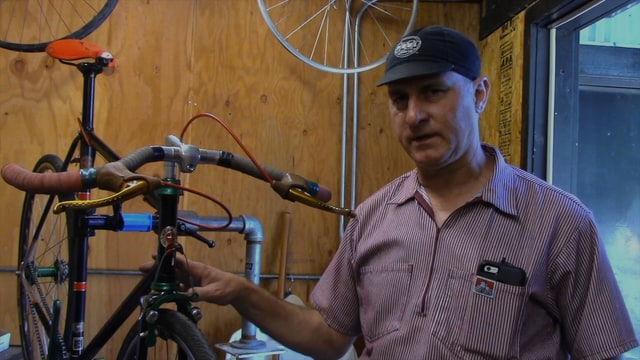
Product page, plus video.
Watch on YouTube


ascpgh
Nov 14, 2025, 8:04:44 AM11/14/25
to RBW Owners Bunch
Your story makes me think my Rivendell Rambouillet was destined to get the set of Paul Racers and the Stampede Pass ELs that it is outfitted with now. It's Ram zenith.
The 650B wheels were the change that led the list of things I couldn't improve Rambouillet with components, materializing the plans and execution of my custom Coast Rando.
Andy Cheatham
Pittsburgh
Jan Heine
Nov 14, 2025, 1:12:58 PM11/14/25
to RBW Owners Bunch
Keith, thanks for sharing that newsletter. Paul is a great guy!
Andy, the Rambouillet was definitely a high point. Toyo made beautiful frames—they were really masters of their craft, and so efficient at it that the end result was very affordable. An updated version of that frame would be amazing! (Unfortunately, last I heard Toyo no longer builds frames for other makers.)
Jan Heine
Rene Herse Cycles
Rene Herse Cycles
Seattle, WA, USA
Reply all
Reply to author
Forward
0 new messages