Curved plywood dome

494 views
Skip to first unread message

JRal

unread,
May 17, 2013, 6:38:57 AM5/17/13
to geodes...@googlegroups.com
Hi Taff

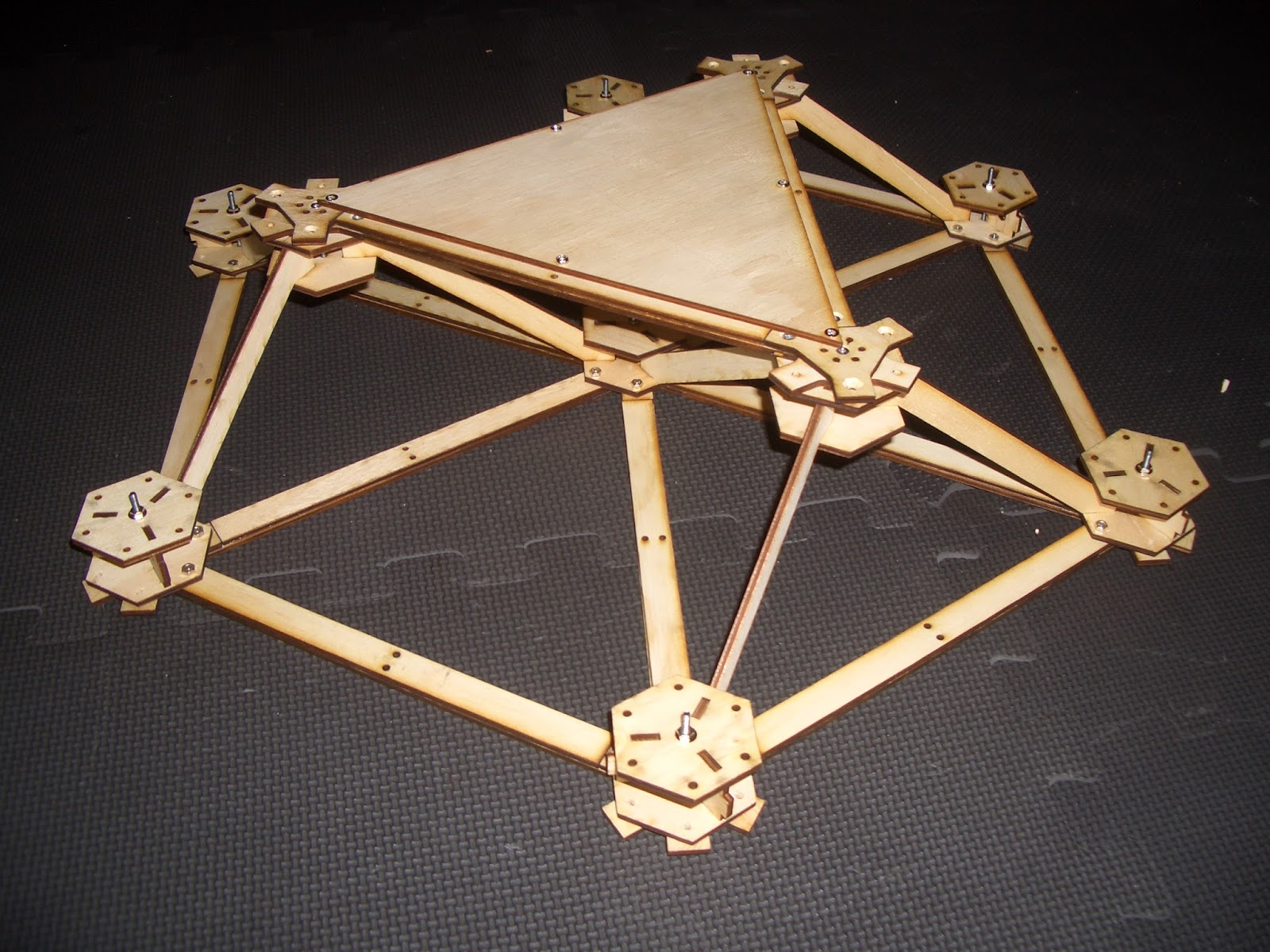
Here are some pictures of the start of a dome I am making, I just wanted to show you since it was you models and explanation of geodesic spheres on SketchUp that helped me understand geodesic geometry. 

Thanks for sharing you knowledge and I appreciate all the hard work you put into making all the SketchUp models. 

FYI 

The dome is modeled in SolidWorks, all the dimensions are extracted from the 3D model and then the pieces are cut on a laser cutter then screwed together. All struts and panels are curved so it is fairly close to a spherical shape. 


JRal


homespun

unread,
May 17, 2013, 7:20:01 AM5/17/13
to geodes...@googlegroups.com
JRal,
   Love those pictures - keep them coming as you progress through the project.  It's just beautiful.  I'm hooked...
          Dan Suttin
 
--
--
You received this message because you are subscribed to the "Geodesic Help" Google Group
--
To unsubscribe from this group, send email to GeodesicHelp...@googlegroups.com
--
To post to this group, send email to geodes...@googlegroups.com
--
For more options, visit http://groups.google.com/group/geodesichelp?hl=en
 
---
You received this message because you are subscribed to the Google Groups "Geodesic Help Group" group.
To unsubscribe from this group and stop receiving emails from it, send an email to geodesichelp...@googlegroups.com.
For more options, visit https://groups.google.com/groups/opt_out.


TaffGoch

unread,
May 17, 2013, 3:15:38 PM5/17/13
to Geodesic Help Group
Very, very nice! I love that you employed thin plywood "project panels" that most folks would discount as being too weak for structural use.

Are the struts glue-laminated on a curved jig? (I'm a woodworker, who appreciates details.)

The only thing I can't tell from the photos is how the hub "stand-offs" are constructed & attached to the hub "stars"

I NEED one of those laser-cutters! (Or, do I? Did you "farm out" that job to a service provider?)
______________

I'm proud to have been a helpful part of your geodesic research & the project. I, too, would enjoy hearing (and seeing) more, as you progress.

-Taff
20130517_200327.jpg
20130517_200207.jpg
20130517_200234.jpg
20130517_200253.jpg

John Ralphs

unread,
May 17, 2013, 9:28:31 PM5/17/13
to geodes...@googlegroups.com
I really rate laser cutters, I think they are more useful than 3D printers. I am lucky enough to have one at work. I am seriously thinking about building or buying one. I also made a cardboard prototype using it. 
Inline image 1 


Those pictures are actually my second attempt, and yes the struts have been glued onto a curved jig. 
  
Inline image 2

Here is how I constructed the hub stand offs. I found these to be very strong and simple to construct compared to my original idea of the S shaped laminated stand offs (will show in next post).  

Inline image 3
Inline image 4


Sorry some of the photos are blurry but you get the gist, these are taken on an old mobile phone. 

Inline image 5
Inline image 6
The centre part is slid over the end piece by leveraging it out on a butter knife while pushing the whole thing together.  

Inline image 7

All four centre pieces need to be lifted at the same time when sliding the pieces together. pull the knives out and the whole thing clicks into place. No glue! 

Inline image 8

The end screws get held by the captured nut on the inside. It helps if the captured nut is glued in as it is annoying if it gets pushed out inside the box. 

Inline image 9

Inline image 10
Inline image 11


--
--
You received this message because you are subscribed to the "Geodesic Help" Google Group
--
To unsubscribe from this group, send email to GeodesicHelp...@googlegroups.com
--
To post to this group, send email to geodes...@googlegroups.com
--
For more options, visit http://groups.google.com/group/geodesichelp?hl=en
 
---
You received this message because you are subscribed to a topic in the Google Groups "Geodesic Help Group" group.
To unsubscribe from this topic, visit https://groups.google.com/d/topic/geodesichelp/90sZTu8DquI/unsubscribe?hl=en.
To unsubscribe from this group and all its topics, send an email to geodesichelp...@googlegroups.com.
IMG_20130518_083327.jpg
IMG_20130518_083036.jpg
IMG_20130518_082634.jpg
IMG_20130518_082645.jpg
IMG_20130518_083204.jpg
IMG_20130427_113845.jpg
IMG_20130518_083225.jpg
IMG_20130518_083513.jpg
IMG_20130518_082901.jpg
IMG_20130518_083403.jpg
2012-11-10 14.51.32.jpg

John Ralphs

unread,
May 17, 2013, 9:49:56 PM5/17/13
to geodes...@googlegroups.com
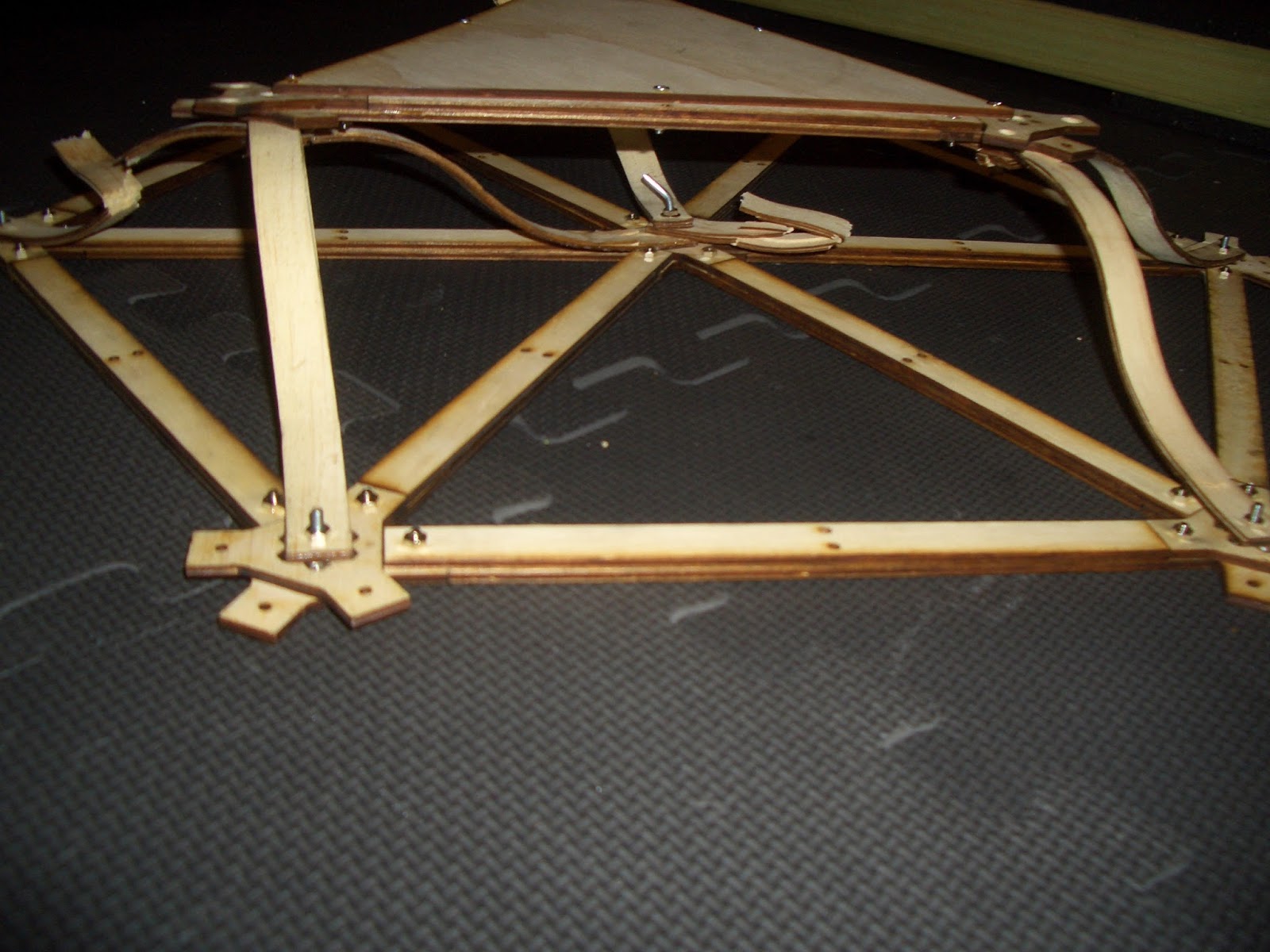
Here is my first attempt, it had too many screws so assembly was quite slow. There is no glue except the laminated S stand offs. 

The beauty of a laser cutter is the holes can be very accurately positioned, just aligning the holes between layers causes the struts to curve slightly, connecting all the struts and hubs pulls the whole thing into a very rigid curved structure.  


Inline image 1
Inline image 2
Inline image 3
Cloth is sandwiched between the layers to create the inside panels.
Inline image 4
Inline image 5
Inline image 6
CIMG7089.JPG
IMG_20130518_083327.jpg
2012-11-10 14.51.32.jpg
IMG_20130518_083403.jpg
CIMG7084.JPG
CIMG7092.JPG
IMG_20130518_083036.jpg
CIMG7094.JPG
CIMG7090.JPG
IMG_20130518_083225.jpg
CIMG7100.JPG
IMG_20130427_113845.jpg
IMG_20130518_083204.jpg
IMG_20130518_082901.jpg
IMG_20130518_082634.jpg
IMG_20130518_083513.jpg
IMG_20130518_082645.jpg

TaffGoch

unread,
May 17, 2013, 10:27:20 PM5/17/13
to Geodesic Help Group
John,

A very clear, concise answer. Thank you for taking the time to take and post photos.

Indeed, captured nuts can serve a great function, when needed. And yes, they can be trying, if not secured. (From personal experience.)

I envy your access to a laser cutter. I, too, would love to have one. (And I agree that they are more useful than current 3D printers, but, perhaps that's because of my woodworking avocation.)

BTW, welcome to the Geodesic Help Group!

-Taff

On Fri, May 17, 2013 at 8:28 PM, John Ralphs <john....@gmail.com> wrote:
I really rate laser cutters, I think they are more useful than 3D printers. I am lucky enough to have one at work. I am seriously thinking about building or buying one. I also made a cardboard prototype using it. 
 
Those pictures are actually my second attempt, and yes the struts have been glued onto a curved jig. 

Here is how I constructed the hub stand offs. I found these to be very strong and simple to construct compared to my original idea of the S shaped laminated stand offs (will show in next post).  

The centre part is slid over the end piece by leveraging it out on a butter knife while pushing the whole thing together.  

All four centre pieces need to be lifted at the same time when sliding the pieces together. pull the knives out and the whole thing clicks into place. No glue! 

IMG_20130518_082645.jpg
IMG_20130518_083036.jpg
IMG_20130518_082634.jpg
2012-11-10 14.51.32.jpg
IMG_20130427_113845.jpg
IMG_20130518_083513.jpg
IMG_20130518_083403.jpg
IMG_20130518_083327.jpg
IMG_20130518_083204.jpg
IMG_20130518_083225.jpg
IMG_20130518_082901.jpg

lpaniceres

unread,
Jun 25, 2013, 2:37:57 PM6/25/13
to geodes...@googlegroups.com
Beautiful!!!

I´ll real love to make one!
Could you help me with the plans?

thanks!

John Ralphs

unread,
Jun 25, 2013, 10:51:38 PM6/25/13
to geodes...@googlegroups.com

Hi lpaniceres

This is still a work in progress, I am still working on the detail on this scale model in the pictures. I am doing the detail of windows, doors and floors, this significantly adds to the complexity. My estimate is there will be about 500 unique parts to a full dome.

I eventually plan to use the design to build a 12 meter dome that can be lived in. 

I am still debating whether to release the cut files as I have put several hundred hours of work into the drawings. 

If you want to do your own cutting files the dimensions are based around arc lengths along great circles between vertices on a standard geodesic dome. From the pictures on this post you should be able to figure out the rest of the construction methods. I am on about iteration 5 on the prototyping so I will have saved you a bit of time anyway.

At any rate I won't be releasing any files until I am 100% happy the design. This will be a way off as I still have many many hours of work to go. The precision cut nature of the build means all the design work must be done up front.

--
--
You received this message because you are subscribed to the "Geodesic Help" Google Group
--
To unsubscribe from this group, send email to GeodesicHelp...@googlegroups.com
--
To post to this group, send email to geodes...@googlegroups.com
--
For more options, visit http://groups.google.com/group/geodesichelp?hl=en
 
---
You received this message because you are subscribed to a topic in the Google Groups "Geodesic Help Group" group.

Dick Fischbeck

unread,
Jun 26, 2013, 6:27:56 PM6/26/13
to Geodesic Help
Diagonal vertex to vertex elements or wires would multiple the domes strength. Have you considered that? Pretty dome. What about water coming through the seams between the faces?


On Tue, Jun 25, 2013 at 2:37 PM, lpaniceres <lpani...@gmail.com> wrote:
Beautiful!!!
Ohio dome.jpg

John Ralphs

unread,
Jun 26, 2013, 9:45:17 PM6/26/13
to geodes...@googlegroups.com
Hi Dick

Yes I did consider putting in diagonal elements, and in my first plywood attempt i used S shaped elements as the spacers between the inside and outside frames, I found it added too much complexity to the build. It would also make insulation installation more problematic. Once I have figured out other more critical aspects of the dome (like how to seal it against the weather) I would like to build a bunch of light weight designs to test the strength and figure out their failure points so I can reduce material usage, adding diagonal elements will be one of the designs also I would like to try offsetting the triangles on the shells to make a octet truss construction. 

One of my goals for the dome is to make it all out of plywood so it can CNC cut and flat packed. This means the whole structure can be constructed with just plywood, glue and fastners. 

I have a few Ideas for waterproofing, I will try all the combinations on this prototype when I finish it. I am thinking rubber gaskets under the panels, foam rubber gaskets / silicone between the panels, paint on water proof membrane coatings on the panels and around the edges, paint on water proof membrane over the silicone / foam rubber / rubber.  hopefully some of these modern materials are up to the job. I was thinking of stretching thin anodized aluminium sheet over the panels to give a hard rubber a smoother surface to seal against, plus it would look awesome especially if dyed.  


--

JRal

unread,
Aug 23, 2013, 6:51:20 AM8/23/13
to geodes...@googlegroups.com

TaffGoch

unread,
Aug 23, 2013, 2:00:44 PM8/23/13
to Geodesic Help Group
To be fair, I wouldn't let a single-cell failure weight/force decide, for me, how much a multi-cell octet floor will support.  You could end-up with a system that is much stronger than the sum of the individual cells.
_____________________

Now, what about how a floor/beam really works. Only the ends should be supported, with weight applied in the center. This will produce maximum compression along the top surface, and max tension along the bottom.

When tested in this manner, you will see what portion "gets pulled to pieces" (tension failure, typically, somewhere in bottom-most components.)  I presume this is next, in your testing regimen?

-Taff

John Ralphs

unread,
Aug 23, 2013, 6:45:53 PM8/23/13
to geodes...@googlegroups.com

Hi Taff, that is my thoughts exactly. My next test will be two cells wide at the bottom one cell wide at the top. And 1.5 meters long (Distance between the centre of the dome where I plan to put a single support and the edge where I plan to put the rest of the supports). Then I will test the entire circle of the floor. Hopefully it gets stronger each time the number of cells go up.

I want it to withstand a point load of 140 kg. ( pressing on one cell, I use a 100 mm diameter footprint. Cells are 250mm along their edges) 

I have thought of an alternative way of doing the horizontal struts that requires less gluing and screwing. I will also test this.

I still haven't figured out a good way to mount the frame on supports. I was thinking screw piles would be a good way to go but then I need way attach the frame to the piles that allows for difference in bolt angles / heights at the top of the pile and large tolerances from not being able to accurately place them in the ground.

What do you think?

--

TaffGoch

unread,
Aug 23, 2013, 7:13:58 PM8/23/13
to Geodesic Help Group
Here's a trick that I used while building a porch on the back of my house.

I attached the porch frame timber to the house, leveling it along the house sill frame. I assembled & adjusted the outer porch frame, to achieve the slight slope that I needed; placing cribbing & shims under the outer-frame 2x6. I "floored" the frame with planks (to provide final rigidity.)

ONLY then, did I....
(1) check level one-more-time,...
(2) bolt metal support poles to/inside the outer frame, SUSPENDED from the frame (hanging in 3'-deep holes,) and...
(3) pour concrete.

So, the support pilings/posts were the LAST step, NOT the first. (I can't take credit for the concept. I learned it from a seasoned, wise, "grandfatherly" contractor.)

Worked like a charm. Accuracy & placement of the supports was virtually guaranteed to be correct, no matter how many potential mistakes I might make, during framing/building.
_______________________

This concept works particularly-well for dome foundation pilings, when the geodesic tessellation doesn't mathematically-produce a level ground plane.

Perhaps, some variation of this technique would serve you as well as it does me

-Taff

JRal

unread,
Aug 24, 2013, 6:47:43 PM8/24/13
to geodes...@googlegroups.com
Taff,  

That is an excellent idea, I love it when I see problems solved by completely flipping the traditional solution on its head. 

I will keep this in mind when it comes time to putting my structures on the ground.

JRal

unread,
Nov 23, 2013, 12:38:15 AM11/23/13
to geodes...@googlegroups.com
The project is still ticking along, I have been looking into options for producing the parts in much higher volumes as it is going to take about 7000 parts to make a full dome. next week I will be going to have a play on a large format CNC router. work holding, spoil board wastage and large spacing between parts is still and issue causing my wastage of material to be over 50%. 

I have started designing my own CNC profile cutter that solves these problems, the work is held between sets of powered rollers, the spindle only moves in the x axis(not the x and y like a standard router) the rollers move the sheet through the y axis. 


I have finished the octet truss floor test piece. I will be taking it to work to destroy (load testing) next week. hopefully it passes as I am not fond of the idea of doing another design iteration on the floor. 

The 1.5 meter length can hold 70kg no problems - I need to check that is is stiff enough to meet building standards when scaled up. There is a bit of movement in the  joins when it is loaded up but tends to stay bent in position (probably has a permanent sag of about 10mm after loading, this does not spring back) it will be the sprung displacement that counts (it has to be under 4.2mm when each triangle has 4kg on it). Additionally it has to withstand a point load of 20 kg in a 3mm circle at any location without damage.   


The other part I have been working on is the base ring, this took more time to design than the rest of the struts (doors and windows not included, they are even more complex), I figured out a formula so that I can calculate the arc of the ring when flattened out, this makes the bottom of the dome parallel with the ground instead of a series of five inverted arches.    


On Friday, May 17, 2013 8:38:57 PM UTC+10, JRal wrote:
Reply all
Reply to author
Forward
0 new messages