
Best practices on services, controllers and directives for Angularjs 1.3.X

asicfr asicfr
Hello, i'm looking for best practices on services, controllers and directives for Angularjs 1.3.X.
Here is the rules i noticed :
- The view (html) knows only the main controller and his scope
- A directive should not have his own services
So :
- The view (html) cannot call the services directly.
- The view (html) must use the main controller to access the services.
- The view must declare the binding between the directive and the main controller
And then :
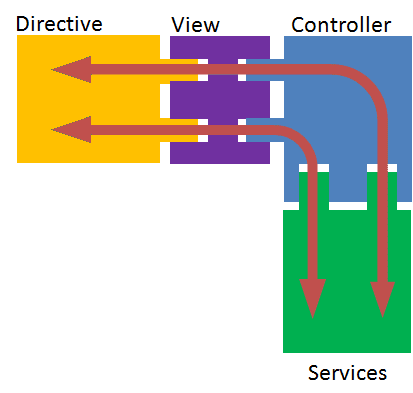
In the code, if a directive have to call a business function F1 of services :
- the main controller must publish a function F2 which wrap the function F1
- the view must declare F2 in the directive configuration
You can look at the picture attached for a more visual explaination.
Questions :
- Are you agree with those rules and the style of code ?
- Do you have any additional rules ?
- Why should we not follow these rules ?

Sander Elias
- The view (html) knows only the main controller and his scope
- the scope of the defined ngController
- the defined controller itself when the controllerAs is used.
- all he $parent scopes.
- the controllers from directives when exposed with controllerAs
- A directive should not have his own services
So :
- The view (html) cannot call the services directly.
- The view (html) must use the main controller to access the services.
- The view must declare the binding between the directive and the main controller
Given the above I think you might need to reevaluate.Angular does not enforce strict rules on how you code.
It provides guidance, on how to implement long proven paradigms, but you are free to program as you want.
Sander

Tony pee
--
You received this message because you are subscribed to the Google Groups "AngularJS" group.
To unsubscribe from this group and stop receiving emails from it, send an email to angular+u...@googlegroups.com.
To post to this group, send email to ang...@googlegroups.com.
Visit this group at http://groups.google.com/group/angular.
For more options, visit https://groups.google.com/d/optout.
asicfr asicfr

Ward Bell
You have learned on this thread the many things you COULD do but, as you noted, you are looking for guidance.
I think your principles are good ones and you'll find them in John's guide.
Two notes w/r/t advice given earlier in the thread.
First, I have no quarrel with invoking services in directives and controllers after injecting them but I wouldn't code what those services do into the controller or directive.
It's a separation of concerns thing. For example, a controller or directive should not make calls on the server directly but rather through an injected service that performs the task required.
Second, a view should only interact with the controller through a binding. The controller may or may not be visible to the view ( it generally is not visible when the view and controller at mated by a router).
The controller may expose a binding point which causes the controller to exercise a service on the view's behalf, e.g. refresh a list from server data. Of course the controller does this by calling upon an injected data service. My controller would not expose the service itself but rather a controller method that invokes the data service.
The value of all this indirection is
- clear and distinct responsibilities
- easier testing
- shorter, easier to maintain components
Remember, I'm giving you recommended practices. You can do what you want.
asicfr asicfr
How can we centralize this kind of function ?
Thx
--
You received this message because you are subscribed to a topic in the Google Groups "AngularJS" group.
To unsubscribe from this topic, visit https://groups.google.com/d/topic/angular/fIZnAL3sEpo/unsubscribe.
To unsubscribe from this group and all its topics, send an email to angular+u...@googlegroups.com.
To post to this group, send email to ang...@googlegroups.com.
Visit this group at http://groups.google.com/group/angular.
For more options, visit https://groups.google.com/d/optout.