
Dekatron frequency counter and 6909 issue

Chris Stephens
http://www.xymox1.com/Projects/erie_instrumation_model_400.htm
Its a wonderful instrument.
Recently tho I noticed that one of the 6909 was degrading. It was getting stuck and could not reach 100khz operation any more. I checked all the signals to it and all were great. The tube was not performing normally. I know these 6909 tubes have life issues. The counter uses 2 of them, one in the 1's position and 1 in the 10's position. Swapping these brought the unit back to normal operation and careful adjustment of voltages got be to 100% perfect operation up to 120khz.
However..
It now painfully obvious the 6909's are dying. As are all 6909's I believe. I could alter the circuit to use 6802's but at a reduced functional max freq of 5Khz which is a long way from its 100khz. There is no doubt that one day there will be no more 6909's as they will all die.
Im looking to pick up some known good, and maybe really great shape 6909's. I need to replace 1 for sure, and then im going to store away the others for later hoping they will last on the shelf.
How should i store these ? If they are outgassing maybe a pressurized container to keep the gasses in the tube ? If the odd gas is reacting with materials inside the tube maybe placing them in the freezer might extend life ? Maybe both, pressurized container and freezing it ? I realize these are extremes but I REAALLY want to have working tubes in 20-30 years. Maybe longer.
I realize im like the only one who cares about these 6909's as I would think no one now needs to go 100khz but my unique frequency counter.
So maybe someone here has some nice 6909's ? and maybe you guys might know of a way to preserve them for 30-100 years from now ?
Also of course, as always, if anyone happens to have a manual for the counter im VERY interested in it.

Tristan

threeneurons

Nick

Tidak Ada
From: neoni...@googlegroups.com [mailto:neoni...@googlegroups.com] On Behalf Of Nick
Sent: vrijdag 21 juni 2013 10:56
To: neoni...@googlegroups.com
Subject: [neonixie-l] Re: Dekatron frequency counter and 6909 issue
You received this message because you are subscribed to the Google Groups "neonixie-l" group.
To unsubscribe from this group and stop receiving emails from it, send an email to neonixie-l+...@googlegroups.com.
To post to this group, send an email to neoni...@googlegroups.com.
To view this discussion on the web, visit https://groups.google.com/d/msgid/neonixie-l/cdef96e1-09f7-440d-ab13-f2b20d355c9e%40googlegroups.com.
For more options, visit https://groups.google.com/groups/opt_out.
Nick
Isn't it just the loss of hydrogen (helium) that makes the trouble? The absolute pressure inside the tube is lower then outside, but the partial tension of the hydrogen (helium) is higher than atmospheric as me is told....
Tidak Ada
To: neoni...@googlegroups.com
Subject: Re: [neonixie-l] Re: Dekatron frequency counter and 6909 issue
To unsubscribe from this group and stop receiving emails from it, send an email to neonixie-l+...@googlegroups.com.
To post to this group, send an email to neoni...@googlegroups.com.
Chris Stephens
The spectral emissions is a interesting thing :)
So im also after some 6909's. As they are not prized because of pinkish glow maybe you guys have some you might want to part with :)
Working a Russian substitute into the instrument is a great idea. Im interested in doing that.
Gotta go, be back later..
threeneurons

The color is the pink/orange on the fringe. That's the color of 3 of my 6909s, both of my 6910s, and a Z505S, when it was working. I did get another 6909, as a swap for a 6802, in the last year, that has a glow that is more of a standard dekatron's orange. Its still a little more yellowish, than the standard speed orange, but closer to that orange, than to the pinkish /orange,in this photo.
I did try a simple spectral analysis with a cheap plastic spectrometer, with inconclusive results. The gas mix has lines all across the spectrum. I need at least a spectrometer, of the grade, that I used in college, so I can get some actual measurements of each of those lines. These tubes definitely use some complex gas mix.
As you can see its not the blue/violet that you see in 3-guide ("single pulse") tubes, like the OG-3 & GC10D.

Dekatron42
Chris Stephens
Hmmmm.....
Well ive a 6909 coming from ebay, who knows what state it is in. Im going to buy a number of 6909's as I can find them.
As far as preserving them, hmmmm.... Lots of good discussions here. So as we dont know the pressure in the tube its impossible to say what pressure outside the tube would be best - even if that concept was good at preserving it. Do you think keeping them in a easy gas to obtain might help ? Like nitrogen ?
So it seems like cold might be a good idea ? maybe a freezer bad with a bunch of desiccant gel packs to reduce the moisture ? or would the desiccant also absorb the gas mix ?
You know, cold will shrink the tube glass ever so much and might change things and allow more gas in/out.
Man this is a difficult topic. A good one to know tho as given 100 years all the dekatron tubes, and neon tubes, will be a issue. So good to know to preserve these things as im sure they are fading, if not now for sure in another 50 years.
A bit off topic. Ive been playing with the counter today. I have a rubidium freq source from ebay and hooked that to a modern ( 70's ) HP freq counter as its external freq source. I was calibrating the Dekatron freq counter. Amazingly accurate. BUT I cant trim out that last little bit because i run out of trim room. The parts are all in spec, its the crystal aging. Over 50 years it aged out of the trim range. I needed to add a 22pf cap to get it back in range. But it reminds me this gear is decaying. A week ago I replaced the electorlytic caps with wet tantalum as they dont age much. But even carbon comp resistors do age. I think at 100 years old this counter is going to start to reach a point its just not going to be serviceable without total overhaul of all the original parts. Which takes the fun outta it. Except for the caps its currently all orginal parts.
I was testing today and it can count at 120khz and not miss one count, over and over and over. The counter has a built in check, and it counts for EXACTLY one second and shows what it counted, so for 120khz you can get a display of (1)20000 over and over and over. Never (1)20001. Dekatron tubes are actually amazingly accurate as long as the circuits around them are well designed and trimmed. Yea I gotta adjust voltages during calibration for best performance at the highest freq and this needs to be done when you replace the ones tube.
Im letting the TXO warm up and then im going to calibrate it against the rubidium source and after I do that I will do a vid showing how it does not miss counts and is amazingly accurate.

Jon
This is fantastic - the group is relatively quiet for weeks, and suddenly we get this brilliant thread on a most interesting subject! :) So, some thoughts...
Chris Stephens
I would think that if we take a pic using a digital camera with NO OTHER LIGHT of the tube glow we would pull that image into something and get a spectrum from the software ? Not exactly a spectradiometer but this might provide clues to the spectra and gas mix.
Hmmmm..... getters.... Thats a whole different subject.. And how does cold effect them.
Yea my 6909's have no getter. None what so ever. Good point on that one.
Indeed I will contact that ebay seller. Thanks for the tip :)
Ive been playing with the counter more.. I have fixed the issue where I could not trim out the main osc properly. Required a 22pf cap of extra range to trim the aged crystal. I was able to trim it to 100000.050hz. It drifts around .01hz after a 30 min warm up. That seems quite good. My brain is failing me to determine ppm drift for it but its impressive.
Good to have it calibrated against a rubidium atomic standard.
Thats the actual osc circuit. It then divides it down to 10khz, 1khz,100hz,10hz,1hz. It does this in a analog domain using some kind of harmonic process I dont quite understand. Each 5965 tube somehow divides the input by 10. These produce perfect division with the 1 hz at the end of the chain of 5965's being 1.00000050 This one hz reference is the BIG deal as its the /sec reference that the counter uses count incoming cycles to. IE cycles per sec.
BUT a error is creeping in. The counter tubes, the 6909's in question, is missing a few counts. So in the self test mode about 10% of the time it misses 3 counts out of 100,000.. Thats counting to 100,000 in 1 sec mind you and it sometimes misses exactly 3. It misses these exact three, rarely, all the way out to 120khz where then it just falls apart.
Im letting it cool off and im going to do a little work on the TXCO ( oven based crystal ) because its case is a little loose.
Remember its using 5 dekatrons to count to 100,000 in 1 second and it almost never misses one count. Dekatrons are stunningly reliable counting devices. Below 100khz it seems 100% accurate.
I will try using a camera and see if I can catch a spectrum.
Dekatron42
Chris Stephens
The 2 6909's i have now are different.
I have a Sylvania 6909 and a Raytheon ck6909. The Raytheon is failing and will not clock at 100khz. The Sylvania works out to 120khz and sputters out and stops at 145khz.
They are driven by 5964's.
Yea I need a set of NOS 6909's that are the same but its that first one that sees the real speeds. The tens digit will only see 10khz max.
threeneurons
Chris Stephens
"Phantastrons"
What a awesome name. I believe that is exactly what the circuits are.
I got in my new 6090. Its a Sylvania 6909 but has different layout of logo and has PAD on it. It looks completely NOS but no box.
I put that into the ones posistion as I can fully test its top counting speed there. Right away I reached 181khz before its sputtered out. It was of course not reliable at that speed. It does look like I can hit 150khz now reliably but I will burn it in and test more. I will determine a top speed where it does not miss a single count. It appears how fast it can count is related to its eventual failure. So as it fails it gets slower.
I moved my other good sylvania 6909 into the 10's position where its max speed will need to be like 15khz.
I still need to adjust the voltages for the new tube, but this is a impressive top speed right away.
I also need to correct something i said in a previous post. There is getter on the Raython tube, the bad one, its all around the counting pins on the inside of the tube. The Sylvania tubes, the good ones, do not have any anywhere on them.

chuck richards
I've been reading all about your very neat dekatron
freq. counter! The pending troubles with the aging 6909s
is an interesting one, and congratulations on your recent
Ebay purchase of a fast 6909 for the "ones" position.
This reminds me somewhat of a much later freq. counter
I have that I bought at a hamfest some years ago.
It was outside, in the parking lot, at the huge Orlando, FL
hamfest. This guy had tons of old test equipment stacked
on the ground and I spotted a few pieces that had nixie
readouts in them.
I bought a few of those pieces basically for scrap value
and paid $2.50 each for a few of the smaller pieces of
test equipment, and I also paid a hefty $5.00 for this
CMC 12-digit nixie tube freq. counter.
Originally I was just going to scrap the counter to get
the NL-5853 nixies, and their old Fairchild driver ics.
But, before I started scrapping it, just for the heck of it
I powered it up, and, amazingly it started working straight
away!! It's only problem was that somewhere along the line
it turned up missing its left-most tube in the readout.
That was an easy fix, I just dug out a NOS NL-5853, and
put it into the socket. The driver ic was still there.
This freq. counter, made by CMC, looks to be made sometime
in the early 1960s. It has a crystal oven, and once warmed
up, it is amazingly accurate! Needless to say, I never had
the heart to scrap it. It works!
It only triggers and operates reliably though if it is
fed a nice square wave. It does not do very well with
a sine wave, nor much of any other waveform, for that matter.
Anyone out there know if this is a common trait of these
old counter-timers?
Great work on the dekatron frequency counter though!
You are very lucky and fortunate to own it.
Chuck
>
>
>---- Original Message ----
>From: pub...@xymox1.com
>To: neoni...@googlegroups.com
>Subject: RE: [neonixie-l] Re: Dekatron frequency counter and 6909
>issue
>>You received this message because you are subscribed to the Google
>Groups "neonixie-l" group.
>>To unsubscribe from this group and stop receiving emails from it,
>send an email to neonixie-l+...@googlegroups.com.
>>To post to this group, send an email to neoni...@googlegroups.com.
>>To view this discussion on the web, visit
>833f94b780f7%40googlegroups.com.
$4.95/mo. National Dialup, Anti-Spam, Anti-Virus, 5mb personal web space. 5x faster dialup for only $9.95/mo. No contracts, No fees, No Kidding! See http://www.All2Easy.net for more details!
Chris Stephens
http://www.youtube.com/watch?v=HIVz9bH6gL4
Chris Stephens
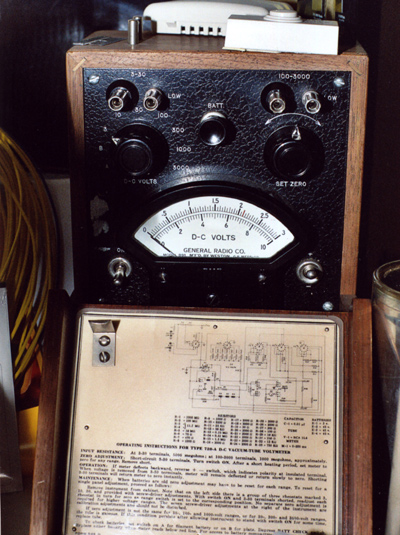
Yea I just love vintage test equipment. I have a fully functional tube based VTVM from the 1940's..
Pics of some of my fully functioning vintage stuff..
Chris Stephens
I got the new 6909 nas i mention above and all was good.
The bad tube and a spare i have both light up and count just not fast like they should, even tho they worked like a year ago. So some decay is happening..
All fine and good..
So I was using the slightly slower tube in te tens digit. I did a lot of use. Like prob 20-30 hours over 3 days. All worked perfectly.
It was running and spinning away and suddenly i noticed that the tens digit was not even lit up.. I investigated. I used my spare 6909 which i had also been using over the previous 3 days as well testing to see which was faster. So it was known good. No luck. So it seemed my counter had developed a issue. I spent a bunch of time with test gear and checked everything around that tube and nothing was wrong. The 520Vdc before the 270k resistor was correct BUT there was no drop on the other side. The tube was not drawing any current.
So I was stumped. Both tubes could not be bad..
So i decided to try my new tube in the socket. IT WORKED.. Back to the other 2 tubes, they did not work..
SOMEHOW BOTH THE TUBES HAD DIED AT THE SAME TIME. Even tho one was not even in the unit. There is no way they both could have died at the same time !.. But indeed further testing revealed both were now dead. No glow at all. When the day before both had glow. INSANE how could this be ?!?!
Here is my guess and it might explain some things..
Maybe my use of the tubes set off a reaction in the gasses and materials in the tube that resulted in both tubes dying at the same time. I started using them both at the same time 4 days before. Even tho one got WAY more use maybe just the act of using them could have triggered some complex chemical reaction that took so many days to complete. Turning on a tube does ionize the gas. Anything in gas will also be ionized. So maybe after 40 years some chemical of something in the tube had mixed with the gas. When i started using the tube this ionization caused some complex reaction that ultimately corrupted the gas in the tube. It started a reaction that ended with some gas being depleted or some reacted gas that wont work. Maybe it deposited some film on the electrodes. I dont know.
As crazy as that sounds..
I just cannot explain what happened any other way. Both tubes dying on the same day even tho one got almost no use and the other got tons of use BUT both got used for the first time in years 4 days before.
So this led to a really stupid, but fun event.. I wondered if there was any neon gas left in the tube. Or ANY gas in the tube.. I applied lots of voltage. Nothing. Tried some HV from a CRT TV, nothing. It was like there was not any gas left.. So in a moment of complete stupidity... I decided to pop it into the microwave.. The tube was toast. Why not.. If there is any gas in there the microwave is sure to ionize it.. It WILL light up...
Wow.. Dont try that at home folks..
So the microwave kicked on. The tube IMMD glowed like a supernova. Not orange, but mostly white. Then something happened inside the tube, most likely arcing.. Then the most amazing thing happened. It changed color to kinda a purple and then the top of the tube popped off, cracked all around the getter. There was little if any pressure difference so nothing really popped. It kinda just cracked and fell open. Then the most amazing thing occurred. The gas escaped as a cloud and STAYED LIT AND IONIZED. It held together for a few seconds and made this awesome 60hz kinda deep hum. Quite loudly in a menacing way. It was not the microwave, it was the gas humming obviously acting as a speaker being modulated by the microwave under duress with a 60hz hum in the signal. It was all kinda a purple cloud. It was rather unexpected and scary so i shut it off in a scramble. But OH MY what a display.
So obviously there was still some gas in the tube. But for some weird reason I could not get it to glow even providing lots of voltage. Of course the microwave could have literally ignited some of the gas. No doubt if there was hydrogen in there when it arced there would been havoc.. But there was something in there. It stayed ionized even outside the tube.
It was awesome... Im going to explore the remaining tube that does not work. Im interested to know what you guys think and any tests I might be able to do to test it to isolate whats going on with the decay of these tubes... In the end tho, I suppose i will have to microwave it and this time use a camera to get the gas plasma fusion ignition. It was pretty impressive. The hum from the gas was awesome. I know you can use a gas as a speaker, Plasmatronics did it back in the 1980's...
But yea... SOMETHING odd happened inside the tube. Im thinking its some sort of chemical reaction I set in motion by using them.. This could be bad.. It might mean all 6909's will suffer this same fate. So use might be bad..
Chris Stephens
Further research...
Taking the tube apart I think I found something...
The ceramic spacer that separates the pins has a odd coating on the top side. Its conductive. Like a thin film resistor. Its 1 Mohm from side to side across any section of it. Its some thin metalized film deposited on the ceramic. This seems odd to me considering the nature of whats going on here with the pins being rather electrified. But if you look none of the pins actually touch this part of the ceramic spacer. But the entire surface has a conductive coating of some kind. This also appears true on the 6802's as well.
http://www.xymox1.com/Misc/Dekatron/IMG_0306a.jpg
Now the interesting part is the film seems to be decaying or changing.. Its got a crackly surface while the ceramic is super smooth. You can see that in the above image. In fact the new 6909 I have has FAR less of this crackly surface. Much smoother.
Close up http://www.xymox1.com/Misc/Dekatron/IMG_0306.jpg close up 2 http://www.xymox1.com/Misc/Dekatron/IMG_0311.jpg
After trying quite hard i could not scrape any off. So its very well deposited onto the ceramic. Its not flaking off so these crackly patterns are not caused by that.
So im thinking maybe a few things..
1. The gases are interacting with the thin film and maybe then when the tube is powered this surface gets some type of charge and some very fine dust from the corrosion of the thin film mixes into the gas. Maybe even there is some small amount of air movement inside the tube when its operating and this moves this conductive dust around. Then maybe this accumulates someplace and causes the tube to not work.
2. Maybe something in this material is becoming vaoprized by the electrical currents flowing thru the film as the counter dot spins around creating very tiny arcs inside the film and over time these vaoprize this material and again there is some deposition on something else and this causes the tube to fail.
Looking at the other failed tube I can see FAR more crackly surface then on this one. This tube was worse performance. So the crackly surface might indicate its decay state. I also noticed much more pronounced and longer connected cracks in the crackly surface. Thet started from pins and went radially outwards. Like arcs would away from a pin. There is no doubt some current must end up in this film from each pin. So maybe the current takes the same path over the years and etches out these cracks in the surface all the while vaoprizing the conductive material that then mixes with the gas and moves around the inside of the tube ending up in the wrong places. Using the tube and electrifying it might cause a vast amplification of this process and a few days of settling later might cause the tube to not work.
These are of course just gueses..
All the other parts of the tube look fine. I doubt the mica spacers are a issue and the metal bits dont seem likely to cause a issue.
I suppose the ceramics might be absorbing something or outgassing something but this does not explain the very short period of operation i saw. Vaporizing this conductive film in use and then having it move around and redeposit might well explain what i saw..
So... MAYBE I can measure something on the remaining tube that might show more then normal conductivity.. But I dont have a easy tester of conductivity at high voltages..


John Rehwinkel
a small lit candle in the microwave.
Check out
http://www.youtube.com/watch?v=vgiaKTEZBCM
Or just search for "lit candle microwave" or "microwave plasma balls" on youtube.
- John
threeneurons
On Thursday, June 20, 2013 10:43:37 PM UTC-7, Chris Stephens wrote: