
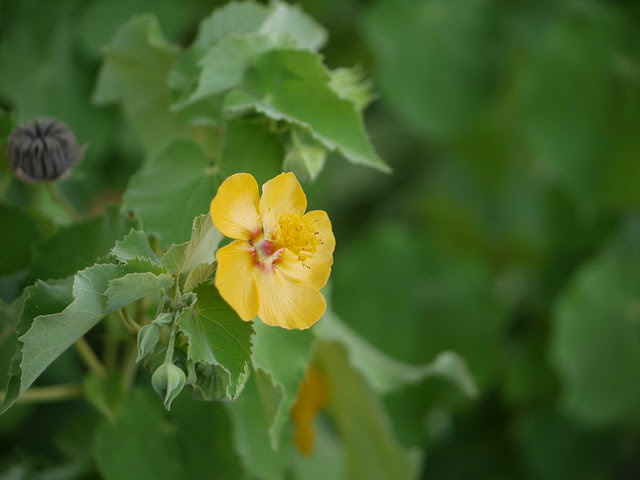
along KSH 34 between Malamba & Gundolli :: Abutilon pannosum FOR VALIDATION :: DVFEB47/80
74 views
Skip to first unread message

Dinesh Valke
Feb 20, 2015, 8:27:49 AM2/20/15
to efloraofindia
 |
| along Karnataka State Highway No. 34 ... between Malamba & Gundolli Date: 15 OCT 2011 ... Altitude: about 640 m asl |
| Abutilon ¿ pannosum ? ... (family: Malvaceae) |
| Dear friends, Shrub, about 1 m height; flower about 30 mm across, fruit about 15 mm across. While it looks like the mericarps are not beaked, not sure whether they are round enough to look like the ones at Western Desert Flora. |
  |
| Regards. Dinesh |

J.M. Garg
Feb 25, 2015, 1:09:20 AM2/25/15
to efloraofindia, Dinesh Valke
--
You received this message because you are subscribed to the Google Groups "efloraofindia" group.
To unsubscribe from this group and stop receiving emails from it, send an email to indiantreepi...@googlegroups.com.
To post to this group, send email to indian...@googlegroups.com.
Visit this group at http://groups.google.com/group/indiantreepix.
For more options, visit https://groups.google.com/d/optout.
You received this message because you are subscribed to the Google Groups "efloraofindia" group.
To unsubscribe from this group and stop receiving emails from it, send an email to indiantreepi...@googlegroups.com.
To post to this group, send email to indian...@googlegroups.com.
Visit this group at http://groups.google.com/group/indiantreepix.
For more options, visit https://groups.google.com/d/optout.
--
With regards,
J.M.Garg
J.M.Garg
'Creating awareness of Indian
Flora & Fauna'
The whole world uses my Image Resource
of more than a thousand
species & eight thousand images of Birds, Butterflies, Plants etc.
(arranged alphabetically & place-wise). You can also use them for free as
per Creative Commons license attached with each image.
For identification, learning, discussion & documentation of Indian Flora, please visit/ join our Efloraofindia Google e-group (largest in the world- more than 2400 members & 2,00,000 messages on 9.9.14) or Efloraofindia website (with a species database of more than 10,000 species & 2,00,000 images). Winner of Wipro-NFS Sparrow Awards 2014 for efloraofindia.
Also author of 'A Photoguide to the Birds of Kolkata & Common Birds of India'.
J.M. Garg
Feb 25, 2015, 11:27:58 PM2/25/15
to efloraofindia, Bimal Sar kar, Dinesh Valke
---------- Forwarded message ----------
From: Bimal Sar kar <bima...@gmail.com>
Date: 25 February 2015 at 19:26
Subject: Re: [efloraofindia:216131] along KSH 34 between Malamba & Gundolli :: Abutilon pannosum FOR VALIDATION :: DVFEB47/80
To: "J.M. Garg" <jmg...@gmail.com>
From: Bimal Sar kar <bima...@gmail.com>
Date: 25 February 2015 at 19:26
Subject: Re: [efloraofindia:216131] along KSH 34 between Malamba & Gundolli :: Abutilon pannosum FOR VALIDATION :: DVFEB47/80
To: "J.M. Garg" <jmg...@gmail.com>
To me it seems to be Abutilon indicum.
Dinesh Valke
Feb 26, 2015, 12:02:58 AM2/26/15
to J.M. Garg, efloraofindia, Bimal Sar kar
Many thanks Garg ji for resurfacing the post.
Thank you very much Bimal da for this possibility.
Regards.
Dinesh

surajit koley
Feb 26, 2015, 10:36:02 AM2/26/15
to J.M. Garg, efloraofindia, Dinesh Valke
Dear Garg Sir,
- I have seen only one Abutilon and that is indicum
- After going through lit. and efloras I think clear pictures of fruits, stipules, etc are necessary to id species level of this genus which I miss in this thread
- Flora of India, vol3 (BSI) recognizes pannosum but doesn't recognize muticum;; or are they synonymous?
- Roxburgh's Sida tomentosa is synonymous with Abutilon muticum G. Don of FBI, maybe synonymous with S. pannosum
I do not think the fruit description of Roxburgh's plant, in FI, matches with the fruit picture in this thread. Neither the same FI description matches with other posts identified in our database.
Thank you
Regards
surajit
Dinesh Valke
Feb 26, 2015, 11:13:54 AM2/26/15
to surajit koley, J.M. Garg, efloraofindia
Yes, agreed Surajit ji with all your points.
Regards.
Dinesh
surajit koley
Feb 26, 2015, 11:48:10 AM2/26/15
to Dinesh Valke, J.M. Garg, efloraofindia
Thank you Dinesh Ji, the problem is FoP recognizes both muticum, with different author citation, and pannosum. Roxburgh's plant has fruit both top and bottom rounded. It appears to me the top of your mericarps are not exactly rounded. But at the same time I also understand that what Roxburgh recorded in writing may be a bit different with the real thing.
Moreover, Roxburgh's plant is not the only species which is synonymous with A. pannosum.
So, finally I never reject probability. I just don't know.
Regards
surajit
Dinesh Valke
Feb 26, 2015, 12:43:00 PM2/26/15
to surajit koley, J.M. Garg, efloraofindia
Thanks Surajit ji for all the efforts.
I had posed the query because mericarps of the posted plant are not well-pointed as I remember to have seen for A. indicum, but my observation does not take care of possibility of variances in pointedness. Was disappointed to find almost no picture of A. pannosum's fruit on internet - thus not sure whether the fruit is globose as described OR seemingly globose.
Regards.
Dinesh
surajit koley
Feb 26, 2015, 1:08:58 PM2/26/15
to Dinesh Valke, J.M. Garg, efloraofindia
Dinesh Ji,
You must have already viewed the only herbarium of A. pannosum in KEW site. The fruit is not clear there. So, it is hard to tell. I agree that A. indicum has more prominent beaks. However, Roxburgh noted "Capsules about twenty, nearly as high as the calyx, in a depressed verticel, very downy, reniform, equally rounded at each end, this mark distinguishes it immediately from S. indica and asiatica...."Surely, Roxburgh's plant is not the type species of Abutilon pannosum, I think.
At the same time my record of Abutilon indicum is different, not like yours one in this thread.
Thank you
Regards
surajit

Anurag Sharma
Feb 26, 2015, 1:49:32 PM2/26/15
to surajit koley, Dinesh Valke, J.M. Garg, efloraofindia
This is a very interesting thread.
I have posted in a separate thread what I believe is A. pannosum with all the relevant details. Please take a look, Dinesh sir, Surajit sir.https://groups.google.com/forum/#!searchin/indiantreepix/ANFEB39$20Abutilon$20pannosum$20%28please$20validate%29|sort:relevance/indiantreepix/bhHzjFXfdcc/O7RbSZeyZ_EJ
Anurag N. Sharma
BSc. (CBZ) 2nd Year
St. Josephs College
Bangalore
Dinesh Valke
Feb 26, 2015, 2:35:06 PM2/26/15
to surajit koley, J.M. Garg, efloraofindia
Thanks Anurag for your upload of possible A. pannosum. (Perhaps not pannosum - mericarps do not appear rounded at top, and the calyx is relatively very short).
My naive query:
Would that herbarium contain a fruit that was fully matured and dried up naturally on the plant ?
Would that herbarium contain a fruit that was fully matured and dried up naturally on the plant ?
1) the mericarps could assume different shape as they dry up - thus would seem higher than the calyx
2) the calyx when drying tend to re-curve; would appear of lesser dimension than that seen in a tender fruit - as can be seen in the first pic of the posted plant.
So much said - the posted plant may be different; some species other than indicum AND pannosum. :-)
Regards.
Dinesh
surajit koley
Feb 26, 2015, 9:26:10 PM2/26/15
to Anurag Sharma, Dinesh Valke, J.M. Garg, efloraofindia
Good morning Anurag Ji
Since I do not know how Abutilon pannosum looks like I cannot say if the your posted plant is the same.
Thank you
Regards
surajit
surajit koley
Feb 26, 2015, 9:37:28 PM2/26/15
to Dinesh Valke, J.M. Garg, efloraofindia
Good morning Dinesh Ji
I asked myself the very question you have pointed out when I was examining the KEW herb. My another query was can dried up mericarps have a bit pointed tip? That is why I cannot rule out any possibility and repeatedly said that maybe Roxburgh's plant is not the type species.
Now please check an old thread which was identified and placed under Abutilon hirtum (Lam.) Sweet in our database - https://groups.google.com/forum/#!msg/indiantreepix/TRSEpDxNHCA/6Q8xOMWuu88J, not the picture of the original post but pic no. Abutilon indicum is it I2 IMG_5261.jpg and series.
Thank you
Regards
surajit
Dinesh Valke
Feb 27, 2015, 12:58:11 AM2/27/15
to surajit koley, J.M. Garg, efloraofindia
Many many thanks Surajit ji for all your efforts.
Yesterday night Anurag helped me with following links ...
Abutilon pannosum: herbarium | description
With all that you discussed and pointed out, I am convinced that the posted plant is not A. pannosum; it must be A. hirtum.
Many thanks to Anurag too - especially for the herbarium of A. pannosum.
Regards.
Dinesh
surajit koley
Feb 27, 2015, 10:44:32 AM2/27/15
to Dinesh Valke, J.M. Garg, efloraofindia
Thank you very much Dinesh Ji, for everything and links.
I would like to add that description and picture in FloraKarnataka (or anywhere else) should not be taken as exhaustive. Vijay Sir has flower without "purple" base - https://groups.google.com/forum/#!msg/indiantreepix/itKwnycckx8/sl-J3Mdmmv4J
Many thanks to Anurag Ji as well.
Regards
surajit
Dinesh Valke
Feb 27, 2015, 11:01:42 AM2/27/15
to surajit koley, J.M. Garg, efloraofindia
Oh yes Surajit ji ... colours in descriptions help in general identification. Variation in colours is quite possible. Thanks for this clarity.
Regards.
Dinesh
surajit koley
Feb 27, 2015, 11:18:27 AM2/27/15
to Dinesh Valke, J.M. Garg, efloraofindia
Thank you again Dinesh Ji.
Regards
surajit

Vijayasankar
Feb 27, 2015, 11:57:45 AM2/27/15
to surajit koley, Dinesh Valke, J.M. Garg, efloraofindia
Dinesh ji,
The posted plant could be as simple as Abutilon indicum. The mericarps are acute (not rounded at tip), about 18 (20 or less) and the plant doesn't seem to have viscid hairs - all pointing to A. indicum.
The posted plant could be as simple as Abutilon indicum. The mericarps are acute (not rounded at tip), about 18 (20 or less) and the plant doesn't seem to have viscid hairs - all pointing to A. indicum.
Vijay
-------------------------------------------------------------------
Research Scientist
National Center for Natural Products Research
University of Mississippi, MS, USA
Dinesh Valke
Feb 27, 2015, 12:23:12 PM2/27/15
to Vijayasankar, surajit koley, J.M. Garg, efloraofindia
OK Vijayasankar ji !!!! Thank you very much.
I think we worked hard :-) but the efforts have helped in knowing about abutilons a bit better.
Will go with Abutilon indicum.
Will go with Abutilon indicum.
Regards.
Dinesh
surajit koley
Feb 27, 2015, 12:56:07 PM2/27/15
to Dinesh Valke, Vijayasankar, J.M. Garg, efloraofindia
Thanks Vijay Sir.
Dinesh Ji, can you please check the number of carpels, which is still green in one of your photographs?
Thank you
Regards
surajit
Dinesh Valke
Feb 27, 2015, 1:31:18 PM2/27/15
to surajit koley, Vijayasankar, J.M. Garg, efloraofindia
About 26 or 28 Surajit ji.
Regards.
Dinesh
surajit koley
Feb 27, 2015, 9:07:46 PM2/27/15
to Dinesh Valke, Vijayasankar, J.M. Garg, efloraofindia
Good morning Dinesh Ji
My count is about 25, not sure but certainly more than 20.
So, let's wait for Vijayasankar Ji.
Thank you for the upload. I get to learn something about Abutilon, just as you have said the efforts have helped knowing about abutilons a bit better.
Regards
surajit
Vijayasankar
Feb 28, 2015, 1:07:30 PM2/28/15
to surajit koley, Dinesh Valke, J.M. Garg, efloraofindia
haha, counting is often controversial :) we need a third umpire now...
I counted the dry fruit wherein the mericarps are dehisced/opened up and have two halves each (seen as lobes from side view) and counting was easier here. I also counted a green fruit from an another picture posted by Dinesh ji at flickr where the edges/tips of mericarps are clearly visible. In both, the mericarps are less than 20. But, I can be wrong. If it is more than 20, then it can't be A. indicum which I suggested earlier. So, we still need to understand the characters clearly and we also need an unambiguous key for this genus covering larger number of species.Vijay
-------------------------------------------------------------------
Research Scientist
National Center for Natural Products Research
University of Mississippi, MS, USA
surajit koley
Feb 28, 2015, 9:46:45 PM2/28/15
to Vijayasankar, Dinesh Valke, J.M. Garg, efloraofindia
I agree Vijay Sir, counting is controversial. At the same time your other points in earlier mail were also controversial -
- The mericarps are acute (not rounded at tip)
If we start from KEY 3 in FoC and proceed to KEY4 we will see mericarps in A. hirtum will have either acute or obscurely (to 2mm) awned apices.
If we start from KEY8 of FoP we will see A. hirtum will have mericarps acute or with a small mucro
If we read Haines in BoBO we will see - "head of carpels rounded, muticous or mucronate
- the plant doesn't seem to have viscid hairs
Haines recorded - "the whole plant covered with a tomentum much as in A. indica, but also with glandular pubescence and long soft hairs on the branches, peduncles, etc."
Very little we can see branches and peduncles in the attached pictures in this thread.
FoP and Roxburgh's account is "clammy pubescence"
Dinesh Ji's flickr account of A. indicum features old photographs too. Here, in this thread there are only two photographs. It is impossible to count mericarps in the 2nd pic. In the first pic You are possibly correct about the number of mericarps in the dry fruit. But when we count number of carpels we cannot reject young fruit, in fact young fruit bears more validity, I think, in the sense that all carpels may not attain full maturity when a fruit is ripe.
Thank you
Regards
surajit
surajit koley
Mar 1, 2015, 9:15:24 PM3/1/15
to Vijayasankar, Dinesh Valke, J.M. Garg, efloraofindia
Vijay Sir seems to busy with something else. Dinesh Ji, if you count number of styles and stigma (red coloured) int he flower of your first pic you will see there are at least 23 clearly visible. So, your species is not A. indicum (L.) Sweet as per KEY given by Vijay Sir in this thread. In A. hirtum (Lam.) Sweet each merricarp is acute tipped as per KEY provided by Vijay Sir in another thread. The picture in the FloraKarnataka link you have provided clearly shows viscid hairs. The buds there exactly same as in your second pic. Haines', Roxburgh's plant has flowers with darker centre - ferruginous/crimson/purple (FoC, FloraKarnataka).
This species is Abutilon hirtum (Lam.) Sweet, not any 2nd form of A. indicum (L.) Sweet.
Thank you
Regards
surajit
Dinesh Valke
Feb 27, 2023, 2:40:44 AM2/27/23
to eFloraofIndia
Many thanks Surajit ji for suggesting the ID.
Daniel McNair, has come up with same ID: Abutilon hirtum (Lam.) Sweet ... in my observation uploaded at iNaturalist.
Regards.
Dinesh
J.M. Garg
Feb 27, 2023, 4:41:50 AM2/27/23
to indian...@googlegroups.com
Ok, Dinesh ji
You received this message because you are subscribed to the Google Groups "eFloraofIndia" group.
To unsubscribe from this group and stop receiving emails from it, send an email to indiantreepi...@googlegroups.com.
To view this discussion on the web, visit https://groups.google.com/d/msgid/indiantreepix/ea57af0b-ea77-4578-af78-238e653dcf2an%40googlegroups.com.
With regards,
J.M.Garg
J.M.Garg
J.M. Garg
Mar 1, 2023, 6:36:54 AM3/1/23
to indian...@googlegroups.com, DineshValke
Thanks, Dinesh ji.
You received this message because you are subscribed to the Google Groups "eFloraofIndia" group.
To unsubscribe from this group and stop receiving emails from it, send an email to indiantreepi...@googlegroups.com.
To view this discussion on the web, visit https://groups.google.com/d/msgid/indiantreepix/ea57af0b-ea77-4578-af78-238e653dcf2an%40googlegroups.com.
With regards,
J.M.Garg
J.M.Garg
Dinesh Valke
Mar 1, 2023, 7:21:29 AM3/1/23
to J.M. Garg, indian...@googlegroups.com
Thanks, Garg ji.
Regards.
Dinesh
Reply all
Reply to author
Forward
0 new messages