
The new robber barons: a quarter century of wealth concentration in Canada

Sid Shniad
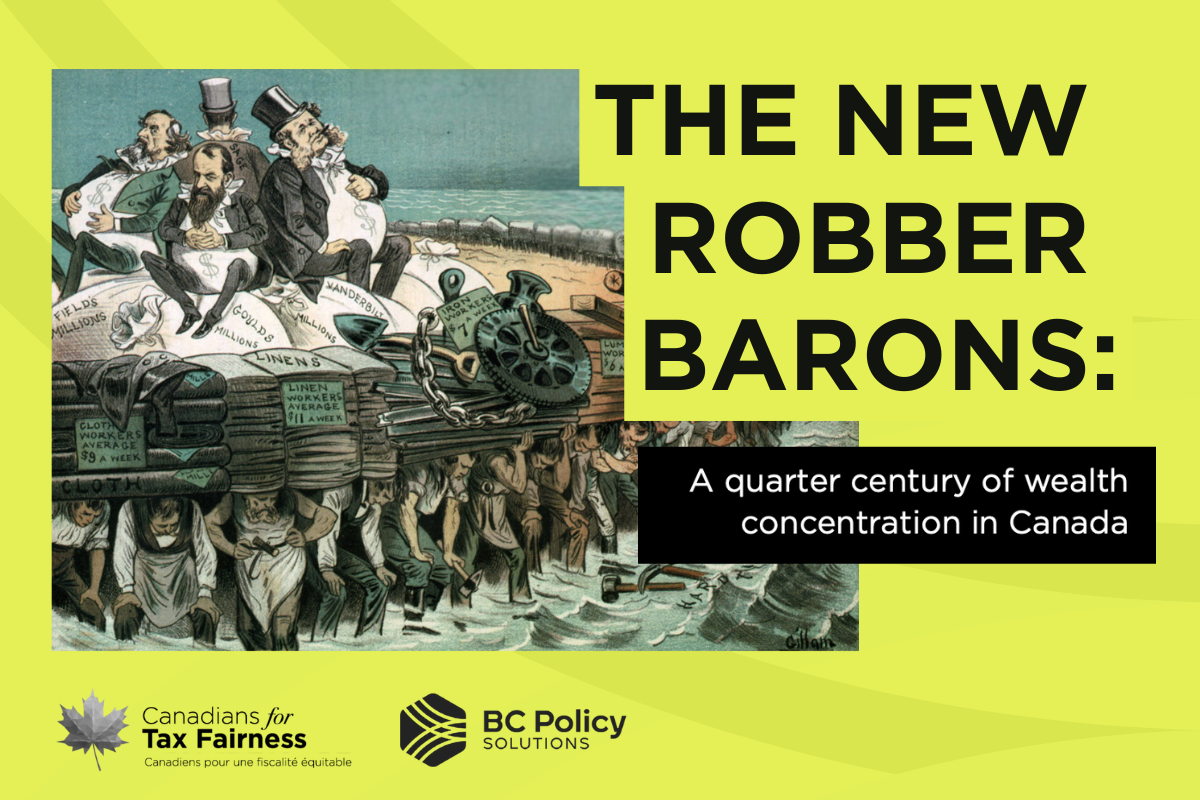
The new robber barons: a quarter century of wealth concentration in Canada
Executive summary
As concern grows about Canada’s sovereignty and economic resilience, it is essential to examine not only our independence from foreign powers but also the concentration of economic and political power inside Canada. Because wealth and political influence tend to reinforce each other, tracking who owns wealth — and how that distribution is changing — is more important than ever for the health of our democracy and the future of this country.
Standard official statistics in Canada fail to capture the extreme concentration of wealthat the top. To help address this gap, this report provides new estimates of the distribution of wealth over the past quarter century. By combining Statistics Canada survey data with billionaire lists, we estimate the complete distribution of wealth in Canada from 1999-2023. We find that:
- The wealthiest 1% of Canadian families (169,000 families) who have at least $7.8 million in wealth per family owned 22.7% of household wealth in 2023, up from 19.3% in 1999 — an increase of $3 trillion in total over that period.
- The wealthiest 0.01% of Canadian families (1,685 families) hold an average of $448.5 million, 4,041x the average wealth of a family in the bottom 50% in 2023.
- In total, the top 0.01% of families (1,685 families) held $756 billion in wealth in 2023, or 4.6% of household wealth, up from $131 billion, or 3.4% of wealth in 1999.
- 86 billionaire families held as much wealth as the 6.2 million least wealthy families in 2023.
- The wealthiest resident family of Canada in 2025 was the Thomsons, with $93.9 billion in combined wealth. They were also the richest family in 1999.
Looking at trends over the last quarter century, wealth concentration in the top 1% increased significantly between 1999 and 2016 before falling slightly from 2016 to 2023. Recent indicators suggest that top-end wealth concentration may be rising again: between July 1, 2023 and July 1, 2025, Canadian-resident billionaire wealth on the Forbes list rose 37.2%, while total household wealth rose only 9.3%.
Things haven’t always been this way. Looking back even further for context, top wealth shares in Canada decreased after the Second World War through the 1960s, alongside economic policies and political trends that helped counterbalance the power of the ultra-wealthy.
“To address wealth inequality, we need to overhaul our tax system to tax high-end wealth and capital income more effectively.”
Increasing wealth concentration is concerning for several reasons. First, high economic inequality is associated with outsized political influence for those at the top and the weakening of democracy. Second, inequality is associated with worse social and economic performance, including lower happiness and economic growth. Finally, an extreme concentration of economic resources means that major investment decisions are disproportionately made by a few powerful actors, often reflecting narrow private interests rather than democratically determined public priorities aimed at meeting the needs of everyone.
To address wealth inequality, we need to overhaul our tax system to tax high-end wealth and capital income more effectively. The revenue raised can be used to fund broad-based, high-return public investments to shore up Canada’s social and economic resilience and strengthen our sovereignty, including: creating a national clean electricity grid, building affordable non-market homes, and expanding universal public child care. Reducing extreme wealth inequality is essential to ensure that democratic priorities, not concentrated economic power, shape a stronger Canada built for everyone.
This executive summary is part of the report The new robber barons: a quarter century of wealth concentration in Canada. Download the full report below.
The NewRobber Barons: A quarter century of wealth concentration in CanadaDownload