
setlocal for Ukrainian language (Issue #23210)

Oleksandra Yushchenko
Description
From version 3.1.6 wxWidgets calls setlocation(0, wxInfoLanguage->LocaleTag), see (prusa3d@deef116#diff-7de25e9a71c4dce61bbf76492c589623d5b93fd1bb105ceaf0662075d15f4472),
where LocaleTag is a Tag of locale in BCP 47 - like notation.
For Ukrainian Language LocaleTag is "uk".
But setlocale(0, "uk") returns "English_United Kingdom.1252" instead of "uk",
and, as a result, locales are set to English_United Kingdom
We use such workaround in PS now. After initialization of the wxLocale, for Ukrainian we call setlocal one more time with GetCanonicalWithRegion() data.
if (language_info->CanonicalName == "uk")
         setlocale(0, language_info->GetCanonicalWithRegion().data());
But I suppose, that this issue have be resolved in wxWidgets internally
Platform and version information
- wxWidgets version you use: 3.2.0
- wxWidgets port you use: any
- OS and its version: any
—
Reply to this email directly, view it on GitHub, or unsubscribe.
You are receiving this because you are subscribed to this thread.
VZ
It would be really great if you could please provide an example of reproducing the problem because while I understand that the issue has something to do with the confusion between the language and country codes, I have no idea how to actually trigger it.
Please show some minimal code or, again, ideally a patch to the internat sample.
—
Reply to this email directly, view it on GitHub, or unsubscribe.
You are receiving this because you are subscribed to this thread.
VZ
I can't reproduce the problem in the internat sample, e.g. here is what it shows under MSW:
[Window Title]

Internat Information


[Content]

Locale "uk_UA" is available.

Identifier: uk-UA; Layout: LTR

English name: Ukrainian (Ukraine)

Localized name: українська (Україна)


[OK]
Please explain what doesn't work exactly for you and, also whether the changes of #23226 change anything for you. TIA!
—
Reply to this email directly, view it on GitHub, or unsubscribe.
You are receiving this because you are subscribed to this thread.
Oleksandra Yushchenko
I'm sorry to be late with the reply.
For the repro you can just use your "calendar" sample, but make a small change
MyApp::MyApp() :
    // Locale affects on the language used in the calendar, and may affect
    // on the first day of the week.
    m_locale(wxLANGUAGE_UKRAINIAN) //m_locale(wxLANGUAGE_DEFAULT)
{
}
- Start "Calendar wxWidgets sample" application
- Select menu "Calendar" > "Use generic version"
- You coudn's see any effect, calendar is in English

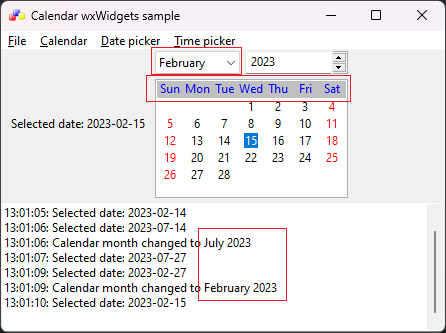
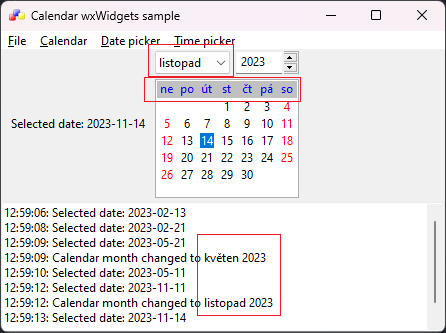
But if I set any other language, for example wxLANGUAGE_CZECH, than everything works as expected.
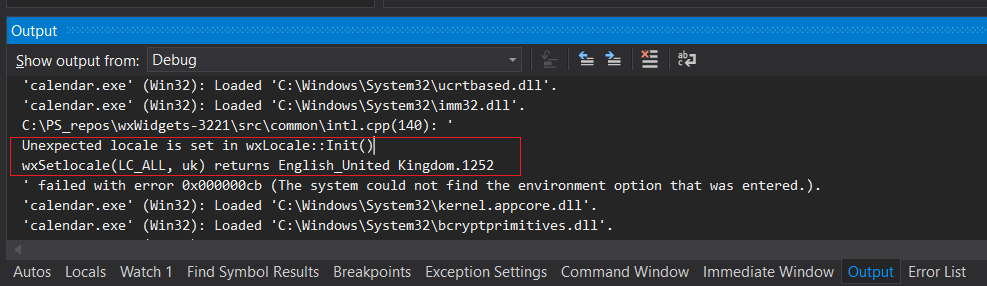
To see where is a problem, add next code:
diff --git a/src/common/intl.cpp b/src/common/intl.cpp
--- a/src/common/intl.cpp
+++ b/src/common/intl.cpp
@@ -128,6 +128,12 @@ const char* wxLanguageInfo::TrySetLocale() const
     {
         locale = LocaleTag;
         const char* const retloc = wxSetlocale(LC_ALL, locale);
+#if 1 // output to check the issue
+        wxString msg = wxString::Format("\nUnexpected locale is set in wxLocale::Init()\n"
+            "wxSetlocale(LC_ALL, %s) returns %s\n", LocaleTag, retloc);
+        if (retloc != locale)
+            wxLogLastError(msg);
+#endif
         if ( retloc )
             return retloc;
See:
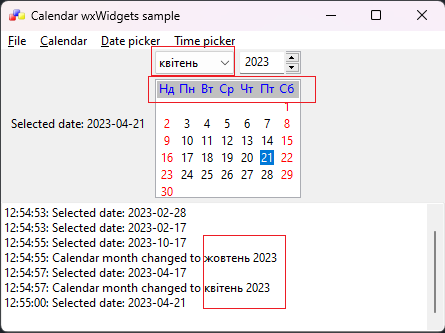
But if use CanonicalRef instead of LocaleTag, then issue is gone.
diff --git a/src/common/intl.cpp b/src/common/intl.cpp
--- a/src/common/intl.cpp
+++ b/src/common/intl.cpp
@@ -126,8 +126,19 @@ const char* wxLanguageInfo::TrySetLocale() const
     // CRT (check by calling setlocale()).
     if ( wxGetWinVersion() >= wxWinVersion_Vista )
     {
+#if 1 // fix for the setLocal issue
+        locale = CanonicalRef;
+#else
         locale = LocaleTag;
+#endif
+
         const char* const retloc = wxSetlocale(LC_ALL, locale);
+#if 1 // output to check the issue
+        wxString msg = wxString::Format("\nUnexpected locale is set in wxLocale::Init()\n"
+            "wxSetlocale(LC_ALL, %s) returns %s\n", LocaleTag, retloc);
+        if (retloc != locale)
+            wxLogLastError(msg);
+#endif
         if ( retloc )
             return retloc;
See
—
Reply to this email directly, view it on GitHub, or unsubscribe.
You are receiving this because you are subscribed to this thread.
Ulrich Telle
From version 3.1.6 wxWidgets calls
setlocation(0, wxInfoLanguage->LocaleTag), where LocaleTag is a Tag of locale in BCP 47 - like notation.
Right. And usually this works as expected.
For Ukrainian Language LocaleTag is "uk".
This is correct. And in principle, it is not necessary to specify a region tag in addition to the language tag.
But setlocale(0, "uk") returns "English_United Kingdom.1252" instead of "uk", and, as a result, locales are set to English_United Kingdom
Unfortunately, this is a flaw in the function setlocale (at least under Windows - I didn't check other platforms yet). The Microsoft Visual C++ documentation describes, which languages are supported by setlocale under the heading Language strings. The first paragraph references Appendix A: Product Behavior in [MS-LCID]: Windows Language Code Identifier (LCID) Reference, where all defined languages are listed in a long table. In that table you find 2 entries for Ukrainian:
- uk for Ukrainian
- uk-UA for Ukrainian in Ukraine
However, the first reference Language strings also contains a second paragraph, Supported language strings. This paragraph describes in a table which language strings the Microsoft C run-time library implementation also supports. Near the end of this table you find the language string uk and the equivalent locale name en-GB.
Obviously setlocale prefers the latter mapping from language string to locale name. And that explains the misbehaviour. Actually, only Ukrainian is affected by this flaw.
Interestingly, method wxLocale::Init(int lang, int flags) uses info->GetCanonicalWithRegion() to determine the short name of the locale (for uk this corresponds to uk-UA), but the Windows implementation of method wxLanguageInfo::TrySetLocale() uses locale = LocaleTag (instead of locale = GetCanonicalWithRegion()).
BTW, the implementation of method wxLanguageInfo::TrySetLocale() for non-Windows platforms does use GetCanonicalWithRegion()).
Conclusion: The Windows implementation of method wxLanguageInfo::TrySetLocale() should be changed to use GetCanonicalWithRegion()) as well.
For the time being, you may use the language identifier wxLANGUAGE_UKRAINIAN_UKRAINE instead of wxLANGUAGE_UKRAINIAN as a workaround to get the expected results.
—
Reply to this email directly, view it on GitHub, or unsubscribe.
You are receiving this because you are subscribed to this thread.
VZ
Closed #23210 as completed via a0be352.
—
Reply to this email directly, view it on GitHub, or unsubscribe.
You are receiving this because you are subscribed to this thread.