
Re: Hubback Checklist
306 views
Skip to first unread message

Rosli Mohd. Ali
Jul 11, 2013, 9:08:38 AM7/11/13
to Mariana Isa, Nooridayu Ahmad Yusuf, Norhayat...@taylors.edu.my, Suhaila Abd Rashid, Abdul Razak Abd. Aziz, Najib Ariffin NADGE, Steven Thang, Mr Laurent Lim Aun Giap, ahmad najmi che pee, Nurul Anida Mohamad, Lam Shen Fei, idayu noor, Sofia Nor Shariza Binti Sharifuddin, nadge my@gmail. com, PAM_Ridzwan
Ha, ha Mariana,
expect this to be a lenghty one....
expect this to be a lenghty one....
PssT* Actually I wanted to send the group my cognizance earlier, mmm...more like"my speculations..",
Since it had been so eerily quiet of late...for the AB Hubback Exhibition Committee to be in silent mode...
Although we pushed the dates back to December, but that's not the reason for complacency...arrogance ??.hehe..
Although we pushed the dates back to December, but that's not the reason for complacency...arrogance ??.hehe..
Ok...herewith were those I was dabbling on earlier, its in "Pam Hericon"!
https://sites.google.com/site/pamhericon/home, going through the personal compilations
Images are from the book "Kuala Lumpur - in Postcards 1900-1930" with Text written
by ex-MCKK History Teacher, the late Arwah Cikgu Muzaffar DJ Tate.
Images are from the book "Kuala Lumpur - in Postcards 1900-1930" with Text written
by ex-MCKK History Teacher, the late Arwah Cikgu Muzaffar DJ Tate.
(But really, I never enjoyed reading when in school, "I hate Dates",worst was History...always failed History!!)...
And, most of my revisions were only by going through pictures and, the rests were made up!!
And, most of my revisions were only by going through pictures and, the rests were made up!!
Old Selangor unmasked; KL, Klang
|
Colonialism and Capitalism
In order to exploit the administrative dependencies and dominance on resources available,
labor and market forces from the native lands, the settlers teamed up with foreign traders and group of capitalists. They practiced hegemony, politically to divide and rule, protecting their cultural imperialism. Thus indirectly they had to exercise control via influence as well as formal military support and or the economic leverage. These apply to both work and play. The interlocutory requirement on economic viabilities was to provide lending facilities as part of the commitment to investments, for implementing the yields and results of the harvests. Hence the bank was needed in its place as the first to exist, followed by the government printers. The Chartered Bank of India, Australia and China, was the earliest to operate a branch in KL in 1888, first at some shophouses, then in 1891, erected its own premise at Lebuh Pasar Besar.  The Government Printing Office for Selangor was originally set up at Bukit Aman. It later served
the needs of FMS in 1904, and further upon the closure of the one at Taiping, Perak, with equipment and staff, both and together transferred into one building with neo-Renaissance facade formerly intended for the Federal Secretariat, built in 1909. (There could possibly be another building been put up at the same location in1899.)  printingoffice02b2b.jpg (1909) [Government Printing Office]
The Chartered Bank was also replaced and reconstructed at the original site in 1909.
 chartered02b2b.jpg (1909) [Chartered Bank]
Meanwhile, at the other end of Market Street, things were also taking shape, for the changes, upon the demise of Yap Ah Loy. Properties were sub-divided at the well-known areas of Market Square.  marketstreet02b2b.jpg [Lebuh Pasar Besar near Medan Pasar (Market Square)]
The Federal Postal Office was also finally completed in 1907 upon the government land deal with
Loke Yew on the shophouses and relocation of the Loke Chow Kit's department store at the road junction, directly opposite the FMS Railways, Central Officers. The latter a reconstructed premise in 1905, to replace the single storey Selangor Railway Office that was built in 1896.  jalanrajalebuhpasar02b2b.jpg [Lebuh Pasar Besar junction of Jalan Raja & Jalan Sultan Hishamuddin]
The European social club was founded in 1884. Its building of timber structures was originally located at the east side of the parade ground. In early 1890s, it acquired few premises and built a two-storeyed structure of brick and tiles as the Club's centre-piece, on the west side of the Padang, designed by AC Norman.  selangorclub102b2b.jpg [Royal Selangor Club]
 selangorclub202b2b.jpg [Royal Selangor Club]
In 1910, the Clubhouse was extensively extended and renovated to a mock-Tudor style, to the
design of AB Hubback, around the original centre-piece that somehow had lost its upper storey.  In 1922, further renovation and extension were done which survived until the present day.
However, in 1970 fire destroyed the northern wing leading it to be rebuilt of slightly bigger scale.  selangorclub402b2b.jpg [Royal Selangor Club]
The Municipal Offices and Town Hall of Kuala Lumpur, was designed by AB Hubback in 1901,
after the KL Sanitary Board was formed in 1890, and it was immediately constructed. The cast-iron bridge over Gombak River in the photo below was built in 1890. It no longer exists.  dewanpanggungkl02b2b.jpg [KL Municipal Hall (Panggung Bandaraya)]
AB Hubback completed the design of Masjid Jamek at the confluence of Klang and Gombak (Lumpur) Rivers in 1908. The foundation was laid on 23 March 1908 and the building was officially declared opened by DYMM Sultan Alauddin Sulaiman Shah on 23 Dec 1909. Photos after the building were completed.  jamek102b2b.jpg [Masjid Jamek]
 jamek202b2b.jpg [Masjid Jamek]
 jamek302b2b.jpg [Masjid Jamek]
The colonnade Supreme Court building to the design by AB Hubback was completed in 1915.
It covers the almost triangular site between the enclaves of Municipal Hall and Masjid Jamed.  supreme102b2b.jpg [Old Supreme Court]
 supreme202b2b.jpg [Old Supreme Court]
The colonnade Survey Office next to the Municipal Hall, fronting Jalan Tun Perak (previously known as Jalan Java and then Mountbatten Road), at the junction of Jalan Raja, was designed by AB Hubback, with the construction completed in 1910.  surveyoffice02b2b.jpg [Old Survey Office]
The previous building at the present Muzium Negara site was the Selangor State Museum.
It was designed by AB Hubback in 1902 and, the west wing was completed and opened to public in 1906.  museum102b2b.jpg [Selangor Museum]
 museum202b2b.jpg [Selangor Museum]
The previous building had initially had the main entrance located at the south end.
 museum302b2b.jpg [Selangor Museum]
In 1914, the building was extended and renovated, with the former main entrance relocated to the
"middle" of the extended east wing. And, the external steps outside leading down to Jalan Damansara. However, with the bad aim of high level Allied bombers in March 1945 during the last months of
the Pacific War demolished the East Wing instead of the Brickfield railway marshalling yards, across the road. Subsequently, the remaining damaged building was demolished, and replaced with the present building. The present Muzium Negara was opened in August 1963.  museum402b2b.jpg [Selangor Museum]
(Note: The original road of Jalan Damansara from Kuala Lumpur led to Damansara,
a town situated at the confluence of Sungai Damansara and Sungai Klang, en route to Klang, passing through Sungai Pencala. The transport mode then was probably riding on Elephant!) Klang is important due to its position commanding the lower reaches of the river by the same
name. It became the royal seat of Selangor when Sultan Alauddin Sulaiman Shah, during his reign in 1898 to 1938, made Istana Mahkota Puri his home with a new palace built in 1903. The building stood until 1958, before it was replaced by Istana Alam Shah which stands on its site today The design of Istana Mahkota Puri's had all the combination and features from the Bangunan
Sultan Abdul Samad, of which AB Hubback was heavily involved in making the renewed changes on the interior and exterior prior to his resignation from Selangor PWD in 1897 upon its completion and having supervised the verification of the superstructure works. AND that, of the KL Municipal Hall, of which he designed on rejoining the reconstituted FMS PWD in 1901. AB Hubback was said to be pursuing his Private Practice between 1898-1900,.
Kindly look for the details and the design elements done by AB Hubback in his work.  mahkotapuri102b2b.jpg [Istana Mahkota Puri]
 mahkotapuri202b2b.jpg [Istana Mahkota Puri]
Cheers,
Pam Hericon. |
-----------------
So they are my thoughts....for now...I think so, but NO!!
I have since been trying to find out who exactly designed that Old Goverment Printing Office,
although I strongly believe AB Hubback also did the Chartered Bank!!...by looking at the design...
although I strongly believe AB Hubback also did the Chartered Bank!!...by looking at the design...
On the Govt Printing Office, Gullick marked it as 1899 on Fig.11, Buildings around Merdeka Square pg.158.
whereas Mr. Tate said in the Postcards Book that it was erected in 1909! Although it could be 1910...
And, by looking at those "Projecting Bay Windows", I believe only AB Hubback had the skill to do it,
similarly to what he did to all those "Parapet Projecting Turrets" and the Bay Window of KL Municipal Hall.
whereas Mr. Tate said in the Postcards Book that it was erected in 1909! Although it could be 1910...
And, by looking at those "Projecting Bay Windows", I believe only AB Hubback had the skill to do it,
similarly to what he did to all those "Parapet Projecting Turrets" and the Bay Window of KL Municipal Hall.
Please I'm not being biased...
you can only judge those buildings by looking through the design technical skills of its authors, ie Architects!!
Because in those days, everything was custom designed, Architects had to do their own working drawings.
you can only judge those buildings by looking through the design technical skills of its authors, ie Architects!!
Because in those days, everything was custom designed, Architects had to do their own working drawings.
Here's what it is said on that building by the current occupants, http://www.klcitygallery.com/history.html
"In 1899, during the British colonial administration, the Kuala Lumpur City Gallery building was first built to
meet the administrative needs of Kuala Lumpur, the newly founded capital of the Federated Malay States.
It replaced the Government Printing Office in Taiping, which was closed down. The government printer at
the time, J. Russell, helped the Public Works Department architect A. C. Norman design the ideal printing
office to house large printing press machines. The exterior façade was designed based on neo-Renaissance
principles, with exposed bricks, plastered columns, and large semi-circular windows decorated with keystones;
while the interior had a structural support system of cast iron columns and trusses. The building did not have
a pronounced entrance or front porch, but just a simple door located on the western side. Canopy roofs were
added above the first floor windows in the 1940s, as protection against the harsh tropical sun.
meet the administrative needs of Kuala Lumpur, the newly founded capital of the Federated Malay States.
It replaced the Government Printing Office in Taiping, which was closed down. The government printer at
the time, J. Russell, helped the Public Works Department architect A. C. Norman design the ideal printing
office to house large printing press machines. The exterior façade was designed based on neo-Renaissance
principles, with exposed bricks, plastered columns, and large semi-circular windows decorated with keystones;
while the interior had a structural support system of cast iron columns and trusses. The building did not have
a pronounced entrance or front porch, but just a simple door located on the western side. Canopy roofs were
added above the first floor windows in the 1940s, as protection against the harsh tropical sun.
For years, the printing office produced official government reports, government books and train tickets. In 1961
the Ministry of Labour took over the building, and later in 1977, the building was converted to the Metropolitan
Postal Security Office."
the Ministry of Labour took over the building, and later in 1977, the building was converted to the Metropolitan
Postal Security Office."
Can you believe that? I don't think so...because the first Govt. Printing Office was located near the Police Barrack
at Bluff Road, ie. now Bukit Aman. [Bluff here is not meaning to mislead or deceive BUT to be at steep cliff,
thus the hillslope of Bukit Aman!!]
at Bluff Road, ie. now Bukit Aman. [Bluff here is not meaning to mislead or deceive BUT to be at steep cliff,
thus the hillslope of Bukit Aman!!]
Interesting to note also, J.Russell in above notation is not the same person as J.A Russell, the former Jack, is the father!
Whereas John Archibald Russell who was the Contractor on the KL Railway Building designed by AB Hubback,
with his brother Phillip Russell, was also the person who started Cameron Highland BOH Tea Plantations.
http://muse.jhu.edu/login?auth=0&type=summary&url=/journals/journal_of_the_malaysian_branch_of_the_royal_asiatic_society/v083/83.1.tuan.html
Whereas John Archibald Russell who was the Contractor on the KL Railway Building designed by AB Hubback,
with his brother Phillip Russell, was also the person who started Cameron Highland BOH Tea Plantations.
http://muse.jhu.edu/login?auth=0&type=summary&url=/journals/journal_of_the_malaysian_branch_of_the_royal_asiatic_society/v083/83.1.tuan.html
Read their family history here, http://www.clairegrey.co.uk/index.html
Please look for Contacts!!
Please look for Contacts!!

http://www.clairegrey.co.uk/photos_web_ready/fromal_boys_jack_and_mad.jpg
"Jack Russell, son of Richard Dearie, with his family in Malaya in 1909"
"Jack Russell, son of Richard Dearie, with his family in Malaya in 1909"
I was looking also whether the building was listed under the Architect, Arthur Charles Alfred Norman.
But hell NO!! Professor Ghafar had taken his website off from the USM network, he has gone commercial...
He has joined JSTOR, MBRAS, see CHRONOLOGICAL BIOGRAPHY OF ARTHUR CHARLES ALFRED NORMAN
But hell NO!! Professor Ghafar had taken his website off from the USM network, he has gone commercial...
He has joined JSTOR, MBRAS, see CHRONOLOGICAL BIOGRAPHY OF ARTHUR CHARLES ALFRED NORMAN
But luckily I remembered someone had earlier copied its contents from the earlier USM site,
http://www.malaysian-explorer.com/acNorman.html
http://www.malaysian-explorer.com/acNorman.html
And, nowhere there written that AC Norman designed the Government Printing Office...!!
Except,
Govt. Offices (1884) $ 33,000•The offices were strategically located on the Bluff area (near Bukit Aman),
a hill site that faces the Selangor Club and Merdeka Square.
•These offices and other buildings on the site including the old police offices and barracks were replaced by
the present national police headquarters. It is believed that some of these offices were then moved to the
Sultan Abdul Samad Building upon its completion in 1897.
a hill site that faces the Selangor Club and Merdeka Square.
•These offices and other buildings on the site including the old police offices and barracks were replaced by
the present national police headquarters. It is believed that some of these offices were then moved to the
Sultan Abdul Samad Building upon its completion in 1897.
Govt. Offices $152,000 The Sultan Abdul Samad Building
...then, written
On 6 July 1896, the Council of the R.I.B.A. confirmed Norman's nomination to become a Fellow.
On 18 September, AC Norman's nomination as a Fellow of the R.I.B.A. was approved.
He signed a Declaration Statement in the presence of architect A.B. Hubback.
1897 The Sultan Abdul Samad Building in Kuala Lumpur was completed. It was the largest building to be built
at that time, stretching 400 feet along Jalan Raja with a central clock tower of 135 feet in height.
1901 Submitted a list of buildings erected by the PWD in his time in support of his application for promotion to
the Resident H.C. Belfield but was unsuccessful.
at that time, stretching 400 feet along Jalan Raja with a central clock tower of 135 feet in height.
1901 Submitted a list of buildings erected by the PWD in his time in support of his application for promotion to
the Resident H.C. Belfield but was unsuccessful.
1903 On the grounds of inefficiency, AC Norman was compulsorily retired at the age of 45.
1904 He left for England and worked with Boulton and Paul Ltd. in Norwich until 1907.
1908 He returned to Plymouth, England.
1928 At the age of 70, AC Norman was elected as the President of Devon Architectural Society.
1944 On 17 October, Norman died in England at the age of 86.
Nothing that I read mainly was good about AC Norman,
except for Professor Ghafar, he seems to like the guy.
except for Professor Ghafar, he seems to like the guy.
If someone has this book, THE BANGUNAN SULTAN ABDUL SAMAD by JM Gullick published by MBRAS (1992),
Please, let me have a read. It seems nothing is good about AC Norman...!!
Here's what I can retrieve from the web on Page 27...
Here's what I can retrieve from the web on Page 27...
"The Bangunan Sultan Abdul Samad, completed 1897, has stood for almost a
century without substantial structural alteration. When built it was first known as
'the new Government Offices', .and later, as 'the Federal Secretariat' (though it was
shared with the Selangor State Government until it moved to Shah Alam). For brev-
ity it is hereafter referred to as 'the Bangunan’.
The Bangunan was the climax of late 19th century buildings in Kuala Lumpur,
and its architectural style was original and still makes it one of the most attractive fea-
tures of Kuala Lumpur. This short account is written to describe how the Bangunan
came to be built and who designed and built it .
The Selangor State Government moved its administrative headquarters, first
established at Klang, to Kuala Lumpur, until then merely a mining and trading settle-
ment in 1880. The first government office, on a very modest scale due to lack of
money, stood on the high ground overlooking what is now Merdeka Square (for_
merly the Padang) on its west side. The area took its name from Bluff Road, which
ran along the edge of the ridge through the office area.
When Swettenham succeeded Bloomfield Douglas as Resident late in 1881, he
began to replace and add to the offices in the Bluff Road area, but still is a very un-
pretentious fashion. The Selangor Government’s revenues increased from $300,000
(in 1882) to more than $1million in 1887. But the surplus over current expenditure
was applied to finance the construction of the railway line from Klang to Kuala
Lumpur, completed in 1886. By 1887 therefore the government's plans for building
were no longer seriously constrained by lack of money.
However the resources of the Selangor Public Work Department were geared
to the modest outlays of the 1880's. Two important figures in the story of the Bangu-
nan joined the PWD in 1883. 'These were H. F. Bellamy, a civil engineer, who be-
came Superintendent of Public Works, and A. C. Norman, an architect, who was As-
sistant Superintendent. Although each was professionally qualified, neither had the
talent or drive required to execute a major construction programme.
When W. E. Maxwell became Resident of Selangor in l889, the first priority
was the construction of two new hospitals to meet the health needs of the popula-
tion. The building of the hospitals, and of premises for the newly established Gov-
ernment Printing Department (in the Bluff Road area) pre-empted existing re-
sources, and no doubt exposed to Maxwell’s critical eye the limitation of the PWD
under Bellamy and Norman. In his plan for badly needed new government offices
Maxwell had in view something more prestigious than the PWD, under this leader-
ship, was likely to produce. He said that 'advertisement should not be neglected even
by a Government'.
Maxwell therefore brought in from Ceylon C. E. Spooner to overhaul the
Selangor PWD, and this led to Spooner's permanent transfer to Selangor, where he
remained until his death in 1909. A new post of State Engineer was created for
Spooner, and Bellamy, who accepted his supersession by a hard taskmaster with ge-"
century without substantial structural alteration. When built it was first known as
'the new Government Offices', .and later, as 'the Federal Secretariat' (though it was
shared with the Selangor State Government until it moved to Shah Alam). For brev-
ity it is hereafter referred to as 'the Bangunan’.
The Bangunan was the climax of late 19th century buildings in Kuala Lumpur,
and its architectural style was original and still makes it one of the most attractive fea-
tures of Kuala Lumpur. This short account is written to describe how the Bangunan
came to be built and who designed and built it .
The Selangor State Government moved its administrative headquarters, first
established at Klang, to Kuala Lumpur, until then merely a mining and trading settle-
ment in 1880. The first government office, on a very modest scale due to lack of
money, stood on the high ground overlooking what is now Merdeka Square (for_
merly the Padang) on its west side. The area took its name from Bluff Road, which
ran along the edge of the ridge through the office area.
When Swettenham succeeded Bloomfield Douglas as Resident late in 1881, he
began to replace and add to the offices in the Bluff Road area, but still is a very un-
pretentious fashion. The Selangor Government’s revenues increased from $300,000
(in 1882) to more than $1million in 1887. But the surplus over current expenditure
was applied to finance the construction of the railway line from Klang to Kuala
Lumpur, completed in 1886. By 1887 therefore the government's plans for building
were no longer seriously constrained by lack of money.
However the resources of the Selangor Public Work Department were geared
to the modest outlays of the 1880's. Two important figures in the story of the Bangu-
nan joined the PWD in 1883. 'These were H. F. Bellamy, a civil engineer, who be-
came Superintendent of Public Works, and A. C. Norman, an architect, who was As-
sistant Superintendent. Although each was professionally qualified, neither had the
talent or drive required to execute a major construction programme.
When W. E. Maxwell became Resident of Selangor in l889, the first priority
was the construction of two new hospitals to meet the health needs of the popula-
tion. The building of the hospitals, and of premises for the newly established Gov-
ernment Printing Department (in the Bluff Road area) pre-empted existing re-
sources, and no doubt exposed to Maxwell’s critical eye the limitation of the PWD
under Bellamy and Norman. In his plan for badly needed new government offices
Maxwell had in view something more prestigious than the PWD, under this leader-
ship, was likely to produce. He said that 'advertisement should not be neglected even
by a Government'.
Maxwell therefore brought in from Ceylon C. E. Spooner to overhaul the
Selangor PWD, and this led to Spooner's permanent transfer to Selangor, where he
remained until his death in 1909. A new post of State Engineer was created for
Spooner, and Bellamy, who accepted his supersession by a hard taskmaster with ge-"
...from the above few statements, they seem to say a lot...!!!
...whereby I believe from the above advertisement that had brought to AB Hubback's appointment in July 1895...
He had his good trainings being "articled to" the prolific liverpool city architect + surveyor, Thomas Shelmerdine
[Surveyor here also means, NOT Land or Quantity Surveyor, but "Building Surveyor" who is supposed to be
proficient and conversant with building regulations, codes, acts and or standards of performance of building
materials and that their properties, hence he should have enough knowledge on the by-laws as well as the
structural performance of components,
proficient and conversant with building regulations, codes, acts and or standards of performance of building
materials and that their properties, hence he should have enough knowledge on the by-laws as well as the
structural performance of components,
AND, as you can see that in AB Hubback's designs, the detailings, its uniqueness and the integrities of
materials compositions and applications when he, as well an architect by profession, to solve problems to
users satisfactions.
materials compositions and applications when he, as well an architect by profession, to solve problems to
users satisfactions.
The works that AB Hubback produced spoke volumes his capabilities and understanding of structures,
they showed depth the elements and his knowledge on material capabilities.]
they showed depth the elements and his knowledge on material capabilities.]
See also this website for other "British Malaya" building images,
http://www.flickr.com/photos/82757070@N00/sets/72157613507146732/
http://www.flickr.com/photos/82757070@N00/sets/72157613507146732/
Likewise, please let me know to more links on AB Hubback buildings.
Thank you,
Selamat Berpuasa...and hope this email is not too exhaustive for you guys,
rosli
Note* Dear Mariana, I have re-attached partly your chart for further perusals.
From: Mariana Isa <maria...@gmail.com>
To: Rosli Mohd. Ali <rosli...@yahoo.com>; Nooridayu Ahmad Yusuf <Noorida...@taylors.edu.my>; "Norhayat...@taylors.edu.my" <Norhayat...@taylors.edu.my>; Suhaila Abd Rashid <suha...@gmail.com>; Abdul Razak Abd. Aziz <ajak...@gmail.com>; Najib Ariffin NADGE <na...@nadge.org>; Steven Thang <stha...@yahoo.com>; Mr Laurent Lim Aun Giap <llim_ar...@yahoo.com>; ahmad najmi che pee <najmi...@gmail.com>; Nurul Anida Mohamad <NurulAnid...@taylors.edu.my>
Sent: Thursday, 11 July 2013, 2:07
Subject: Hubback Checklist
To: Rosli Mohd. Ali <rosli...@yahoo.com>; Nooridayu Ahmad Yusuf <Noorida...@taylors.edu.my>; "Norhayat...@taylors.edu.my" <Norhayat...@taylors.edu.my>; Suhaila Abd Rashid <suha...@gmail.com>; Abdul Razak Abd. Aziz <ajak...@gmail.com>; Najib Ariffin NADGE <na...@nadge.org>; Steven Thang <stha...@yahoo.com>; Mr Laurent Lim Aun Giap <llim_ar...@yahoo.com>; ahmad najmi che pee <najmi...@gmail.com>; Nurul Anida Mohamad <NurulAnid...@taylors.edu.my>
Sent: Thursday, 11 July 2013, 2:07
Subject: Hubback Checklist
Dear Friends,
I've worked out a checklist template for our Hubback Project. See attached. Please tell me if you think there are other items that need to be included. I have to admit, the architectural element part is quite weak. I've not had the chance to sit down and study Hubback's buildings.
The table is not completely filled up yet. What is most important is to confirm the list of buildings that we are presenting at the exhibition.
Rosli, do tell if you think we missed out on any.
-- Best regards, Mariana Isa Rosli Mohd. Ali
Jul 14, 2013, 3:37:11 PM7/14/13
to Mariana Isa, Steven Thang, Nooridayu. Yusuf@taylors. edu. my, Norhayati. Hussain@taylors. edu. my, suhaila77@gmail com, ajakaziz@gmail com, najib@nadge org, llim_architect@yahoo com, najmi mail@gmail. com, NurulAnida. Mohamad@taylors. edu. my, shenfei@nrasb com. my, adidasad...@yahoo.com, Sofia. Sharifuddin@taylors. edu. my, nadge my@gmail. com, PAM_Ridzwan
Dear Mariana,
You are right, my mistake for leaving out altogether the KTMB Admin Building, I've just re-edit my list.
I listed the FMS Railways, Central Offices (as it was originally written back then on the building) as the
current Textile Museum. Mind you when that 2-Storey Building was completed, it was used by the
Railways Admin only for a short spell, because the Terminal Office was at the original Residency site,
before the new (now Old) KL Railway Station cum Hotel was completed in 1910.
current Textile Museum. Mind you when that 2-Storey Building was completed, it was used by the
Railways Admin only for a short spell, because the Terminal Office was at the original Residency site,
before the new (now Old) KL Railway Station cum Hotel was completed in 1910.
Then when the Malayan Railway Admin Building (KTMB) was completed in 1917, this former FMS
Railways Central Officers was occupied by the PWD, I presume it was the Federal PWD, before they
moved to the new modern era PWD Office at Jalan Sultan Salahuddin. and thus the reason the building
is Listed a National Heritage Building by Jabatan Warisan Negara as "The Former PWD Office".
Railways Central Officers was occupied by the PWD, I presume it was the Federal PWD, before they
moved to the new modern era PWD Office at Jalan Sultan Salahuddin. and thus the reason the building
is Listed a National Heritage Building by Jabatan Warisan Negara as "The Former PWD Office".
I have since improvised the Checklist again, see attached.
I think we should also include the old Masjid Al-Ridzuaniah with the Memorial Cenotaph, next to
the Malay College in Kuala Kangsar in the list as well. Just like the old Selangor Museum and Istana
Mahkota Puri of Jugra, Klang as those among the items, "Lost but not Forgotten" of AB Hubback's.
the Malay College in Kuala Kangsar in the list as well. Just like the old Selangor Museum and Istana
Mahkota Puri of Jugra, Klang as those among the items, "Lost but not Forgotten" of AB Hubback's.
(This one looks like a bigger version of the mausoleum at Masjid Ubudiah!)

Image collection from this site: http://www.flickr.com/photos/82757070@N00/sets/72157613507146732/
For more information on the Old Masjid Al-Ridzuaniah, and how it relates to Masjid Ubudiah and
the Sultan Idris Murshidur Azam Shah.
Read here, http://bandarkkangsar.blogspot.com/2010/04/kuala-kangsar-bandar-bersejarah-1.html
In particular,
7. MASJID RIDZUANIAH
Jalan Tun Abdul Razak, Kuala Kangsar
Jalan Tun Abdul Razak, Kuala Kangsar
"Sultan Idris Murshidul Azam Shah, iaitu sultan yang menerajui negeri Perak dari tahun 1887 hingga 1916
adalah sultan yang sangat mengambil berat tentang kemajuan agama Islam di Negeri Perak. Baginda juga
menggalakkan didirikan lebih banyak sekolah-sekolah Melayu, Inggeris dan juga sekolah-sekolah agama.
Tidak ketinggalan juga baginda berminat mendirikan pejabat-pejabat kerajaan yang tesergam dan mendirikan
masjid-masjid yang indah. Selain daripada Masjid Ubudiah di Bukit Chandan, Sultan Idris juga telah merancang
sebuah lagi masjid di Kuala Kangsar. Masjid tersebut yang kemudiannya dinamakan Masjid Ridzuaniah (Al-Ridzuaniah),
telah siap dibina dan mula digunakan untuk sembahyang pada awal Jumaat Bulan Ramadhan 1335 (Bulan Oktober 1916).
Pembukaan rasminya telah dilakukan oleh Sultan Abdul Jalil Nasaruddin Shah, Sultan Perak yang menggantikan
Sultan Idris Murshidul Azam Shah yang mangkat pada 1 Januari 1916.
Pada tahun 1980, bangunan masjid ini telah dirobohkan dan didirikan bangunan baru di atas tapak yang sama."
PssT* I have some old school photos to carry on with the nolstagia about the masjid, especially those of the
Minister of Culture and Tourism's classmates inside that old masjid. Those with sporting events from the
school's padang too....but I have to retrieve them. I was commissioned to photo edit their batch photos!!
Minister of Culture and Tourism's classmates inside that old masjid. Those with sporting events from the
school's padang too....but I have to retrieve them. I was commissioned to photo edit their batch photos!!
AND AGAIN, LET ME RE-ITERATE.....
I am adamant that AB Hubback was the man behind the facade of Bangunan Sultan Abdul Samad, and
NOT ACA Norman!! (See my notation below the revised checklist!!)
NOT ACA Norman!! (See my notation below the revised checklist!!)
Because in the course of the procedurals in the workings of our Architectural Profession...
First, in order for the Government to determine the budget during Swettenham's time, a sketch plan was done
by ACA Norman, HF Bellamy was the Engineer, but then it was for a lower cost. And then, RAJ Bidwell later
improved the design after WE Maxwell took over the Residency roles, and with increased cost.
by ACA Norman, HF Bellamy was the Engineer, but then it was for a lower cost. And then, RAJ Bidwell later
improved the design after WE Maxwell took over the Residency roles, and with increased cost.
WE Maxwell summoned CE Spooner to take over the role as Chief Engineer to supersession WE Maxwell.
Meantime, the foundations stone was laid in 1894 to Spooner's supervision. The "Substructure Work" took
more than a year due to the sheer size of the building giving ample time for the appointment of AB Hubback.
Meantime, the foundations stone was laid in 1894 to Spooner's supervision. The "Substructure Work" took
more than a year due to the sheer size of the building giving ample time for the appointment of AB Hubback.
From July 1895 until 1897 completion of Bangunan Sultan Abdul Samad, AB Hubback revamped the design
of the "SuperStructure Works" on a fast-track basis to the keen eyes of CE Spooner, the reason being to
be within the cost budget and time constraints. Thus as mentioned by JM Gullick's account, "who design and
built it....!!" Certainly it was not ACA Norman...!!
of the "SuperStructure Works" on a fast-track basis to the keen eyes of CE Spooner, the reason being to
be within the cost budget and time constraints. Thus as mentioned by JM Gullick's account, "who design and
built it....!!" Certainly it was not ACA Norman...!!
I have always reiterate that Architects should be the Master Builders...and, and he, as in singular term,
should also be the Master Specifier...!!
should also be the Master Specifier...!!
The trick of the trade is that, the Architect should furnish the design before the Contractor should quote,
BUT not the other way round where in order to maximise profit, the Developer suddenly tells the Client
to ask the Architect to trim specifications or substitute materials at whims and fancies...and that is what
is going on with our Restoration Works!! Heritage going doldrum...shortcutting the cross country run..hehe.
BUT not the other way round where in order to maximise profit, the Developer suddenly tells the Client
to ask the Architect to trim specifications or substitute materials at whims and fancies...and that is what
is going on with our Restoration Works!! Heritage going doldrum...shortcutting the cross country run..hehe.
Anyway Mariana, I have added to Pam Hericon few more images for your storytelling medley.
(Although, my reserved storage is full at google site, I have to store images at "Pam Hericon" picasa,
via links...) Herewith, https://sites.google.com/site/pamhericon/home/picture-additions-unmasked
via links...) Herewith, https://sites.google.com/site/pamhericon/home/picture-additions-unmasked
picture additions unmasked
 "Aftermath of the Allied bombings on the East Wing of the Selangor Museum"
 "From Muara Sungai Kangsar looking up at the Residency...King's Pavilion/SMRP Kelsom...in 1906"
 "Istana Hulu...in 1906, now Sultan Azlan Shah Royal Gallery"
 "Coronation Festival of King George V and Queen Mary in 1911"
 "FMS Railway Building and the marshalling grounds in 1906"
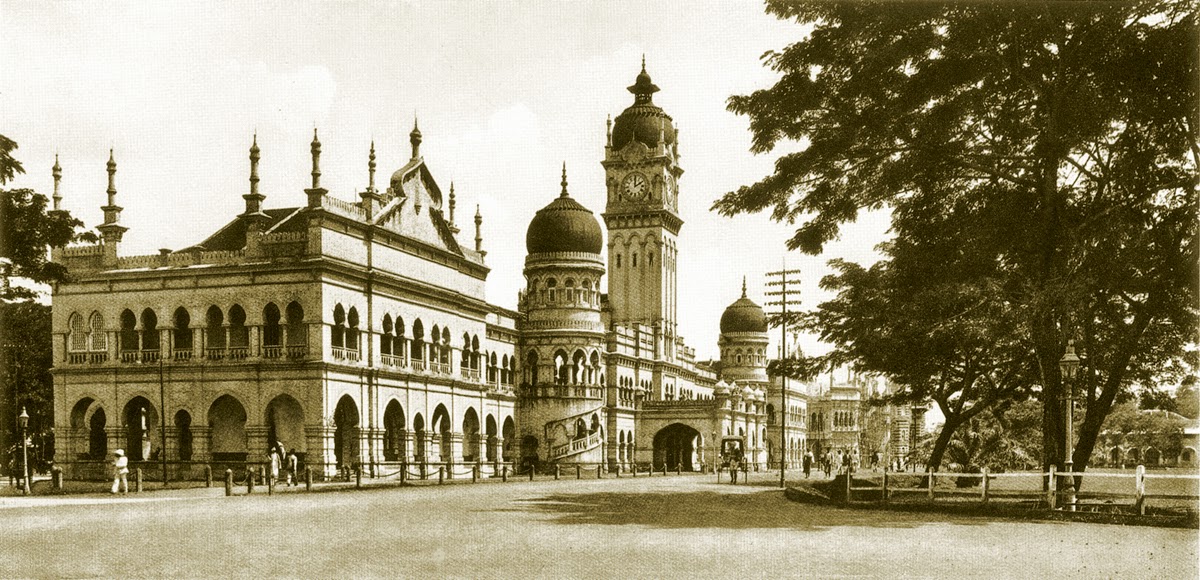 "Bangunan Sultan Abdul Samad in 1906"
 "Selangor Museum, shortly after its construction in 1906, this road to Lake Garden.."
 "Bangunan Sultan Abdul Samad under Construction and Loke Chow Kit's Dept Store, pre-1897"
 "Masjid Jamek in 1906"
 "Bangunan Sultan Abdul Samad and the Post Office after 1907"
 "A game at the Padang during the Second Durbar held at Kuala Lumpur in 1903"
[Note* The Govt. Printing Office was already there, built in 1899 according to JM Gullick.]
 |
Mariana,
As for the Attachment, I changed the Building Use to Purpose Group (By-Law 134,138) as per 5th Schedule of the UBBL,
for Passive Fire Protection requirements.
As for the Attachment, I changed the Building Use to Purpose Group (By-Law 134,138) as per 5th Schedule of the UBBL,
for Passive Fire Protection requirements.
Maybe we need to rope in someone from Bomba to participate in our Talk during the Exhibition.
Or maybe too technical for some?
Even for the Old Selangor Museum, East Wing Entrance that was damaged had the Roof Framing done in Cast-Iron
Framings with gusset plates and all, interesting, those stuffs were cut to order and then imported into the country....
Or maybe too technical for some?
Even for the Old Selangor Museum, East Wing Entrance that was damaged had the Roof Framing done in Cast-Iron
Framings with gusset plates and all, interesting, those stuffs were cut to order and then imported into the country....
Yeah,...we'll soldier on.
Have you line up the "Wataniah Singers" yet?
Hope to have a meeting with the Timber people...not so much choices left,
unless Rubber wood would...
those slender ones from Lenggong Valley...
unless Rubber wood would...
those slender ones from Lenggong Valley...
Go diet you people...selamat berpuasa.
Cheers,
rosli
Psst*I'm having problems with my e-mailings of late.
All these while I had refused to upgrade my Yahoo since last December 2012,
suddenly last few days they enforced it on me these changes.
Now, I'm having heaps of problem with the teething,
menyampah betul, buat sakit hati aje...these so-called high tech,
even my handphone I refused to answer anymore,
preferring someone would rather come pick me up for coffee,
All these while I had refused to upgrade my Yahoo since last December 2012,
suddenly last few days they enforced it on me these changes.
Now, I'm having heaps of problem with the teething,
menyampah betul, buat sakit hati aje...these so-called high tech,
even my handphone I refused to answer anymore,
preferring someone would rather come pick me up for coffee,
otherwise meet at half-way house via lrt route...hehe
Do you know that it is better to drive a car with less gadgets, less distractions?
Mmm...kombi do me fine except traffic jams, old volvo is simple too, sucks petrol...
my blabbering...no class...hehe...cheers!
From: Mariana Isa <maria...@gmail.com>
To: Steven Thang <stha...@yahoo.com>
Cc: "Nooridayu. Yusuf@taylors. edu. my" <Noorida...@taylors.edu.my>; "Norhayati. Hussain@taylors. edu. my" <Norhayat...@taylors.edu.my>; "suhaila77@gmail com" <suha...@gmail.com>; "ajakaziz@gmail com" <ajak...@gmail.com>; "najib@nadge org" <na...@nadge.org>; "llim_architect@yahoo com" <llim_ar...@yahoo.com>; "najmi mail@gmail. com" <najmi...@gmail.com>; "NurulAnida. Mohamad@taylors. edu. my" <NurulAnid...@taylors.edu.my>; "shenfei@nrasb com. my" <she...@nrasb.com.my>; "adidasad...@yahoo.com" <adidasad...@yahoo.com>; "Sofia. Sharifuddin@taylors. edu. my" <Sofia.Sh...@taylors.edu.my>; "nadge my@gmail. com" <nadg...@gmail.com>; PAM_Ridzwan <rid...@pam.org.my>; "rosliali52@yahoo com" <rosli...@yahoo.com>
Sent: Friday, 12 July 2013, 8:42
Subject: Re: Hubback Checklist
To: Steven Thang <stha...@yahoo.com>
Cc: "Nooridayu. Yusuf@taylors. edu. my" <Noorida...@taylors.edu.my>; "Norhayati. Hussain@taylors. edu. my" <Norhayat...@taylors.edu.my>; "suhaila77@gmail com" <suha...@gmail.com>; "ajakaziz@gmail com" <ajak...@gmail.com>; "najib@nadge org" <na...@nadge.org>; "llim_architect@yahoo com" <llim_ar...@yahoo.com>; "najmi mail@gmail. com" <najmi...@gmail.com>; "NurulAnida. Mohamad@taylors. edu. my" <NurulAnid...@taylors.edu.my>; "shenfei@nrasb com. my" <she...@nrasb.com.my>; "adidasad...@yahoo.com" <adidasad...@yahoo.com>; "Sofia. Sharifuddin@taylors. edu. my" <Sofia.Sh...@taylors.edu.my>; "nadge my@gmail. com" <nadg...@gmail.com>; PAM_Ridzwan <rid...@pam.org.my>; "rosliali52@yahoo com" <rosli...@yahoo.com>
Sent: Friday, 12 July 2013, 8:42
Subject: Re: Hubback Checklist
Discussion with FRIM/MTIB can be arranged. All we need is a formal letter from PAM to them.
Rosli,
FMS Admin Office is now Textile Museum and FMS Railway Offices is the KTMB HQ right?
On 12 July 2013 07:19, Steven Thang <stha...@yahoo.com> wrote:
To: Mariana Isa <maria...@gmail.com>; Nooridayu Ahmad Yusuf <Noorida...@taylors.edu.my>; "Norhayat...@taylors.edu.my" <Norhayat...@taylors.edu.my>; Suhaila Abd Rashid <suha...@gmail.com>; Abdul Razak Abd. Aziz <ajak...@gmail.com>; Najib Ariffin NADGE <na...@nadge.org>; Steven Thang <stha...@yahoo.com>; Mr Laurent Lim Aun Giap <llim_ar...@yahoo.com>; ahmad najmi che pee <najmi...@gmail.com>; Nurul Anida Mohamad <NurulAnid...@taylors.edu.my>; Lam Shen Fei <she...@nrasb.com.my>; idayu noor <adidasad...@yahoo.com>; Sofia Nor Shariza Binti Sharifuddin <Sofia.Sh...@taylors.edu.my>; "nadge my@gmail. com" <nadg...@gmail.com>; PAM_Ridzwan <rid...@pam.org.my>
Sent: Thursday, 11 July 2013, 21:08
Subject: Re: Hubback Checklist
Reply all
Reply to author
Forward
0 new messages