
weewx-skyfield 2.1 and weewx-celestial 8.1 — comets, meteor showers, supermoons

John Kline
Hi all,
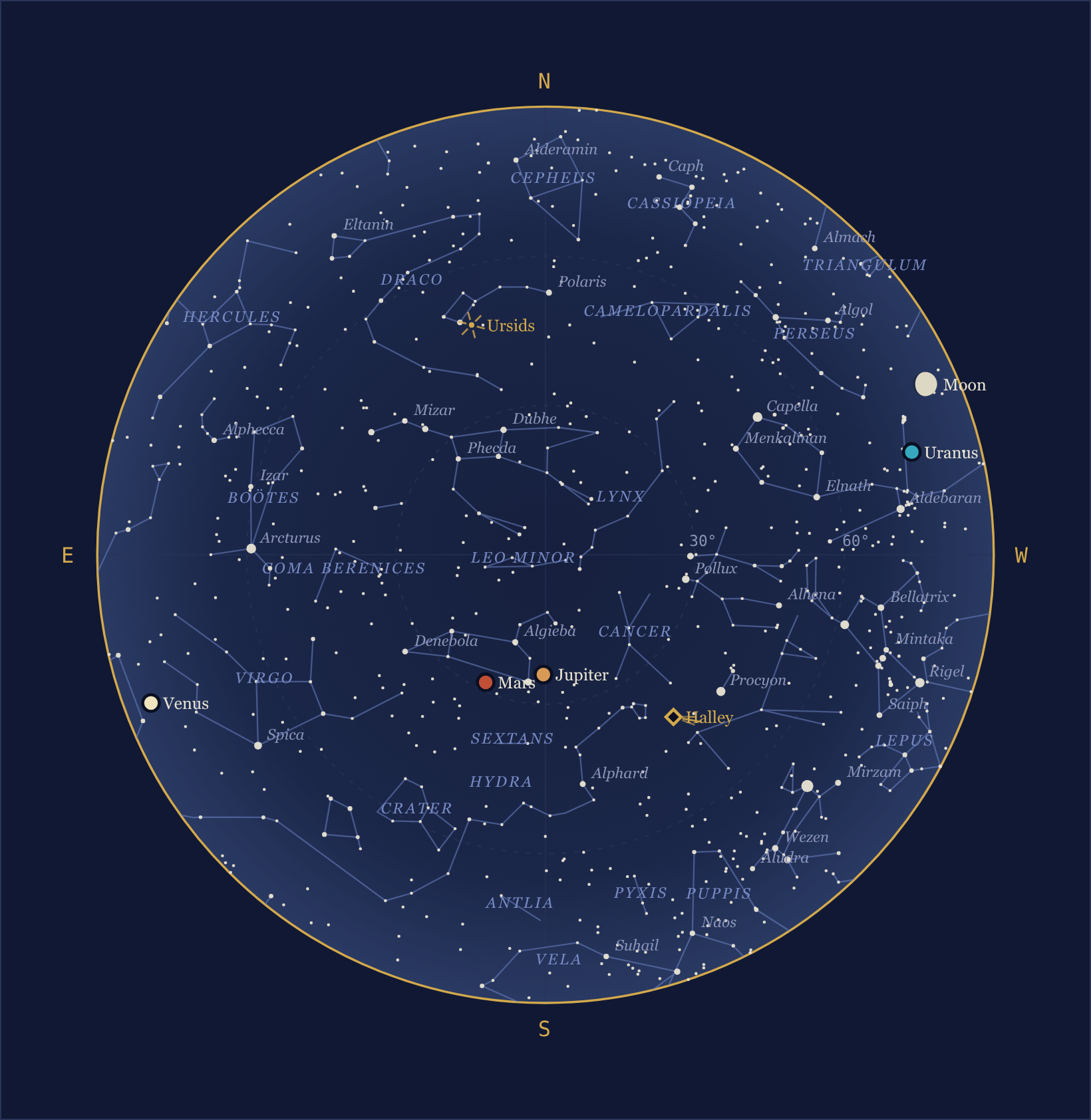
weewx-skyfield 2.1 is out. The almanac now serves comets: any comet the Minor Planet Center tracks, added to weewx.conf by designation, with Halley and Hale-Bopp configured out of the box. Each gets the full planet-style tag surface — $almanac.halley.rise, .mag, .perihelion and the rest — and rides the Sky page: a tailed diamond on the dome, a marker in the orrery, a countdown chip when a perihelion is less than a year out. Elements come from the MPC's own file and refresh automatically, with one switch to turn off the fetching.
The almanac also learns the dozen major annual meteor showers — $almanac.next_meteor_shower counts down to a peak computed from the sun's ecliptic longitude, and the radiant is marked on the dome while a shower is active. This year's Perseids peak on a new moon — a dark-sky year, and the page says so.
Here is the dome on a winter-solstice morning: Halley's tailed diamond high in the southwest — hollow, honestly beyond the naked eye until the 2060s — the Ursids' radiant marked beside the Little Dipper, and the moon setting in the west two days shy of December's supermoon:
Rounding out 2.1: moon perigee/apogee and $almanac.next_supermoon, Earth's perihelion and aphelion, solar time and the equation of time with its own chart panel, and unit-aware distances ($almanac.moon.distance.km converts on ask).
weewx-celestial 8.1 ships alongside, and the new almanac facts go live there. Comets join the Geocentric dial exactly like planets — diamond, anti-sunward tail, hollow when too faint for the naked eye — added with a one-command --add-comet utility. And the top of the page becomes a row of ticking countdown chips: the soonest visible satellite pass, sunset or sunrise, the next meteor shower's peak with the moon's interference judgment, astronomical darkness, and — within thirty days of their events — the next equinox or solstice, Earth's perihelion or aphelion, the next supermoon, the next eclipse visible from your station, and each comet's perihelion. Days-hours-minutes far out, a ticking hh:mm:ss clock inside the final day.
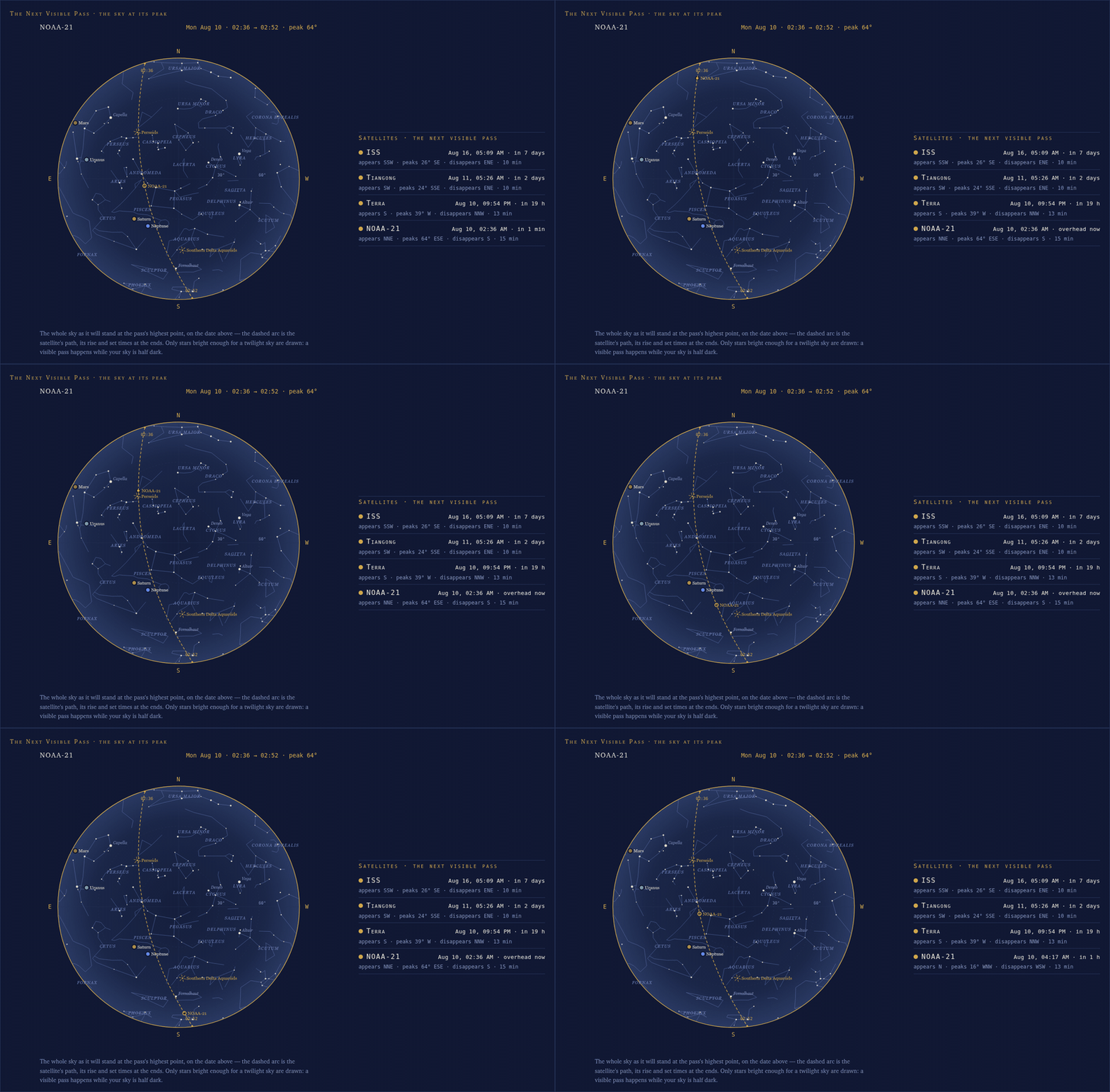
The Next Visible Pass chart's sweeping dot now tells the live truth: when a satellite crosses into Earth's shadow mid-pass, the dot flips from solid to the hollow in-shadow ring the same second the dome's marker does. NOAA-21 proved the fix the morning of the capture — rising sunlit into the pre-dawn sky, then dropping into shadow at 48°:
All nine bundled languages learn the new strings, and the migrator commands now paste-and-run on Debian/Red Hat package installs (thanks to Gert Andersen for the report).
Both are drop-in upgrades — install over the previous version; celestial's installer now wires up the new loop-data fields for you. Release notes:
https://github.com/chaunceygardiner/weewx-skyfield/releases/tag/v2.1
https://github.com/chaunceygardiner/weewx-celestial/releases/tag/v8.1