
How do I characterize a splitter?
845 views
Skip to first unread message

Michael Wollensack METAS
Aug 7, 2014, 4:41:41 AM8/7/14
to vnat...@googlegroups.com
How do I characterize a splitter using VNA Tools II?
Michael Wollensack METAS
Aug 7, 2014, 5:01:13 AM8/7/14
to vnat...@googlegroups.com
Hi,
I know three ways to characterize a splitter:
- Measure the splitter using a 4-Port VNA. You can do a 3-Port Unknown Thru calibration and you obtain directly all 9 (3 x 3) S-parameters of the splitter. From the S-parameters of the splitter you can compute the equivalent source matches of port 2 and 3.
- Measure the splitter using a 2-Port VNA. First perform a 2-Port Unknown Thru calibration using the splitter as unknown thru. Then perform a second tier calibration (measuring all 4 S-parameters) on the third port of the splitter. Decascade the first calibration errror terms from the second calibration error terms and you obtain all 9 (3 x 3) S-parameters of the splitter. From the S-parameters of the splitter you can compute the equivalent source matches of port 2 and 3.
- Use the Juroshek method to measure the equivalent source match of a splitter. Connect port 1 and 2 of the splitter to the VNA and perform an One Port calibration on the third port of the splitter. You will obtain the equivalent source match of port 3. Connect port 1 and 3 of the splitter to the VNA and perform an One Port calibration on the second port of the splitter. You will obtain the equivalent source match of port 2.
I will write for each method a post and describe it more in details.
Regards
Michael
Michael Wollensack METAS
Aug 7, 2014, 5:16:04 AM8/7/14
to
1. Measure the splitter using a 4-Port VNA:
- Measure open, short, load at port 1.
- Measure open, short, load at port 2.
- Measure open, short, load at port 3.
- Connect your splitter and measure all 9 S-parameters (ports: 1, 2, 3).
- Compute 3-Port Unknown Thru calibration.
- Perform error correction. --> You obtain all 9 S-parameters of your splitter.
- Compute the equivalent source matches of port 2 and port 3 using the following python script:
import clrclr.AddReference('System.Windows.Forms')clr.AddReference('Metas.Vna.Tools')from System.Threading import Threadfrom System.Windows.Forms import MessageBoxfrom Metas.Vna.Tools import Scriptfrom Metas.Vna.Misc import ThreePortToolsfrom Metas.UncLib.Core import Complexfrom Metas.UncLib.LinProp import UncNumbers = Script(RootPath)d = s.LoadSParamData('Splitter.sdatb')e = SParamTools.EquivalentSourceMatch[UncNumber](d)s.SaveSParamData('Splitter_EQSM.sdatb', e)
The first file contains the S-parameters of the splitter. The second file `*_EQSM.sdatb' contains the equivalent coefficients and the transmission tracking of the splitter, where
- S22 is the equivalent reflection coefficient of splitter output 2.
- S33 is the equivalent reflection coefficient of splitter output 3.
- S21 is the transmission tracking (S21 / S31).
Michael Wollensack METAS
Aug 7, 2014, 5:28:57 AM8/7/14
to vnat...@googlegroups.com
2. Measure the splitter using a 2-Port VNA:
- Measure open, short, load at port 1.
- Measure open, short, load at port 2.
- Connect your splitter (splitter port 1 to VNA port 1 and splitter port 2 to VNA port 2). Measure all 4 S-parameters (ports: 1, 2).
- Compute 2-Port Unknown Thru calibration (using your splitter as unknown thru).
- Perform error correction.
- Measure (all 4 S-parameters) open, short, load at port 3 of the splitter.
- Connect your splitter (splitter port 1 to VNA port 1 and splitter port 3 to VNA port 2). Measure all 4 S-parameters (ports: 1, 2).
- Measure (all 4 S-parameters) open, short, load at port 2 of the splitter.
- Compute the S-parameters and the equivalent source matches with the following script:
# Michael Wollensack METAS - 22.08.2013
import clrclr.AddReference('System.Windows.Forms')clr.AddReference('Metas.Vna.Tools')
clr.AddReference('Metas.Vna.Data')clr.AddReference('Metas.Vna.Database')clr.AddReference('Metas.Vna.Optimization')clr.AddReference('Metas.UncLib.Core')clr.AddReference('Metas.UncLib.LinProp')clr.AddReference('Metas.Vna.Misc')from System import Arrayfrom System import Doublefrom System.IO import Filefrom System.IO import FileInfo
from System.Threading import Threadfrom System.Windows.Forms import MessageBoxfrom Metas.Vna.Tools import Script
from Metas.Vna.Data import SParamDatafrom Metas.Vna.Data import SParamToolsfrom Metas.Vna.Database.CalibrationStandards.FileIO import CalibrationStandardXmlfrom Metas.Vna.Optimization import OptSParamTools
from Metas.Vna.Misc import ThreePortToolsfrom Metas.UncLib.Core import Complexfrom Metas.UncLib.LinProp import UncNumber
def LoadCalStdData(name, freqlist):fi = FileInfo(s.RootPathDatabase + '\\CalibrationStandards\\' + name + '.calstd')fs = File.OpenRead(fi.FullName)c = CalibrationStandardXml.LoadCalStd[UncNumber](fs, fi.Directory.FullName)c.Init(freqlist)d = c.Compute()return ds = Script(RootPath)m1 = s.LoadSParamData('UThru_01_out\CalStandards\Sxx_Splitter_P3_Open(m)_1041_01\Sxx_Splitter_P3_Open(m)_1041_01_02.sdatb');m2 = s.LoadSParamData('UThru_01_out\CalStandards\Sxx_Splitter_P3_Short(m)_729_01\Sxx_Splitter_P3_Short(m)_729_01_01.sdatb');m3 = s.LoadSParamData('UThru_01_out\CalStandards\Sxx_Splitter_P3_Load(m)_507_01\Sxx_Splitter_P3_Load(m)_507_01_04.sdatb');f = m1.Frequencys1 = LoadCalStdData('N50\\85054B\\85054B_Open(m)', f)s2 = LoadCalStdData('N50\\85054B\\85054B_Short(m)', f)s3 = LoadCalStdData('N50\\Loads\\MM006929_Load(m)_507\\MM006929_Load(m)_507_20121031', f)d3 = ThreePortTools.ComputeThreePort[UncNumber](m1, m2, m3, s1, s2, s3);s.SaveSParamData('Splitter_P3.sdatb', d3)d = SParamTools.EquivalentSourceMatch[UncNumber](d3);s.SaveSParamData('Splitter_P3_EQSM.sdatb', d)m1 = s.LoadSParamData('UThru_01_out\CalStandards\Sxx_Splitter_P2_Open(m)_1041_01\Sxx_Splitter_P2_Open(m)_1041_01_01.sdatb');m2 = s.LoadSParamData('UThru_01_out\CalStandards\Sxx_Splitter_P2_Short(m)_729_01\Sxx_Splitter_P2_Short(m)_729_01_03.sdatb');m3 = s.LoadSParamData('UThru_01_out\CalStandards\Sxx_Splitter_P2_Load(m)_507_01\Sxx_Splitter_P2_Load(m)_507_01_02.sdatb');s1 = LoadCalStdData('N50\\85054B\\85054B_Open(m)', f)s2 = LoadCalStdData('N50\\85054B\\85054B_Short(m)', f)s3 = LoadCalStdData('N50\\Loads\\MM006929_Load(m)_507\\MM006929_Load(m)_507_20121031', f)d2 = ThreePortTools.ComputeThreePort[UncNumber](m1, m2, m3, s1, s2, s3);d2.Ports[1] = 3;d2.Ports[2] = 2;d2 = SParamTools.SubsetIndices[UncNumber](d2, Array[int]((0, 2, 1)));s.SaveSParamData('Splitter_P2.sdatb', d2)d = SParamTools.EquivalentSourceMatch[UncNumber](d2);s.SaveSParamData('Splitter_P2_EQSM.sdatb', d)nfreq = d.NFreq;for i in range(nfreq):d2.Data[i][0][0] = (d2.Data[i][0][0] + d3.Data[i][0][0]) / Complex[UncNumber](2.0)d2.Data[i][1][0] = d2.Data[i][1][0]d2.Data[i][2][0] = d3.Data[i][2][0]d2.Data[i][0][1] = d2.Data[i][0][1]d2.Data[i][1][1] = d3.Data[i][1][1]d2.Data[i][2][1] = (d2.Data[i][2][1] + d3.Data[i][2][1]) / Complex[UncNumber](2.0)d2.Data[i][0][2] = d3.Data[i][0][2]d2.Data[i][1][2] = (d2.Data[i][1][2] + d3.Data[i][1][2]) / Complex[UncNumber](2.0)d2.Data[i][2][2] = d2.Data[i][2][2]s.SaveSParamData('Splitter.sdatb', d2)d = SParamTools.EquivalentSourceMatch[UncNumber](d2);s.SaveSParamData('Splitter_EQSM.sdatb', d)
Michael Wollensack METAS
Aug 7, 2014, 5:31:13 AM8/7/14
to vnat...@googlegroups.com
3. Use the Juroshek method to measure the equivalent source match of a splitter:
It's not implemented in VNA Tools II V1.3.2. I will post an update when I've implement the method.

Tuomas Haitto
Aug 8, 2014, 4:05:31 AM8/8/14
to vnat...@googlegroups.com
It's just my opinion, but i prefer to do first full 2-port unknown thru calibration using female-female adapter (not DUT splitter) from the calkit. After measurement calibration i want be sure and
verify that calibration is surely well done before splitter measurement process. When female-female adapter is still on place, i prefer to do verification measurement checking all S-parameters and S12/S21 (nice smooth/linear attenuation curves). This method keep VNA unknown thru measurement calibration and DUT measurements separates...less error posibilites and whole consept is more clearly in mind.

przeme...@gmail.com
Dec 15, 2014, 6:16:09 AM12/15/14
to vnat...@googlegroups.com
Thank Yoy for describing 2-Port VNA method.

Kevin Sterling
Mar 26, 2015, 7:09:23 AM3/26/15
to vnat...@googlegroups.com
Hello Michael
In calibration type Juroshek and a two port VNA, what are these measurements:
Reflection 1 E
|
Thanks
Michael Wollensack METAS
Mar 27, 2015, 8:55:05 AM3/27/15
to vnat...@googlegroups.com
Hi Kevin,
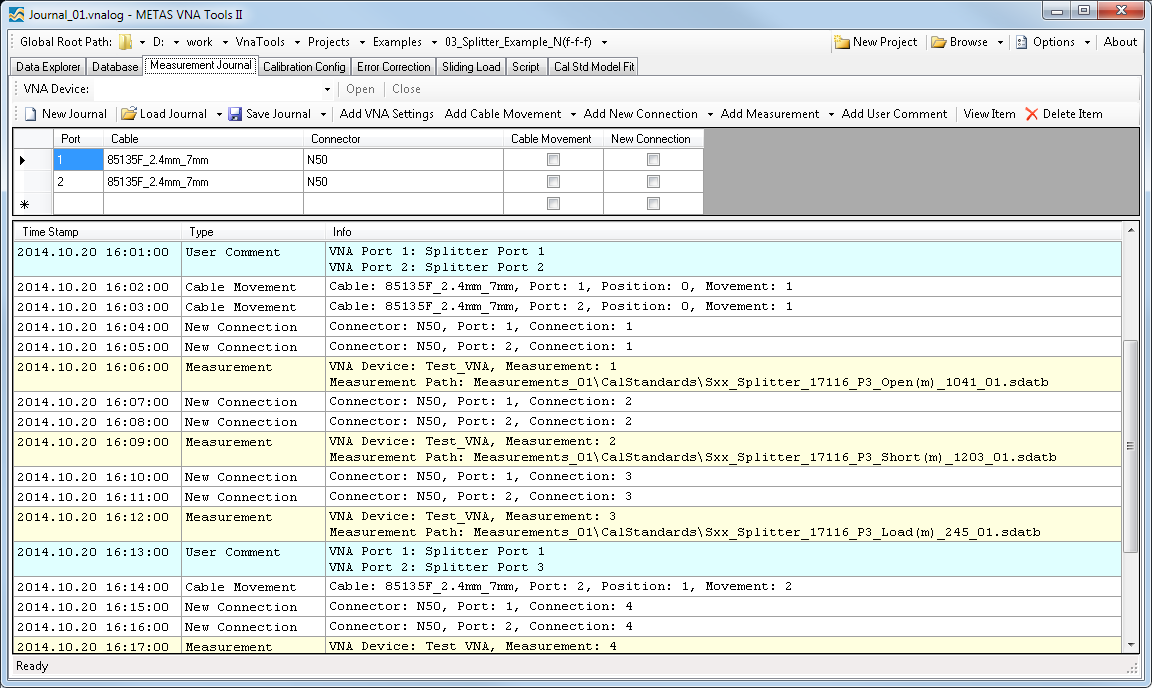
Step by step to measure the equivalent source match of port 3:
- Connect port 1 of the splitter to port 1 of the VNA.
- Connect port 2 of the splitter to port 2 of the VNA.
- Connect a open, short and load to port 3 of the splitter and collect for each all for S-parameters (S11, S21, S12 and S22).
- Assign those measurements with their definition in the calibration config tab. (Create a new Juroshek calibration).
- The equivalent source match of the splitter is in the error terms of the calibration.
See as well the attached screen shots.


Regards
Michael

George Krikelas
Dec 10, 2018, 8:09:41 AM12/10/18
to VNA Tools
Hi Michael. Regarding the script for measuring the splitter using a 2-port VNA, is it possible to use it when you have a lowband+sliding load combination (.slcfg file)? Obviously not in that format, but is it possible with some manipulation?
Michael Wollensack METAS
Dec 19, 2018, 5:11:20 AM12/19/18
to VNA Tools
Hi George,
> Regarding the script for measuring the splitter using a 2-port VNA, is it possible to use it when you have a lowband+sliding load combination (.slcfg file)?
No but you can use a characterized load.
Today if you've a 2-port VNA I would recommend the Palmer method, see the following example
04_Splitter_Palmer_Example_2.4mm(f-f-f)
and the attached presentation.
Regards
Michael

Mr Skinner
Jan 9, 2026, 4:51:53 AMJan 9
to VNA Tools
Dear Michael,
I think it is important to provide the criteria for the 3-port DUT under which these methods are applicable.
It is my understanding that a number of these methods are only applicable if the device is symmetric, i.e., if the two output ports are equal.
Therefore they would not be valid for characterisation of a range of 3-port devices which have unequal splitting, namely directional couplers. To my knowledge, this point is not specified in the publications from METAS on this topic e.g. J. Hoffmann, M. Wollensack, J. Ruefenacht and M. Zeier, "Comparison of methods for measurement of equivalent source match," 2015 European Microwave Conference (EuMC), Paris, France, 2015, pp. 730-733.
Please can you clarify?
Best regards
Best regards
James
Michael Wollensack METAS
Jan 9, 2026, 4:55:29 AMJan 9
to VNA Tools
Hi,
some of the methods assume that S31 = S13 and S21 = S12 but none of the methods assume S31 = S13 = S21 = S12.
Regards
Michael
Mr Skinner
Jan 9, 2026, 12:13:03 PMJan 9
to VNA Tools
Hi Michael,
Understood, perhaps the output signals do not have to be strictly equal, however as an example, for the case of a 10 dB directional coupler with good isolation, S23 is very small and so the 2-port method results for G (eq 5 in the paper) tend to reduce to S33, which is not the equivalent source match.
Best regards
James

kim jeonghwan
Jan 10, 2026, 1:31:18 AMJan 10
to VNA Tools
Hi James,
Even when G_eq tends to reduce to S33 (S23 goes to zero), it is the equivalent source match.
Regards,
Jeong Hwan Kim
p.s. As for using a sliding load to measure the G_ge, it would be possible to use it e.g. above 2 GHz for Type-N case, if a circle fitting scheme can be applied for the measured data.
Actually I tried it and got it done long before even though I did not use the VNA tools and its scripts.
2026년 1월 10일 토요일 AM 2시 13분 3초 UTC+9에 james....@live.com님이 작성:
Tuomas Haitto
Jan 11, 2026, 1:35:12 PMJan 11
to VNA Tools
Hi,
I want to say my comment to this power splitter characterization in general. We must remember, that power splitters ports are very rarely
perfectly symmetrical and more common issue especially some HP/Agilent/Keysight 11667A has poor connector repeatability. Even the splitter ports
would chracterize very acccurately but when splitters using in the real life T&M enviroment when one port might connect various not well matched power sensors, cables etc
those weakens power sensors balance. Better to think uncertainty of this in larger scale what devices connecting to the power spitter.
-Tuomas
Mr Skinner
Jan 12, 2026, 3:11:33 PMJan 12
to VNA Tools
Hi Jeong,
I don't believe this is correct. Where S23 is small, the change in response with a short connected vs a load is negligible, so eq 5 collapses to S33. On the other hand, eq 1 will give the true equivalent source match for the same DUT.
Best regards
James
Reply all
Reply to author
Forward
0 new messages