
தன்னாட்சி கொடுப்பது காலத்தின் கட்டாயம் 2/3 – க.வி.விக்கினேசுவரன் +++ Sirisena regime will not deliver acceptable solution
3 views
Skip to first unread message

இலக்குவனார் திருவள்ளுவன்
Oct 10, 2016, 6:44:27 PM10/10/16
to thiru thoazhamai
Sirisena regime will not deliver acceptable solution
Sirisena regime will not deliver acceptable solution without international intervention: ITAK MP
[TamilNet, Saturday, 08 October 2016, 21:53 GMT]
ITAK Parliamentarian from Batticaloa S Yogeswaran has categorically stated that the regime of Sirisena and Wickramasinghe, which was brought to power with the votes of Tamils, is not going to deliver a reasonable political solution satisfying the expectation of Tamils on its own without international intervention. “I don't speak for others. My conviction is that the Government will not deliver an acceptable solution for Tamils on its own,” he said. “There are a lot of steps to be taken,” and none of these have been achieved so far, he added. Austin Fernando, installed as the governor of the East after Sirisena became the SL president, has been preoccupied with tracing every avenue to Sinhalicise the Batticaloa district. It has now been revealed that the SL President Sirisena's Mahaweli ministry is also behind the Sinhala colonisation, he said.
The leaders in South produce only words, not deeds. Their words too are now going against the expectation of Tamils as all shades of the Sinhala polity stand openly opposed to even mention “federalism,” in the SL Constitution to come, Mr Seeniththamby Yogeswaran, who was elected twice on TNA ticket representing the ITAK in Batticaloa district said in the video interview to TamilNet.
Tamils are regarded only as a minority by the Colombo regime. Tamils constitute a distinct nation in the island and this should be accepted by the Sinhala leaders if they are genuine about a political settlement, Mr Yogeswaran said.
On the burning issues of persons subjected to forcible disappearances and continued imprisonment of Tamil political prisoners, the current regime has adopted the same line of the Rajapaksa government, Mr Yogeswaran said.
The grandfather of the current Tamil minister in the Sirisena regime, D.M. Swaminthan, who is in charge of Prison Reforms and Resettlement was none other than the grandson of Sir Pon Ramanathan, who was celebrated by the Sinhalese in 1915 when he took the burden of traveling to UK amidst the Second World War to secure the release of Sinhalese leaders. The Sinhalese leader were imprisoned by the British rulers in the island for their involvement in anti-Muslim violence at that time. When Sir Pon Ramanathan released them, they celebrated him. But, the irony in the history of political prisoners in the island is that the grandparent of Ramanathan is not able to release the Tamil political prisoners who are languishing in the SL prisons for several years, the TNA parliamentarian told TamilNet.
The JVPers who were imprisoned by the Colombo regime in the past were released after a general amnesty. But the current regime is not able to take a principled decision on giving general amnesty and release the Tamil political prisoners, who have been languishing for several years in the prison, he said.
Apart from delivering some promises in the resettlement of uprooted Champoor Tamils in Trincomalee, in Jaffna and in bringing relatively better environment than as it was under the Rajapaksa regime, there is nothing else to be mentioned as achievements on the ground so far, according to Yogeswaran.
Under the Rajapaksa regime, it was the Forest Department and Wild-Life Department, which were engaged in seizing the lands from border areas in Batticaloa district situated towards Polonnaruwa and Ampaa'rai districts. The SL military, SL Navy and Buddhist monks were deployed in colonising the Tamil lands.
Rajapaksa was attempting to divert UN’s funding mechanism, which was intended to safeguard the aboriginal communities to colonize Vaakarai region with Sinhala settlers. His plan was to twist the identity of 47 birth certificates of Ceylon Tamils into Veddahs at Challith-theevu in Vaakarai with the backing of Pillayan, who was installed as the Chief Minister of the Eastern Province.
Since there was no distinction between Tamil or Sinhala in the Veddah identity used in the false birth certificates, Rajapaksa regime was aiming to bring in Sinhala settlers from Mahiyangana in the South using the Veddah identity to change the demographic pattern of Tamil Vaakarai. The plan was spoiled following sharp opposition coming from the Tamils, Mr Yogeswaran said.
However, as the plan didn’t work, Colombo aimed to convert 1,000 acres belonging to cashew plantations at Kadjuwatte in Panichchang-kea’ni into a Sinhala settlement through the SL Navy. “Let us say, if they had managed to alienate 20 perches of lands to each Sinhala family, they would have created a settlement of 8,000 families numbering around 24,000 Sinhalese achieving their agenda of electing at least one parliamentary seat from Batticaloa district for Sinhalese,” he said. Mr Yogeswaran was describing how the demographic genocide was committed in Trincomalee and Ampaa'rai against Tamils.
Although the opposition coming from Tamils managed to stop the colonisation schemes at Vaakarai and Panichchang-kea'ni, the SL Navy is still occupying the coastal area situated just south of Vaakarai, he added.
Under the Rajapaksa regime, there were several plans to seize the lands of Tamils by occupying their pasturelands, border villages and the military Governor of Eastern Province was also trying to allocate lands to businessmen from South at several places.
The SL Forest Department and Wild-Life Department were operating against the Tamils backing the settlers and home guards.
“But all of a sudden, we are now being told that the pasturelands and Sinhala settlements are coming under the Mahaweli Ministry, which is under the SL president Maithiripala Sirisena,” Yogeswaran said adding that Buddhist monks are continuing to settle Sinhalese with the backing of Colombo’s military.
Immediately after coming to power, the current Governor was only thinking to trace the possibilities and manipulate these to colonize the Batticaloa district with Sinhalese, Yogeswaran said.
Austin Fernando suddenly invited the Government Agent and Divisional Secretary of Vaakarai division with the claim that there were 178 Sinhala families living in Kaarai-munai until 1985.
The GA, without knowing the historical background, promised to look into the matter. “If there were 178 Sinahalese families as the Governor claims, there would have been a Sinhala village by a name; there would have been birth certificates issued to their children; the families would have received PLR if they had engaged in agriculture; there would have been an electoral registry with their entries. Without tracing all these, you can’t proceed with settling them I told the GA. I was very well aware that there was no such Sinhala settlement,” he said.
“For some time there was no response. But, all of a sudden some Sinhalese to come with documents of permit lands in their names. These documents were in Sinhala language. I told GA that there was no such practice of issuing permit lands in Sinahala language in the history of Batticaloa district. All these documents were fake,” he said.
Recently, the GA and EPC Minister for Agriculture went together to inspect the Sinhala colonisation of Mayilaththa-madu. But, they issued statements contradicting each other. While the EPC Minister was saying that there was excessive colonisation, the GA was claiming there was no such big-scale colonisation. The GA was further delaying clarifications on the border-line of Batticaloa district causing ambiguity on the issue, he said.
The TNA MP from Batticaloa was also claiming that there was widespread corruption prevailing at the District Secretariat under the GA and that some among the ITAK hierarchy were still defending her. The ITAK cannot fail the people, he said adding that he is set to take up the issues with the hierarchy of the ITAK.
ITAK Parliamentarian from Batticaloa S Yogeswaran has categorically stated that the regime of Sirisena and Wickramasinghe, which was brought to power with the votes of Tamils, is not going to deliver a reasonable political solution satisfying the expectation of Tamils on its own without international intervention. “I don't speak for others. My conviction is that the Government will not deliver an acceptable solution for Tamils on its own,” he said. “There are a lot of steps to be taken,” and none of these have been achieved so far, he added. Austin Fernando, installed as the governor of the East after Sirisena became the SL president, has been preoccupied with tracing every avenue to Sinhalicise the Batticaloa district. It has now been revealed that the SL President Sirisena's Mahaweli ministry is also behind the Sinhala colonisation, he said.
The leaders in South produce only words, not deeds. Their words too are now going against the expectation of Tamils as all shades of the Sinhala polity stand openly opposed to even mention “federalism,” in the SL Constitution to come, Mr Seeniththamby Yogeswaran, who was elected twice on TNA ticket representing the ITAK in Batticaloa district said in the video interview to TamilNet.
Tamils are regarded only as a minority by the Colombo regime. Tamils constitute a distinct nation in the island and this should be accepted by the Sinhala leaders if they are genuine about a political settlement, Mr Yogeswaran said.
On the burning issues of persons subjected to forcible disappearances and continued imprisonment of Tamil political prisoners, the current regime has adopted the same line of the Rajapaksa government, Mr Yogeswaran said.
The grandfather of the current Tamil minister in the Sirisena regime, D.M. Swaminthan, who is in charge of Prison Reforms and Resettlement was none other than the grandson of Sir Pon Ramanathan, who was celebrated by the Sinhalese in 1915 when he took the burden of traveling to UK amidst the Second World War to secure the release of Sinhalese leaders. The Sinhalese leader were imprisoned by the British rulers in the island for their involvement in anti-Muslim violence at that time. When Sir Pon Ramanathan released them, they celebrated him. But, the irony in the history of political prisoners in the island is that the grandparent of Ramanathan is not able to release the Tamil political prisoners who are languishing in the SL prisons for several years, the TNA parliamentarian told TamilNet.
The JVPers who were imprisoned by the Colombo regime in the past were released after a general amnesty. But the current regime is not able to take a principled decision on giving general amnesty and release the Tamil political prisoners, who have been languishing for several years in the prison, he said.
Apart from delivering some promises in the resettlement of uprooted Champoor Tamils in Trincomalee, in Jaffna and in bringing relatively better environment than as it was under the Rajapaksa regime, there is nothing else to be mentioned as achievements on the ground so far, according to Yogeswaran.
Under the Rajapaksa regime, it was the Forest Department and Wild-Life Department, which were engaged in seizing the lands from border areas in Batticaloa district situated towards Polonnaruwa and Ampaa'rai districts. The SL military, SL Navy and Buddhist monks were deployed in colonising the Tamil lands.
Rajapaksa was attempting to divert UN’s funding mechanism, which was intended to safeguard the aboriginal communities to colonize Vaakarai region with Sinhala settlers. His plan was to twist the identity of 47 birth certificates of Ceylon Tamils into Veddahs at Challith-theevu in Vaakarai with the backing of Pillayan, who was installed as the Chief Minister of the Eastern Province.
Since there was no distinction between Tamil or Sinhala in the Veddah identity used in the false birth certificates, Rajapaksa regime was aiming to bring in Sinhala settlers from Mahiyangana in the South using the Veddah identity to change the demographic pattern of Tamil Vaakarai. The plan was spoiled following sharp opposition coming from the Tamils, Mr Yogeswaran said.
However, as the plan didn’t work, Colombo aimed to convert 1,000 acres belonging to cashew plantations at Kadjuwatte in Panichchang-kea’ni into a Sinhala settlement through the SL Navy. “Let us say, if they had managed to alienate 20 perches of lands to each Sinhala family, they would have created a settlement of 8,000 families numbering around 24,000 Sinhalese achieving their agenda of electing at least one parliamentary seat from Batticaloa district for Sinhalese,” he said. Mr Yogeswaran was describing how the demographic genocide was committed in Trincomalee and Ampaa'rai against Tamils.
Although the opposition coming from Tamils managed to stop the colonisation schemes at Vaakarai and Panichchang-kea'ni, the SL Navy is still occupying the coastal area situated just south of Vaakarai, he added.
Under the Rajapaksa regime, there were several plans to seize the lands of Tamils by occupying their pasturelands, border villages and the military Governor of Eastern Province was also trying to allocate lands to businessmen from South at several places.
The SL Forest Department and Wild-Life Department were operating against the Tamils backing the settlers and home guards.
“But all of a sudden, we are now being told that the pasturelands and Sinhala settlements are coming under the Mahaweli Ministry, which is under the SL president Maithiripala Sirisena,” Yogeswaran said adding that Buddhist monks are continuing to settle Sinhalese with the backing of Colombo’s military.
Immediately after coming to power, the current Governor was only thinking to trace the possibilities and manipulate these to colonize the Batticaloa district with Sinhalese, Yogeswaran said.
Austin Fernando suddenly invited the Government Agent and Divisional Secretary of Vaakarai division with the claim that there were 178 Sinhala families living in Kaarai-munai until 1985.
The GA, without knowing the historical background, promised to look into the matter. “If there were 178 Sinahalese families as the Governor claims, there would have been a Sinhala village by a name; there would have been birth certificates issued to their children; the families would have received PLR if they had engaged in agriculture; there would have been an electoral registry with their entries. Without tracing all these, you can’t proceed with settling them I told the GA. I was very well aware that there was no such Sinhala settlement,” he said.
“For some time there was no response. But, all of a sudden some Sinhalese to come with documents of permit lands in their names. These documents were in Sinhala language. I told GA that there was no such practice of issuing permit lands in Sinahala language in the history of Batticaloa district. All these documents were fake,” he said.
Recently, the GA and EPC Minister for Agriculture went together to inspect the Sinhala colonisation of Mayilaththa-madu. But, they issued statements contradicting each other. While the EPC Minister was saying that there was excessive colonisation, the GA was claiming there was no such big-scale colonisation. The GA was further delaying clarifications on the border-line of Batticaloa district causing ambiguity on the issue, he said.
The TNA MP from Batticaloa was also claiming that there was widespread corruption prevailing at the District Secretariat under the GA and that some among the ITAK hierarchy were still defending her. The ITAK cannot fail the people, he said adding that he is set to take up the issues with the hierarchy of the ITAK.
+++++
தன்னாட்சி கொடுப்பது காலத்தின் கட்டாயம் 2/3 – க.வி.விக்கினேசுவரன்
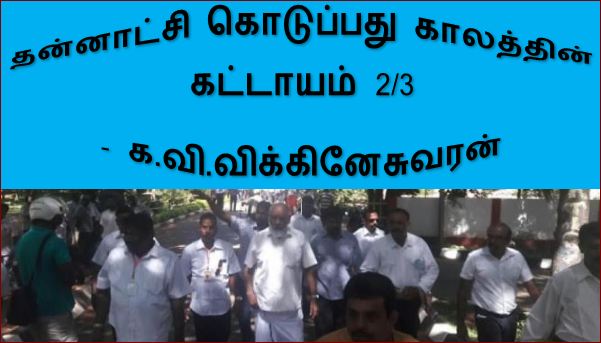
தன்னாட்சி கொடுப்பது காலத்தின் கட்டாயம் 2/3
கேரத்தீவில் உப்பளம் அமைக்க மத்திய அரசு
ஒப்புதல் வழங்கியுள்ளது. அது பற்றி எமக்கு எதுவுமே தெரியாது.
பாதிக்கப்படும் எமது மக்கள் எதிர்ப்புத் தெரிவித்துள்ளனர். எம்மைப் புறக்கணித்து மத்திய அரசு எமது வட மாகாணத்தில் இப்பேர்ப்பட்ட நடவடிக்கைகளுக்கு ஒப்புதல் வழங்குவதன் உட்பொருள் என்ன?
போர் முடிந்து ஏழு ஆண்டுகள் ஆன பின்னரும் (சிங்களப்)
படையினர் பல காணி (ஏக்கர்) நிலங்களைப் பிடித்து வைத்துக் கொண்டு, அவற்றில்
பயிர் செய்து பயன்களைத் துய்ப்பதன் (அனுபவிப்பதன்) பொருள் என்ன?
கேளிக்கை விடுதிகள், வேளாண் பண்ணைகள், தனியார் குடியிருப்புகள்
போன்றவற்றைத் தொடர்ந்து படையினரின் கட்டுப்பாட்டில் வைத்திருப்பதன் நீதி
என்ன?
வல்லாளுகை(ஆக்கிரமிப்பு) செய்யப்பட்ட
நிலங்கள் அனைத்தையும் விடுவிக்காததன் காரணம் என்ன? மேலும், பல காணி
அளவுக்கு மக்கள் நிலங்களை இப்பொழுதும் புதிதாகக் கையகப்படுத்தும்
படையினரின் நடவடிக்கை எம் மக்களின் மனத்தில் ஐயத்தை ஏற்படுத்துகின்றது.
போர்க்குற்றப் பொறிமுறையானது கலப்புப் பொறிமுறையாக இருக்க வேண்டும்
என்பது 2015ஆம் ஆண்டின் செட்டம்பர் மாதப் பன்னாட்டு எதிர்பார்ப்பு.
வெளிநாட்டு வழக்கு நடத்துநர், வெளிநாட்டு நீதிபதிகள், பன்னாட்டுப்
போர்க்குற்றச் சட்டத்தை உள்ளேற்றல் போன்றவை இல்லாது கலப்புப் பொறிமுறையைப்
புறக்கணித்து மீண்டும் உள்ளகப் பொறிமுறையை மட்டும் எமது நல்லாட்சி அரசு
நாடுவது எமக்கு ஐயங்களை எழுப்பியுள்ளது. பாதிக்கப்பட்ட எமது மக்களுக்கு நீதி கிடைக்காமல் செய்ய எடுக்கப்படும் முன்னேற்பாடுகளா இவை என்று நாம் சிந்திக்க வேண்டியுள்ளது.
இவை மட்டுமல்ல, எமது வடக்கு – கிழக்கு மீனவர்களின் வாழ்வாதாரங்கள் இப்பொழுதும் பறிக்கப்பட்ட நிலையிலேயே அவர்கள் காலத்தை ஓட்டி வருகின்றார்கள்.
தென்னிலங்கை மீனவர்கள் வடக்கு – கிழக்குக் கடற்பரப்பினுள் அத்துமீறி
நுழைவது மட்டுமன்றி எமது மீனவர்களின் படகுகளைச் சட்டப்புறம்பாகப் படையினர்
உதவியுடன் கைப்பற்றுகின்றார்கள்; வாடிகளை (மீன் உலத்தும் இடங்களை)
அமைக்கின்றார்கள். சட்டப்புறம்பான மீன்பிடி முறைகளைக் கையாள்கின்றார்கள்.
கடல் வளங்கள் சூறையாடப்படுகின்றன.
இந்நடவடிக்கைகளால் எமது வடக்கு – கிழக்குப் பொருளாதாரம் பாதிக்கப்பட்டு
வருகின்றது. மயிலிட்டித் துறைமுகம் இன்னும் மக்களிடம் கையளிக்கப்படவில்லை.
இவற்றை யாரிடம் சொல்வது? சொன்னாலும் தீர்வுகள் கிடைக்குமா?
இவற்றை உலகறியச் செய்யத்தான் இந்தப்
பேரணி. வடக்கு கிழக்கில் 2009ஆம் ஆண்டு மே மாதம் வரையில் போதைப் பொருள்
பழக்கம் இல்லாமல் இருந்தது. இதனை மத்திய அரசு உயர் அலுவலர்கள் கூட ஏற்றுக்
கொண்டுள்ளனர். 2009ஆம் ஆண்டு மே மாதத்தின் பின்னர் ஏறக்குறைய ஆயிரத்து
ஐந்நூறாயிரம் (ஒன்றரை இலட்சம்) படையினர் பாதுகாப்பு என்ற போர்வையில் வடக்கு
கிழக்கில் குடியமர்ந்து இருக்கும் நிலையில், பெரும்பான்மையான காவலர்களை
எமது காவல் நிலையங்களில் பதவியில் நிறுத்தியுள்ள நிலையில் நாளாந்தம்
நூற்றுக்கணக்கான அயிரைக்கல்(கிலோ) கஞ்சா வட பகுதியை வந்தடைகின்றது. மேலும், போதைப் பொருட்களும் வந்தடைகின்றன; மிகுதியான சாராயம் விற்பனையாகின்றது. இஃது எப்படி? சட்டமும் ஒழுங்கும் எங்களின் கையில் இல்லை.
அப்படியானால் இவை எவ்வாறு நடக்கின்றன அல்லது இவை ஏன் நடக்கின்றன? இவை எமது
இளம் தலைமுறையினரைத் திட்டமிட்டு அழிக்கும் செயல்பாட்டின் ஒரு பகுதியா
என்கிற கேள்விக்கு யார் பதில் தருவார்கள்? இதனை எமது பெரும்பான்மை
உடன்பிறப்புக்களிடமும் உலக நாட்டு மக்களிடமும் கேட்கவே இந்தப் பேரணி.
தனியாகச் சொன்னால் எவரும் கேட்க மறுக்கின்றார்கள். ஆகவே, நாங்கள் நடை
பயின்று வந்து பலராகக் கேட்கின்றோம். எமது மனக் கசப்பை வெளிப்படுத்துகின்றோம். மக்கள் சார்பாளர்களும் மக்களும் சேர்ந்து கேட்கின்றோம்.
அடுத்து, அரசியல் யாப்புக்கு வருவோம். தொடர்ந்து தமிழ் மக்கள் அரசியல் சார்ந்து வஞ்சிக்கப்பட்டு வந்துள்ளார்கள்.
ஆங்கிலேயர் ஆட்சியுரிமைகளை உள்ளூராருக்கு வழங்கப் போகின்றார்கள் என்று
தெரிந்ததும் 1919ஆம் ஆண்டில் இருந்தே அதைத் தம் கையில் வைத்திருக்கப்
பெரும்பான்மையின மக்கள் தலைவர்கள் கங்கணம் கட்டி விட்டார்கள். ஆட்சியுரிமை
முழுமையாக பெரும்பான்மையின மக்களிடம் சென்று விட்டது. எமது மக்கள் இதற்கு
எதிர்ப்புத் தெரிவித்தபொழுது ‘இவ்வளவு தருகின்றோம்’, ‘இன்னும் கொஞ்சம்
தருகின்றோம்’, ‘சரி! இவ்வளவுதான். இதற்கு மேல் எதுவும் கேட்கக்கூடாது’
எனவெல்லாம் பேரம் பேசி வருகின்றார்கள்.
இவ்வளவுக்கும், தமிழ் பேசும் மக்கள்
காலம் காலமாக 2000 ஆண்டுகளுக்கு மேலாக வடக்கு கிழக்கில் பெரும்பான்மையின
மக்களாக வாழ்ந்து வருகின்றார்கள். இங்கே சிங்கள மக்கள் ஒருபொழுதும்
வாழவில்லை. சிங்கள மொழி நடைமுறைக்கு வந்ததே கி.பி. ஆறாம் நூற்றாண்டளவில்.
தமிழ் மக்கள் பௌத்தர்களாகச் சில நூறு
ஆண்டுக் காலம் மாறியிருந்தமையே பௌத்த சமய எச்சங்கள் வடக்குக் கிழக்கில்
காணப்படுவதற்குக் காரணம். அப்படியிருந்தும் எம்மை ‘வந்தேறு குடிகள்’
என்றும், வடக்கு – கிழக்கில் சிங்கள மக்கள் முன்னர் வாழ்ந்தார்கள் என்றும்,
அவர்கள் விரட்டப்பட்டு விட்டார்கள் என்றும் புதிய வரலாற்றை வேண்டுமென்றே எழுதத் தொடங்கி விட்டனர்.
தாம் எழுதிய புதிய வரலாற்றின் அடிப்படையிலேயே ‘இவ்வளவு தருகின்றோம்’,
‘இன்னும் கொஞ்சம் தருகின்றோம்’ எனப் பேரம் பேசத் துணிந்துள்ளார்கள்.
இலங்கையின் வடக்கு – கிழக்கு தமிழ் பேசும் மக்களின் தாயகம். அவர்களுக்குத் தன்னாட்சி கொடுப்பது காலத்தின் கட்டாயம்.
இந்த நாடு அமைதியுடனும் நல்லுறவுடனும் அரசியல், குமுக(சமூக), பொருளாதார
விடிவை நோக்கிப் பயணிக்க விரும்பினால் நிகர்முறை(சமசுட்டி) அரசியல்
முறையொன்றே அதற்குத் தீர்வாக அமையலாம்.
இதில் கட்சிகளும் மக்களும் உறுதியாக
இருக்கின்றனர். ஒற்றையாட்சியானது ஆட்சி உரிமைகளைத் தொடர்ந்து
பெரும்பான்மையின மக்களின் கைகளிலேயே தேக்கி வைக்கச் செய்யும். தமிழ் பேசும்
மக்களும் சிங்கள மொழி பேசும் மக்களும் நல்லுறவாக, இணையான தரத்துடன்
இனியாவது வாழ்வதானால் வடக்கு – கிழக்கு மாகாணத் தமிழ் பேசும் மக்களுக்கு
அவர்களின் உரிமையை மதித்துத் தன்னாட்சி வழங்குவதே ஒரே வழி! அதனால்தான்
நாங்கள் நிகர்முறை ஆட்சி முறையை வலியுறுத்தி வருகின்றோம். அதற்கேற்றவாறு
அரசியல் யாப்புப் பற்றிய நகர்வுகள் நடப்பதாகத் தெரியவில்லை.
ஏனோ தானோ என்று மூடி மெழுகி அரசியல் தீர்வு ஒன்றைத் தரலாம் எனத் தெற்கு நினைப்பதாக எமக்குத் தோன்றுகின்றது. எமக்குத் தர வேண்டிய உரித்துகள் எமது குழுமம் சார்ந்த உரித்துகளே அன்றித் தனிப்பட்டவர்களுக்கு அளிக்கும் உரித்துக்கள் அல்ல.
வடக்கு கிழக்கை இணைக்க வேண்டும்
என்று நாம் கேட்பதை ஏதோ கேட்கக் கூடாததை நாம் கேட்பதாகத் தெற்கில்
நோக்கப்பட்டு வருகின்றது. தமிழ் பேசும் மக்கள் பலரால் கூட அவ்வாறே
நோக்கப்படுகின்றது.
(தொடரும்)
- நீதியரசர் க.வி.விக்கினேசுவரன்,
முதலமைச்சர்,
வட மாகாணம். - ‘எழுக தமிழ்’ நிகழ்வில் ஆற்றிய உரை
- தரவு : இ.பு.ஞானப்பிரகாசன்
அயற் சொற்களையும் அயல் எழுத்துகளையும் நீக்கித்தான் எழுத வேண்டும் என்றாலும் பிறரது கருத்துகளையும் பிற இதழ்கள் அல்லது தளங்களில் வந்த செய்திகளையும் மேலனுப்புகையில் அவ்வாறே பதிவதால் அல்லது அனுப்புவதால் தமிழ்த்தாயே பொறுத்தருள்க.
அன்புடன் இலக்குவனார் திருவள்ளுவன்
அகரமுதல இணைய இதழ் www.akaramuthala.in
இலக்குவனார் இல்லம்,
23 எச், ஓட்டேரிச் சாலை, மடிப்பாக்கம்,சென்னை 600 091
மனை பேசி 044 2242 1759
அலை பேசி 98844 81652
/ தமிழே விழி! தமிழா விழி!
எழுத்தைக் காப்போம்! மொழியைக் காப்போம்! இனத்தைக் காப்போம்! /
பின்வரும் பதிவுகளைக் காண்க:
www.ilakkuvanar.com
thiru2050.blogspot.com
thiru-padaippugal.blogspot.com
http://writeinthamizh.blogspot.com/
http://literaturte.blogspot.com/
http://semmozhichutar.com
அன்புடன் இலக்குவனார் திருவள்ளுவன்
அகரமுதல இணைய இதழ் www.akaramuthala.in
இலக்குவனார் இல்லம்,
23 எச், ஓட்டேரிச் சாலை, மடிப்பாக்கம்,சென்னை 600 091
மனை பேசி 044 2242 1759
அலை பேசி 98844 81652
/ தமிழே விழி! தமிழா விழி!
எழுத்தைக் காப்போம்! மொழியைக் காப்போம்! இனத்தைக் காப்போம்! /
பின்வரும் பதிவுகளைக் காண்க:
www.ilakkuvanar.com
thiru2050.blogspot.com
thiru-padaippugal.blogspot.com
http://writeinthamizh.blogspot.com/
http://literaturte.blogspot.com/
http://semmozhichutar.com
Reply all
Reply to author
Forward
0 new messages