Biafra: ‘What can we do to make Igbo feel they belong,not alienated – Soyinka [With Rich List of Comments]

7 views
Skip to first unread message

Oluwatoyin Adepoju

unread,
Dec 9, 2015, 1:26:25 PM12/9/15
to WoleSoyinkaSociety, USAAfricaDialogue

Bode

unread,
Dec 9, 2015, 2:49:57 PM12/9/15
to 'Ikhide' via USA Africa Dialogue Series
"Jamiu Imam from Facebook12 minutes ago

Igbos have long been assimilated.. But biafrauders never desire to be."


I agree with Soyinka. And would even go further, we had a referendum for Southern Cameroon, why can't we have one for the Igbos, as i stated months ago, in 10 years? However, my concern is that if not properly conceived, managed, and articulated, the agitation may end up leaving the East in a bad position if the secession is not realized; they would have to face the kind of sentiment expressed in the twit above over again within one generation. If the options narrow as they seem to be at the moment, it leaves very little room for retreat and we may soon cross the line of no return, yet again....


On Wed, Dec 9, 2015 at 1:19 PM, Oluwatoyin Adepoju <oluwas...@gmail.com> wrote:

Biafra: ‘What can we do to make Igbo feel they belong,not alienated – Soyinka

on December 09, 2015   /   in News 8:43 am   /   Comments

By Our Reporter

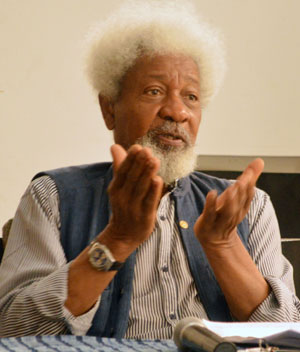
Nobel laureate, Professor Wole Soyinka, has urged the Federal Government to employ more diplomacy in handling the agitation for the Republic of Biafra.

SOYINKA

SOYINKA

Soyinka said statements like “Nigeria is indivisible”, “This won’t happen under my watch,” “Nigeria’s unity is non-negotiable” would not help matters.

The Nobel laureate spoke in an interview on Channels Television programme, Channels Books’ Club.

Agitation for the Republic of Biafra gained more traction recently following the arrest of Director of outlawed Biafra Radio,Nnamdi Kanu.

The protesters had taken over the Niger Bridge, Onitsha, Anambra State blocking traffic and it took the intervention of security agents before they could be dislodged, leaving some persons dead in its wake.

Soyinka asked President Muhammadu Buhari to approach the agitation in a more diplomatic way, pointing out that he had said earlier that Biafra cannot be defeated.

According to him, ”Once an idea has taken off, you may defeat those behind it in a war but that does not mean the end of the idea.”

But he lamented that he had been misunderstood at the time.

He said the attitude of the government should be to sit down with the  those leading the renewed agitation and ask: “What can we do to make the Igbo feel part of the country, what can we do to make them to feel that they belong and not alienated.

“This is what we are ready to push for in the overall governance content of the country. It is not to be carrying on that this will not happen under my watch; Nigeria is indivisible, Nigeria’s unity is non-negotiable, he stated”


Selections below  from more than a 1,000 comments-

Idris Usman Yola from Facebook8 minutes ago

buhari pls crush them all

LikeReply
THE LION OF BIAFRA
THE LION OF BIAFRA8 minutes ago

BIAFRA RE-ACTIVATING -NIGER/DELTA -DOWNLOADING 2016 - THE ONLY THING THAT CAN SAVE NIGERIA IS UNLESS AMNESTY FOR OUR PEOPLE CONTINUE IN NIGER/DELTA- BIAFRA/NIGERDELTA REPUBLIC ALL THE WAY

LikeReply
James Kalu Oleh
James Kalu Oleh from Facebook9 minutes ago

Nigeria it is too late Biafra all the way

LikeReply
Chimobi P Ebenezer
Chimobi P Ebenezer from Facebook10 minutes ago

plz wia in this country can u live peacefully if it's nt in igbo land?

LikeReply
Jamiu Imam
Jamiu Imam from Facebook12 minutes ago

Igbos have long been assimilated.. But biafrauders never desire to be.

LikeReply
Peter Udokwu
Peter Udokwu from Facebook15 minutes ago

All we want is biafra

LikeReply
Tayo Akinleye
Tayo Akinleye from Facebook16 minutes ago

Sir, this comment is not too good in the spirit of one Nigeria..We all have our good and bad side as far as each tribe is concern. ..may God help us to understand ourselves n our differences.

LikeReply
Joseph Freeman
Joseph Freeman from Facebook16 minutes ago

Prof., but has Nigeria survived now? Right now, Nigeria is sitting on a keg of gunpowder that is about exploding. No job, unpaid salaries everywhere, no life, no future, miseries and gnashing of teeth everywhere, people are dying everyday; hunger, abject poverty and hopelessness killing more people than Boko Haram. Indeed, Nigeria is obnoxiously and dangerously pregnant!

LikeReply
Hassan Nasiru
Hassan Nasiru from Facebook21 minutes ago

Just killing them s best solution

LikeReply
Chukwujekwu Uzokwe
Chukwujekwu Uzokwe from Facebook21 minutes ago

Gen elias u need to understd d article every well.

LikeReply
Kalu Evarestus
Kalu Evarestus from Facebook28 minutes ago

NOTHING SIR ITS TOO LATE NOW JUST BIAFRA AND OUR LEADER NNAMDI KANU

LikeReply
Maluchukwu Emmanuel
Maluchukwu Emmanuel from Facebook32 minutes ago

U ar not any thing a wayo man like u

LikeReply
Maluchukwu Emmanuel
Maluchukwu Emmanuel from Facebook34 minutes ago

Soyinka or wat ever u kol ur self at the god of igbos

LikeReply
...

[Message clipped]  

Olayinka Agbetuyi

unread,
Dec 9, 2015, 3:39:47 PM12/9/15
to usaafric...@googlegroups.com

I agree with Prof. Soyinka's comments but will pre-empt him by asking that the first question to be given to indigenes of Igbo states is whether as an immediate palliative a referendum should not be staged among Igbos on the desirability of naming one of the existing Igbo states Biafra ( that ensures that the idea indeed can never die) and ask the Igbos to determine which of the current states will be so called, within the democratic framework of Nigeria, they can carry out the organizing principles and priorities of Biafrans.  Other residents of other igbo states will be free to emigrate there if they so desire (as would other residents of other non-Igbo states; with right of return to their former states if it does not work out).  It will be but a short step to confederacy I concede but not outrightly so.  If they are able to build an eldorado they wave in the face of other Nigerians, not only would they have earned their gambit, they would have provided a 'control' blueprint in an experiment for other Nigerian states to emulate in state  governance, in a non rancorous atmosphere.


Olayinka Agbetuyi


From: usaafric...@googlegroups.com <usaafric...@googlegroups.com> on behalf of Bode <omi...@gmail.com>
Sent: 09 December 2015 18:51
To: 'Ikhide' via USA Africa Dialogue Series
Subject: Re: USA Africa Dialogue Series - Biafra: ‘What can we do to make Igbo feel they belong,not alienated – Soyinka [With Rich List of Comments]
 
--
Listserv moderated by Toyin Falola, University of Texas at Austin
To post to this group, send an email to USAAfric...@googlegroups.com
To subscribe to this group, send an email to USAAfricaDial...@googlegroups.com
Current archives at http://groups.google.com/group/USAAfricaDialogue
Early archives at http://www.utexas.edu/conferences/africa/ads/index.html
---
You received this message because you are subscribed to the Google Groups "USA Africa Dialogue Series" group.
To unsubscribe from this group and stop receiving emails from it, send an email to usaafricadialo...@googlegroups.com.
For more options, visit https://groups.google.com/d/optout.

Bode

unread,
Dec 9, 2015, 4:20:52 PM12/9/15
to 'Ikhide' via USA Africa Dialogue Series
Besides, in a democracy, large numbers of people cannot show strong support for an idea and you try to suppress it. Something now has to be done politically by elected officials to give the protesters something for their troubles, for lack of better words. 

Anunoby, Ogugua

unread,
Dec 9, 2015, 6:09:52 PM12/9/15
to usaafric...@googlegroups.com

Why does it take Wole Soyinka to state the obvious for some in this Forum to acknowledge the obvious. The Igbo are not an unreasonable people. No people are I might add. Their problem has never been that they could not compete. Nigerians know that they can and do compete. It has been that they believe the dice has been loaded against them. This belief does not have to be true.  If that is the feeling, it should be addressed and all resentment assuaged. The smart thing to do therefore, is to talk, not berate, threaten, or ignore the indignation as some in this forum seem to be doing.

I would say the same for any other groups that are disaffected. The Yoruba were, some say rightly, after the Abiola case. They believed they were hard done by. Nigerians shared their pain. The Yoruba got the Obasanjo presidency in recompense. That was okay. Obasanjo in fact had Olu Falae, another Yoruba as his only opponent in the presidential election. The Hausa/Fulani (arguably on behalf of Northern Nigeria) claimed they were entitled to eight years of the  Yar ’Adua presidency.  Let us not worry about why they were sure Yar’Adua will have been elected to a second term if he ran.  Nigerians conceded the presidency to them after President Jonathan. That is how fissured countries work until they are no longer so. Thank goodness for Soyinka. Will the country listen to him? That is the question.


oa

Bode

unread,
Dec 9, 2015, 6:26:21 PM12/9/15
to 'Ikhide' via USA Africa Dialogue Series
you know how easy it is to rent crowd or mobilize an ethnic group or religion against governments they feel do not represent them. if we go down that road, it becomes easy to blackmail every government. Soyinka is doing the right thing, and I support his statesmanship even if Kanu and the Government are not, because he KNOWS too well what is brewing. I do not construe his statement as a vindication of your position but an attempt to stop history from repeating itself. let us all join him in stopping history from repeating itself. 

Anunoby, Ogugua

unread,
Dec 9, 2015, 8:33:26 PM12/9/15
to usaafric...@googlegroups.com

What is your point Bode? Must one speak if the one has nothing of true value to add to a conversation of great moment. True is true just as untrue is untrue. Soyinka’s validation is neither required nor necessary for the above to be the case. He knows what is expected of him. Did you notice he did not volunteer his opinion and counsel. He was asked for it.

I appreciate that Soyinka at this time, said by some to be a time of unreason, is still the constructive, rational human being that many others in this forum, in government, and elsewhere choose not to be. I remind you I am not in a contest for Soyinka’s validation of my or indeed any point of view. He will be first to say he has no interest in the politics of opinion validation. On this issue, all who want Nigeria to work for all Nigerians have Soyinka in their company. The corollary is true. Those who want Nigeria to work for some Nigerians only, do not.

Bode

unread,
Dec 10, 2015, 4:03:48 AM12/10/15
to usaafric...@googlegroups.com
The idea that those who agree with you are rational and constructive and those who are skeptical of your objectives are irrational and should not speak even if they consider themselves your allies in many respects is offensive and totalitarian. Soyinka has been fighting for Biafra probably before Kanu was born.

Anunoby, Ogugua

unread,
Dec 10, 2015, 12:35:46 PM12/10/15
to usaafric...@googlegroups.com
"Skeptical of my objectives"? What objectives? What are they? I would prefer that is my ideas and thoughts not my objectives, that are of interest to anyone who is kind enough to pay some attention to me. Why would I be skeptical about anyone's position on my opinion? I believe that the human mind should be free to wonder and choose. I know also that the human mind may loses its way sometimes. It's is not usually possible for all positions to be rational and constructive when the positions are in conflict with each other. Sometimes, one position is right and the other is wrong. You decide what the case is on this subject. I will respect your decision.? Thank you Bode.

oa

Sent from my iPhone

Moses Ebe Ochonu

unread,
Dec 10, 2015, 12:50:51 PM12/10/15
to USAAfricaDialogue
1. Soyinka is saying what I have been saying since 1999 on Nigeria-centered list serves, in several essays, in my 2014 book of essays, Africa in Fragments, and in a forward I wrote for a recently published book on intra-national struggles of self determination. I don't have the intellectual clout or name of Soyinka, so my articulation of the issue seem not to have gotten any traction. Now that the great one has voiced it in almost the exact terms that I have been articulating it, hopefully Nigerians will realize how dangerous the rhetoric of "preserving Nigeria at all costs" really is. There is absolutely nothing sacrosanct about Nigeria, a creation of colonial convenience, or about any other nation-state for that matter. The problem is that we have configured international law, scholarly protocols, and international relations to fetishize the existing, often forced, boundaries of nation-states. The fetish of national sovereignty has seduced even some of our smartest intellectuals, who have bought into the nonsense that Nigerian unity is non-negotiable, that Nigeria has come to stay, and that there is nothing anyone can do about it. I will return to expatiate on this point later and post some of my own writings/publications on this for those who are interested. But for now, let me say that this is precisely the reason that, of all the contributions made on this issue so far, my favorite is a single paragraph from Nimi Wariboko's post, which I reproduce below:

Here is the wildcat idea. Give every group the option of exiting from the polity through a referendum. Let us write into the constitution that every 25 or 50 years any group or collectivity can decide to leave the union. Its members will vote and if there is a two-third majority that supports exiting from the union, the others will let then go in peace. Meanwhile, let us all work hard to make the union excel and if at the end of 25 or 50 years, a group is still aggrieved enough to want to leave the others will let them go. Perhaps, knowing that there is an exit strategy might make some groups to feel that they are not doomed to stay within Nigeria forever. We need to let aggrieved groups or collectivities know that others will not put undue obstacle on their path to paradise. Let every group has the democratic “option” to buy or sell its membership in the union.

Nimi's proposal is refreshing in its robust enunciation of the imperative of self-determination, and in its bold, frontal confrontation with the shallow artificiality of Nigeria and the concomitant continuation and proliferation of legitimate separatist and centrifugal agitations. There is no pretense or platitude in his proposal; no escapism, and no feel-good diplomatic pronouncement. Our country has a legitimacy problem and we ignore it at our own peril. One way to grapple with this legitimacy deficit is precisely to stop demonizing the separatist and self-determination aspirations of various Nigerian groups and to instead provide a constitutional outlet and platform for expressing or exercising the right to self-determination by people whose ancestors had been forcefully coopted into a colonial territorial state. The Canadians have done so, so too the British with the Scots and Irish. Ironically, it's in the former colonies, the so-called colonial creations, that the fetish of inviolable national sovereignty is strongest. Like Nimi, I believe that if actually given an opportunity to secede in a referendum, neither the Igbo nor the Yoruba nor the Niger Delta (nor any other groups) would choose secession. We've commingled too much for that. Which is precisely the reason why one does not understand the paranoid reaction of Buhari and OBJ before him to Biafra agitations and to Niger Delta aspirations--which is precisely why the fear and hysteria about Biafra is perplexing; and finally, which is why one does not understand why in fact a smart leader should not even welcome the open, peaceful expression of separatism rather than the stealthy festering of such centrifugal agitations. When they are encouraged to come into the open even in their charged, incendiary forms, you can then engage them productively and use them as a basis to perfect or build a flawed, illegitimate union. Why the heck are we afraid of legitimate self-determination? Of referendum? Of discussing the very continued existence of Nigeria in its colonially created form? We have had several so-called national conferences but in each case, the question of self-determination for the various constituencies that make up Nigeria was ab initio taken off the agenda. Even the less fragmentary option of confederacy was always a no-go area. We are always told that Nigeria is better off as one, that our strength lies in our diversity, blah blah blah. How the heck do we know that we are better off as one unitary nation held together by certain fragile elite consensuses when we have not dared to try alternative, less unitary forms of nationhood, or confederacy, or even separation into autonomous, neighboring nations? The idea of foreclosing and discrediting an option even before you've tried it seems foolish to me, sorry.


2. Let's be careful trying to delegitimize and devalue the legitimate struggle of the Igbo. Personally, I believe that what the Igbo really want is a sense of inclusion, acceptance, and fairness in Nigeria, a thing that they have been denied since the end of the civil war, and that Biafra (as a separate country) is their last resort. In a bid to devalue the current agitation, some people have tried to make Nnamdi Kanu a spokesperson for all Igbo, which is as ridiculous as saying that Ganiyu Adams of OPC represents and speaks for all Yoruba and their political aspirations. Kayode Ogundamisi, who should know better, even tweeted about a fake burning of a Hausa mosque in Onitsha, which never happened while others attributed other refuted violent acts to the protesters--all in a move to devalue what they are doing. In the meantime, these same folks have been silent on the killing of many of these protesters by Nigeria's armed forces. 

The mockers of the protests and of the grassroots Biafra movement forget that the youth protesters were legitimately and peacefully calling for the release of Kanu, who is being illegally detained despite having been granted bail by a high court, and whose arrest was a foolish act that has now turned a deranged, inconsequential nonentity into an international prisoner of conscience. The protests were in response to the arrest and continued unconstitutional detention of Kanu; they did not precede the arrest. These critics and skeptics want us to believe that the protests are not about Kanu's release and Biafra but about Buhari's victory in the last election while conveniently forgetting that IPOB had existed through the Jonathan years, had occasionally clashed with security agencies in Enugu state, and that Radio Biafra and its incendiary rhetoric began in late 2013 or early 2014, long before the 2015 elections that brought Buhari to power. Chronology matters in establishing a chain of causation or correlation. 

These people want us to forget that in fact it was the Buhari administration that foolishly escalated and in fact unwittingly internationalized and mainstreamed IPOB/Radio Biafra's fringe agitation by proclaiming that it had jammed the group's broadcasts when in fact such a feat is virtually impossible in this age of democratized, shoestring guerrilla broadcasting. As my friend, Farooq Kperogi wrote, it was this act that brought Radio Biafra and Kanu to most Nigerians' consciousness and made him an overnight political sensation. These critics/skeptics also want us to forget that in fact the idea of Biafra had never died; that Biafra had always been Nigeria's unfinished historical business, ever complicating our political struggles and nation-building efforts; and that before IPOB/Radio Biafra/Kanu, there was MASSOB and Uwazuruike.

3. Speaking of MASSOB, the group emerged to crystallize and represent the grassroots nostalgia and agitation for Biafra, which has always existed in tension with the aspirations of the Igbo political and traditional/gerontocratic elite. MASSOB took its losses, fizzled out and today IPOB/Kanu is the bearer of that grassroots Biafra mantle. This Biafra from below has always been vibrant in Nigeria, only undergoing an ebb and flow determined by many factors. My first encounter with this grassroots Biafra began as early as 1999, when I was a participant in the Nigeriaworld forum. The Biafra sentiment on that listserv was such that it was always the proverbial big elephant in the discursive room, coloring almost all conversations. Later, because of the discursive belligerence of the young online Biafra advocates, who were now courting and making common cause with the newly established MASSOB, the proprietor grew uncomfortable and began censoring the "Biafra boys" as we called them. In justified anger they left the forum and established their own, where Biafra advocacy, very incestuous and monotonous in my opinion, continued and continues to flourish.

This history is important because revisionism, if allowed to take hold, can redefine and discredit an organic, historical movement as a fleeting emotional reaction to electoral loss or as a strategic instrument of political blackmail. Grassroots Biafra did not begin post 2015 elections. It has always been there. And it makes the Igbo political elite, who are now accused of using it as a form of political blackmail, as uncomfortable as it does the government. As for the protests, the foolish actions of the Buhari government precipitated them and played right into IPOB/Kanu's hands.


And no, I am not Igbo. I am a proud Idoma man whose village was bombed to smithereens by Biafran Airforce bombers during the civil war, killing and maiming many and sending the survivors scampering for safety in refugee camps and in the caring hands of relatives in Otukpo, the ancestral headquarters of the Idoma. My people's victimhood (a subject which is missing from the historiography of the civil war and which, God willing, will constitute the material for revisions and new directions in civil war research and studies in the near future) will not cause me to deny the wrongs done to the Igbo during and after the war. Post-war reconciliation and reconstruction are not accomplished with slogans. Abandoned properties, 20 pounds for all savings, etc are markers of a much more elaborate Nigerian problem with the Igbo. Nigeria is haunted by a Biafra problem, by the unfinished business of a nasty civil war, but we are reluctant to confront it. If any of the other big three ethnic groups in Nigeria had been treated as the Igbo have, I dare say there would not be a Nigeria today. I don't say this lightly, since I am a historian and we historians are not comfortable with making counterfactual statements.


To be continued, time permitting.


Bode

unread,
Dec 10, 2015, 1:36:20 PM12/10/15
to 'Ikhide' via USA Africa Dialogue Series
Very comprehensive! and compelling. A liberal and democratic persuasion will surely entertain the principle of self-determination. I started out myself from this idealist position and have now arrived at a more or less realist position that beyond fine intellectual arguments and legitimate grievances, the reality is that the ultimately determining principle in this case will most likely be the nature of the political economy of Nigeria as presently constituted. Until there is oil and coastal access in every region, arguments for self-determination will always meet an equally determined opposition, which is not totally irrational. If not managed with care and deft compromises, this is a recipe for war or disfunction, especially as the streets have taken over the struggle. I think there is a less volatile path of political solution which is what I read Soyinka as promoting. 

Bode

unread,
Dec 10, 2015, 2:28:49 PM12/10/15
to 'Ikhide' via USA Africa Dialogue Series
By the way, things were relatively quiet in the 70s and 80s despite the lingering realities of the injuries. OPC and the new Biafran movements etc all seemed to have emerged as a direct response to the Abacha dictatorship of the 1990s. One could state that while the Igbos suffered gravely during the civil war and the immediate aftermath, the suffering of the Niger-Delta was front and center during that period of the 1990s. That was were the repressive brutality of the Nigerian state was most focused and directed for obvious reasons. It does not minimize the suffering of any to point to the suffering of others, it makes it all the more imperative that a coalition be forged across the country to deal with the problem. 

Mensah, Edward K

unread,
Dec 11, 2015, 2:37:11 AM12/11/15
to usaafric...@googlegroups.com

Friends,


The African experiment at nation building has been very complicated and disastrous precisely because the various countries were cobbled together via the assemblages of various tribes that, under certain circumstances, may not even want to be together. In my mind, our major problem emanates from the behaviors of our corrupt and thieving, as well as murderous, politicians. These politicians have behaved as if the owned the citizens nothing. Their main job is to loot the national coffers for the benefit of their foreign and domestic friends.  In the meantime the citizens have been stripped of all avenues to redress their problems. Those of us with the means run to the West to become economic exiles (oops, I know I am offending many elites who do not see themselves as economic exiles) do so leaving our unfortunate brethren at home. In desperation they agitate for their own states in the belief that, once they have their own unviable nation  all issues will be addressed.  And some of us  sit in the West and shamefully support these aspirations without discussing the unintended consequences as  if secession will deliver honey to all citizens.( I have not read a single post about the unintended consequences yet!)

The fact that there is not a single African country ( maybe Botswana is an exception but I am not sure) that can demonstrate that the leaders work to improve the standards of living of their citizens and do not simply loot the national coffers for the benefit of the elite 0.1 suggests to me that all our leaders have no social conscience. They are in the business of governance for their own benefit.  Note that when I say ALL LEADERS I am also including most of the individuals.


The examples our elites quote for secession referenda in Canada and Scotland are disingenuous because the  groups within these countries ( Canada and Scotland or Catalan in Spain)  who agitate for independence have very clear boundaries and are monolingual.  Take an African country with about 20 tribes cobbled together to form a country. Any secession, to be successful, must be carefully throughout. Which tribes are in and which are out? And where are the legitimate boundaries? And who decides where a tribe’s boundaries begin and end?   One major legacy of the current nation states, like Nigeria or Ghana is that our thieving politicians have created huge national debts in the name of all citizens.   When a group of tribes secedes, in addition to the issue  of settling legitimate boundaries, what proportion of the national debt should be allocated to the new nations? So not only do we have  issues with legitimate boundaries we also have economic issues to address, bills to pay.  In all honesty  you can’t leave and expect to not pay your share of the national debt. How is the debt apportioned?  And assuming the debt is apportioned fairly, for example, in proportion to the share of the national population, the new nation will start off with a huge national debt.


I am neither a political scientist nor a historian. I am an economist who dabbles in politics here and there. And I believe that these agitations for secession have not been well thought-out. There are no perfect countries, just as there are no perfect marriages. We Africans must all understand that our issues are with the corrupt politicians, and they come in all tribes. These politicians will not cease to be corrupt the moment they become leaders of another geopolitical entity. Hell no!! We will simply end up creating new set of corrupt and thieving leaders. Where is the evidence? Show me a single African country with leaders who behave otherwise. We should listen to the legitimate cries of our citizens and work out models of coexistence, unitary governance with powers devolved to groups within the country, real federations, ect.. Secession, if you ask me, should be the very last option.


Best


Kwaku


P/S

Given the historical and current behaviors of Chicago police and City Hall, I will vote for Hyde Park to secede. But Chicago could forbid us from driving on Lakeshore Drive to work by increasing the toll astronomically!! There are no perfect options.

kenneth harrow

unread,
Dec 11, 2015, 1:56:12 PM12/11/15
to usaafric...@googlegroups.com
hi kwaku
i have only one small thought on this. we have always heard about the failures of the colonialists to draw reasonable border lines for african states. the logic goes that the lines should reflect the ethnic divisions.
i don't particularly share that view. the cobbling together of different peoples is entirely the project of the nation-state, and just about everywhere. i see national identities as different from, not commensurate with, and certainly/absolutely not congruent with other forms of identity.
and lastly, even if it were congruent with ethnic identities, give it enough time and the same divisions of interest, e.g. class, would arise anyway. the same mixage of peoples would arise anyway.
in deed, look closely enough at already existent ethnic identities, look at them over time, and what do you find? the same mixing, the same sorting out, the same dividing of groups and peoples, as is found among national entities.
more or less.
ken
-- 
kenneth w. harrow 
professor of english
michigan state university
department of english
619 red cedar road
room C-614 wells hall
east lansing, mi 48824
ph. 517 803 8839
har...@msu.edu

Moses Ebe Ochonu

unread,
Dec 11, 2015, 1:56:44 PM12/11/15
to USAAfricaDialogue
Bode,

I like the refreshing honesty of your post. It is all about the oil, or more precisely its location in one area of the country. But unlike you, I actually think that were oil to be discovered in other all parts of the country, rather than make Nigerian elites receptive to self-determination agitations, it might actually have the effect of making people realize that self-determination is only one of many freedoms and aspirations that they should invest in. Accordingly, rather than hasten Nigeria's balkanization, such a development may actually serve as a bulwark against it. Even as things stand I strongly believe that if an actual referendum is placed before different ethno-regional cleavages they would not endorse outright secession. We have become too entwined for that in my opinion. What people really desire is autonomy--economic, political, and cultural. The de facto unitary system we run is suffocating for everyone but more so for those who carry historical injuries.

Moses Ebe Ochonu

unread,
Dec 11, 2015, 1:57:28 PM12/11/15
to USAAfricaDialogue
Oga Mensah,

Two things that your marriage analogy fails to reckon with:

1. There are no perfect marriages, but marriage implies a degree of consent on the the part of the parties involved. Where there was no such consent as was the case with the emergence of these forced colonial marriages called nations, it is wrong to apply the logic of marital imperfection. The marriage was flawed to begin with and only a renegotiation of its foundation terms would make it legitimate.

2. In all marriages, there is an exit clause, a way out if one or both parties no longer find the union satisfying or find it abusive. You invoke marriage but you, like most African intellectuals, will not decry the fact that in the case of postcolonial African nation-states, no such exit clauses are allowed or tolerated, that in fact there is a murderous intolerance for the freedom to partially or completely exit unsatisfying union.

Thanks.

Bode

unread,
Dec 11, 2015, 3:37:56 PM12/11/15
to 'Ikhide' via USA Africa Dialogue Series
Moses, the more i think about this the more i am convinced that federalism, with its offer of limited self determination is the best strategy of rights and inclusion that you can have. the problem is that we want self determination as an exit from citizenship for ourselves alone. from others we demand that our citizenship overrides their self determination, but for us, self determination is an exit from citizenship. how do we reconcile these contradictory and simultaneous arguments for self determination and citizenship? multiple nationwide rights to self determination necessarily places constraints on citizenship. the acceptance of those constrains by everyone assures equal conditions of citizenship. you cannot remove the constraints on citizenship without exiting citizenship altogether just as you cannot remove the constraints marriage imposes without exiting marriage as we know it. 

John Mbaku

unread,
Dec 11, 2015, 3:38:05 PM12/11/15
to usaafric...@googlegroups.com
Ken:

What you are suggesting would, indeed, happen if the country is provided with the appropriate institutions--for example, institutions that enhance economic mobility. For example, it is relatively easy for an individual living in Michigan to migrate to Utah and within a short period of time establish residence in Utah and begin to participate fully and effectively as a "citizen" of the State of Utah. That person, legally, cannot be discriminated against based solely on the fact that he or she is a "foreigner" or "stranger"--to use the language common in West Africa. Consider the case of the Austrian movie actor who migrated to California and eventually became governor! However, in many African countries, including both Nigeria and Cameroon, for example, they are many citizens of these countries who are designated "strangers" in various parts of their own countries. Under conditions as they currently exist in these countries, citizenship is not portable and as a consequence, the type of integration that you speak of is not likely to take place, even after many years of "living together." 
JOHN MUKUM MBAKU, ESQ.
J.D. (Law), Ph.D. (Economics)
Graduate Certificate in Environmental and Natural Resources Law
Nonresident Senior Fellow, The Brookings Institution
Attorney & Counselor at Law (Licensed in Utah)
Brady Presidential Distinguished Professor of Economics &  John S. Hinckley Fellow
Department of Economics
Weber State University
1337 Edvalson Street, Dept. 3807
Ogden, UT 84408-3807, USA
(801) 626-7442 Phone
(801) 626-7423 Fax

kenneth harrow

unread,
Dec 11, 2015, 3:38:25 PM12/11/15
to usaafric...@googlegroups.com
all countries on earth have an uneven distribution of their resources.
an oddity is the u.s., where the former slaveowning states enjoy a disproportionate weight at the electoral college--and the senate--due to the great compromise of union.
we are paying for that now.
and urban centers are de-valued as a result
ken
-- 
kenneth w. harrow 
professor of english
michigan state university
department of english
619 red cedar road
room C-614 wells hall
east lansing, mi 48824
ph. 517 803 8839
har...@msu.edu

kenneth harrow

unread,
Dec 11, 2015, 4:11:03 PM12/11/15
to usaafric...@googlegroups.com
dear kwaku
what you write about is EXACTLY what geschiere writes about in his book Perils of Belonging. where people from the west of cameroon, bamileke (regarded often as being like your igbo in nigeria when migrating to other parts of the country) come to douala and are regarded as outsiders, as not being allowed to vote there; as  belonging only where they were born, and needing to prove this w birth certificates, before being allowed to vote; and finally, most importantly, being indigenous only to the place where they will be buried. and if your father determines where you are from, you'd better be prepared to show a photo of his grave in the location you are claiming to be your home.

this is autochthony's insanity.
but you know, it is recent, all of it. it dates to the 1980s when this sea change away from national identity slowly began. and it was the same sstory in cote d'ivoire, and i suspect in many many other countries in the world, not just africa.
so you are right about michigan and utah. but maybe it is less a question of the good working structures of the govt, but of a social fabric where a vast percentage of our children are finding jobs in locations outside of the city and the state in which they were born; and where immigration still figures in the shaping of our national profile.

if the national service in nigeria were to help create a new culture for the children, that might be a start in the direction you are favoring
ken
-- 
kenneth w. harrow 
professor of english
michigan state university
department of english
619 red cedar road
room C-614 wells hall
east lansing, mi 48824
ph. 517 803 8839
har...@msu.edu

Bode

unread,
Dec 11, 2015, 4:26:45 PM12/11/15
to 'Ikhide' via USA Africa Dialogue Series
John, 

What would you say of Senator Scott Brown who was defeated in New Hampshire because he was considered a carpetbagger? 

---- for definition: ""Carpetbagger" was a pejorative term referring to the carpet bags (a form of cheap luggage at the time) which many of these newcomers carried. The term came to be associated with opportunism and exploitation by outsiders. The term is still used today to refer to a parachute candidate, an outsider who runs for public office in an area where he or she does not have deep community ties, or has lived only for a short time."

I think not all states would have elected an Arnold and i can predict Lagos state would soon elect a "non-indigene." things are not as clear cut as you seem to present it.

kenneth harrow

unread,
Dec 11, 2015, 4:34:20 PM12/11/15
to usaafric...@googlegroups.com
interestingly, clinton in ny was considered a carpetbagger, and so was rfk, when i was young.
they both did win, however.
nowadays we have snobirds--older people who have moved to the south, to the point where florida has become a beacon for millions of old folks.
ken
-- 
kenneth w. harrow 
professor of english
michigan state university
department of english
619 red cedar road
room C-614 wells hall
east lansing, mi 48824
ph. 517 803 8839
har...@msu.edu

Bode

unread,
Dec 11, 2015, 4:41:30 PM12/11/15
to usaafric...@googlegroups.com
New York and california are similar they would elect carpetbaggers. I think Lagos is moving in that direction too. There are probably places where that label would stick. Not sure where

John Mbaku

unread,
Dec 11, 2015, 5:05:18 PM12/11/15
to usaafric...@googlegroups.com
Sorry, but I do not believe that this person was defeated simply because he was considered a foreigner. The opposing candidates may have used his "foreignness" as a campaign tool but in the end, it was the weaknesses of his campaign and his inability to present himself as a superior alternative to the opposition that doomed his candidacy. He simply did not adequately articulate his agenda well to potential voters.

Someone, who considers himself a "native" son of Utah tried the same message during an election here and it did not work--he painted his opponent (whose parents were born outside the United States) as an outsider and opportunist and the tactic did not work. On the other hand, the "outsider" actually used the "outsider" status to mount an effective and successful campaign and was elected to high public office. 

Except for Native American tribes that have been granted specific geographic locations within the country as belonging only to them and hence, they can actually discriminate against outsiders/nonmembers, no state can legally discriminate against a citizen of the United States who has established residency in that state. 


Anunoby, Ogugua

unread,
Dec 11, 2015, 5:05:36 PM12/11/15
to usaafric...@googlegroups.com
A distinction should be made between the competition calling a competitor in a political race carpetbagger and a citizen living away from home being called and treated as a foreigner or stranger. 

Sent from my iPhone
--

Bode

unread,
Dec 11, 2015, 5:58:01 PM12/11/15
to 'Ikhide' via USA Africa Dialogue Series
By the way, I believe it worked against Dick Cheney's daughter in Missouri, that was why she lost out, she was considered a carpetbagger.


On Fri, Dec 11, 2015 at 5:16 PM, Bode <omi...@gmail.com> wrote:
it is not inscribed in law, foreignness as a legal status is not what we are discussing here, but the attitude, the politics that sometimes works to give advantage, that is what your candidate in Utah was seeking, advantage over the opponent. of course, it doesn't work all the time, that is what those categories of "foreign" etc mean in reality. they represent a particular mode of politicking. not the best , not one i would engage in or endorse but one that exists everywhere, admittedly in varying degrees....

kenneth harrow

unread,
Dec 11, 2015, 6:15:38 PM12/11/15
to usaafric...@googlegroups.com
we are all carpetbaggers, but it is true that this accusation, specious though it may be, is often used
as i said, even in ny
ken
Reply all
Reply to author
Forward
0 new messages