
The Leica M5: Leitz's big ugly failure, or not...: by Craig Hoehne

Funmi Tofowomo Okelola
The Leica M5: Leitz's big ugly failure, or not...
The end of the 1960s heralded the finale to the golden age for Couple Rangefinder photography. It is often said that the last examples of a technological line represents the best of that technology. A view amply illustrated by the renowned Nikon Sand Canon 7 series rangefinder (RF) cameras. During the concluding years of the decade these marques too had joined the famous Contax on the shelves of photo-history. The dominance of rangefinder cameras had been usurped by developments in 35mm SLR camera technologies. The humble rangefinder simply could not compete with the versatility offered by the likes of a Nikon F combined with zoom lenses.
Meanwhile, E. Leitz in Germany stood alone in championing rangefinders as the superior photographer's tool. It is true that they had already, albeit begrudgingly with the Leicaflex (1965), accepted growing consumer aspiration for SLRs. As other manufacturers continued to take the lead in development of their SLR ranges, Leitz envisioned a new rangefinder camera for a new era. Consequently, the radical Leica M5 was eagerly unveiled in 1971. Ultimately, the M5 was an advanced camera that represented the pinnacle of a matured technology.
Where to Buy
While Leica is no longer making the M5, you still can find used cameras available. Search Photo.net's Classified Ads Section. You could also consider going digital with the Leica M9.

More Photographs of silver chrome M5s and features
Most notably, the Leica M5 was the first rangefinder camera to boast TTL (Through The Lens) metering. This was very much a state-of-the-art feature for any camera at the time. However, the innovation of in-board metering necessitated a total redesign of the classic Leica rangefinder. Incorporation of all the additional parts and circuitry needed for a TTL metering capability dictated an enlarged body size. The familiar and much treasured profile of M series cameras was summarily dispensed with. A design statement of its time, the M5's angular brutalist styling was a fundamental departure from the past. The tacky decade of the 1970s had impinged its uncompromising vision on conservative E. Leitz.
At the end of the day, consumers were not aroused by the specter of an expensive rangefinder camera, no matter how sophisticated or well made. The Leica M5 failed to meet sales expectations and production was prematurely curtailed. Development of the M5 was a serious miscalculation on the part of Leitz. The situation wrought a devastating effect and nearly ruined the firm. This market reality, together with the harsh styling that brought with it those debatable period aesthetics, has forever stigmatized this camera. Within Leica circles it continues to be demonized as biggest and ugliest Leica. "...The M5 is really an ugly Leica camera. I had a minty one a few years ago, but I traded it for some useful camera equipment" [Reference: Raid W. Amin, photo.net Leica Photography Discussion forum. (2002)]
Table of Selected Leica M Model Dimensions and Weights Model Leica M3
| Table of Selected Leica M Model Dimensions and Weights | |||||||
| Model | Leica M3 | Leica M4 | Leica M5 | Leica M6 | Leica M6 TTL | Leica M7 | Leica MP |
| Width (mm) | 138 | 138 | 150 | 138 | 138 | 138 | 138 |
| Height (mm) | 77 | 77 | 84* | 77 | 79.5 | 79.5 | 77 |
| Depth (mm) | 36 | 36 | 36 | 36 | 38 | 38 | 38 |
| Weight (grams) | 595 | 600 | 700 | 560 | 600 | 610 | 600 |
| * Solid body dimension. Full height to top of film advance lever, 88mm. | |||||||
On the positive side of the equation, the ergonomics offered through its enlarged dimensions are often appreciated by those RF users with bigger hands. Moreover, the argument of "oversized" cannot be supported against widespread acceptance of today's bulky pro-systems dSLRs. The Leica M5 measures up as tiny in comparison. It is true that the M5 is nowhere near as sweet looking as the curvaceous traditional Leicas. Objectively, however, the lines of the M5 are quite clean and uncluttered. The author would argue that standards of RF camera ugliness are set but the revamped Voigtlander brand, Bessa.
M5 Production History
Three M5 prototypes were made in 1970, and a preproduction series of 50 silver-chrome cameras was assembled the next year. Production proper commenced during 1971 with a further batch of silver chrome cameras. A subsequent batch sporting Leica's new "black-chrome" finish followed. The M5 pioneered "black chrome" which thereafter became a standard. Initially considered as an improvement, this finish has however, proved less hard wearing than traditional enamel paint over brass. Well used black M5s, now over thirty years old, tend to take on that "grayed old man" look.
Interestingly, once the Leica M5 had been introduced, Leitz continued production of small numbers of M4s. In addition, they began marketing the Leica CL, a pocket sized "budget" RF camera, manufactured in Japan by Minolta. Undoubtedly these added further competition to the Wetzlar factory's floundering flagship product. In 2002, when Leica AG updated the M series with the AE-featured Leica M7 (basically an "M6 TTL Electronic" model), the firm had clearly learned from its M5 experience, completely dropping production of the much loved M6.
Poor acceptance of the M5 forced Leitz's hand and the last unit, sn 1384000, came off the production line in 1975. In all only some 30 000 M5s were produced. With the exception of Kiev Contax copies, it seemed rangefinder camera manufacture had run its due course. With the failure of the M5 Leitz had intended to cut their, not inconsiderable, losses concentrating all efforts into SLRs.
Ironically, the sudden cessation of M series production at Leitz probably saved RF photography from a natural evolutionary demise. The end of the line for the Leica M came as a shock to diehard Leica aficionados and a movement quickly arose to resurrect production. Leitz was unexpectedly faced with renewed demand, albeit relatively small, for their recently relinquished product line. To silence its critics, fabrication of the M series was reinstated during 1977. With more economical modern production methods, the Leica M4 was reborn as the M4-2. And it is from this camera that the legendary Leica M6 sprung in 1984. It took nearly tens years for Leica to redevelop an M camera which matched the TTL metering feature of the vanquished M5. Its time had come and through the M6, a contemporary renaissance in RF photography was assured.
[Reference; Guinta, Filippo, Leica M mount cameras: a systematic approach, Giunta Libre, Italia (1996) pp. 285-312]
A natural progression
Despite its ground breaking design and unique styling the M5 is basically a logical progression from the M4. The conventional cloth type mechanically governed shutter and mechanism, originally developed for the M3 (1954), was retained. With this configuration the "set-in-stone" user specifications of 1/50th of a second flash sync and 1/1000th of a second top shutter speed, were preserved from the M4. It is worth remembering that these were still quite respectable figures for the period. The fact that Leica have been able to persist with these heady specifications on all other subsequent models into to the twenty first century, is quite remarkable.

The optical rangefinder / viewfinder mechanism is the same as the M4, and that which was inherited from the M2 (1958). Rangefinder patch flare issues only surfaced in models produced after the M5. The Leica M5 adopts the regular 0.72 view finder magnification and therefore retains the established 49.9mm effective RF base length. As with the M4 the viewfinder provides bright-line frames for 35mm, 50mm, 90mm, and 135mm lenses. The 35 and 135mm frames appearing together as a pair.
The articulated plastic tipped wind-on lever, self-timer and bright-line frame preselector arm details, are of the same design as with the M4. The M5 was the last M series model to feature a mechanical self timer feature.
What's Different?
Continuing on from the M4, the M5 also incorporates a rapid film loading spool but is of an improved fool-poof design. Unfortunately with the demise of the M5 the superior take up spool died with it. I've never understood why the M4-2 and subsequent models retained the troublesome (to some) M4 loading system when a proven viable alternative was already available. The answer probably lies with economics and the cost cutting culture that went into the development of the M4-2.
To make way for the meter's electronics, the film rewind crank is relocated to the bottom-plate. The positioning forced the bottom-plate removal catch to be displaced to the opposite side. The unorthodox location of the folding crank is not an issue in practice. Overall it should be considered a better design to the smaller fiddly rewind systems typical of M and R series Leica cameras. The crank is similar in dimensions to that of the R8 and R9 film rewind and in use has a similar positive action or "solidity of feel."
The M5 was also the first Leica M to feature an X synchronised active hot-shoe.
Interestingly, the forward thinking that went it to developing the Leica M5 did not extend to provision for motor-wind film transport. After all, this feature was available with certain M2 cameras and carried on through to the M4.
Shutter Speed Dial
The shutter speed selector dial is of a different design to all other Leica M series models. The thin enlarged radius wheel protrudes a little beyond the face of the camera. This allows the user to seamlessly turn the speed selector dial with their right forefinger without having to remove their eye from the finder. A similar feature that mimics the M5s functionality in this respect was only later reintroduced with the M6 TTL (1998) and carried through to the current M7 model.

The dial has full click stops between 1/1000 of second, through to the 1/2 second setting. The M5 was the last mechanical Leica M to allow intermediate speeds settings between full stop increments. In order to take advantage of the lowlight sensitivity of the inboard CdS photocell, stepless "B" (bulb) times are indicated from 1 second through to 30 seconds. These B scale times, however, are not coupled to separate escapements. As with any normal "B" setting the actual exposure must be manually timed by the photographer.
The Strap Lugs
A further intriguing idiosyncrasy of the M5 is its unusual strap lug configuration. (see illustration 2 above) The positioning, aligned both lugs along the short (viewfinder) side of the camera so that it hung vertically by the neck strap. Undoubtedly this arrangement was considered funky at time it was designed. However, it became a controversial feature of the M5. The issue was diffused with later cameras which had an additional or third lug, fitted at the opposite side of the camera. This then allowed M5s be hung from the neck in the more conventional horizontal position. It is also a far more logical setup for this particular camera, as the instruction manual states;
"Exposure measurements should be made with the camera held horizontally."
That is to say, with the M5 carried horizontally, it was at the ready for metering. The vertical hang of pre 1973 examples, makes rapid accurate metering a somewhat awkward operation.
On the plus side, the robust indestructible design of the M5 strap fittings was an overall improvement on traditional Leica M brass lugs which wear through overtime.
The TTL meter
At the heart of the M5 is its metering system. The then state-of-the-art, CdS (Cadmium sulphide) photocell still provides a very respectable working sensitivity range, from LV (light value) 0 to LV 20.
Incorporating a photocell into an M body presented considerable technical challenges. The answer for Leitz was an ingenious small (by the standards of the time) photoresistor mounted to a pivoting carrier arm. For metering the photocell sits up in front of the shutter curtain. When not in operation the meter cell arm is retracted into its own housing at the bottom of the camera's body cavity.
The meter is activated by winding-on the film transport lever. The photocell carrier arm engages toward final stages of the stoke action. Only then does the photocell instantaneously swing up into position directly in front of the shutter blinds. Once in position, the light meter remains active until an exposure is made. As the shutter release is depressed, the pivoting meter-cell reclines back into its housing, thereby clearing the film gate for the exposure to take place. Any slight pressure placed on shutter release button during metering, will cause the pivoting meter arm to move and introduce the chance of a false reading.
If the M5 shutter has been cocked the light meter is permanently active. The only way to turn the meter off is to make an exposure. In practice, the meter can remain on for quite lengthy periods, without the risk of draining the batteries and consequent loss of meter functionality.
Because of its mechanical synchronization with the meter arm, some resistance can be felt in the latter portion of the stroking action of the film transport lever. The continuous silky smooth operation found with earlier models is therefore, somewhat lost. The travel of the release button is also slightly longer than that of previous Leica models. It is however, smoother feeling than the stepped operation of subsequent metered Ms.
Ordinarily, positioning the photocell some distance (8mm) in front of the film-plane would introduce significant metering inaccuracy, ie over different working apertures, lens focal lengths and even different lens designs for the same focal length. The problem was solved by adding a set of concentric patterned venetian blinds to the face of the photocell.
[Reference; Brueckner and Schaefer, "Exposure determination with the Leica M5", Leica Fotograpfie, Umschau Verlag, English Edition, No.2 (1972) pp. 72-74]
The unique M5 photocell design provides a highly accurate, tight 8mm diameter selective metering pattern. It is as close to real spot metering as it comes. The metering pattern of the M5 is considered a benefit to those who prefer the control actual spot metering provides over weighted averaging techniques.
Lens compatibility issues
The major drawback to the intricate pivoting photocell setup is that the exposed meter arm is very delicate and can easily be damaged. As a precaution against accidental damage the vulnerable metering arm automatically drops out harms way when the lens is removed from the camera. A damaged meter arm necessitates a rather costly repair.
Certain deep-seated wide angle lenses, such as the 28mm Elmarit (below the sn 2 314 920), and pre-M5 production Super-Angulon 21mm lenses, have rear elements that protrude well into the lens mount body cavity, to the extent that they interfering with the meter carrier arm. These cannot be used with the M5 without factory modification and are unable to take advantage of TTL metering. All later lenses within the Leica M range are fully compatible with the M5.
Another obvious danger to the M5s pivoting meter are collapsible lenses which if retracted will injure the carrier arm. Other problem lenses for the M5 include those with removable viewfinder attachments, ie the 35mm f1:3.5 Summaron and the 50mm Dual Range Summicron. The auxiliary optical attachments of these lenses butt up against the front plate of the Leica M5 and cannot be fitted without modification.
The M5 is also supplied with its own body cap and it is recommended that only this type be used.
References; Ernst Leitz GMBH Wetzlar, Older interchangeable lenses on the Leica M5, pub. 120-47/Engl. Germany, (1971)
Ernst Leitz GMBH Wetzlar, Instructions: Leica M5, pub. 110-88/Engl. Germany, (1971)
Setting the film speed
Film speeds for the camera's meter are set via a knob located within the central top deck layout. These are displayed as dual, easily read ASA and DIN numbers. The range of settable speeds is from ISO 6/9º to ISO 3200/36º. The film speed setting knob is not easily turned without fingernail purchase. The design insures that the knob cannot be inadvertently knocked onto an incorrect setting.
The positioning of the film speed readout means all of the camera's settings data is clearly visible at one glance from the top. This contrasts against modern M series cameras, where the film speed dial is situated on the rear hinge door, and ostensibly out of view. The M5 still retains the traditional rear positioned film reminder disc and it additionally incorporates a handy exposure calculator dial.
Battery Power
The Leica M5 is a fully mechanical camera and a battery is only required to power the inboard light meter. The CdS photocell is powered by a single 1.35 volt HgO (mercury oxide) PX 625 type button cell. Typically these provide a useful working life of up two years. Unfortunately for the M5, due to more stringent environmental laws, mercury batteries have been phased out and have become difficult or impossible to obtain in recent years. The advantage of HgO batteries is their long working life, delivering consistent current until exhausted. Stored mercury batteries will also keep well for many years, particularly if refrigerated. The alternatives to hard to get mercury cells are to use the 1.35 volt Wein Cell, (Zinc/Air) batteries, or compatible a 1.5 volt Silver Oxide button cells. The additional voltage of Silver Oxide battery will need to be compensated for by having a voltage regulator fitted to the camera.
The battery compartment cover sits at the side of the camera between the strap lug. It is of the threaded coin slot type and is more secure arrangement than the bayonet variety caps that surfaced with the M6.
More information on the Hg battery issue
Leica M series Specifications
| Leica M Series Specifications | |||||||
| Model | Leica M3 | Leica M4 | Leica M5 | Leica M6 | Leica M6 TTL | Leica M7 | Leica MP |
| Shutter Governing | Fully mechanical | Fully mechanical | |||||
| Exposure Control | manual | manual | manual | manual | manual | manual/AE | manual |
| TTL metering | No | No | Yes | Yes | Yes | Yes | Yes |
| Pattern Type | 8mm spot | 12mm selective area "weighted average" | 12mm selective area "weighted average" | 12mm selective area "weighted average" | 12mm selective area "weighted average" | ||
| Sensitivity (LV) | 0 to 20 | -1 to 20 | -2 to 20 | -2 to 20 | -2 to 20 | ||
| Metering Cell | CdS photocell | Silicon Photo Diode | Silicon Photo Diode | Silicon Photo Diode | Silicon Photo Diode | ||
| Measurement Technique | Direct measurement from off the film plane photocell | Reflected measurement off shutter curtain white disc | Reflected measurement off shutter curtain white disc | Reflected measurement off shutter curtain white disc | Reflected measurement off shutter curtain white disc | ||
| Film Speeds (ISO) | 6 to 3200 | 6 to 6400 | 6 to 6400 | 6 to 6400 | 6 to 6400 | ||
| Battery Power | 1.35 volts via HgO cell | 3 volts via Li, or 2x 1.5 V AgO cells | 6 volts via 2x 3.0 V li Cells | 3 volts via Li, or 2x 1.5 V AgO cells | 3 volts via Li, or 2x 1.5 V AgO cells | ||
| Meter Readout | Dual match needle bar | balance between two triangular LEDs | triangular LEDs with central spot confirmation | manual mode triangular LEDs with central spot confirmation Numeric SS display in AE mode | triangular LEDs with central spot confirmation | ||
| Leica M bright-line frame statistics | ||||||||
| Model (Production Range) | VF Mag. Effective RF base | Viewfinder Bright-Line Frames | ||||||
| 28mm | 35mm | 40mm | 50mm | 75mm | 90mm | 135mm | ||
| M3 (1954-1966) | 0.92 (63.71mm) | M3 spec. 35mm lens only | 50 | 90 | 135 | |||
| Only two VF mask settings are available for either, 35mm and 135mm lens FLs. The 50mm bright-line frame remains permanently visible. | ||||||||
| M2 (1958-1966) | 0.72 (49.9mm) | 35 | 50 | 90 | ||||
| M1 (1959-1964) | 0.72 | 35 | 50 | |||||
| M4 (1967-1975) | 0.72 | 35 | 50 | 90 | 135 | |||
| M5 (1971-1975) | 0.72 | 35 | 50 | 90 | 135 | |||
| CL (1973-1976) | 0.60 | 40 | 50 | 90 | ||||
| M4-2 (1977-1980) | 0.72 | 35 | 50 | 90 | 135 | |||
| M4-P (1980-1984) | 0.72 | 28 | 35 | 50 | 75 | 90 | 135 | |
| M6 (1984-1998) | 0.72 | 28 | 35 | 50 | 75 | 90 | 135 | |
| (1998) | 0.85 (59.1mm) | 35 | 50 | 75 | 90 | 135 | ||
| M6J LHSA (1993-1995) | 0.85 | 35 | 50 | 90 | 135 | |||
| M6 TTL (1998-2002) | 0.72 | 28 | 35 | 50 | 75 | 90 | 135 | |
| 0.85 | 35 | 50 | 75 | 90 | 135 | |||
| 0.58 (40.2mm) | 28 | 35 | 50 | 75 | 90 | |||
| M7 (2002- ) | 0.72 | 28 | 35 | 50 | 75 | 90 | 135 | |
| 0.85 (40.2mm) | 35 | 50 | 75 | 90 | 135 | |||
| 0.58 | 28 | 35 | 50 | 75 | 90 | |||
| MP (2003- ) | 0.72 | 28 | 35 | 50 | 90 | 135 | ||
| 0.85 | 35 | 50 | 75 | 90 | 135 | |||
| 0.58 | 28 | 35 | 50 | 75 | 90 | |||
| MP3 LHSA (2005-2006) | 0.72 | 35 | 50 | 90 | ||||
| Except for the M3, one of three VF masks are brought up, when either; 28 and 90 mm, 50 and 75 mm, or 35 and 135 mm lenses are fitted to a Leica M. Corresponding bright-line frames, where available, are displayed in these pair sets. | ||||||||
The Viewfinder
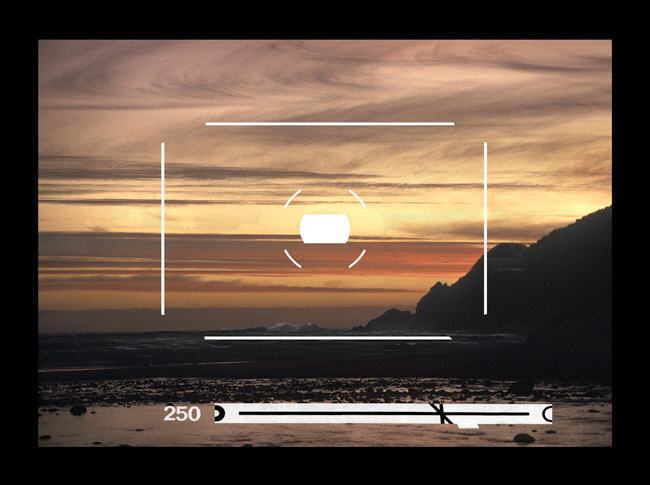
In a word, the M5 viewfinder is cluttered. This is mainly due to the intrusion of the TTL meter readout. In order to incorporate the readout bar the viewfinder mask is slightly larger than that of the M4. This brings with it the added benefit for spectacle wearers by making it easier to see the full viewing area. Otherwise the general overview resembles that of the M4.
The M5 Viewfinder Layout
50mm frameline
The markings shown correspond to those brought up for a 50mm focal length lens
The Viewfinder Markings for 35mm and 135mm Focal Length lenses

35mm and 135mm framelines
The markings shown above automatically appear in the viewfinder when either a 35 mm or 135mm lens is fitted to the camera. This mask may also be previewed by moving the pre selector switch outwards to the 35/135 position.
The large bright-line frame indicates the field of view for 35mm lenses. The metering field for the 35mm focal length is approximated by an imaginary circle around the bounds of the smaller frame corners. This frame also indicates the field of view for 135mm lenses. The metering spot for this focal length is shown by a full circle around the dimensions of the rangefinder focusing patch.
The Viewfinder Markings for the 90 mm lens focal lengths

90mm frameline
Except for the presence of the readout bar the masking for the 90mm focal length is the same as for the M4
In addition, the viewfinder also incorporates some distinctive built-in features to delineate the extent of the metering field for different focal length lenses. For example, a set of four circular arcs surrounding the focusing patch, indicate the metering circumference for the 50mm lens focal length. These bright-line arcs are only visible when a 50mm lens is fitted. (see illustration above)
A peculiarity of the M5 is also the shape of its rangefinder focusing patch. The conventional rectangle shaped patch is extended with semicircular edges on the short sides. This feature marks the extent of the metering field for a 135mm lens focal length. It also serves as an approximation the metering coverage for 90 mm lenses. The metering field for 35mm lenses is estimated using the 135mm bright-line frame as a guide.
Meter readout display
The M5 meter readout is a dual match needle system typical of cameras produced during the 1970s. Why camera manufacturers moved away from this system, I don't know, as it gives the most comprehensive easily readable data of any display type. In keeping with Leica's design tendencies, the M5s metering readout is positioned along the lower extremity of the view finder. An additional illuminator window at the top of the viewfinder lights the "bright-line frame" style readout bar.
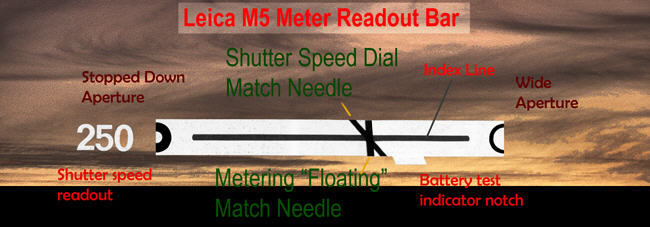
One of the two sloping match needles is governed by the light entering through the lens. This floating needle is free to move as the light intensity changes. Its position is, therefore, controlled by the lens aperture setting. As the lens is stopped down, the floating meter needle responds by moving to the left. That is to say, the needle moves the same direction as the aperture ring is turned. Unfortunately the readout bar does not have a marked scale for lens apertures. Rather, wide apertures are simply indicated to the right-hand side and smaller apertures to the left. However, the display information provided is reasonably comprehensive. With experience actual values can be anticipated from the position of the floating needle along the bar.
The second needle is linked to the shutter speed dial and only moves when the shutter speed is changed. The shutter speed selected is also shown at the left-hand end of the readout bar. This meter needle also moves in the same direction as the shutter selector is wheel. Correct exposure is indicated when the two inclined match needles are made to cross over, either by changing the shutter speed and or lens aperture.
Over all, the readout display of the M5 is both, more comprehensive, and logical compared against the triangular LED balance arrangement of the original M6.
Battery condition check
Unlike subsequent metered Leica Ms, the M5 includes a manual battery test function. This is built in to the viewfinder mask preview lever. In models from the Leica M2 onwards the bright-line frame preview lever has click stop positions for each of the three viewfinder masks, ie the 90 and 28 focal length mask (left) 50 and 75 (central) 35 and 135 (right). The preview lever of the M5 has an additional forth (far right) point beyond the 35/135 focal length position which engages the battery test function. A quirk of the M5 stems from this battery test feature, as the action of preselector lever seems less positive and somewhat sloppy against that felt with other Ms.
In order to check the condition of the battery, the bright-line frame preview arm is held past the 35/135 position ie, pushed fully in the direction away from the lens. Good battery functionality is indicated in the viewfinder by the floating meter needle falling within the notched area under the exposure readout bar. The preset lever returns to it original position once the lever is let go.
Conclusion
In many respects the Leica M5 will always be defined by its troubled history, forever dismissed as hanging the wrong way, the wrong shape, the wrong size, the wrong weight and ultimately designated with the wrong model number. Potential users looking for a metered Leica M dismiss an M5 out of hand, at their own loss. The Leica M5 is arguably the best user model of all the M series. That said the M5 is not for everyone. This is not a camera that engenders blithe indifference; chances are you will either love it or hate it.
The author admits some bias toward this camera. I obtained mine in 1988, a time before the advent of internet fora discussions and therefore before I knew any better. The bottom line is that it is built on the features proven from previous Leicas and shares their build quality attributes. The M5 was the last model to be assembled according to Leica's traditional individual parts hand adjusted methods. Therefore, it has much of the solid smoothness of feel in use, as the more prized earlier models. Over the years the M5 has confirmed itself as a robust reliable tool capable of coping with the most demanding of conditions. Leitz put an enormous amount of thought and effort into developing the M5 and this translates into a very user-friendly photographic tool. After a short introductory period the M5 becomes intuitive to handle.
On the negative side the M5 does have some irritating quirks. Personally, I've never liked the vertical hang of my two lug version but have learned to live with it. Having to make an exposure to switch off the light meter can also be inconvenient at times. Otherwise the intuitive user interface allows the photographer to go about trouble free image making.
At the end of the day, the Leica M5 is simply a good solid work camera.
The Leica M5 User Manual
While Leica is no longer making the M5, you still can find used cameras available. Search Photo.net's Classified Ads Section. You could also consider going digital with the Leica M9.
Funmi Tofowomo Okelola