
RESEARCH DOCUMENT : National Security Agency Tracking of U.S. Citizens - "Questionable Practices" from 1960s & 1970s

Özel Büro (Digi.Security.Isnet)

National Security Agency Tracking of U.S. Citizens – “Questionable Practices” from 1960s & 1970s

Lt. General William P. Yarborough, Army Deputy Chief of Staff for Intelligence. On 20 October 1967, he asked the member agencies of the U.S. Intelligence Board for “any available information on foreign influence over, or control of, civil disturbances in the U.S.”
Published: Sep 25, 2017
Briefing Book #605
Edited by William Burr
For more information contact William Burr: 202/994-7000 and nsar...@gwu.edu
Ralph David Abernathy, Donald Sutherland, Women’s Liberation, and Vietnam Veterans Against the War – Among Those on NSA’s Watch List
NSA Biographic Files Included 73,000 U.S. Citizens, Including Journalists Art Buchwald and Tom Wicker and Actors Joanne Woodward and Gregory Peck
Washington, D.C., September 25, 2017 – The National Security Agency’s (NSA) own official history conflated two different constitutionally "questionable practices" involving surveillance of U.S. citizens, according to recent NSA declassifications published today by the National Security Archive, an independent research organization based at The George Washington University. During the mid-1970s, the U.S. Senate’s Church Committee investigated a number of such “practices” by NSA, including the so-called Watch List program, which monitored the international communications of anti-Vietnam war activists and other alleged “subversives.” The “Watch List” was one of the questionable activities; the other was the NSA’s creation of a voluminous filing system on prominent U.S. citizens whose names appeared in Signals Intelligence (SIGINT) collected by the Agency. That filing system, abandoned in the early 1970s and destroyed in 1973, stayed secret for years.[1]
The files on well-known Americans were a product of the Agency’s sweeping efforts to track the communications of Cold War adversaries and to identify the individuals mentioned in them. Ultimately the filing system, and corresponding indexes, surpassed 1,000,000 names, including 73,000 U.S. citizens mentioned in SIGINT collected by the Agency. Among them were politicians, corporate leaders, trade unionists, Hollywood personalities, and journalists, ranging from Church Committee member Senator Walter Mondale (D-MN) and actor Joanne Woodward to IBM CEO Thomas Watson and United Auto Workers President Leonard Woodcock.
The recent NSA release has more information on the Watch List, such as the identities of a number of targeted individuals and organizations: Canadian actor and antiwar activist Donald Sutherland, civil rights leader Ralph David Abernathy, journalist Seymour Hersh, antiwar activist David Dellinger, the Venceremos Brigade, and an entire social movement, Women’s Liberation.
Four years ago, the National Security Archive published a newly declassified National Security Agency history that included details about the Agency’s Watch List. As it turned out, the Agency’s history mistakenly folded in the NSA’s filing system on U.S. citizens into the Watch List, which focused on social reformers, revolutionaries, anti-war activists, and their organizations. Thus, the history incorrectly stated that Senator Howard Baker and journalists Art Buchwald and Tom Wicker, among others, were on the Watch List. Declassified documents confirm, however, that the NSA included those individuals and 73,000 others as part of the Agency’s name files of U.S. citizens. New documents that the NSA released to the Archive through a mandatory declassification review appeal provide an important corrective to the Agency’s official history by demonstrating that the Watch List and the biographical files were what the Church Committee – the U.S. Senate Select Committee to Study Governmental Operations with Respect to Intelligence Activities, chaired by Senator Frank Church (D-ID) – saw as two different “questionable practices” with respect to the Agency’s treatment of U.S. citizens.
To identify people mentioned in intercepted messages and other SIGINT products, the NSA (and its predecessors) created special indexes and sets of biographical files. The index to the biographical files was the “Rhyming Dictionary” used by NSA analysts as they decrypted and reported on SIGINT. Eventually including over a million names, the “Rhyming Dictionary” was organized in forward and reverse alphabetical order to make it easier for intelligence analysts to access the names of individuals and to retrieve biographical files as needed. When the Agency began to collect the names of U.S. personalities during the 1960s, it included them in the “Rhyming Dictionary” and created corresponding files that ended up filling 8-10 filing cabinets with over 73,000 entries.
According to the newly declassified documents, among the subjects of biographical files were prominent U.S. individuals. Besides Joanne Woodward, Thomas Watson, and Walter Mondale, the files included Washington Posthumorist Art Buchwald, Federal Reserve Board Chairman Arthur Burns, actor Gregory Peck, Congressman Otis Pike (D-NY), New York Times columnist Tom Wicker, civil rights leader Whitney Young, and members of the Senate Select Committee including Howard Baker, Jr., and Frank Church. The Church Committee regarded the creation of files on American citizens by a U.S. intelligence agency as an improper activity, but their specific existence was not disclosed at the time, even though the procedures that generated such files were discussed during hearings.
The NSA’s Watch List, the other dubious activity, had been created in the early 1960s to keep track of U.S. citizens traveling to Cuba. During the following years Watch List targets broadened. After President Kennedy’s assassination, it included possible threats to the president.[2] On 20 October 1967, the Watch List began including anti-Vietnam War and civil rights activists, after U.S. Army intelligence informed the Agency “that Army ACSI, assistant chief of staff for intelligence [General William P. Yarborough], had been designated executive agent by DOD for civil disturbance matters and requested any available information on foreign influence over, or control of, civil disturbances in the U.S.” That comported with the thinking of President Lyndon Johnson who privately claimed that covert financial support from "international Communism" was behind the anti-Vietnam War movement, which was then preparing for a major demonstration in Washington (21 October 1967).[3] To determine whether there were such connections, the Federal Bureau of Investigation began providing hundreds of names for the Agency’s Watch List. During the Nixon administration, the list expanded further to include narcotics traffickers and terrorist organizations.
According to testimony by NSA Director General Lew Allen, in October 1975, U.S. government agencies nominated the names of individuals and organizations that appeared on the Watch List. Thus, to cover the Defense Intelligence Agency’s “requirements on possible foreign control of, or influence on, U.S. antiwar activity,” DIA nominated the names of 20 U.S. persons who traveled to North Vietnam. The FBI “submitted watch lists covering their requirements on foreign ties and support to certain U.S. persons and groups,” with the lists including “names of ‘so-called’ extremist persons and groups … active in civil disturbances, and terrorists.” The FBI lists included about 1,000 individuals. The Secret Service nominated about 180 U.S. individuals and groups that “were potentially a threat to Secret Service protectees.” During 1967-1973, Allen testified, all of the lists combined had a “cumulative total of about 450 U.S. names on the narcotics list, and about 1,200 U.S. names on all other lists.”
Senator Church and his colleagues did not object to Watch Lists of narcotics traffickers or to genuine threats to the president, but they wondered about the “lack of adequate legal basis for some of this activity and what that leads to.” Allen agreed that there was a problem and spoke of “domestic intercepts which cannot be conducted under the President's constitutional authority for foreign intelligence,” which meant that “we are not authorized by law or constitutional authority and they are clearly prohibited.” As General Allen explained, there were “interpretations which deal with the right to privacy [from] unreasonable search and seizure of the fourth amendment.” It was “self-doubt” (referred to in Document 10) that led the NSA to stop accepting Watch Lists with the names of U.S. citizens in the summer of 1973. When Attorney General Elliot Richardson raised questions about the propriety of FBI and Secret Service requests for information from NSA Allen officially closed down the program.
One of the most sensational revelations of the Church Committee was Operation SHAMROCK by which the major telecommunications companies RCA, Western Union, and International Telephone and Telegraph reluctantly shared their telegram traffic with the NSA and its predecessors from 1945 to the early 1970s. Near the program’s end, NSA analysts were reviewing 150,000 telegrams a month. Information from the telegrams provided grist for the Watch List, which, in the words of Frank Church, “resulted in the invasion of privacy of American citizens whose private and personal telegrams were intercepted.” Church also saw a betrayal of trust by companies whose “paying customers who had a right to expect that the messages would be handled confidentially.” In November 1975 those and other considerations led Church and the committee majority to unilaterally declassify facts about the SHAMROCK program over the objections of President Ford. According to former Committee staffer L. Brit Snider, “This was the “only occasion ... where a Congressional committee voted to override a presidential objection and publish information the President contended was classified.”[4]
A mandatory declassification review request by the National Security Archive to the National Security Agency produced the documents in today’s posting. The subject of the request was the sources cited in an endnote to the NSA history. The documents in the Agency’s initial release were excised and more information on the watch list and the Rhyming Encyclopedia was released under appeal. Pending declassification requests to the FBI and other agencies may produce more information on the history of the Watch List.

Lt. General Marshall S. Carter (U.S. Army), formerly Deputy Director of the Central Intelligence Agency, was Director of the NSA when the Watch List program was expanded. He served during 1965-1969.
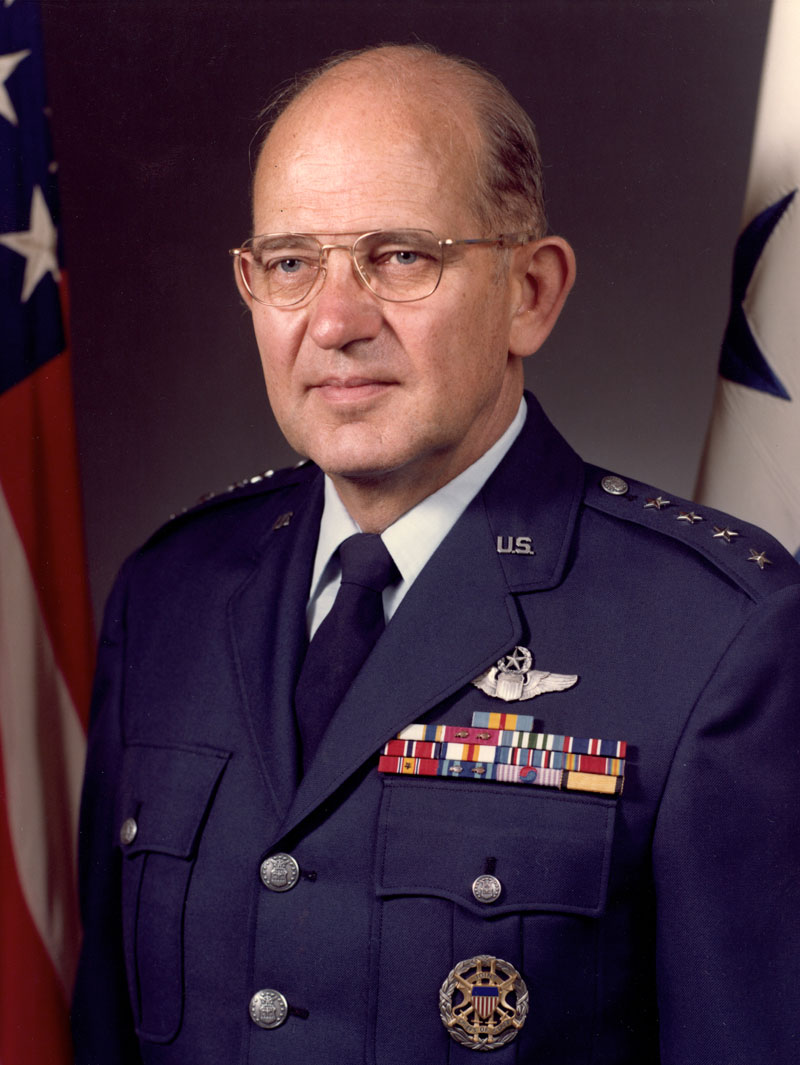
Lt. General Lew Allen (USAF) became NSA Director in August 1973, when the Justice Department began raising questions about the propriety of the Watch List. He was the first NSA Director to testify in public, when he appeared before the Church Committee in October 1975. He later became Air Force Chief of Staff.

Watch List target David Dellinger (1915-2005), anti-war activist and a leading figure in the National Coordinating Committee to End the War in Vietnam. With A. J. Muste, he was a founder and editor of Liberation Magazine (1955-1977), a publication of the pacifist left. With Tom Hayden, Bobby Seale, Rennie Davis, Jerry Rubin, John Froines, Lee Weiner, and Abbie Hoffman, he was a member of “The Chicago Seven,” who were indicted on federal conspiracy charges after the August 1968 protests at the Democratic National Convention. (Photo from Browse Biography)
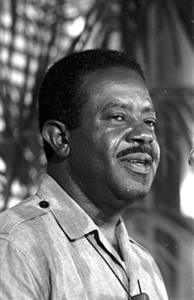
Watch List target Ralph David Abernathy (1996-1990) was, with Martin Luther King, a co-founder of the Montgomery Improvement Association and the Southern Christian Leadership Conference. Like King, Abernathy spoke out against the Vietnam War. (Photo from Legal Legacy)
READ THE DOCUMENT

Work request, 3 July 1967, with 3 annexes attached, including introduction to 1958 Rhyming Dictionary, Confidential, excised copy
1967-07-03
This is a request for the creation of a microfilm copy of the Rhyming Dictionary as it stood at the end of 1958. As Robert Tracy later explained, the Rhyming Dictionary was "an index to biographic files and served as a reference tool for researching names of personalities mentioned in communications." Analysts at the Central Information office used the dictionary "in response to requests from translators, cryptanalysts and SIGINT reporters .... to either complete the name of a personality when it was misspelled, or garbled or to determine his nationality which, in turn, would lead to the country file containing information on the particular individual." The 1958 dictionary included over 1.6 million names of non-Soviet and Soviet "personalities", keyed to their country of origin. Apparently, the biographical files ("Personality Files") were kept on 3x5 inch cards, later 5x8.
With names in forward and reverse order, analysts could use the dictionary to "complete the name of a personality when only the beginning or the ending of the surname is known," "to resolve inconsistencies or variations in spelling of surnames of various nationalities," or "to determine the country file or various country files which may contain information on a surname or a complete name."

"Rhyming Dictionary, 1959-1969," May 1970, Confidential
1970-05-00
This edition of the dictionary included some 1.4 million names, thousands of which were the names of U.S. citizens.

"Rhyming Dictionary, 1970 Supplement," n.d., Confidential
1970-00-00
This edition included 77,000 names of non-Soviet personalities and "unique Soviet surnames" consisting of "Soviets abroad."

"Rhyming Dictionary, 1970-1971 Supplement," n.d., Confidential
1971-00-00
This edition included an additional 106,000 names.

Col. Clayton C. Swears, Acting Chief Central Information Center, Production Organization, to [Excised] Central Intelligence Agency, 13 March 1972, Confidential, Excised copy
1972-03-13
As the CIA was gradually taking over the biographical filing and indexing function under project "Millstream," the NSA sent the agency microfilm copies of the "Rhyming Dictionary," including the ones for 1958 and 1959-1969.

Robert J. Tracy, Chief, C52, National Security Agency, to Distribution, "Rhyming Dictionary (Job No. 15188)," 30 November 1973, Confidential
1973-11-30
With the CIA taking over biographical indexing, Tracy ordered the termination of the project as of 31 December 1973

Memorandum for the record by Robert J. Tracy, "Interview of Mr. Robert Tracy by the Senate Select Committee for the Investigation of Intelligence," 28 August 1975, Secret, excised copy
1975-08-28
Tracy prepared his own record of the interview by Church Committee staffers, during which they asked questions about the Rhyming Dictionary and the names files.

Memorandum for the record by special assistant to the Deputy Director, "Interview of Mr. Robert Tracy by the Senate Select Committee for the Investigation of Intelligence," 28 August 1975, Secret, excised copy
1975-08-28
An agency official also prepared a record of the interview of Tracy by the Church Committee staff.

Memorandum from David D. Lowman, Special Assistant to the Director for Congressional Reviews to the Special Assistant to the Secretary and the Deputy Secretary of Defense, "Preliminary Statement of Robert J. Tracy before the Senate Select Committee on 24 September 1975," 26 September 1975, Secret, excised copy
1975-09-26
For Tracy's testimony before the Church Committee a month later, Tracy prepared a detailed preliminary statement on the Rhyming Dictionary and the name files. In the statement, Tracy said that the Rhyming Dictionary "directly supported SIGINT production by enabling the cryptanalyst to: (a) identify or verify partially known elements of the text such as names of personalities; (b) recover possible verbatim texts; or (c) interpret code or cipher traffic from significant background information."
According to Tracy, during 1959-1973 the dictionary included 1,667,396 names of which 73,141 were U.S. personalities. The files on U.S. names in the dictionary took up 8-10 filing cabinets, whose contents were destroyed in October 1974, "as a matter of economy and reduction of space." In one of the interviews, however, Tracy acknowledged that his "office chief, Mr. Welday," ordered the destruction and he did not know why

[U.S. Senate, Select Committee to Study Governmental Operations with respect to Intelligence Activities], "NSA Monitoring Issues Outline," 10 September 1975, Top Secret, Excised copy
1976-09-10
Besides discovering the SHAMROCK program, the Church Committee's investigators discovered the Watch List program, which the National Security Agency had terminated at the end of 1973. With hearings planned by for the late summer of 1975 the Committee staff worked up detailed questions for director Lew Allen and other senior Agency staff. By 10 September, staffers had prepared 39 pages of questions, some of them apparently based on interviews or access to documents on the genesis and development of the Watch List program, including the letter from General William P. Yarborough dated 21 October 1967, which asked the NSA to begin the activity. The Church Committee shared the questions with the Agency so its officials could prepare in advance and decide how far they would go in providing information.
One of the questions on page 16 concerning watch list "targets" mentioned "illustrative product examples (Times, McIntire, Abernathy, Hersh)," that is, references to individuals/organizations that were on the Watch List. Whether the reference to the New York Times was to all and any of that paper's international communications or to those of specific reporters and columnists is not clear, but its inclusion may have reflected the animus felt by the FBI. The other references are most likely to Carl McIntire, a fundamentalist minister who had organized pro-Vietnam War demonstrations, journalist Seymour Hersh, and Southern Christian Leadership Council president Ralph Abernathy. Hersh's inclusion may have reflected hostility to his journalism (for example about the My Lai massacre in Vietnam), while the FBI leadership's hatred of the civil rights movement is a matter of record, hence the inclusion of Abernathy, who like Martin Luther King opposed the Vietnam War. It would be interesting to know which agency requested McIntire's inclusion and why.
Questions on pages 18, 30, and 31 refer to other targets. One was the Venceremos Brigade (U.S. left-wingers who did volunteer work in Cuba, including the sugar harvest). Some of the targets are mentioned in the context of a question whether Director of Central Intelligence Directive (DCID) 6/3 allowed for the monitoring of communications between foreign citizens in the U.S. and foreign citizens outside the U.S., e.g., "Arab student groups" or communications between U.S. citizens in the U.S. and U.S. citizens overseas: e.g., "Dellinger to Dellinger" and "Cleaver to Cleaver." Plainly those were references to the well-known pacifist activist David Dellinger (who traveled to North Vietnam) and his wife Elizabeth Dellinger and to Black Panther leader Eldridge Cleaver (who fled to Cuba and then Algeria and elsewhere) and Katherine Cleaver.
On page 36, other targets are mentioned: SNCC (Student Nonviolent Coordinating Committee), Black Panthers, Clergy and Laymen Concerned (later Clergy and Laity Concerned), and Vietnam Veterans Against the War, as well as the Jewish Defense League and its leaders: Meir Kahane, and Bertram Zweibon, who initiated a wiretapping lawsuit against the Department of Justice in 1973.

Robert J. Tracy to David D. Lowman, "Rhyming Dictionary Log Entries," 11 September 1975, with attached memorandum for the record, "United States Personalities," 8 November 1963, Secret
1975-09-11
This memorandum and the attachment explain how NSA staffers, beginning as early as 1963, took information on targeted "U.S. personalities" gleaned from SIGINT and entered it into the Rhyming Dictionary and personality files.

Letter from Frederick A. O. Schwarz to Thomas Latimer, 16 September 1975, with attached Tabs A, "Factual Issues" and B, "Proposed Presentation of Issues," Top Secret, excised copy
1975-09-16
In a letter to Thomas K. Latimer, a special assistant on intelligence policy to Secretary of Defense Schlesinger, Schwarz sent a proposed list of "factual issues" for discussion at an executive session of the Church Committee. The committee believed that a wide range of information about "questionable practices" could be discussed in public hearings, including the NSA's monitoring of international lines of communications (ILC), telephone calls and telegrams (Operation SHAMROCK), the Watch List program, and the C-5 files on U.S. citizens.
The discussion of the Watch List included details about its history and the decisions that led to its drastic curtailment at the end of 1973. A list mentioned in the document included Whitney Young, the NAACP, Benjamin Spock, and the Urban League, all of which may have been on the Watch List. Other names definitely on the Watch List were actor Donald Sutherland, requested by the FBI during 1971-73, Congress of Racial Equality leader Roy Innis (FBI, 1971-73, his endorsement of Richard Nixon notwithstanding); the Women's Liberation Movement (Secret Service, 1971-73), Vietnam Veterans Against the War (Secret Service, 1971-73); Quaker Action Group (Secret Service, 1971-73); and Jewish Defense League activist Bertram Zweibon (Secret Service, 1971-73).
Despite the termination of the Watch List, intercepted communications distributed to other agencies continued to refer to U.S. names and entities. To prevent the disclosure of their identities, "NSA now has internal regulations that require that specific U.S. citizens/entities not be identified in any material disseminated to other agencies as a result of ILC intercepts 'only if great intelligence significance is gained by doing so.'"
Schwarz included a list of names of NSA officials from whom the Committee wanted to hear testimony. It included director Lew Allen, but also long-standing officials with knowledge of "questionable practices," including "Mrs. Moody," Milton H. Iredell, and Robert J. Tracy. While Allen and NSA General Counsel Roy Banner testified in public, none of the others did, owing to objections from the White House and the Agency itself.
NSA took issue with a statement on page 5 of the "Factual Issues" report that that the Agency "included the names of U.S. citizens/entities" on the Watch List. In a handwritten comment, someone tried to defend the Agency by writing that it "never put names" on the list and that "it received names from authorized agencies."

Fritz (Frederick A. O.) Schwarz to Members of the Senate Select Committee, "The Executive Session on Friday, September 19," 19 September 1975, Top Secret
1975-09-19
In advance of the executive session with General Allen scheduled for that day, Schwarz sent the committee members a memo reviewing the controversy between the committee and the NSA over what information could be made public. As far as the Agency was concerned, there should be no public hearings and no NSA witnesses. It also objected to declassification of information on the biographic files, the cooperation of the telegraph companies (SHAMROCK), or telephone intercepts except for those relating to drug trafficking. The fact that the Watch List had existed could be disclosed but not the names of individuals or organizations because the Agency wanted to avoid FOIA requests and litigation. The Agency also objected to disclosure of information on its budget because it would "somehow tell other countries of NSA capabilities."
As it turned out, despite the Agency's objections, the Committee held a public hearing, but with only Allen, Banner, and Deputy Director Benson Buffham as witnesses. Allen testified about the Watch List, but the biographical file system remained classified. Nevertheless, as noted earlier, the Church Committee declassified SHAMROCK.

Memorandum from David D. Lowman, Special Assistant to the Director for Congressional Reviews to Mr. Alton H. Quanbeck, Senate Select Committee to Study Governmental Operations with Respect to Intelligence Agencies Staff, "Documents Containing Senator Mondale's Name for the Period 1966-1975," 10 October 1975, Top Secret, excised copy
1975-10-10
Senator Fritz Mondale (D-MN) had been shown some intercepts mentioning his name, which piqued his interest enough for the Agency to do a search and send to the Committee staff 22 reports from 1966-1975 that referred to Mondale.

Handwritten memo from Chief T12, Information Services to Mr. Tracy, Dec. 1978, with attachments and annotated tape inventories, Top Secret, excised copy
1978-12-00
The NSA was out of the rhyming dictionary work ("our job is 'dead''), but records of the dictionaries could be found in the Agency's collections of magnetic tapes. In a memo to Tracy, the T12 office head asked for an inventory of the Rhyming Dictionary, a decision on retaining the tapes, and whether to answer the attached questionnaire regarding the packaging of microfiche. The inventory of tapes (duplicated twice) has some interest because it identifies intelligence targets, such as "China PL/N" (Peoples Liberation Navy), Warsaw "telephone," and "E Berlin phone no."
NOTES
[1]. For background on the history of U.S. SIGINT programs, see Matthew M. Aid, The Secret Sentry: The Untold History of the National Security Agency (New York: The Bloomsbury Publishing, 2007) and James Bamford, The Puzzle Palace: Inside the National Security Agency, America’s Most Secret Intelligence Organization(New York, Penguin, 1982)
[2]. This and the following paragraphs draw on testimony by NSA director Lew Allen and comments by Senator Frank Church in U.S. Senate Select Committee to Study Governmental Operations with Respect to Intelligence, Hearings Before the Select Committee to Study Governmental Operations with Respect to Intelligence Activities of the United States Senate, 94th Congress, First Session, Volume 5, The National Security Agency and Fourth Amendment Rights,October 29 and November 6, 1975 (Washington, D.C.: Government Printing Office, 1976); Also, on the Watch List, see Bamford, The Puzzle Palace, 316-323.
[3]. Johnson’s suspicions led to demands on the CIA for intelligence demonstrating the link between domestic protests and the Communist movement. Dissatisfied with the Agency’s conclusions that student unrest was a “home-grown phenomenon,” Johnson and his advisers pressed DCI Richard Helms for more information to make the opposite case. Those pressures led to CIA snooping on student movements--“Operation Chaos”-- an activity that transgressed the Agency’s charter, but DCI Richard Helms complied with Johnson’s requests, without protest (although there was dissent within the Agency). See Thomas Powers, The Man Who Kept the Secret, Richard Helms & the CIA (New York: Alfred A. Knopf, 1979), 245-246; Rockefeller Commission, Report of the President's Commission on CIA Activities Within the United States, 130-150.
[4]. L. Britt Snider, “Unlucky SHAMROCK: Recollections from the Church Committee's Investigation of NSA,” Studies in Intelligence, Winter 1999-2000, 43-52; U.S. Senate, Select Committee to Study Governmental Operations with Respect to Intelligence Activities, Supplementary Detailed Staff Reports on Intelligence Activities and the Rights of Americans Book III(Washington, D.C.: Government Printing Office, 1976), 740
[status draft]
[nogallery]
[geotag on]
[publicize off|twitter|facebook]
[category araştırma]
[tags RESEARCH DOCUMENT, National Security Agency, U.S. Citizens]


