
Trinity River Restoration Program // River Riffle Newsletter - July Edition

Abel, Jennifer (Kiana)
Contents
-
Current Conditions: Stay up to date on summer conditions in the basin: Fish Health, Reservoir Conditions & Temperature
-
Program Updates: Sawmill Rehabilitation In-River Period of Work Begins July 15
- Trinity River Watershed Spotlight: Watershed Restoration Grant Program - 2026
- Upcoming Meetings and Events
- Reading, Listening & Watching
Current Conditions

Screenshot of the KFHAT map which presents the readiness level from Report #6 in the Klamath Basin. Click here to access the 2026 reports.
Fish Health
The Klamath Fish Health Assessment Team (KFHAT) hold regular meetings throughout the summer months to assess Klamath Basin Fish Health.
Determinations are currently favorable for the lower Klamath and Trinity basin, however, conditions continue to be of concern in the the Upper Mid Klamath. Migrant traps are catching a high percentage of dead juvenile fish downstream of Iron Gate (likely related to C. shasta and other pathogens).
Upper Trinity River catch rates have been low, but are picking up. Most fish are healthy with some showing minor gill rot. Lower Trinity fish that have been handled
are reported to be in good condition.

Screenshot on July 14 of Trinity Reservoir Elevation in comparison to select water years shown from CDWR. Check Trinity Reservoir Storage Conditions | CDWR
Trinity Reservoir Conditions
Trinity Reservoir is at 80% capacity. Snowpack for the 2026 water year was below average and reports indicate that the Central Valley Project will rely more heavily on stored water through the spring and summer, including from Trinity Reservoir.

Temperature
Keep tabs on Trinity River temperatures by bookmarking the USGS gauge links below.
- Trinity River gauge at Lewiston CA – USGS
- Trinity River gauge at Douglas City, CA – USGS
- Trinity River gauge at NF Trinity R NR Helena CA – USGS
- Trinity River gauge at Hoopa CA – USGS
Program Update

July 15 | In-River Work Period Begins at Sawmill
Sawmill Gravel Processing Site Channel Rehabilitation Project
Lewiston, Ca. - The in-river work period begins on July 15 for the restoration project at Sawmill. Crews will be focused on access, wood instillation, excavation and fill.
During rehabilitation, the river does experience short-term impacts. To mitigate impacts to salmon and other wildlife, experts monitor to minimize turbidity, wildlife presence, and machinery impact.
Please contact us with any questions: (530) 623-1800 and/or click here to read more.
Trinity River Watershed

Photo Credit: [WRTC/Ben Sparks]
Watershed Restoration Program - 2026
This summer the TRRP are involved in funding the design and/or implementation to support projects happening in several places throughout the Trinity River watershed.
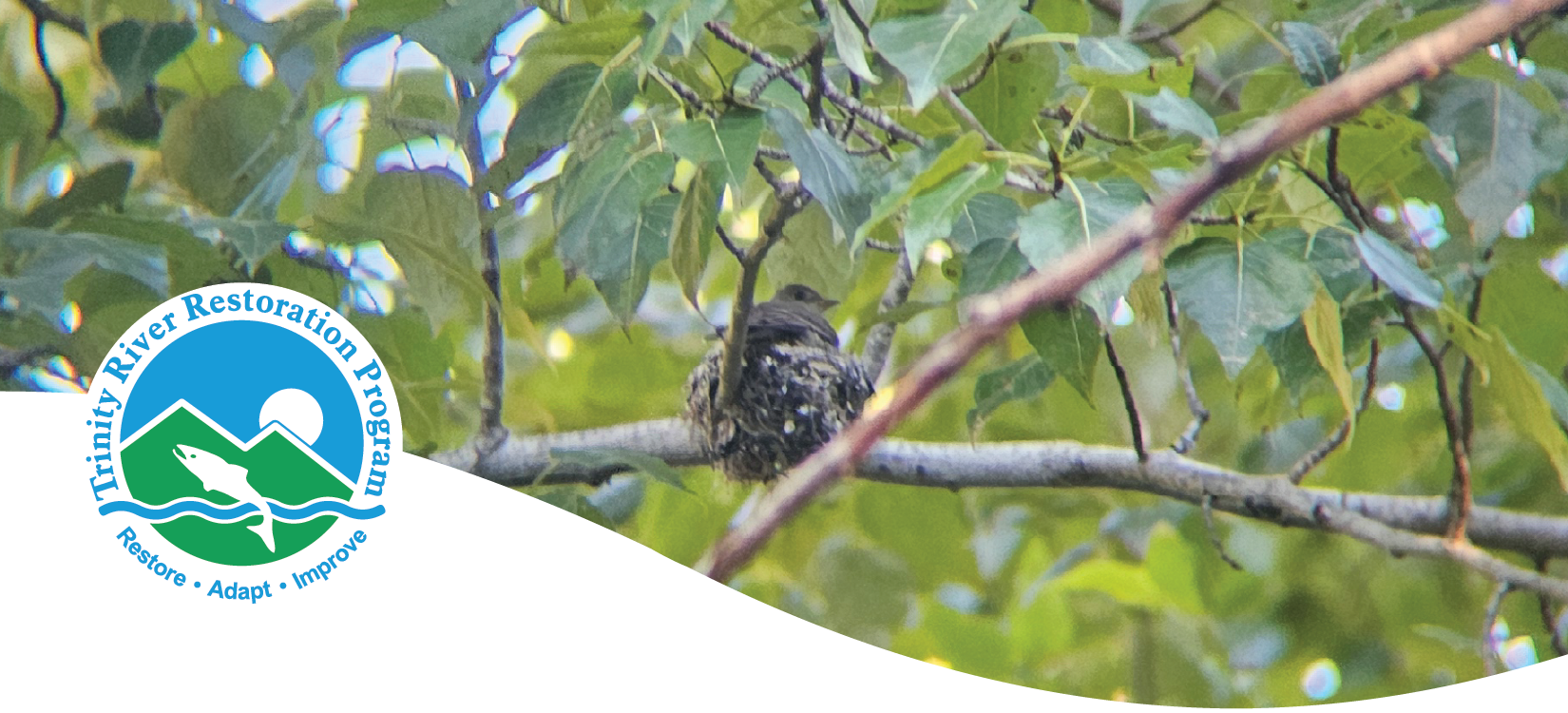
The July newsletter header image and photo in this section were taken on the Weaver Creek Habitat Rehabilitation Project site earlier this month. During pre-construction wildlife surveys, crews discovered a nest containing an adult Western wood-pewee (Contopus sordidulus) and 3 chicks in a cottonwood tree near a designed access route. Due to the presence of the nest the Yurok Tribe Construction Corporation and Yurok Tribe Fisheries staff designated a 100+ft buffer exclusion zone so construction activities and noise would not bother the newly hatched chicks and food-finding parents. To read more about the Weaver Creek Habitat Restoration and other projects happening in the basin, click here.
Upcoming Meetings and Events
For a full list of events, click to view the TRRP Calendar.

Summer Art Contest
How to Paint a Coho | How to Paint a Steelhead | How to Paint a Chinook | How to Paint a Green Sturgeon

July 28 | Reclamation to Hold Quarterly Meeting to Provide Update on the Long-Term Operation of the Central Valley Project and State Water Project
SACRAMENTO, Calif. — On Tuesday, July 28, between 1 p.m. and 3 p.m., Reclamation will hold a quarterly meeting to provide an update on the Long-Term Operation of the Central Valley Project and State Water Project, pursuant to the Water Infrastructure Improvements for the Nation Act. The meeting will be held virtually on Microsoft Teams. For previous meeting materials and the link to this upcoming meeting, visit www.usbr.gov/mp/bdo.

August 6-10 | Hoopa Sovereign Days
Visit the Hoopa Valley Tribe during the 38th Annual Sovereign Days, taking place August 6–10, 2026! We and many others will be present on the Tribal Lawn to talk salmon on Friday August 7, 10-4pm.
Be sure to check out the full schedule and start making plans to join us for one of Hoopa's biggest celebrations of the year. Event Details

Sept. 23, 6 p.m.| Science on Tap
Globally, bees are the most important group of pollinators and are critical components of natural and agricultural systems. While bee diversity is high in California, the Klamath region is not well studied relative to biodiversity hotspots in montane and desert systems in southern reaches of the state. This talk explores the diversity, ecology, and conservation of native bees, with an emphasis on those found in the Klamath-Siskiyou ecoregion.
Our speaker, Mac Wilson is an ecologist that recently completed his master's degree at Cal Poly Humboldt studying bird, bat, and bee communities on licensed cannabis farms. Currently, he is a senior field technician at Cannabis for Conservation where he works on a collaborative research project exploring bumble bee community dynamics and development of novel methods for monitoring bumble bees and other invertebrates. Event Details
September 23 & 24 | All Day Quarterly TMC Meeting
In Person: TRRP Office in Weaverville
Meeting ID: 265 801 011 886 73
Passcode: wm7YZ9LR
Reading, Listening, Watching

Screenshot from High Country News; Image: Juvenile fall run Chinook salmon on Spencer Creek in the Upper Klamath Basin this May. [Paul Wolf Wilson]
The Klamath Tribes couldn’t get federal dollars for salmon. Then the Yurok stepped in
High Country News | By 'Toastie' Oaster | Jul. 2, 2026
For more than 100 years, salmon had been absent from the Klamath Tribe’s lands — a fact that cut them off from funding sources to fix that. Continue Reading...

Image screenshot from Sea Grant California
These Rain Gardens Were Never Meant to Catch Microplastics. They Do Anyway
Sea Grant California | By Ute Eberle | Jul. 1, 2026
California's roadside biofilters were built for an earlier era of pollution. Two new studies asked whether they could handle microplastics — and got a surprisingly clear answer Continue Reading...
Image screenshot from Sea Grant California

Image: Screenshot taken from the article website Trout Unlimited
Is it too hot?
Trout Unlimited | Staff Article | Jun. 30, 2026
Did you know that trout are cold blooded? What does that mean, exactly? Well, it means that their body temperature depends on the temperature of the water in which they swim. Why is this important to consider? Continue Reading...
