GLOBAL DIMMING: The Cause of Climate Intervention?

HAROLD SAIVE
GLOBAL DIMMING: The Cause of Climate Intervention?
https://newsparadigm.substack.com/p/global-dimming-the-cause-of-climate
https://newsparadigm.substack.com/p/global-dimming-the-cause-of-climate
Implications of Global Dimming
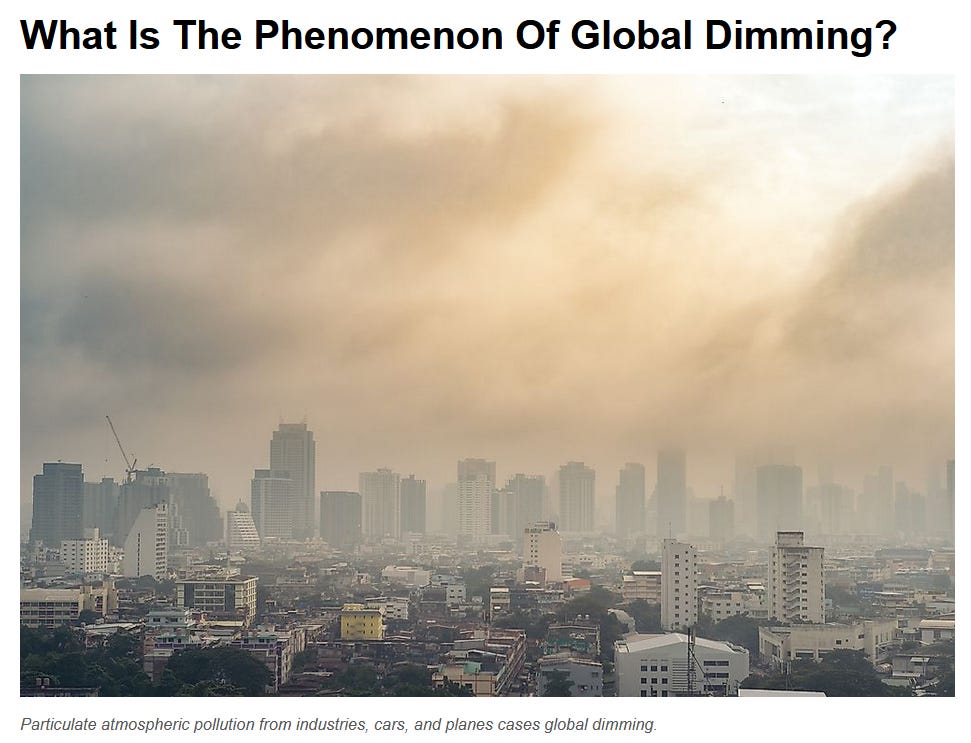
Global dimming refers to the reduction in the amount of solar radiation reaching the Earth’s surface, a phenomenon first observed systematically in the 1950s. This decrease is primarily attributed to atmospheric particulate matter, such as sulfate aerosols, which are components of air pollution. These aerosols can scatter or absorb solar radiation and influence cloud formation. Stratospheric aerosols such as those released from Mt. Pinatubo in 1991, can create clouds that reflect sunlight back into space.
Global dimming has several implications, including interfering with the water cycle by lowering evaporation and potentially reducing rainfall in certain areas. It can affect agriculture by reducing the sunlight reaching plants, which in turn impacts photosynthesis rates and can lead to lower crop yields and concerns for food security.
Perspectives
Mitigating Global Warming
Some scientists propose geoengineering strategies, such as continuously spraying sulfur high into the stratosphere, to intentionally create a dimming effect to buy time against global warming.
Environmental and Societal Risks:
Global dimming negatively impacts ecosystems and can lead to lower crop yields due to decreased sunlight, which affects photosynthesis and raises concerns for food security.
It interferes with hydrological cycles, lowering evaporation and reducing rainfall, which has been linked to severe events like the 1984 Ethiopian famine.
Any cooling effect caused by global dimming is not uniformly beneficial and can hurt ecosystems while also accelerating global warming if dark, carbon-rich particles settle on Arctic snow, causing it to melt.
Potential side effects of deliberately dimming the sun include turning the sky white and plunging entire regions into ecological chaos.
Airline contrails warm the planet twice as much as CO2, EU study finds (Link)
While airline contrails have featured less in our skies during the pandemic, an EU study published today finds they are among the non-CO2 emissions which contribute twice as much to global warming as aircraft CO2.[1] The research, by leading scientists, finds that jet engine emissions of nitrogen oxides, water vapor, soot and black carbon were responsible for two-thirds of aviation’s climate impact in 2018. Transport & Environment (T&E) said it is an acknowledgement by the European Commission that contrails finally need to be addressed. (Link)
Is Climate Intervention Seen as a Fix?
Some climate scientists, like David Travis have created a hypothesis that the condensation trails created by airplanes lead to global dimming. The ongoing global air traffic never allowed the thesis to be proved, but after the 9/11 “terror attacks” no plane took off for three days. This rare event with air traffic grounded allowed climate scientists to determine the diurnal temperature excursion to be +1.8 degree Celsius higher than the day before the flights were grounded. Such a high difference between high and low temperatures had not been measured at that spot in over 30 years. This finding supported Travis’ theory that contrails are warming the earth by trapping gasses in the atmosphere. This is in addition to the higher CO2 levels due to the turbofan engine combustion.
Travis’s finding had already been supported by the 1999 IPCC “SPECIAL REPORT on AVIATION AND THE GLOBAL ATMOSPHERE” where on page 7 it’s reported: “Contrails” tend to warm the Earth’s surface, similar to thin high clouds.” (PDF) - HERE
Sources: HERE — Mt. Pinatubo Sources HERE
News Paradigm is a reader-supported publication. To receive new posts and support my work, consider becoming a free or paid subscriber.