
[My Textile Notes] Matt, Hopsack or Basket Weaves
337 views
Skip to first unread message

Priyank
Jan 12, 2010, 9:54:30 PM1/12/10
to the-foun...@googlegroups.com
MATT, HOPSACK OR BASKET WEAVES
Simple matt weaves are those in which groups of two or more adjacent warp threads and picks interlace with each others so as to produce a chequered or dice effect.

Regular Matt Weaves
The simplest of these weaves is known as two-and-two and four-end matt weaves as indicated in figure above, in which warp threads and picks interweave in pairs throughout the fabric, on the principle of plain weaves.
Irregular Matt Weaves
Variegated or irregular matt weaves are developed by combining irregular groups of warp and weft threads.
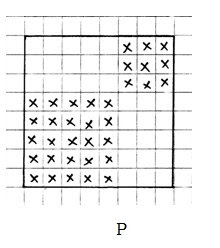
P = 5/3 matt irregular
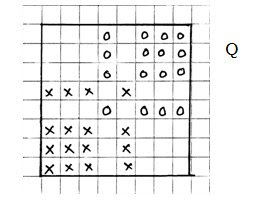
Q = Fancy basket which in combination of warp and weft Rib. 3/1, 1/3 fancy basket
R = Centre Stitched Hopsack Derivative

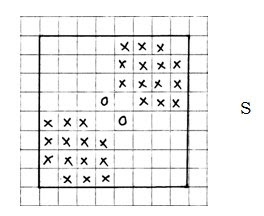
S = Barley corn Hopsack.
T = Stitched Hopsack-stitching is done everywhere except centre.

Further extension of Hopsack Weaves (Variegated Hopsack)
The purpose of modifying Hopsack Weaves is to make the surface more firm and to get more variety of patterns.
Self Stitched hopsack weaves.
In this weave one end is (or pair of ends) stitched down to give fancy appearance to fabric.
How to make a self stitched Hopsack
Let us take a 3-and-3 hopsack. It is represented as
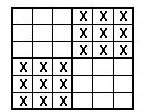
We see that it is divided into four parts. To make it self-stitched , reverse the working of the centre of each small square , that is where weft is up, make it down and where warp is up make it weft up as shown in the given figure:

We can also modify the hopsack by another method. Again we take the same weave as A and reverse the float at one corner of each small square to get the required weave as shown below:

Barley Corn Weaves
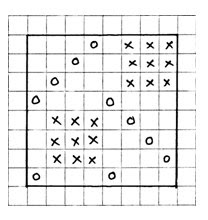
The Barley Corn weaves are modified hopsack weaves which employ cross twill in their designs. The cross-twill in the designs gives a considerable degree of firmness to a cloth as compared with ordinary hopsacks of similar sizes.
Stitched Hopsacks
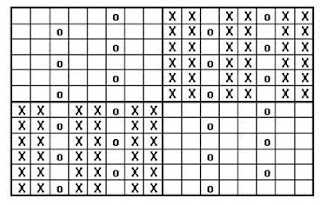
Stitched Hopsacks are used to impart firmness to large weaves by the introduction of plain stitching threads. In Design below the plain threads are introduced only in the warp , so that the float in the weft sections of the design are broken. This is known as Hopsack with Single Line Stitch.
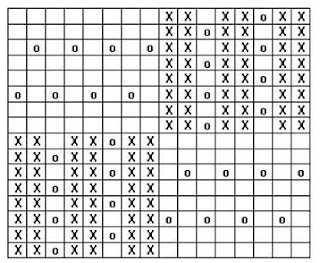
Similarly we can make Hopsack with Double line Stitch in which certain threads of both series interweave plain to produce similar warp and weft sections as given below
Compared to plan weave, hopsack fabrics tend to have a softer drape and hand. They are more wrinkle resistance and permit more air to pass through them. They however, shrink more, have more yarn slippage and less abrasion resistance.
Common Fabrics classified by Identifying characteristics
• Light weight, transparent, sheer, unbalanced: dimity (also ribweave)
• Medium weight, opaque, balanced look, soft hand-oxford cloth, chambray, sail cloth.
• Heavy weight, operque, balanced look, soft hand: Hopsack, monk’s cloth.
• Heavy weight, opaque, balanced look, crisp hand: duck and canvas.
Now that you've finished reading this post, what are you going do? You should go join the Forum.
--
Posted By Priyank to My Textile Notes on 1/13/2010 08:24:00 AM
Simple matt weaves are those in which groups of two or more adjacent warp threads and picks interlace with each others so as to produce a chequered or dice effect.

Regular Matt Weaves
The simplest of these weaves is known as two-and-two and four-end matt weaves as indicated in figure above, in which warp threads and picks interweave in pairs throughout the fabric, on the principle of plain weaves.
Irregular Matt Weaves
Variegated or irregular matt weaves are developed by combining irregular groups of warp and weft threads.
P = 5/3 matt irregular

Q = Fancy basket which in combination of warp and weft Rib. 3/1, 1/3 fancy basket

R = Centre Stitched Hopsack Derivative

S = Barley corn Hopsack.

T = Stitched Hopsack-stitching is done everywhere except centre.

Further extension of Hopsack Weaves (Variegated Hopsack)
The purpose of modifying Hopsack Weaves is to make the surface more firm and to get more variety of patterns.
Self Stitched hopsack weaves.
In this weave one end is (or pair of ends) stitched down to give fancy appearance to fabric.
How to make a self stitched Hopsack
Let us take a 3-and-3 hopsack. It is represented as

We see that it is divided into four parts. To make it self-stitched , reverse the working of the centre of each small square , that is where weft is up, make it down and where warp is up make it weft up as shown in the given figure:

We can also modify the hopsack by another method. Again we take the same weave as A and reverse the float at one corner of each small square to get the required weave as shown below:

Barley Corn Weaves
The Barley Corn weaves are modified hopsack weaves which employ cross twill in their designs. The cross-twill in the designs gives a considerable degree of firmness to a cloth as compared with ordinary hopsacks of similar sizes.

Stitched Hopsacks
Stitched Hopsacks are used to impart firmness to large weaves by the introduction of plain stitching threads. In Design below the plain threads are introduced only in the warp , so that the float in the weft sections of the design are broken. This is known as Hopsack with Single Line Stitch.

Similarly we can make Hopsack with Double line Stitch in which certain threads of both series interweave plain to produce similar warp and weft sections as given below

Compared to plan weave, hopsack fabrics tend to have a softer drape and hand. They are more wrinkle resistance and permit more air to pass through them. They however, shrink more, have more yarn slippage and less abrasion resistance.
Common Fabrics classified by Identifying characteristics
• Light weight, transparent, sheer, unbalanced: dimity (also ribweave)
• Medium weight, opaque, balanced look, soft hand-oxford cloth, chambray, sail cloth.
• Heavy weight, operque, balanced look, soft hand: Hopsack, monk’s cloth.
• Heavy weight, opaque, balanced look, crisp hand: duck and canvas.
Now that you've finished reading this post, what are you going do? You should go join the Forum.
--
Posted By Priyank to My Textile Notes on 1/13/2010 08:24:00 AM
Reply all
Reply to author
Forward
0 new messages