
[My Textile Notes] Plain Weave Variations- Ribs and Chords
12 views
Skip to first unread message

Priyank
Jan 11, 2010, 10:12:37 PM1/11/10
to the-foun...@googlegroups.com
PLAIN WEAVE VARIATIONS- Ribs and Chords
This group of structure comprises of different simple weaves which are all extensions of the plain weave and can be produced on two heald shafts.
RIB AND CORD EFFECT PRODUCED IN PLAIN WEAVE
Ribs refer to the lines in horizontal direction like ≡ whereas cord refers to the lines running in vertical direction │││There are many ways to produce rib and cords, some of these methods are as follows:
(1) By using different counts of warp and wefts
By using different counts of threads, ribbed or corded effects can be produced throughout the fabric.
The ribs or cords will be is the direction of coarsest threads. The figure illustrates an example of cloth woven from comparatively fine warp and coarse weft which develop a series of ribs lying in the direction of weft and known as warp ribs.
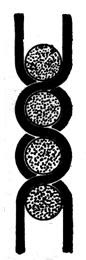
If we take coarse warp and fine weft, the ribs would be called the weft ribs.
(2) By using tension difference within warps and wefts
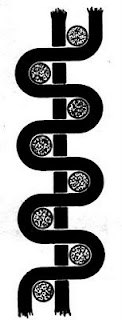
Rib formation can be also be done by taking two series of warp threads. One series of warp threads is at higher tension than the other. Only one system of coarse and soft weft is used. During weaving the warp thread from higher tension beams are held taut. Thus during weaving they are prevented from bending, as shown: This causes weft to form prominent ribs on both sides of the cloth. The slack warp threads freely bend over and under picks of weft to bind these firmly in position.

(4) By Using Normal Warp and Weft
Here we make use of the principle of fabric structure which says that “The relative prominence of threads diminishes in proportion to the amount of bending performed by them in the cloth.”
Here the ribs or cords may be formed by causing two or more threads of one series (i.e. either warp or weft) to lie closely side by side, so as to virtually constitute a coarse thread composed of several strands not twisted together, and interweaving such groups of threads with separate threads of other side.
Ribs
Simple ribs in the direction of weft may be formed by separating alternate warp threads (as in calico plain weave) and inserting two or more picks of the weft in the same warp shed. Figures shown below are designs for this class of rib weaves containing two, there, four and six picks respectively in each warp shed:

Cords
Similarly simple cords in the direction of warp may be formed by raising warp threads in uniform group of two or more threads. Figure given below are the designs for chords in which three, four and six warp threads respectively are grouped together.
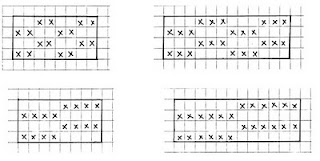
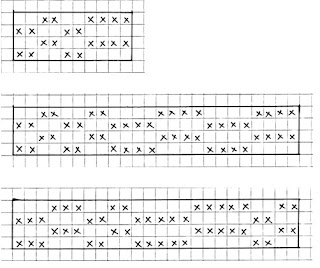
As the horizontal and vertical lines produced in the above two cases are regular in size so these are known as regular warp and weft ribs respectively Figures given below represent irregular or variegated chords which are unequal in size. Similarly irregular ribs can be produced by turning these figures to sides.
Performance Characteristics of Ribs and Cords compared to plain weave fabrics
Ribs are more subject to yarn slippage and raveling. They are less abrasion resistant, softer and crisper if crisper yarn is used.
Now that you've finished reading this post, what are you going do? You should go join the Forum.
--
Posted By Priyank to My Textile Notes on 1/12/2010 08:42:00 AM
This group of structure comprises of different simple weaves which are all extensions of the plain weave and can be produced on two heald shafts.
RIB AND CORD EFFECT PRODUCED IN PLAIN WEAVE
Ribs refer to the lines in horizontal direction like ≡ whereas cord refers to the lines running in vertical direction │││There are many ways to produce rib and cords, some of these methods are as follows:
(1) By using different counts of warp and wefts
By using different counts of threads, ribbed or corded effects can be produced throughout the fabric.
The ribs or cords will be is the direction of coarsest threads. The figure illustrates an example of cloth woven from comparatively fine warp and coarse weft which develop a series of ribs lying in the direction of weft and known as warp ribs.

(2) By using tension difference within warps and wefts
Rib formation can be also be done by taking two series of warp threads. One series of warp threads is at higher tension than the other. Only one system of coarse and soft weft is used. During weaving the warp thread from higher tension beams are held taut. Thus during weaving they are prevented from bending, as shown: This causes weft to form prominent ribs on both sides of the cloth. The slack warp threads freely bend over and under picks of weft to bind these firmly in position.

(3) By using two series of both warp and weft
In this the warp series comprise two counts of yarn, one fine and strong, which is held at greater tension during weaving, and the other coarse and soft, which is held at a lesser degree of tension. The weft series also comprise two counts of yarn one fine and strong and the other very coarse and strong.
When coarse picks are inserted, all medium warp threads only are raised to form ribs, and when fine picks are inserted, all fine warp threads only are raised, it causes deep furrows (dents) as shown in figure:

(4) By Using Normal Warp and Weft
Here we make use of the principle of fabric structure which says that “The relative prominence of threads diminishes in proportion to the amount of bending performed by them in the cloth.”
Here the ribs or cords may be formed by causing two or more threads of one series (i.e. either warp or weft) to lie closely side by side, so as to virtually constitute a coarse thread composed of several strands not twisted together, and interweaving such groups of threads with separate threads of other side.
Ribs
Simple ribs in the direction of weft may be formed by separating alternate warp threads (as in calico plain weave) and inserting two or more picks of the weft in the same warp shed. Figures shown below are designs for this class of rib weaves containing two, there, four and six picks respectively in each warp shed:

Cords
Similarly simple cords in the direction of warp may be formed by raising warp threads in uniform group of two or more threads. Figure given below are the designs for chords in which three, four and six warp threads respectively are grouped together.

As the horizontal and vertical lines produced in the above two cases are regular in size so these are known as regular warp and weft ribs respectively Figures given below represent irregular or variegated chords which are unequal in size. Similarly irregular ribs can be produced by turning these figures to sides.

Performance Characteristics of Ribs and Cords compared to plain weave fabrics
Ribs are more subject to yarn slippage and raveling. They are less abrasion resistant, softer and crisper if crisper yarn is used.
Now that you've finished reading this post, what are you going do? You should go join the Forum.
--
Posted By Priyank to My Textile Notes on 1/12/2010 08:42:00 AM
Reply all
Reply to author
Forward
0 new messages