
Restoring an episode in Hindu history: Aurangzeb exhibition in Shivaji Maharaj Museum of Indian History, Pune

S. Kalyanaraman
AURANGZEB, AS HE WAS ACCORDING TO MUGHAL RECORDS
AN EXHIBITION MOUNTED BY FACT - INDIA
 Aurangzeb, Emperor Shah Jahan's sixth son, was born on 24th October 1618 at Dohad in Madhya Pradesh, and wrested India's crown from his father before the end of June 1658, after defeating his brother Prince Dara Shukoh's armies, first at Dharmat near Ujjain (15th April 1568) and the second, led by Dara himself, at Samugarh on 29th May 1658. The War of Succession to the richest throne in the world was practically over with this victory, and Aurangzeb secured his position by making Murad, his brother and accomplice in his impetuous pursuit for power, his prisoner, by treachery, on 25th June. He had already made his old father Emperor Shah Jahan a prisoner in the Agra Fort (8th June 1658).
Shah Jahan survived his confinement by nearly eight years and the disgraceful manner of his burial (Exhibit No. 5) will ever remain a stigma on this unscrupulous son Aurangzeb's advent to the throne in his father's life time was not welcomed by the people of India, because of the treacherous manner it was achieved; but public opinion became all the more hostile towards him when Prince Dara Shukoh, the favourite son of Shah Jahan, the translator of the Upanishads (Exhibit No. 2), and a truly liberal and enlightened Musalman, was taken prisoner on the Indian border, as he was going to Persia. Dara was paraded in a most undignified manner on the streets of Delhi on 29th August 1659. The French Doctor, Bernier, was an eye-witness to the scene and was deeply moved by the popular sympathy for Dara (Exhibit No. 3) which so much alarmed Aurangzeb that he contrived to have a decree from his Clerics announcing death-sentence for his elder brother on the charge of apostasy (Exhibit No. 4).
Throughout the War of Succession, Aurangzeb had maintained that he was not interested in acquiring the throne and that his only object was to ward off the threat to Islam, which was inevitable in case Dara Shukoh came to power. Many, including his brother Murad, were deceived by this posture. After his formal accession in Delhi (5th June 1659) he posed as a defender of Islam who would rule according to the directions of the Shariat, and with the advice of the Clerics or Ulama for whom the doctrines, rules, principles and directives, as laid down and interpreted in the 7th and 8th century Arabia, Persia and Iraq, were inviolable and unchangeable in all conditions, in all countries, and for all times to come.
One of the main objectives of Aurangzeb's policy was to demolish Hindu temples. When he ordered (13th October 1666) removal of the carved railing, which Prince Dara Shukoh had presented to Keshava Rai temple at Mathura, he had observed 'In the religion of the Musalmans it is improper even to look at a temple', and that it was totally unbecoming of a Muslim to act like Dara Shukoh (Exhibit No. 6, Akhbarat, 13th October 1666). This was followed by destruction of the famous Kalka temple in Delhi (Exhibit No. 6, 7, 8, Akhbarat, 3rd and 12th September 1667).
In 1669, shortly after the death of Mirza Raja Jai Singh of Amber, a general order was issued (9th April 1669) for the demolition of temples and established schools of the Hindus throughout the empire and banning public worship (Exhibit Nos. 9 & 10). Soon after this the great temple of Keshava Rai was destroyed (Jan.-Feb. 1670) (Exhibit No. 12) and in its place a lofty mosque was erected. The idols, the author of Maasir-i-Alamgiri informs, were carried to Agra and buried under the steps of the mosque built by Begum Sahiba in order to be continually trodden upon, and the name of Mathura was changed to Islamabad. The painting (Exhibit No. 13) is thus no fancy imagination of the artist but depicts what actually took place.
This was followed by Aurangzeb's order to demolish the highly venerated temple of Vishwanath at Banaras (Persian text, Exhibit No. 11), Keshava Rai temple (Jan.-Feb. 1670) (Persian Text, exhibit No. 12 and Painting, Exhibit No. 13), and of Somanatha (Exhibit No. 14).To save the idol of Shri Nathji from being desecrated, the Gosain carried it to Rajputana, where Maharana Raj Singh received it formally at Sihad village, assuring the priest that Aurangzeb would have to trample over the bodies of one lakh of his brave Rajputs, before he could even touch the idol (Exhibit No. 15)
Aurangzeb's zeal for temple destruction became much more intense during war conditions. The opportunity to earn religious merit by demolishing hundreds of temples soon came to him in 1679 when, after the death of Maharaja Jaswant Singh of Jodhpur in the Kabul Subah, he tried to eliminate the Rathors of Marwar as a political power in Rajputana. But Maharana Raj Singh of Mewar, in line with the great traditions of his House, came out in open support of the Rathors.. This led to war with both Mewar and Marwar during which the temples built on the bank of Rana's lake were destroyed by his orders (Exhibit No. 23, Akhbarat 23rd December 1679) and also about three hundred other temples in the environs of Udaipur. (Exhibit No. 25, Text), including the famous Jagannath Rai temple built at a great cost in front of the Maharana's palace which was bravely defended by a handful of Rajputs (Exhibit Nos. 20, 21).
Not only this, when Aurangzeb visited Chittor to have a view of the famous fort, he ordered the demolition of 63 temples there which included some of the finest temples of Kumbha's time (Exhibit No. 22). From Marwar (in Western Rajasthan) alone were brought several cart-loads of idols which, as per Aurangzeb's orders, were cast in the yard of the Court and under the steps of Jama Masjid (Exhibit No. 19). Such uncivilized and arrogant conduct of the Mughal Emperor alienated Hindus for ever, though they continued to be tolerant towards his creed.
In June 1681, orders, in a laconic two-liner, were given for the demolition of the highly venerated Jagannath Temple in Orissa (Exhibit No. 24, Akhbarat, 1st June 1681). Shortly afterwards, in September 1682, the famous Bindu-Madhav temple in Banaras was also demolished as per the Emperor's orders (Exhibit No. 27, Akhbarat, Julus 26, Ramzan 20). On 1st September 1681, while proceeding to the Deccan, where his rebel son Prince Akbar, escorted by Durga Das Rathore, had joined Chhatrapati Shivaji's son, Shambhaji, thus creating a serious problem for him, Aurangzeb ordered that all the temples on the way should be destroyed. It was a comprehensive order not distinguishing between old and newly built temples (Exhibit No. 26, Akhbarat, Julus 25, Ramzan 18). But in the district of Burhanpur, where there were a large number of temples with their doors closed, he preferred to keep them as such, as the Muslims were too few in number in the district. (Exhibit No. 28, Akhbarat 13th October 1681). In his religious frenzy, even temples of the loyal and friendly Amber state were not spared, such as the famous temple of Jagdish at Goner near Amber (Exhibit Nos. 30, Akhbarat, 28th March and 14th May 1680). In fact, his misguided ardour for temple destruction did not abate almost up to the end of his life, for as late as 1st January 1705 we find him ordering that the temple of Pandharpur be demolished and the butchers of the camp be sent to slaughter cows in the temple precincts (Akhbarat 49-7).
The number of such ruthless acts of Aurangzeb make a long list but here only a few have been mentioned, supported by evidence, mostly contemporary official records of Aurangzeb's period and by such credible Persian sources as Maasir-i-Alamgiri.
In obedience to the Quranic injunction, he reimposed Jizyah on the Hindus on 2nd April 1679 (Exhibit No. 16), which had been abolished by Emperor Akbar in 1564, causing widespread anger and resentment among the Hindus of the country. A massive peaceful demonstration against this tax in Delhi, was ruthlessly crushed. This hated tax involved heavy economic burden on the vast number of the poor Hindus and caused humiliation to each and every Hindu (Exhibit No. 18). In the same vein, were his discriminatory measures against Hindus in the form of exemption of the Muslims from the taxes (Exhibit No. 31, Akhbarat 16th April 1667) ban on atishbazi and restriction on Diwali (Exhibit No. 32), replacement of Hindu officials by Muslims so that the Emperor's prayers for the welfare of Muslims and glory of Islam, which were proving ineffective, be answered (Exhibit Nos. 33, 34). He also imposed a ban on ziyarat and gathering of the Hindus at religious shrines, such as of Shitla Mata and folk Gods like Pir Pabu (Exhibit No. 35, Akhbarat 16th September 1667), another ban on their travelling in Palkis, or riding elephants and Arab-Iraqi horses, as Hindus should not carry themselves with the same dignity as the Muslims! (Exhibit No. 36). In the same vein came brazen attempts to convert Hindus by inducement, coercion (Exhibit No. 41) or by offering Qanungoship (Exhibit No. 44, 45, 46) and to honour the converts in the open Court. His personal directions were that a Hindu male be given Rs.4 and a Hindu female Rs.2 on conversion (Exhibit No. 43, Akhbarat 7th April 1685). “Go on giving them”, Aurangzeb had ordered when it was reported to him that the Faujdar of Bithur, Shaikh Abdul Momin, had converted 150 Hindus and had given them naqd (cash) and saropas (dresses of honour) (Exhibit No. 40, Akhbarat, 11th April 1667). Such display of Islamic orthodoxy by the State under Aurangzeb gave strength and purpose to the resistance movements such as of the Marathas, the Jats, the Bundelas and the Sikhs (Exhibit No. 46).
On the 12th May 1666, the dignity with which Shivaji carried himself in the Mughal court and defied the Emperor's authority, won him spontaneous admiration of the masses. Parkaldas, an official of Amber (Jaipur State) wrote in his letter dated 29th May 1666, to his Diwan. “Now that after coming to the Emperor's presence Shivaji has shown such audacity and returned harsh and strong replies, the public extols him for his bravery all the more …” (Exhibit No. 37). When Shivaji passed away on April 1680 at the age of 53 only, he had already carved a sufficiently large kingdom, his Swarajya, both along the western coast and some important areas in the east as well.
Aurangzeb could never pardon himself for his Intelligence in letting him escape from his well laid trap and wrote in his Will (Exhibit No. 48) that it made him 'to labour hard (against the Marathas) to the end of my life (as a result of it)”. He did not realize that it was his own doing: the extremely cruel manner 'even for those times - in which he put to death Shivaji' son, Shambhaji (Exhibit No. 38) made the Maratha king a martyr in the eyes of the masses and with that commenced the People' War in Maharashtra and the Deccan which dug the grave of the Mughal empire.
Till the very end Aurangzeb never understood that the main pillars of the government are the affection and support of the people and not mere compliance of the religious directives originating from a foreign land in the seventh-eighth centuries.
His death after a long and ruinous reign lasting half a century, ended an eventful epoch in the history of India. He left behind a crumbling empire, a corrupt and inefficient administration, a demoralized army, a discredited government facing public bankruptcy and alienated subjects.

Source: AurangzebHall2.pdf
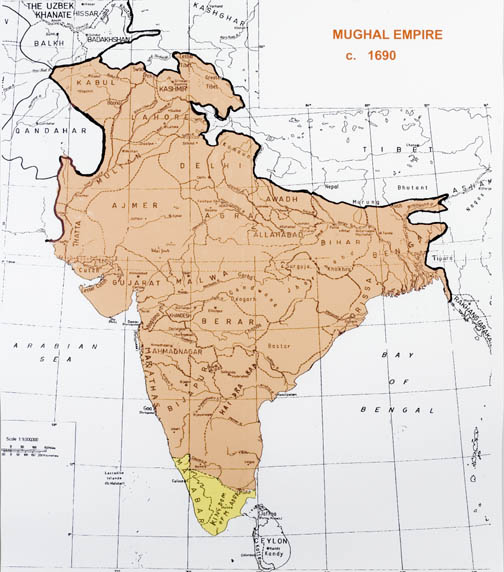 Exhibit No. 1: Mughal Empire map based on sheet o A 16 A of Irfan Habib's "An Atlas of Mughal Empire", Oxford Univ. Press, Delhi. (1982)
Source: http://www.aurangzeb.info/2008/06/exhibit-no_1814.html
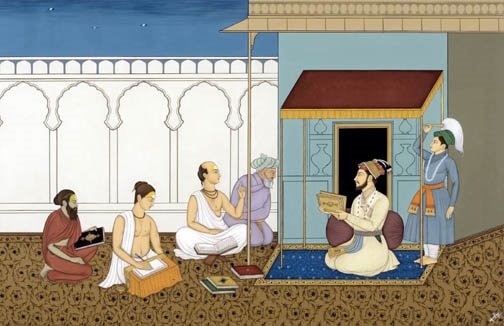 Exhibit No. 2: Prince Dara Shukoh translating the Upanishads.
Prince Dara Shukoh, the eldest son of Emperor Shah Jahan, was like his great ancestor Akbar, a very liberal and enlightened Musalman and a true seeker of truth. Akbar respected all religions – Islam, Hinduism, Christianity, Zoroastrianism, Jainism, Sikhism, etc., and gave their votaries complete religious freedom. He was ever keen to discuss and understand their religious beliefs, practices and philosophy and, in order to make the Musalmans familiar with the culture, and universal values, philosophy and traditions of India, he had the great epics of India – Ramayana and Mahabharat – translated into Persian. He also arranged for the translation of the Atharvaveda.
Continuing the unfinished work of Emperor Akbar, Prince Dara Shukoh too, assisted by the Indian scholars, translated Bhagvad Gita, Prabodha Chandrodaya (a philosophical drama written in 1060 A.D.), and Yoga Vashishtha into Persian. He also translated the Upanishadas, which are the fountain-head of Indian philosophy, with the help of learned Pandits from Banaras, well versed in the Vedas and the Upanishadas. The translation of the Upanishadas by him entitled Sirr-i-Akbar (The Grand Secret) was completed on the 28th June 1657, shortly before the commencement of the War of Succession, which he lost to his crafty and unscrupulous brother, Aurangzeb who ruled India from 1659-1707.
In the painting, Dara is shown translating the Upanishadas, assisted by Indian scholars. http://www.aurangzeb.info/2008/06/exhibit-no_7645.html
 Exhibit No. 3: Scene of Captive Dara being paraded in Delhi. (29th April 1659)
The painting based on Dr. Bernier’s eyewitness account, shows captive Dara Shukoh and his son being carried on an elephant on the streets of Delhi, girt round by troops ready to foil any attempt to rescue the prisoner, and led by Bahadur Shah on an elephant. Behind Prince Dara Shukoh is Nazar Beg, their goaler. Dara is shown throwing his wrapper to a beggar who had cried out, “Dara! When you were master, you always gave me alms, today I know well thou hast naught to give”. Describing the scene Bernier writes, “The crowd assembled was immense; and everywhere I observed the people weeping and lamenting the fate of Dara in the most touching language … men, women and children were wailing as if some mighty calamity had happened to themselves”.
The outburst of popular sympathy for Dara Shukoh and the contemptuous response which Aurangzeb had received from the people for his outrageous treatment of his brother made him procure in all haste a decree from the Clerics in his own pay, and had his elder brother beheaded on the charge of apostasy.
This was a sad end of a genuine seeker of truth, translator of the Upanishadas, author of many works on Sufi philosophy, and one who could have revived and carried the enlightened policies of his great ancestor Akbar to fulfillment.
http://www.aurangzeb.info/2008/06/exhibit-no_8839.html
 Exhibit No. 6: Keshava Rai Temple. "Even to look at a temple is a sin for a Musalman", Aurangzeb. Umurat-i-Hazur Kishwar-Kashai Julus (R.Yr.) 9, Rabi II 24 / 13 October 1666.
‘It was reported to the Emperor (Aurangzeb) that in the temple of Keshava Rai at Mathura, there is a stone railing presented by Bishukoh (one without dignity i.e. Prince Dara, Aurangzeb's elder brother). On hearing of it, the Emperor observed, "In the religion of the Musalmans it is improper even to look at a temple and this Bishukoh has installed this kathra (barrier railing). Such an act is totally unbecoming of a Musalman. This railing should be removed (forthwith)”. His Majesty ordered Abdun Nabi Khan to go and remove the kathra, which is in the middle of the temple. The Khan went and removed it. After doing it he had audience. He informed that the idol of Keshava Rai is in the inner chamber. The railing presented by Dara was in front of the chamber and that, formerly, it was of wood. Inside the kathra used to stand the sevakas of the shrine (pujaris etc.) and outside it stood the people (khalq)’.
Note:
Aurangzeb's solemn observation recorded in his own Court's bulletin that "In the religion of the Musalmans it is improper even to look at a temple" and therefore, presentation of a stone railing to Keshava Rai temple by Dara was "totally unbecoming of a Musalman" casts serious doubts about a few instances of religious toleration and temple grants attributed to him. Only two years before his long awaited death, he had ordered (1st January 1705) to “demolish the temple of Pandharpur and to take the butchers of the camp there and slaughter cows in the temple … It was done”. Akhbarat, 49-7, cited in J.N. Sarkar, Aurangzeb, Vol.III, 189).
http://www.aurangzeb.info/2008/06/exhibit-no_7171.html
 Exhibit No. 7: Demolition of Kalka's Temple - I. Siyah Waqa'i- Darbar Regnal Year 10, Rabi I, 23 / 3 September 1667.
"The asylum of Shariat (Shariat Panah) Qazi Abdul Muqaram has sent this arzi to the sublime Court: a man known to him told him that the Hindus gather in large numbers at Kalka's temple near Barahapule (near Delhi); a large crowd of the Hindus is seen here. Likewise, large crowds are seen at (the mazars) of Khwaja Muinuddin, Shah Madar and Salar Masud Ghazi. This amounts to bid‘at (heresy) and deserves consideration. Whatever orders are required should be issued.
Saiyid Faulad Khan was thereupon ordered (by the Emperor) to send one hundred beldars to demolish the Kalka temple and other temples in its neighbourhood which were in the Faujdari of the Khan himself; these men were to reach there post haste, and finish the work without a halt".
Note:
Kalkaji's temple which stands today was rebuilt soon after Aurangzeb's death (1707 A.D.) on the remains of the old temple dedicated to Goddess Kali. The two Akhbarat dated R.Yr. 10, Rabi I, 23 and Rabi II, 3 (Sept.3 and Sept. 12, 1667) provide details regarding the demolition of the temple on Aurangzeb's orders. Since 1764, the temple has been renovated and altered several times but the main 18th century structure more or less remains the same. The site is very old dating back to Emperor Asoka's time (3rd century B.C.). There is mention of Kalkaji in the Maratha records of 1738. People flock to the temple in large numbers especially during Navratras.
http://www.aurangzeb.info/2008/06/exhibit-no_5608.html
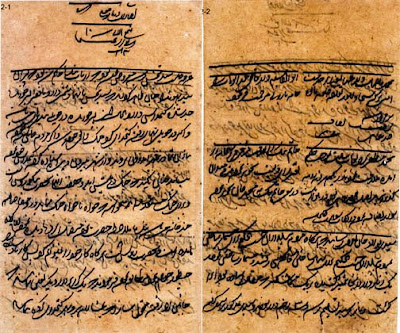 Exhibit No. 8: Demolition of Kalka Temple II. Siyah Akhbarat-i-Darbar-i-Mu‘alla Julus 10, Rabi II 3 / 12 September 1667.
"Saiyad Faulad Khan reported that in compliance with the orders, beldars were sent to demolish the Kalka temple which task they have done. During the course of the demolition, a Brahmin drew out a sword, killed a bystander and then turned back and attacked the Saiyad also. The Brahmin was arrested”.
Note:
There are only a few recorded instances of armed opposition by outraged Hindus, such as at Goner (near Jaipur), Ujjain, Udaipur and Khandela, but there must have been many more such instances of angry outbursts and resistance against Muslim vandalism which do not find mention in the official papers of Emperor Aurangzeb.
Most of the Hindus took the destruction of these temples philosophically considering these as acts of ignorance and folly for a vain purpose. They regarded that it was beyond the understanding or intelligence of the Musalmans to comprehend the principle behind the idol worship or the fundamental oneness of saguna and nirguna worship. The Hindus believed that the Gods and Goddesses leave for their abode before the hatchet or the hammer of the vile “mlecchas” or “asuras” so much as even touched the idols. The idea has been well described in Kanhadade Prabandha (wr. 1456 A.D.) when giving an account of the destruction of the Somnath temple by Sultan Alauddin's troops in 1299.
http://www.aurangzeb.info/2008/06/exhibit-no_4008.html
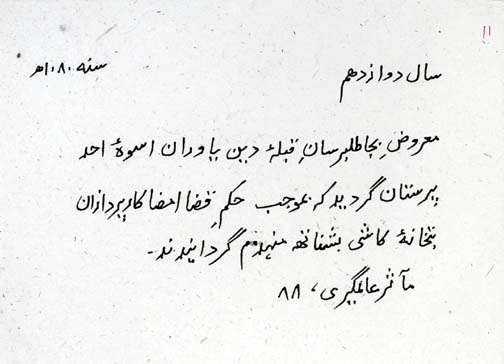 Exhibit No. 11: Demolition of the temple of Viswanath (Banaras). August 1669 A.D.
It was reported that, “according to the Emperor’s command, his officers had demolished the temple of Viswanath at Kashi”. (Maasiri-‘ Alamgiri, 88)
Note:
Kashi is one of the mort sacred towns in India and reference to the worship of Shiva as Vishveshvara goes back to very early times. Kashi itself enjoys highest sanctity since times immemorial. According to the Puranas, every foot-step taken in Kashi Kshetra has the sanctity of making a pilgrimage to a tirtha. Lord Vishvanatha is regarded as the protector of Kashi and the belief is that one earns great religious merit by having darshana (view) of the deity after having bathed in the Ganges. After destruction of the temple on Aurangzeb’s orders, a mosque was built which still stands there as a testimony of the great tolerance and spirit of forgiveness of the Hindus even towards those who had for centuries desecrated and destroyed their temples and other places of worship and learning, and also as a lesson that “mutually uncongenial cultures”, when forced by circumstances to intermingle in the same Geographical area, result in such calamities. A portion of the sculpture of the demolished temple, probably built in the late 16th century, still survives to tell the fate of Aurangzeb’s vandalism and barbarity. The present temple of Vishveshvara was built by Ahilya Bai Holkar of Indore.
http://www.aurangzeb.info/2008/06/exhibit-no_4620.html
 Exhibit No. 14: Demolition of Somnath temple.
About the time the general order for destruction of Hindu temples was issued (9th April 1669), the highly venerated temple of Somanath built on the sea-shore in Kathaiwad was also destroyed. The famous temple was dedicated to Lord Shiva. In the 11th century, the temple was looted and destroyed by Mahmud Ghaznavi. It was rebuilt by King Bhim Deva Solanki of Gujarat and again renovated by Kumarapal in 1143-44 A.D. The temple was again destroyed by Alauddin Khalji’s troops in 1299. In a rare description of the scene of a temple destruction, like of which continued to occur time and again during the long and disastrous rule of the Musalman rulers in India, we have the following account. “The Mlechchha (asura) stone breakers”, writes Padmanabha in his classic work “climbed up the shikhar of the temple and began to rain blows on the stone idols on all three sides by their hammers, the stone pieces falling all around. They loosened every joint of the temple building, and then began to break the different layers (thara) and the sculptured elephants and horses carved on them by incessant blows of their hammers. Then, amidst loud and vulgar clamour, they began to apply force from both the sides to uproot the massive idol by means of wooden beams and iron crowbars” (Kaanhadade Prabandha, Canto I, vss. 94-96).
After the destruction of Somnath temple during Alauddin’s time, it was rebuilt again. When Aurangzeb gave orders for its destruction, the scene must have been little different from the one described by Padmanabha. The artist in his painting has tried to recreate the scene.
http://www.aurangzeb.info/2008/06/exhibit-no_9931.html
 Exhibit No. 18: Hindus forced to suffer humiliation in paying the Jizyah tax.
On 2nd April 1679, Aurangzeb re-imposed Jizayah upon the Hindus which had been abolished by Emperor Akbar in 1564. The author of Maasir-i-Alamgiri writes: ‘As all the aims of the religious Emperor (Aurangzeb) were directed to the spreading of the law of Islam and the overthrow of the practices of the infidelity, he issued orders ….. that from Wednesday, the 2nd April 1679/1st Rabi I, in obedience to the Qur’anic injunction, “till they pay Jizyah with the hand of humility”, and in agreement with the canonical traditions, Jizyah should be collected from the infidels (zimmis) of the capital and the provinces’.
The economic burden of Jizyah was felt most by the poor who formed the vast majority of the Hindus; for the middle classes and the rich, it was not so much the economic burden which mattered but the humiliation involved in the prescribed mode of payment, which the Jizyah collector could always insist upon, as of right i.e. by insisting that he would accept it only when paid personally. The Qur’anic injunction that war must be made upon all those who do not profess Islam “till they pay Jizyah out of their hand and they are humiliated”, was interpreted to mean that the Hindus must be made conscious of their inferior position when paying this tax.
In the painting, a number of Hindus, both rich and poor are lining up to pay Jizyah while the arrogant Jizyah collector is picking up the coins from the palm of a Hindu Jizyah payer. Some people have come from the neighbouring areas in their bullock-carts; their bullocks are resting under the shade of the trees.
http://www.aurangzeb.info/2008/06/exhibit-no_512.html
 Exhibit No. 36: Restrictions on the Hindus: forbidden to travel in Palkis, or ride on elephants and Arab-Iraqi horses.
In March 1695, all the Hindus, with the exception of the Rajputs, were forbidden to travel in palkis, or ride on elephants or thorough-bred horses, or to carry arms. (Muntakhab-ul-Lubab, ii, 395; Maasir-i-Alamgiri, 370 and News Letter, 11 December 1694).
In the sketch, well to do Hindus are being made to alight from palki (sedan chair), elephant and good horse by Mughal officers. The need to issue this derogatory order was the requirement also recorded in Fatwa-i-‘Alamgiri, that Hindus should not be allowed to look like Muslims, that is carry themselves with the same dignity. The folly and futility, or even danger of applying or observing the guiding principles, practices and law prescribed, interpreted, or recommended in the seventh and eighth centuries in Arabia, after a lapse of ten centuries in a country like India, was never realized by the Muslim clerics or their Emperor.
http://www.aurangzeb.info/2008/06/exhibit-no_7371.html
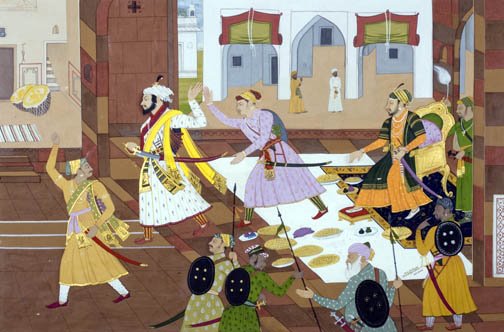 Exhibit No. 37: Shivaji leaving Aurangzeb’s Court in anger.
Shivaji reached Agra on the 12th May 1666 by noon, and had to be rushed to the Court to attend the special darbar on Aurangzeb’s 50th lunar birthday. Shivaji was presented to the Emperor by Asad Khan in the Diwan-i-Khas and was then directed to stand in the line of 5 hazari mansabdars. “The Emperor neither talked nor addressed any word to him”. The work of the court proceeded and Shivaji seemed to have been forgotten.
Shivaji was not expecting this kind of reception. He was very much upset when Kumar Ram Singh (son of Mirza Raja Jai Singh of Amber), in response to his query, informed him that the noble standing in front of him was Maharaja Jaswant Singh of Jodhpur. He flared up “Jaswant, whose back my soldiers have seen! I to stand behind him? What it all means”?
He was made to feel neglected in other ways also. At this he began to fret and “his eyes became wet with anger”. The Emperor noticed the commotion and told Ram Singh, “Ask Shivaji, what ails him”. When Kumar came, Shivaji burst forth, “You have seen, your father has seen, and your Padishah has seen, what sort of man I am, and you have wilfully made me stand up so long. I cast off your mansab ….”.
After saying this he then and there turned his back to the throne and rudely walked away. Kumar Ram Singh caught hold of his hand, but Shivaji wrenched it away …’
In the painting, the above scene, based on a contemporary letter, has been depicted. Shivaji is shown coming out of the Court in great anger, his back towards Aurangzeb, his sword half drawn, and Kumar Ram Singh of Amber trying in vain to pacify him. Wrote Parkaldas of Amber to the State’s Diwan in his letter of 29th May 1666, “The people had been praising Shivaji’s high spirit and courage before. Now that after coming to the Emperor’s presence he has shown such audacity and returned harsh and strong replies, the public extols him for his bravery all the more …”
http://www.aurangzeb.info/2008/06/exhibit-no_7893.html
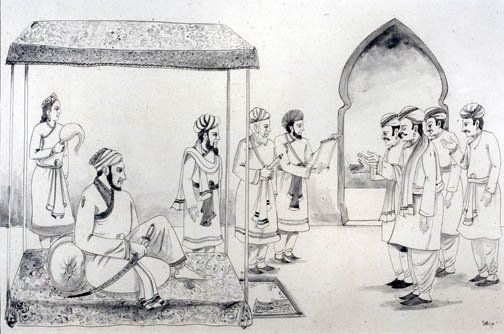 Exhibit No. 44: Aurangzeb restoring the office of qanungoship to Hindu officials who were forced to become Musalman.
Qanungoship on becoming Musalman:
There are a large number of Akhbarat (Aurangzeb’s Court Bulletins) which mention that either Qanungoi was restored on becoming Musalman, or that a person or persons were appointed Qanungos on accepting Islam, or that they agreed to become Musalman, obviously under pressure or as inducement.
A typical entry in the Akhbarat, such as of R.Yr. 10, Zilqada / April 22, 1667, reads “Makrand etc., in all four persons, became Musalman. The Qanungoi of Parganah Khohri was restored to them. Four Khil‘ats were conferred upon them”. Sir Jadunath Sarkar is right in saying that “Qanungoship on becoming a Muslim”, had become a proverb.
As Qanungo had intimate knowledge of the customs and tenures of the land, he could serve as the best agent for protecting the interests of the Musalmans and in extending influence of Islam in the rural areas. The sketch shows four Qanungos being restored their Qanungoi on becoming Musalman.
http://www.aurangzeb.info/2008/06/exhibit-no_6222.html

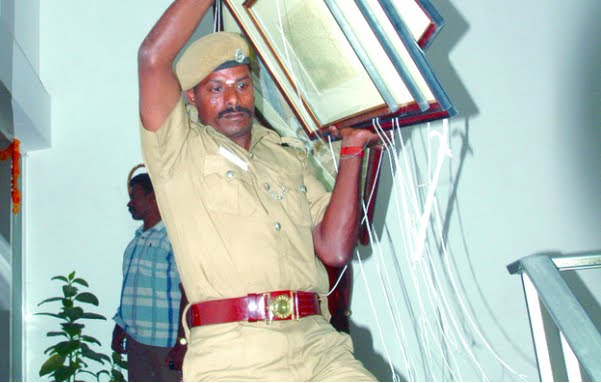 Nobody could thus question the historicity of our Aurangzeb paintings, but nevertheless, when we exhibited them in Chennai in 2009, the nawab of Arcot, whose ancestor was nominated by Aurangzeb, complained to the then CM’s son, Stalin, who got the police to close down the exhibition...The police, were extremely harsh: they threw some of the paintings on the ground & imprisoned the two harmless old ladies who were guarding the exhibition.
Links:
BOOKS
History of Aurangzib by Sir Jadunath Sarkar in 3 volumes published by Orient BlackSwan
DOWNLOADS
- Ma'asir-i Alamgiri of Saqi Musta'd Khan Download
- History of Aurangzib (Vol. 1), Sir Jadunath Sarkar Download
- History of Aurangzib (Vol. 2), Sir Jadunath Sarkar Download
- Aurangzeb responsible for 4.6 million deaths
- Destruction of Hindu Temples by Aurangzeb
- Why did Aurangzeb Demolish the Kashi Vishvanath?
S. Kalyanaraman

Thirumala Raya Halemane
these mughal atrocities with many, many ancient sacred temples destroyed by the invaders with their barbaric and unjust rule, terrorizations, carnage, forced conversions, abusive treatment of hindus, are things that indian society, all indian people must condemn and find ways to reject and then come out of the traumatic mental hangover and heaviness that has been holding us back because of it.
it is the ancient sanatana dharma heritage (and the temples) which is common to all indian people, and they have the natural right and responsibility to reclaim and restore all destroyed or damaged ancient sacred places, if they choose to do so, and, whenever or wherever feasible.
this will help the entire indian society, irrespective of their current status. foreign invading aggressive ideology rulers do not have any "right" to destroy or damage temples that were sacred to the people of the land and to forcefully build mosques over them.
================
__._,_.___
Reply via web post Reply to sender Reply to group Start a New Topic Messages in this topic (1) ![Yahoo! Groups]() .
.![]()
__,_._,___--
With regards to all,
------Mukund Apte

Kumar Arun
From: kumar...@yahoo.com
Date: Sun, 16 Dec 2012 07:35:13 -0800
Subject: Re: [media_monitor5] Restoring an episode in Hindu history: Aurangzeb exhibition in Shivaji Maharaj Museum of Indian History, Pune
1. Qawwat al-Islam Mosque at Delhi: "According to my findings the first mosque of Delhi is Qubbat al-Islam or Quwwat al_Islam which, Qutubud-Din Aibak constructed in H. 587 after demolishing the hindu temple built by Prithvi Raj and leaving certain parts of the temple outside the mosque proper; and when he returned from Ghazni in H. 592 he started building, under orders from Shihabud -Din Ghori, a huge mosque of inimitable red stones, and certain parts of the temple were included in the mosque..."
2.The Mosque at Jaunpur: "This was built by Sultan Ibrahim Sharqi with chiselled stones. Originally it was a Hindu temple after demolishing which he constructed the mosque. It is known as the Atala Masjid.."
5.Babri Masjid at Ayodhya: "This mosque was constructed by Babar at Ayodhya which Hindus call the birth place of Ramchandraji... Sita had a temple here in which she lived and cooked for her husband. On that very site Babar constructed this mosque in H.963 "
Name Of The Book: Futuhu'l-Buldan Name Of The Historian: Ahmed bin Yahya bin Jabir About The Author: This author is also known as al- Biladhuri. He lived at the court of Khalifa Al- Mutawakkal (AD 847-861) and died in AD 893. His history is one of the major Arab chronicles. The Muslim Rulers He Wrote About:
1.Ibn Samurah (AD 653) Siestan (Iran) "On reaching Dawar, he surrounded the enemy in the mountain of Zur, where there was a famous Hindu temple." "...Their idol of Zur was of gold, and its eyes were two rubies. The zealous Musalmans cut off its hands and plucked out its eyes, and then remarked to the Marzaban how powerless was his idol..."
4.Hasham bin 'Amru al-Taghlabi Khandahar (Maharashtra) "He then went to Khandahar in boats and conquered it. He destroyed the Budd(idol) there, and built in its place a mosque."
Name Of The Book: Tarikh-i-Tabari Name Of The Historian: Abu Ja'far Muhammad bin Jarir at-Tabari About The Author: This author is considered to be the foremost
historian of Islam. The above mentioned book written by him is regarded as the mother ofhistories. The Muslim Rulers He Wrote About:
5.Qutaibah bin Muslim al-Bahili (AD 705-715) Beykund (Khurasan) "The ultimate capture of Beykund (in AD 706) rewarded him with an incalculable booty; even more than had hitherto fallen into the hands of the Mohammedans by the conquest of the entire province of Khorassaun; and the unfortunate merchants of the town, having been absent on a trading excursion while their country was assailed by the enemy, and finding their habitations desolate on their return contributed further to enrich the invaders, by the ransom which they paid for the recovery of their wives and children. The oranments alone, of which these women had been plundered, being melted down, produce, in gold, 150,000 meskals; of a dram and a half each. Among the articles of the booty, is also described an image of gold, of 50,000 meskals, of which the eyes were two pearls, the exquisite beauty and magnitude of which excited the surprise and admiration of Kateibah. They were transmitted by him, with a fifth of the spoil to Hejauje, together with a request that he might be permitted to distribute, to the troops, the arms which had been found in the palace in great profusion."
Samarkand (Farghana) "A breach was, however, at last effected in the walls of the city in AD 712 by the warlike machines of Kateibah; and some of the most daring of its defenders having fallen by the skill of his archers, the besieged demanded a cessation of arms to the following day, when they promised to capitulate. The request was acceded to the Kateibah; and a treaty was the next day accordingly concluded between him and the prince of Samarkand, by which the latter engaged for the annual payment of ten million of dhirems, and a supply of three thousand slaves; of whom it was particularly stipulated, that none should either be in a state of infancy, or ineffective from old age and debility. He further contracted that the ministers of his religion should be expelled from their temples and their idols destroyed and burnt; that Kateibah should be allowed to establish a mosque in the place of the principal temple...."
6.Yaqub bin Laith (AD 870-871) Balkh and Kabul (Afghanistan)
Name Of The Book: Tarikhu'l-Hind Name Of The Historian: Abu Rihan Muhammad bin Ahmad al-Biruni al-Khwarizmi.About The Author: This author spent 40 years in India during the reign of Sultan Mahmud of Ghazni (AD 997 - 1030). His history treats of the literature and learning of the Hindus at the commencement of the 11th century.
The Muslim Rulers He Wrote About:
8.Sultan Mahmud of Gazni (AD 997-1030) Thanesar (Haryana) "The city of Taneshar is highly venerated by Hindus. The idol of that place iscalled Cakrasvamin, i.e. the owner of the cakra, a weapon which we have already described. It is of bronze, and is nearly the size of a man. It is now lying in the hippodrome in Ghazna, together with the Lord of Somnath, which is a representation of the penis of the Mahadeva, called Linga." Somnath (Gujrat) "The linga he raised was the stone of Somnath, for soma means the moon and natan means master, so that the whole word means master of the moon. The image was destroyed by the Prince Mahmud, may God be merciful to him! --AH 416. He ordered the upper part to be broken and the remainder to be transported to his residence, Ghaznin, with all its coverings and trappings of gold, jewels, and embroided garments. Part of it has been thrown into the hippodrome of the town, together with Cakrasvamin , an idol of bronze, that had been brought from Taneshar. Another part of the idol from Somnath lies before the door of the mosque of Ghaznin, on which people rub their feet to clean them from dirt and wet."
Name Of The Book: Kitabu'l-Yamini Name Of The Historian: Abu Nasr Muhammad ibn Muhammad al Jabbaru'l-Utbi.About The Author: This author's work comprises the whole of the reign of Subuktigin and that of Sultan Mahmud down to the year AD 1020.
The Muslim Rulers He Wrote About:
Amir Sbuktigin Of Ghazni Lamghan (Afghanistan) "The Amir marched out towards Lamghan, which is a city celebrated for its great strength and abounding wealth. He conquered it and set fire to the places in its vicinity which were inhabited by infidels, and demolishing idol temples, he established Islam in them. He marched and captured other cities and killed the polluted wretches, destroying the idolaters and gratifying the Musulmans." Sultan Mahmud of Ghazni (AD 997-1030) Narain (Rajasthan) "The Sultan again resolved on an expedition to Hind, and marched towards Narain, urging his horses and moving over ground, hard and soft, until he came to the middle of Hind, where he reduced chiefs, who, up to that time obeyed no master, overturned their idols, put to the sword the vagabonds of that country, and with delay and circumspection proceeded to accomplish his design..."
Nardin (Punjab) "After the Sultan had purified Hind from idolatry, and raised mosques therein, he determined to invade the capital of Hind to punish those who kept idols and would not acknowledge the unity of God...He marched with a large army in the year AH 404 (AD 1013) during a dark night..."
Thanesar (Haryana) "The chief of Tanesar was...obstinate in his infidelity and denial of God. So the Sultan marched against him with his valiant warriors, forthe purpose of planting the standards of Islam and extirpating idolatry.." "The blood of the infidels flowed so copiously, that the stream was discoloured, notwithstanding its purity, and people were unable to drink it...The victory gained by God's grace, who has established Islam for ever as the best religions, notwithstanding that idolaters revolt against it...Praise be to God, the protector of the world, for the honour he bestows upon Islam and Musulmans."
Mathura (Uttar Pradesh) "The Sultan then departed from the environs of the city, in which was a temple of the Hindus. The name of this place was Mahartul Hind... On both sides of the city there were a thousand houses, to which idol temples were attached, all strengthened from top to bottom by rivets of iron, and all made of masonry work..." "In the middle of the city there was a temple larger and firmer than the rest, which can neither be described nor painted. The Sultan thus wrote respecting it:--'If any should wish to construct a building equal to this, he would not be able to do it without expending an 100,000,000 red dinars, and it would occupy 200 years even though the most experience and able workmen were employed'... The Sultan gave orders that all temples should be burnt with naptha and fire, and levelled with the ground."
Kanauj (Uttar Pradesh) "In Kanauj there were nearly 10,000 temples, which the idolaters falsely and absurdly represented to have been founded by their ancestors two or three hundred thousand years ago...Many of the inhabitants of the place fled and were scattered abroad like so many wretched widows and orphans, from the fear which oppressed them, in consequence of witnessing the fate of their deaf and dumb idols. Many of them thus effected their escape, and those who did not fly were
put to death."
Destruction Of Hindu Temples By Muslims - Part II
Name Of The Book: Diwan-i-Salman Name Of The Historian: Khawajah Masud bin Sa'd bin Salman About The Author: Khawajah Masud bin Sa'd bin Salman was a poet. He wrote poems in praise of the Ghaznavid Sultans- Masu'd, Ibrahim and
Bahram Shah. He died sometime between AD 1126 and 1131.
The Muslim Rulers He Wrote About:
Sultan Abu'l Muzaffar Ibrahim (AD 1059-1099) "As power and the strength of a lion was bestowed upon Ibrahim by the Almighty, he made over to him the well-populated country of Hindustan and gave him 40,000 valiant horsemen to take the country, in which there were more than 1000 rais...The army of the king destroyed at one time a thousand temples of idols, which had each been built for more than a thousand years. How can I describe the victories of the King..." Jalandhar (Punjab) "The narrative of any battles eclipses the stories of Rustam and Isfandiyar...By morning meal, not one soldier, not one Brahmin remained unkilled or uncaptured. Their heads were levelled with the ground with falming fire..Thou has secured the victory to the country and to religion, for amongst the Hindus this achievement will be remembered till the day of resurrection.
Name Of The Book: Chach-Namah Name Of The Historian: Mohammed Al bin Hamid bin Abu Bakr Kufi About The Author: The Persian history was translated from arabic by the above mentioned author in the time of Nasiruddin Qabacha, a slave
of Mohammed Ghori.
The Muslim Rulers He Wrote About:
Name Of The Book: Jamiu'l-Hikayat Name Of The Historian: Maulana Nuruddin
Muhammed `UfiAbout The Author: The author was born in or near the city of Bukhara in Transoxiana. He came to India and lived in Delhi for some time in the reign ofShamsu'd-Din Iltutmish (AD 1210-1236)
Name Of The Book: Taju'l-Ma'sir Name Of The Historian: Sadru'd-Din Muhammed
Hasan Nizamii About The Author: The author was born at Nishapur in Khurusan. He had to leave his ancestral place because of the Mongol invasion. He came to India and started writing his history in AD 1205.
The Muslim Rulers He Wrote About:
Kuhram and Samana (Punjab) "The Government of the fort of Kohram and Samana were made over by the Sultan to Kutuu-din..He purged by his sword the land of Hind from the filth of infidelity and vice, and freed it from the thorn of God-plurality, and the impurity of idol-worship and by his royal vigour and intrepidity, left not one temple standing..."
Meerut (Uttar Pradesh) "Kutub-d din marched from Kohran and when he arrived at Meerut which is one of the celebrated forts of the country of Hind, for the strength of its foundations and superstructure, and its ditch, which was as broad as the ocean and fathomless- an army joined him, sent by the dependent chiefs of the country. The fort was captured, and a Kotwal was appointed to take up his station in the fort, and all the idol temples were converted into mosques."
Delhi "He then marched and encamped under the fort of Delhi...The city and its vicinity were freed from idols and idol-worhips, and in the sanctuaries of the images of the Gods, mosques were raised by the worshippers of one God. Kutub-d din built the Jami Masjid at Delhi and adorned it with stones and gold obtained from the temples which had been demolished by the elephants, and covered it with inscriptions in Toghra, containing the divine commands."
Varanasi (Uttar Pradesh) "From that place (Asni) the royal army proceeded towards Benares which is the center of the country of Hind and here they destroyed nearly 1000 temples, and raised mosques on their foundations and the knowledge of the law became promulgated, and the foundations of religion were established.."
Aligarh (Uttar Pradesh) "There was a certain tribe in the neighbourhood of Kol which had..occasioned much trouble..Three bastions were raised as high as heaven with their heads, and their carcases became the food of beasts of prey. That tract was freed from idols and idol worship and the foundation of infidelity were destroyed"..
Bayana (Rajasthan) "When Kutub-d din heard of Sultan's march from Ghazna, he was much rejoiced and advanced as far as Hansi to meet him.. In the year AH 592 (AD 1196), they marched towards Thangar, and the center of idolatry and perdition became the abode of glory and splendour.."
Kalinjar (Uttar Pradesh) "In the year AH 599 (Ad 1202), Kutub-d din proceeded to the investment Kalinjar, on which expedition he was accompanied by the Sahib-Kiran, Shamsu-d din Altmash... The temples were converted into mosques and abodes of goodness, and the ejaculations of bead counters and voices of summoners to prayer ascended to high heaven, and the very name of idolatry was annihilated.."
Sultan Shamsu'd-Din Iltutmish (AD 1210-1236) Delhi "The Sultan then returned from Jalor to Delhi..and after his arrival 'not a vestige or name remained of idol temples which had raised their heads on high; and the light of faith shone out from the darkness of infidelity..and the moon of religion and the state became resplendent from the heaven of prosperity and glory."
Name Of The Book: Kamilu't-Tawarikh Name Of The Historian: Ibn Asir About The Author: The author was born in AD 1160 in the Jazirat ibn Umar, an island on the Tigris above Mosul.
The Muslim Rulers he Wrote About:
Name Of The Book: Tarikh-i-Jahan-Kusha Name Of The Historian: Alaud-Din Malik
ibn Bahaud-Din Muhammed JuwainiAbout The Author: The author was born a native of Juwain in Khurasan near Nishapur. He was the Halaku during the Mongol campaign against the Ismai'lians and was later appointed the governor of Baghdad. He fell from grace and was imprisoned at Hamadan.
The Muslim Rulers he Wrote About:
Name Of The Book: Mifathu'l-Futuh Name Of The Historian: Amir Khusru About The Author: The author, Amir Khusru was born at Delhi in 1253. His father occupied high positions in the reigns of Sultan Shamsu'd Din Iltutmish (AD 1210-1236) and his successors. Reputed to be the dearest disciple of Shykh Nizamuddin Auliya, he became the lick-spittle of whoever came out victorious in the contest for the throne
at Delhi. He became the court poet of Balban's successor, Sultan Kaiqbad.
The Muslim Rulers he wrote About:
Sultan Alaud-Din Khilji (AD 1296-1316) Vidisha (Madhya Pradesh) "When he advanced from the capital of Karra, the Hindus, in alarm, descended into the earth like ants. He departed towards the garden of Behar to dye that soil with blood as red as tulip. He cleared the road road to Ujjain of vile wretches, and created consternation in Bhilsan. When he affected his conquests in that country, hew drew out of the river the idols which had been concealed in it.
Devagiri (Maharshtra) "But see the mercy with which he regarded the broken-hearted, for, after seizing the rai, he set him free again. He destroyed the temples of the idolaters, and erected pulpits and arches for mosques. "
---------------------------------
Destruction Of Hindu Temples By Muslims - Part III
Name Of The Book: Nuh Siphir Name of the Historian: Amir Khusru About the Author: The above mentioned book is the fourth historical mathnavi which Amir Khusru wrote when he was 67 years old. It celebrates the reign of Sultan Mubarak Shah Khalji.
The Muslim Rulers he wrote About:
Name of the Book: Siyaru'l-Auliya
The Muslim Rulers he wrote About:
those who bring others into the fold of Islam by the sword of Islam. Until the Day of Judgement these converts will be in debt of Shaykh al-Islam Mu'in al-din Hasam Sijzi..."
Shihabu'd-Din 'Abu'l Abbas Ahmed bin Yahya. About the Author: He was born in AD 1301. He was educated in Damascus and Cairo. He is considered to be a great man scholar of his time and author of many books. He occupied high positions in Syria and Egypt.
The Muslim Rulers he wrote About:
Name of the Book: Rehala of Ibn Battuta Name of the Historian: Shykh Abu Abdullah Muhammad ibn Ibrahim al-Lawatt at-Tanji al-Maruf be Ibn Battuta.
About the Author: He belonged to an Arab family which was settled in Spain since AD 1312. His grandfather and father enjoyed the reputation of scholars and theologians. He himself was a great scholar who travelled extensively and over many lands. He came to India in 1325 and visited many places. He was very fond of sampling Hindu girls from different parts of India. They were presented to him by the Sultan Mohammed bin-Tughlaq with whom Ibn Battuta came in close contact. He also married Muslim women wherever he stayed and divorced them before his departure.
His Travel description: (Delhi) "Near the eastern gate of the mosque, lie two very big idols of copper connected together by stones. Every one who comes in and goes out of the mosque treads over them. On the site of this mosque was a bud Khana that is an idol-house. After the conquest of Delhi, it was turned into a mosque..."
Name of the Book: Tarikh-i-Firuz Name of the Historian: Shams Siraj Alif
About the Author: The author became a courtier of Sultan Firuz Shah Tughlaq and undertook to complete the aforementioned history of Barani who had stopped at the sixth year of Firuz Shah's reign.
The Muslim Rulers he wrote About:Sultan Firuz Shah Tughlaq (AD 1351-1388) Puri (Orissa):"The Sultan left Banarasi with the intention of pursuing the Rani of Jajnagar,
who had fled to an island in the river...News was then brought that in the jangal were seven elephants, and one old shoe-elephant, which was very fierce. The Sultan resolved upon endeavoring to capture these elephants before continuing the pursuit of the Rai... After the hunt was over, the Sultan directed his attention to the Rai of
Jajnagar, and entering the palace where he dwelt he found many fine buildings. It is reported that inside the Rai's fort, there was a stone idol which the infidels called Jagannath, and to which they paid their devotions. Sultan Firoz, in emulation of Mahmud Subuktign, having rooted up the idol, carried it away to Delhi where he placed it in an ignominious position."
Nagarkot Kangra(Himachal Pradesh)"..Sultan Muhammed Shah bin Tughlaq and Sultan Firuz Shah Tughlaq were sovereigns especially chosen by Almighty from among the faithful, and in their whole course of their reigns, wherever they took an idol temple they broke and destroyed it..
" Delhi "A report was brought to the Sultan that there was in Delhi an old Brahmin who persisted in publicly performing the worship of idols in his house; and that people of the city, both Musalmans and Hindus, used to resort to his house to worship the idol. The Brahmin had constructed a wooden tablet which was covered within and without with paintings of demons and other objects. .An order was accordingly given that the Brahmin, with his tablet, should be brought into the presence of the Sultan at Firozabad. the judges and doctors and elders and lawyers were summoned, and the case of the Brahaman was submitted for their opinion. Their reply was that the provisions of the Law were clear: the Brahmin must either become a Musalman or be burned. The true faith was declared to the Brahmin, and the right course pointed out, but he refused to accept it. Orders were given for raising a pile of faggots before the door of the darbar (court).The Brahmin was tied hand and foot and cast into it ; the tablet was thrown on top and the pile was lighted. The writer of this book was present at the darbar and witnessed the execution. The tablet of the Brahmin was lighted in two places, at his head and at his feet; the wood was dry and the fire first reached his feet, and drew him a cry, but the flames quickly enveloped his head and consumed him. Behold the Sultan's strict adherence to law and rectitude, how he would not deviate in the least from its decrees!"
Name of the Historian: Sultan Firuz Shah Tughlaq About the Author: Sultan had got the eight chapters of his work inscribed on eight slabs of stone which were fixed on eight sides of the octagonal dome of a building near the Jami Masjid at Firuzabad.
Prayers of Temple-destroyers in this Book "The next matter which by God's help I accomplished, was the repetition of names and titles of former sovereigns which had been omitted from the prayers of Sabbaths and Feasts. The names of those sovereigns of Islam, under whose happy fortune and favour infidel countries had been conquered, whose banners had waved over many a land, under whom idol-temples had been demolished, and mosques and pulpits built and exalted..." Delhi and Evirons "The Hindus and idol-worshippers had agreed to pay the money for toleration (zar-i zimmiya) and had consented to the poll-tax(jiziya) in return for which they and their families enjoyed security. These people now erected new idol-temples in the city and the environs in opposition to the law of the Prophet which declares that such temples are not to be tolerated. Under divine guidance I destroyed these edifices and I killed those leaders of infidelity who seduced others into error, and the lower orders I subjected to stripes and chastisement, until this abuse was entirely abolished. following is an instance: In the village of Maluh, there is a tank which they call kund (tank). Here they had built idol-temples and on
certain days the Hindus were accustomed to proceed thither on horseback, and wearing arms. their women and children also went out in palankins and carts. Then they assembled in thousands and performed idol worship....when intelligence of this came to my ears my religious feelings prompted me at once to put a stop to this scandal and offence to the religion of Islam. On the day of the assembly I went
there in person and I ordered that the leaders of these people and the promoters of this abominations should be put to death. I destroyed their idol-temples and instead there of raised mosques."
Gohana (Haryana)"Some Hindus had erected a new idol-temple in the village of Kohana and the idolators used to assemble there and perform their idolatrous rites. These people were seized and brought before me. I ordered that the perverse conduct of the leaders of this wickedness should be publicly proclaimed, and that they should be put to death before the gate of the palace. I also ordered that the
infidel books, the idols and the vessels used in their worship, which had been taken with idols, should all be publicly burnt. The others were restrained by threats and punishments, as a warning to all men, that no zimmi could follow such wicked practices in a Muslaman country."
bin Abdullah Sirhindi About the Author: The author lived in the reign of Sultan
Muizu'd-Din Abu'l Fath Mubarak Shah (AD 1421-1434) of the Sayyid dynasty which
ruled at Delhi from AD 1414-1451.
The Muslim Rulers he wrote About:
temple of Mahakal, he uprooted the statue of Bikramajit together with all other statues and images which were placed on pedestals, and brought them to the capital where they were laid before the Jami Masjid for being trodden under foot by the people
Bihamad Khani About the Author: The author was the son of the governor of Irich in Bundelkhand. He was a soldier who participated in several wars. His history covers a long period - from Prophet Mohammed to AD 1438-39
The Muslim Rulers he wrote About:
mischief of rebels on account of this aid from King and the name of this king of Islam became famous by this reason." Another Moghul ruler by the name of Babur who was in love with a young boy named Baburi glorifies his lecherously Islamic deeds in the Babur-Nama
Name of the Book: Babur-Nama Name of the Author: Zahiru'd-Din Muhammed Babur
About the Author: The author of this book was the founder of Mughal dynasty in India who proclaimed himself a Padshah (Ruler) after his victory in the First Battle of Panipat (AD 1526), and a Ghazi (killer of kafirs) after the defeat of Rana Sanga in the Battle of Khanwa (AD 1528) While presenting himself as an indefatigable warrior and drug-addict he does not hide the cruelties he committed on the defeated people, particularly his fondness for building towers of the heads of those he captured as prisoners of war or killed in battle. He is very liberal in citing appropriate verses from the Quran on the eve of the battle with Rana Sanga. In order to ensure his victory, he makes a covenant with Allah by breaking the vessels containing wine as also the cups for drinking it, swearing at the same time that "he would break the idols of the idol-worshippers in a similar manner". In the Fath-Nama (prayer for victory) composed for him by Shykh Zain, Allah is described as "destroyers of idols from their foundations" The language he uses for his Hindu adversaries is typically Islamic.
Zahirud-Din Muhammed Babur Padshah Ghazi (AD 1526-1530)Chanderi (Madhya Pradesh) "In AH 934 (AD 1528), I attacked Chanderi and, by the grace of Allah, captured it in a few hours..We got the infidels slaughtered and the place which had been a daru'l-harb for years, was made into daru'l-Islam."
Gwalior (Madhya Pradesh) "Next day, at the time of the noon prayer, we went out for seeing those places in Gwalior which we had not seen yet..Going out of the Hathipole Gate of thefort, we arrived at a place called Urwa.. Urwa is not a bad place It is an enclosed space. Its biggest blemish is its statues. I ordered that they should be destroyed..."
Part IV of the series of articles on this subject will contain the Epigraphic evidence which is available to us. There are inscriptions on present day Mosques in India which clearly state that the Muslims have converted the existing Hindu temples into Mosques. Note: The passages presented in this article have been taken from Shri Sita Ram Goel's book, Hindu Temples: What Happened To Them Vol. I & II.
---------------------------------
The Destruction Of Hindu Temples By Muslims - Part IV
The point made above by Sita Ram Goel is exactly what I have voiced in my previous articles titled, Destruction of Hindu Temples by Muslims. The evidence which I have presented is of purely Islamic nature and cannot be refuted. The crucial question: why the Islamic invaders did what they did can be clearly seen by reading the
evidence. The evidence basically consists of Muslims glorifying their heinous tasks by invoking the name of Allah and verses from the Koran. They justify their barbaric deeds of loot, plunder, rape, torture, murder and destruction by saying that they do Allah's bidding and for doing so their reward will be paradise with countless houries, untouched young boys, rivers of wine, variety of fruits and abundant water. (To understand more clearly why such a paradise attracted Muslims read my article, The X-Rated Paradise of Islam).In my preceding articles on this topic I have presented the vast amount of literary evidence which prove to us that the Mosques and other Muslim structures present today in India, Pakistan and Bangladesh were originally Hindu places of worship. The greedy and the lustful Islamic invaders inspired by the Koran and out of utter disrespect looted these sacred places and converted them into Islamic structures. These existing Islamic structures are harsh reminders of the bloody Islamic invasions and the oppression, torment and torture that these invaders brought with them. This article will focus on the epigraphic evidence associated with the Islamic structures existing in India, Pakistan and Bangladesh. All the proofs that I have presented in my other articles concerning this topic have been taken from purely Islamic sources and as this epigraphic evidence constitutes of inscriptions left by Muslims themselves the evidence presented in this article is also of purely Islamic nature. Some of the inscriptions on the mosques have been published by the Archaeological Survey of India in its Epigraphia Indica-Arabic and Persian Supplement, an annual which appeared first in 1907-08 as Epigraphia Indo-Moslemica.I have selected only a few inscriptions which have been thoroughly researched by the following: Arun Shourie, Harsh Narain, Jay Dubashi, Ram Swarup and Sita Ram Goel. They have presented their research work in two volumes titled, Hindu Temples: What Happened To Them.The following is the narration of the "pious performance" by Muslims of plundering and converting Hindu temples to mosques and other Islamic structures.
Name of the structure: Quwwat al-Islam Masjid Location: Delhi in UttarPradesh Inscription: "This fort was conquered and the Jami Masjid built in the year 587 by the Amir(*), the great, the gloriuous commander of the Army, Qutub-ud-daula wad-din, the Amir-ul-umara Aibeg, the slave of the Sultan, may Allah strengthen his helperes. The materials of 27 idol temples, on each of which 2,000,000 Delhiwals
(**) had been spent were used in the construction of the mosque." *The Amir mentioned above was Qutubud-Din Aibak, slave of Muhammed Ghori.
**"Delhiwal" was a high denomination coin current at that time in Delhi.
Name of the structure: Mansuri Masjid Location: Vijapur in Gujrat Inscription:
Name of the structure: Masjid at Manvi Location: Manvi in Karnataka Inscription:
"Praise be to Allah that by the decree of the Parvardigar, a mosque has been converted out of a temple as a sign of religion in the reign of the world- conquering emperor, the Sultan who is the asylum of the Faith and the possessor of the crown, who's kingdom is young, viz. Firuz Shah Bahmani, who is the cause of Exuberant spring in the garden of religion, Adu'l-Fath the king who conquered. After the victory of the emperor, the chief of chiefs, Safdar (the valiant commander) of the age, received the fort. The builder of this noble place of prayer is Muhammad Zahir Aqchi, the pivot of the Faith. He constructed in the year 809 from the Migration of the Chosen (prophet Muhammdad) this Ka'ba like momento."
Name of the structure: Mausoleum of Shykh 'Abdullah Shah Changal Location:
Dhar in Madhya Pradesh Inscription:"The centre became Muhammadan first by him(*) (and) all the banners of religion were spread... This lion-man came from the centre of religion to this old temple with a large force. He broke the images of the false deities, and turned the idol temple into a mosque. When Rai Bhoj saw this, through wisdom he embraced Islam with the family of his brave warriors(**). This quarter becameilluminated by the light of the Muhammadan law, and the customs of the infidels became obsolete and abolished."
*Shykh 'Abdullah Shah Changal **In this case the Hindu King was Bhoj II and during his reign Jalalu'd-Din Khalji (AD 1290-1296) of Delhi invaded Malwa. Changal was the Muslim missionarywho accompanied Khalji's army. This army after plundering and looting the kingdom of Bhoj II converted a Hindu temple into a mosque and forced the ruler and his subjects to accept Islam.
Name of the structure: Jami' Masjid Location: Malan in Gujrat Inscription: "...(The Prophet), on him be peace, says 'He who builds a mosque in the world, the Exalted Allah builds for him a palace in Paradise.' In the auspicious time of the government and peaceful time of Mahmud Shah, son of Muhammad Shah, the sultan, the Jami', mosque was constructed on the hill of the fort of Malun (or Malwan) by Khan-i-Azam Ulugh Khan...at the request of the thandar Kabir, (son of Diya), the building was constructed by the son of Ulugh Khan who is magnimonius, just, generous, brave and who suppressed the wrteched infidels. He eradicated the idol-houses and mine of infidelity, along with the idols... with the edge of his sword, and made ready this edifice... He made its walls and doors out of the idols; the back of every stone became the place for prostration of the believer..."
Name of the structure: Jami' Masjid Location: Amod in Gujrat Inscription:
"Allah and His grace. When divine favour was bestowed on Khalil Shah, he constructed the Jami' Masjid for the decoration of Islam; he ruined the idol-house and temple of the polytheists, (and) completed the Masjid and pulpit in its place. Without doubt, his building was accepted by Allah."
Name of the structure: Shrine of Shah Madar Location: Narwar in Mdhya pradesh
Inscription:"Dilawar Khan, the chief among the king's viceroys, caused this mosque to built which is like a place of shelter for the favourites. Infidelity has been subdued, and Islam has triumphed because of him. The idols have bowed to him and the temples have been razed to the ground along with their foundations, and mosques and worship houses are flowing with riches."
Name of structure: Hamman Darwaza Masjid Location: Jaunpur in Uttar Pradesh
Inscription: "Thanks by the guidance of Everlasting and the Living Allah, this house of infidelity became the niche of prayer. As a reward for that, the Generous Lord constructed an abode for the builder in paradise..."
Name of structure: Jami Masjid Location: Ghoda in Maharashtra Inscription: "O Allah O Muhammed ! O Ali ! When Mir Muhammed Zaman made up his mind, he
opened the door of prosperity on himself by his own hand. He demolished thirty-three idol temples and by divine grace laid the foundation of a building in the abode of predition."
Name of structure: Gachinala Masjid Location: Kurnool District of Andhra Pradesh Inscription: "He is Allah, may be glorified..During the august rule of... Muhammed Shah, there was a well established idol-house in Kuhmum... Muhammed Salih...razed to the ground, the edifice of the idol-house and broke the idols in a manly fashion. He constructed on its site a suitable mosque, towering above the building of all."
Remains of a temple found under the debris of a Dargah (Photo 2)
Pune: The base wall of Chhota Shaikh Sallah dargah had collapsed about a month ago. Now as the repairs of the wall is going on, ruins of Hindu ancient temple have been found under the debris of the wall.
Near Mutha River at Pune, there is a dargah of Shaikh Sallah. About a month back, the wall of durgah collapsed. The local municipality took up work of development of the Mutha River. Now when the debris is being cleared, ruins of ancient Hindu temple have been unearthed. The news spread likes a fire and members of many Hindu organizations rushed to the spot resulting in creating tension in the area. Police prohibited people from going there by raising barricades. The media persons were, however, allowed to visit the spot. Shri. Gajanan Mehandale and Shri. Pandurang Balkawade senior historians also visited the site on hearing the news.
The ruins found in the debris belong to a temple built by Yadav dynasty ? Pandurang Balkawade, Historian
While informing the media persons, Shri. Bulkawade said that according to the historical records, the ruins are of temple built in Yadava reign. There were Shiva and Vishnu temples at Punyeshwar and Narayaneshwar on the banks of Mutha River. Muslim Sultan Allauddin Khilaji attacked southern India. Later, he appointed Bada alias Bura Arab as his first Muslim administrator in the year 1194.
During that time, one 'Avalia' called Nizamuddin came to Pune from Delhi along with his 700 followers. Two of his disciples named Shaikh Isauddin and Shaikh Saluddin started propagation of 'Islam'. These two disciples destroyed the Shiva and Vishnu temples. In the holy book 'Gatha' written by Saint Namdev, there is a mention of these temples. After their death, in place of Narayaneshwar temple, Shaikh Sallah was built in the name of the elder and in place of Punyeshwar temple; Shaikh Sallah was built in the name of younger shaikh in the year 1330.
Pune got its name from the name of the temple 'Punyeshwar' . In the year 1918, Pune municipality had found some ruins of the temple when development work was undertaken e.g. dwarshakha of the temple, idol of Sree Vishnu, an idol of a hermit, other idols of Hindu deities, 'Shiva-linga' , Gomukh etc. these ruins were handed over to the Indian Historians Committee.
This is a proof of 'Mosque over temples' mind-set of Muslims. Upon questining, Maulvi Mohd Siddquie admitted having seen Hindu Deities idols in the basement five years ago while some construction work was going on. They deliberately withheld this info from the fellow Muslims. They now admit this Mosque/Dargah to be an original temple.
It is a slap on the face of so-called secularists and is one more proof of the theory that 'Attackers are always breakers; they can never be creators'. It is not a coincidence that after Paithan, ruins of temples have been found at Muslim structures at Pune; but it is an evident proof that Muslims have been 'idol breakers'. Even in excavations at Babri Masjid, ruins of Hindu temples have been found; but despite so many proofs, Muslims are claiming it as their structure and even Government is keeping mum. Hindus should not be under the wrong impression that Govt. would do anything for taking over their structures but need to unite and fight for getting back their own structures ? appealed Shri. Ramesh Shinde, the spokesperson of HJS for the State of Maharashtra
Every mosque is a built over a Hindu temple ? P.N. Oak, Senior Historian Shri. P. N. Oak has said that it is his theory that every mosque is a taken over Hindu temple. This applied to even 'Kaba', a Muslim holy place. He said that he has won a number of cases in court based on this theory.
Source: AurangzebHall2.pdf
Exhibit No. 1: Mughal Empire map based on sheet o A 16 A of Irfan Habib's "An Atlas of Mughal Empire", Oxford Univ. Press, Delhi. (1982) Source: http://www.aurangzeb.info/2008/06/exhibit-no_1814.html
Exhibit No. 2: Prince Dara Shukoh translating the Upanishads. Prince Dara Shukoh, the eldest son of Emperor Shah Jahan, was like his great ancestor Akbar, a very liberal and enlightened Musalman and a true seeker of truth. Akbar respected all religions – Islam, Hinduism, Christianity, Zoroastrianism, Jainism, Sikhism, etc., and gave their votaries complete religious freedom. He was ever keen to discuss and understand their religious beliefs, practices and philosophy and, in order to make the Musalmans familiar with the culture, and universal values, philosophy and traditions of India, he had the great epics of India – Ramayana and Mahabharat – translated into Persian. He also arranged for the translation of the Atharvaveda. Continuing the unfinished work of Emperor Akbar, Prince Dara Shukoh too, assisted by the Indian scholars, translated Bhagvad Gita, Prabodha Chandrodaya (a philosophical drama written in 1060 A.D.), and Yoga Vashishtha into Persian. He also translated the Upanishadas, which are the fountain-head of Indian philosophy, with the help of learned Pandits from Banaras, well versed in the Vedas and the Upanishadas. The translation of the Upanishadas by him entitled Sirr-i-Akbar (The Grand Secret) was completed on the 28th June 1657, shortly before the commencement of the War of Succession, which he lost to his crafty and unscrupulous brother, Aurangzeb who ruled India from 1659-1707. In the painting, Dara is shown translating the Upanishadas, assisted by Indian scholars. http://www.aurangzeb.info/2008/06/exhibit-no_7645.html
Exhibit No. 3: Scene of Captive Dara being paraded in Delhi. (29th April 1659) The painting based on Dr. Bernier’s eyewitness account, shows captive Dara Shukoh and his son being carried on an elephant on the streets of Delhi, girt round by troops ready to foil any attempt to rescue the prisoner, and led by Bahadur Shah on an elephant. Behind Prince Dara Shukoh is Nazar Beg, their goaler. Dara is shown throwing his wrapper to a beggar who had cried out, “Dara! When you were master, you always gave me alms, today I know well thou hast naught to give”. Describing the scene Bernier writes, “The crowd assembled was immense; and everywhere I observed the people weeping and lamenting the fate of Dara in the most touching language … men, women and children were wailing as if some mighty calamity had happened to themselves”. The outburst of popular sympathy for Dara Shukoh and the contemptuous response which Aurangzeb had received from the people for his outrageous treatment of his brother made him procure in all haste a decree from the Clerics in his own pay, and had his elder brother beheaded on the charge of apostasy. This was a sad end of a genuine seeker of truth, translator of the Upanishadas, author of many works on Sufi philosophy, and one who could have revived and carried the enlightened policies of his great ancestor Akbar to fulfillment. http://www.aurangzeb.info/2008/06/exhibit-no_8839.html
Exhibit No. 6: Keshava Rai Temple. "Even to look at a temple is a sin for a Musalman", Aurangzeb. Umurat-i-Hazur Kishwar-Kashai Julus (R.Yr.) 9, Rabi II 24 / 13 October 1666. ‘It was reported to the Emperor (Aurangzeb) that in the temple of Keshava Rai at Mathura, there is a stone railing presented by Bishukoh (one without dignity i.e. Prince Dara, Aurangzeb's elder brother). On hearing of it, the Emperor observed, "In the religion of the Musalmans it is improper even to look at a temple and this Bishukoh has installed this kathra (barrier railing). Such an act is totally unbecoming of a Musalman. This railing should be removed (forthwith)”. His Majesty ordered Abdun Nabi Khan to go and remove the kathra, which is in the middle of the temple. The Khan went and removed it. After doing it he had audience. He informed that the idol of Keshava Rai is in the inner chamber. The railing presented by Dara was in front of the chamber and that, formerly, it was of wood. Inside the kathra used to stand the sevakas of the shrine (pujaris etc.) and outside it stood the people (khalq)’. Note:Aurangzeb's solemn observation recorded in his own Court's bulletin that "In the religion of the Musalmans it is improper even to look at a temple" and therefore, presentation of a stone railing to Keshava Rai temple by Dara was "totally unbecoming of a Musalman" casts serious doubts about a few instances of religious toleration and temple grants attributed to him. Only two years before his long awaited death, he had ordered (1st January 1705) to “demolish the temple of Pandharpur and to take the butchers of the camp there and slaughter cows in the temple … It was done”. Akhbarat, 49-7, cited in J.N. Sarkar, Aurangzeb, Vol.III, 189). http://www.aurangzeb.info/2008/06/exhibit-no_7171.html
Exhibit No. 7: Demolition of Kalka's Temple - I. Siyah Waqa'i- Darbar Regnal Year 10, Rabi I, 23 / 3 September 1667. "The asylum of Shariat (Shariat Panah) Qazi Abdul Muqaram has sent this arzi to the sublime Court: a man known to him told him that the Hindus gather in large numbers at Kalka's temple near Barahapule (near Delhi); a large crowd of the Hindus is seen here. Likewise, large crowds are seen at (the mazars) of Khwaja Muinuddin, Shah Madar and Salar Masud Ghazi. This amounts to bid‘at (heresy) and deserves consideration. Whatever orders are required should be issued. Saiyid Faulad Khan was thereupon ordered (by the Emperor) to send one hundred beldars to demolish the Kalka temple and other temples in its neighbourhood which were in the Faujdari of the Khan himself; these men were to reach there post haste, and finish the work without a halt". Note:Kalkaji's temple which stands today was rebuilt soon after Aurangzeb's death (1707 A.D.) on the remains of the old temple dedicated to Goddess Kali. The two Akhbarat dated R.Yr. 10, Rabi I, 23 and Rabi II, 3 (Sept.3 and Sept. 12, 1667) provide details regarding the demolition of the temple on Aurangzeb's orders. Since 1764, the temple has been renovated and altered several times but the main 18th century structure more or less remains the same. The site is very old dating back to Emperor Asoka's time (3rd century B.C.). There is mention of Kalkaji in the Maratha records of 1738. People flock to the temple in large numbers especially during Navratras. http://www.aurangzeb.info/2008/06/exhibit-no_5608.html
Exhibit No. 8: Demolition of Kalka Temple II. Siyah Akhbarat-i-Darbar-i-Mu‘alla Julus 10, Rabi II 3 / 12 September 1667. "Saiyad Faulad Khan reported that in compliance with the orders, beldars were sent to demolish the Kalka temple which task they have done. During the course of the demolition, a Brahmin drew out a sword, killed a bystander and then turned back and attacked the Saiyad also. The Brahmin was arrested”. Note:There are only a few recorded instances of armed opposition by outraged Hindus, such as at Goner (near Jaipur), Ujjain, Udaipur and Khandela, but there must have been many more such instances of angry outbursts and resistance against Muslim vandalism which do not find mention in the official papers of Emperor Aurangzeb. Most of the Hindus took the destruction of these temples philosophically considering these as acts of ignorance and folly for a vain purpose. They regarded that it was beyond the understanding or intelligence of the Musalmans to comprehend the principle behind the idol worship or the fundamental oneness of saguna and nirguna worship. The Hindus believed that the Gods and Goddesses leave for their abode before the hatchet or the hammer of the vile “mlecchas” or “asuras” so much as even touched the idols. The idea has been well described in Kanhadade Prabandha (wr. 1456 A.D.) when giving an account of the destruction of the Somnath temple by Sultan Alauddin's troops in 1299. http://www.aurangzeb.info/2008/06/exhibit-no_4008.html
Exhibit No. 11: Demolition of the temple of Viswanath (Banaras). August 1669 A.D. It was reported that, “according to the Emperor’s command, his officers had demolished the temple of Viswanath at Kashi”. (Maasiri-‘ Alamgiri, 88)Note:Kashi is one of the mort sacred towns in India and reference to the worship of Shiva as Vishveshvara goes back to very early times. Kashi itself enjoys highest sanctity since times immemorial. According to the Puranas, every foot-step taken in Kashi Kshetra has the sanctity of making a pilgrimage to a tirtha. Lord Vishvanatha is regarded as the protector of Kashi and the belief is that one earns great religious merit by having darshana (view) of the deity after having bathed in the Ganges. After destruction of the temple on Aurangzeb’s orders, a mosque was built which still stands there as a testimony of the great tolerance and spirit of forgiveness of the Hindus even towards those who had for centuries desecrated and destroyed their temples and other places of worship and learning, and also as a lesson that “mutually uncongenial cultures”, when forced by circumstances to intermingle in the same Geographical area, result in such calamities. A portion of the sculpture of the demolished temple, probably built in the late 16th century, still survives to tell the fate of Aurangzeb’s vandalism and barbarity. The present temple of Vishveshvara was built by Ahilya Bai Holkar of Indore. http://www.aurangzeb.info/2008/06/exhibit-no_4620.html
Exhibit No. 14: Demolition of Somnath temple. About the time the general order for destruction of Hindu temples was issued (9th April 1669), the highly venerated temple of Somanath built on the sea-shore in Kathaiwad was also destroyed. The famous temple was dedicated to Lord Shiva. In the 11th century, the temple was looted and destroyed by Mahmud Ghaznavi. It was rebuilt by King Bhim Deva Solanki of Gujarat and again renovated by Kumarapal in 1143-44 A.D. The temple was again destroyed by Alauddin Khalji’s troops in 1299. In a rare description of the scene of a temple destruction, like of which continued to occur time and again during the long and disastrous rule of the Musalman rulers in India, we have the following account. “The Mlechchha (asura) stone breakers”, writes Padmanabha in his classic work “climbed up the shikhar of the temple and began to rain blows on the stone idols on all three sides by their hammers, the stone pieces falling all around. They loosened every joint of the temple building, and then began to break the different layers (thara) and the sculptured elephants and horses carved on them by incessant blows of their hammers. Then, amidst loud and vulgar clamour, they began to apply force from both the sides to uproot the massive idol by means of wooden beams and iron crowbars” (Kaanhadade Prabandha, Canto I, vss. 94-96). After the destruction of Somnath temple during Alauddin’s time, it was rebuilt again. When Aurangzeb gave orders for its destruction, the scene must have been little different from the one described by Padmanabha. The artist in his painting has tried to recreate the scene. http://www.aurangzeb.info/2008/06/exhibit-no_9931.html
Exhibit No. 18: Hindus forced to suffer humiliation in paying the Jizyah tax. On 2nd April 1679, Aurangzeb re-imposed Jizayah upon the Hindus which had been abolished by Emperor Akbar in 1564. The author of Maasir-i-Alamgiri writes: ‘As all the aims of the religious Emperor (Aurangzeb) were directed to the spreading of the law of Islam and the overthrow of the practices of the infidelity, he issued orders ….. that from Wednesday, the 2nd April 1679/1st Rabi I, in obedience to the Qur’anic injunction, “till they pay Jizyah with the hand of humility”, and in agreement with the canonical traditions, Jizyah should be collected from the infidels (zimmis) of the capital and the provinces’. The economic burden of Jizyah was felt most by the poor who formed the vast majority of the Hindus; for the middle classes and the rich, it was not so much the economic burden which mattered but the humiliation involved in the prescribed mode of payment, which the Jizyah collector could always insist upon, as of right i.e. by insisting that he would accept it only when paid personally. The Qur’anic injunction that war must be made upon all those who do not profess Islam “till they pay Jizyah out of their hand and they are humiliated”, was interpreted to mean that the Hindus must be made conscious of their inferior position when paying this tax. In the painting, a number of Hindus, both rich and poor are lining up to pay Jizyah while the arrogant Jizyah collector is picking up the coins from the palm of a Hindu Jizyah payer. Some people have come from the neighbouring areas in their bullock-carts; their bullocks are resting under the shade of the trees. http://www.aurangzeb.info/2008/06/exhibit-no_512.html
Exhibit No. 36: Restrictions on the Hindus: forbidden to travel in Palkis, or ride on elephants and Arab-Iraqi horses. In March 1695, all the Hindus, with the exception of the Rajputs, were forbidden to travel in palkis, or ride on elephants or thorough-bred horses, or to carry arms. (Muntakhab-ul-Lubab, ii, 395; Maasir-i-Alamgiri, 370 and News Letter, 11 December 1694). In the sketch, well to do Hindus are being made to alight from palki (sedan chair), elephant and good horse by Mughal officers. The need to issue this derogatory order was the requirement also recorded in Fatwa-i-‘Alamgiri, that Hindus should not be allowed to look like Muslims, that is carry themselves with the same dignity. The folly and futility, or even danger of applying or observing the guiding principles, practices and law prescribed, interpreted, or recommended in the seventh and eighth centuries in Arabia, after a lapse of ten centuries in a country like India, was never realized by the Muslim clerics or their Emperor. http://www.aurangzeb.info/2008/06/exhibit-no_7371.html
Exhibit No. 37: Shivaji leaving Aurangzeb’s Court in anger. Shivaji reached Agra on the 12th May 1666 by noon, and had to be rushed to the Court to attend the special darbar on Aurangzeb’s 50th lunar birthday. Shivaji was presented to the Emperor by Asad Khan in the Diwan-i-Khas and was then directed to stand in the line of 5 hazari mansabdars. “The Emperor neither talked nor addressed any word to him”. The work of the court proceeded and Shivaji seemed to have been forgotten. Shivaji was not expecting this kind of reception. He was very much upset when Kumar Ram Singh (son of Mirza Raja Jai Singh of Amber), in response to his query, informed him that the noble standing in front of him was Maharaja Jaswant Singh of Jodhpur. He flared up “Jaswant, whose back my soldiers have seen! I to stand behind him? What it all means”? He was made to feel neglected in other ways also. At this he began to fret and “his eyes became wet with anger”. The Emperor noticed the commotion and told Ram Singh, “Ask Shivaji, what ails him”. When Kumar came, Shivaji burst forth, “You have seen, your father has seen, and your Padishah has seen, what sort of man I am, and you have wilfully made me stand up so long. I cast off your mansab ….”. After saying this he then and there turned his back to the throne and rudely walked away. Kumar Ram Singh caught hold of his hand, but Shivaji wrenched it away …’In the painting, the above scene, based on a contemporary letter, has been depicted. Shivaji is shown coming out of the Court in great anger, his back towards Aurangzeb, his sword half drawn, and Kumar Ram Singh of Amber trying in vain to pacify him. Wrote Parkaldas of Amber to the State’s Diwan in his letter of 29th May 1666, “The people had been praising Shivaji’s high spirit and courage before. Now that after coming to the Emperor’s presence he has shown such audacity and returned harsh and strong replies, the public extols him for his bravery all the more …” http://www.aurangzeb.info/2008/06/exhibit-no_7893.html
Exhibit No. 44: Aurangzeb restoring the office of qanungoship to Hindu officials who were forced to become Musalman. Qanungoship on becoming Musalman:There are a large number of Akhbarat (Aurangzeb’s Court Bulletins) which mention that either Qanungoi was restored on becoming Musalman, or that a person or persons were appointed Qanungos on accepting Islam, or that they agreed to become Musalman, obviously under pressure or as inducement. A typical entry in the Akhbarat, such as of R.Yr. 10, Zilqada / April 22, 1667, reads “Makrand etc., in all four persons, became Musalman. The Qanungoi of Parganah Khohri was restored to them. Four Khil‘ats were conferred upon them”. Sir Jadunath Sarkar is right in saying that “Qanungoship on becoming a Muslim”, had become a proverb. As Qanungo had intimate knowledge of the customs and tenures of the land, he could serve as the best agent for protecting the interests of the Musalmans and in extending influence of Islam in the rural areas. The sketch shows four Qanungos being restored their Qanungoi on becoming Musalman. http://www.aurangzeb.info/2008/06/exhibit-no_6222.html
Nobody could thus question the historicity of our Aurangzeb paintings, but nevertheless, when we exhibited them in Chennai in 2009, the nawab of Arcot, whose ancestor was nominated by Aurangzeb, complained to the then CM’s son, Stalin, who got the police to close down the exhibition...The police, were extremely harsh: they threw some of the paintings on the ground & imprisoned the two harmless old ladies who were guarding the exhibition. Links:BOOKSHistory of Aurangzib by Sir Jadunath Sarkar in 3 volumes published by Orient BlackSwan DOWNLOADS- Ma'asir-i Alamgiri of Saqi Musta'd Khan Download - History of Aurangzib (Vol. 1), Sir Jadunath Sarkar Download - History of Aurangzib (Vol. 2), Sir Jadunath Sarkar Download - Aurangzeb responsible for 4.6 million deaths - Destruction of Hindu Temples by Aurangzeb- Why did Aurangzeb Demolish the Kashi Vishvanath?

