
Prospects for Peace in Colombia
4 views
Skip to first unread message

Stewart in Colombia
May 16, 2016, 12:34:59 PM5/16/16
to Stewart in Colombia
* * * * * *
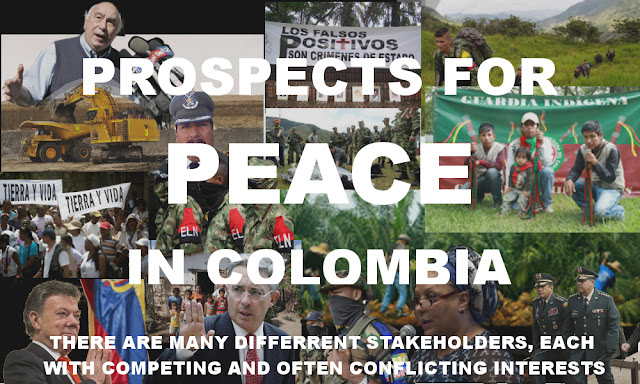
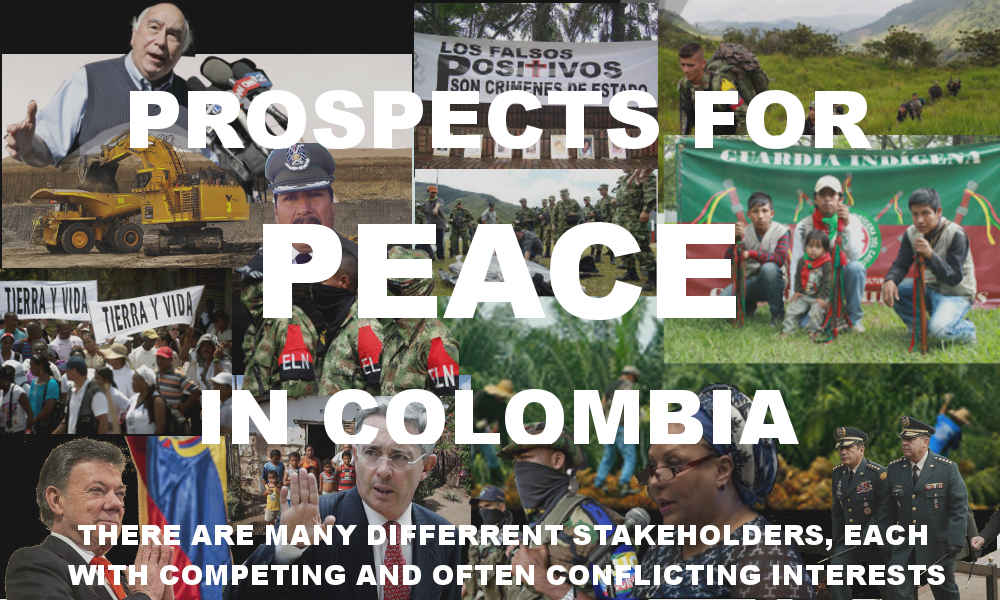
How
one views the prospects for peace in Colombia depends on how one
understands the conflict and how one defines peace. There are many
different stakeholders, each with competing and often conflicting
interests.
The
ongoing peace negotiations with the Colombian Government and left-wing
FARC guerrilla insurgents in Havana, along with a more recent government
commitment to enter into a separate talks with the ELN insurgents in
Ecuador, are being celebrated both nationally and internationally as the
imminent end to the fifty-year conflict in Colombia. Not everyone in
Colombia is ready to break out the champagne and celebrate just yet.
There remains a great deal of concern over what may happen in a post conflict Colombia.
FARC demobilization postponed indefinitely:
The demobilization of the FARC, which was originally expected to take
place on March 23rd, 2016, has been postponed indefinitely. The FARC
still agrees to disarm, but insist that a third party, not the Colombian
government, take custody of their arms. This implies that they want to
retain the option of rearming should they decide the government is not
keeping its end of the agreement. More significantly it may also imply
the FARC wants the government to first put an end neo-paramilitary
groups, which are considered by many to be a far greater on-going threat to human rights than the FARC.
Their concern is that these neo-paramilitaries, not the government,
would fill the vacuum in territory currently occupied by the FARC and
ELN. These concerns are well-founded. In a recent demonstration of power
(March 31st, 2016) one such group paralyzed the entire northern part of Colombia; the Urabeños have made it absolutely clear that they, not the state, are the authority in much of Colombia.
The Urabeño paramilitary shut-down is widely held to have been in support of “Marches against Peace”
held across the country two days later (Saturday, April 2nd). Hundreds
of thousands of supporters of ex-president Uribe, opposing the Santos
Government and the Peace Accord and negotiations with the FARC, took to
the streets in cities across Colombia. It is noteworthy that former
President Alvaro Uribe is himself under suspicion for collaborating with paramilitaries, and accused of playing an active role in Parapolitics,
which involved many high-level officials in the military, all levels of
government, his own Party and Cabinet, as well as some of his political
appointees. Many of of these have been convicted and are now in exile
or serving lengthy prison sentences for having collaborated with
paramilitaries. The current President, Juan Manuel Santos, denies the
existence of paramilitaries. He considers groups like the Urabeños as
nothing more than organized criminals involved in drug trafficking and
illegal gold mining, not major players in the military conflict, and
insists that state will prosecute them as such (see “Failed
demobilization of the Paramilitaries in the 2006” below). The Urabeños
themselves claim they are politically motivated,
and should therefore be included in the clemency being offered to
left-wing guerrilla and military combatants under the terms of the transitional justice.
The 1980s Experience of Disarmament in Favour of Political Participation:
Doubtlessly the history of the previous 1980’s failed attempt to seek
solutions to Colombia’s social problems through negotiation and the
integration of insurgents into party politics is also fresh in the minds
of FARC and ELN combatants. The Unión Patriótica (UP or Patriotic Union
political party) founded by the FARC and Communist Party in 1985 was
formed as a way of finding political solutions rather than military ones
after peace negotiations with the Conservative Belisario Betancur
administration. But violent opposition from drug lords, paramilitaries
and security forces agents during the 1980s exterminated the party,
along with many of its supporters in what has been described as “political genocide”.
While
the state has erased nearly all references to the UP from its official
discourse, survivors and supporters of the UP certainly remember it very
clearly. The Marcha Patriótica,
one of the largest social movements in Colombia today, takes much of
its inspiration as well as part of its name from the UP. And like so
many survivors of massacres, forced displacement and violence, in
addition to an end to armed combat members of the Marcha Patriótica and other social movements want guarantees of non repetition of the massacres that resulted in the deaths of thousands of Patriotic Union members and supporters in 1987:
While
the assassination of affiliates of the Marcha Patriótica movement have
not reached the number of assassinations of those affiliated with the
Patriotic Union Party in the 1980s, there is nonetheless a very clear
and present and danger. To date 102 members of the Marcha Patriótica had been assassinated.
ELN demobilization: Despite
failure to meet the March 23 date for the demobilization of the FARC
guerrillas, the Colombian Government intends to proceed with negotiations with the ELN --the second-largest left-wing guerrilla group in Colombia. President Santos says negotiations with the ELN will result in a more complete peace, and completely put an end to the armed conflict.
The
negotiations will run concurrently, but take place separately. (FARC
negotiations are taking place in Cuba. ELN negotiations in Ecuador). The
ELN is a much smaller guerrilla force than the FARC, but there are
reports that FARC combatants and lower-ranking commanders who are not
content with the terms being negotiated by FARC representatives in
Havana are being recruited into the ELN. According to Ombudsmen and the
National Organization of Colombian Indigenous peoples (ONIC) the ELN is now moving into territory once controlled by the FARC. While some civilians who fear a paramilitary
takeover of their area may welcome this move, the state considers it to
be undermining the primary objectives of its negotiations with the
FARC. (The FARC have agreed to a unilateral ceasefire during the
negotiations, and are no longer militarily defending their territory.)
The Unnamed Elephant in the Room: Members of the Marcha Patriótica being assassinated are being targeted by some armed group, and,
given the similarity between the Marcha Patriótica and the decimated
UP, it would be preposterous to claim that they were being killed by the
ELN or FARC guerrilla. And the assassinations of Marcha Patriótica
affiliates are only the tip of a very large iceberg; Marcha Patriótica
members are only a fraction of total number of victims. Human rights defenders are especially hard hit,
and the vast majority of these crimes are thought to have been carried
out by paramilitaries. In the first seven months of 2015 there were 399
attacks on human rights defenders, including 332 direct threats against
individuals, 34 assassinations, 25 assaults and 7 cases of arbitrary
arrest or arbitrary detentions..A continual climate of impunity negates
any real guarantees of non repetition. Of the 219 assassinations which
occurred between 2009 and 2013, 95% of investigations did not proceed
past the preliminary phase, and just one case resulted in the sentencing
of those responsible.
Relatives
of victims of human rights violations who campaigned for justice, as
well as members of human rights organizations helping them, faced death
threats and other serious human rights violations from paramilitaries
and members of the security forces.
Failed demobilization of the Paramilitaries in the 2006:
Whether the AUC (United Self-defence Forces of Colombia) Paramilitaries
re-mobilized or never demobilized in the first place is a debated
point. There is ample evidence supporting both arguments. The Santos
government however, has opted to re-brand neo-paramilitaries as BaCrim
--Criminal Bands. Santos dismisses them as criminal profit-motivated
mafia-type organizations whose activities are primarily limited to
involvement in illegal mining and drug trafficking.This rebranding
serves two purposes: First, Santos can present the ongoing negotiations
with the FARC and ELN as negotiating an end to the armed conflict in
Colombia by simply refusing to acknowledge that paramilitaries continue
to play a major role in it. (Victims of paramilitaries know them to be
real, active, and very deadly. Santos’ denial of their existence is
anything but reassuring for its victims.) Secondly, Santos admission to
the continued existence of a paramilitary threat would make evident the
total failure of the transitional justice not
only under the Peace and Justice Law of his predecessor Alvaro Uribe in
2006; but also the total failure of his own replacement laws -- the
Victims Rights Law and Land Restitution Law. Neither the victims of
ongoing paramilitary violence, who for the most part fit the same
profile as those targeted by the AUC paramilitaries before their
supposed demobilization in 2006; nor the neo-paramilitaries themselves
who insist that they are not BaCrim, but rather armed participants in the conflict
who should be included in the negotiations. There is strong opposition
to the use of the term BaCrim from both sides, albeit for very different reasons.
Under the transitional justice
of the 2006 Peace Accords with the AUC, paramilitaries who confessed to
all of their crimes received a maximum eight-year jail sentence. Many
of their confessions implicated even high-up Colombian military
commanders and government officials at all levels, including Uribe
appointees and members of his own cabinet. These were shown to be
willing collaborators with the paramilitaries in massacres and other war
crimes as well as co-authors of some of these atrocities. The whole
process resulted in more government officials being incarcerated than
paramilitaries. This sandal became known as Parapolitics. The lenient sentences offered to the paramilitaries in exchange for their confessions were not
offered to the government officials they collaborated with, most of
whom are serving much lengthier jail sentences. Most paramilitaries who
demobilized under the Peace and Justice Law in 2006 are now back out on
the streets, many resuming their former activities.
However many of the paramilitaries never demobilized at all. Some demobilizations were faked
with the collaboration of the military in order to inflate the numbers.
Non-combatant civilians were encouraged to present themselves as
paramilitaries in exchange for the generous government benefits offered
to demobilized paramilitaries. Some AUC members regrouped into smaller
groups under new various names, who collectively continue to represent a
large and brutal force that controls much of the country (see “FARC
demobilization postponed indefinitely” above).
Transitional justice in 2016: One stated objective of the Urabeños is to be included in the even more lenient transitional justice
package being offered to both military and guerrilla combatants in the
current negotiations. This package being offered as part of the Peace
Process with the guerrilla has been broadly criticized by groups on the
right as well as human rights defenders. It has been described as little
more than an exchange of impunity
between two groups of war criminals. The right wants harsh penalties
for guerilla war crimes, while the left wants the state to be held
accountable for its own many war crimes as well as crimes committed in
collaboration with paramilitaries. It should not come as a surprise that
neo-paramilitary war criminals want the same opportunity as the state
and guerilla to wipe their slates clean again by being included in the
generous terms of this new transitional justice deal.
Peace for Whom? An
end to the armed conflict with the guerrilla will not benefit everyone
equally. Different sectors of society experience and view the conflict
very differently, have very different ideas about the primary causes of
the conflict, and very different ideas about what a post conflict
Colombia would and should look like.
SECTOR ONE:
Those who see and experience paramilitaries or the state as the primary
perpetrators of violence and injustice want to see changes that go far
beyond the demobilization of the guerrillas.
Above
we examined ample evidence to show that the demobilization of the AUC
right-wing paramilitaries in 2006 never really happened. It is equally important to note that the transitional justice in terms of reparation and land restitution never happened either. Even the act of identifying yourself as a victim and seeking justice is as likely to get you killed.
Despite these dangers, since the introduction of the Land Restitution
Law in 2008 some 87,000 brave souls made claims for land restitution. To
date only 3.4% of these claims have been judicially resolved,
indicating that some victims of forced displacement can expect to wait
235 years before they see justice done. (Source El Espectador, 8 April 2016 in Spanish)
Victims of Paramilitary and State violence are under no illusions that the current negotiations with the FARC and ELN will increase their security and redress injustices committed by paramilitaries and the Colombian State. They are clear that these peace talks are intended only to end the armed conflict with the guerrilla, and will do little if anything to address the social conflict, impunity and injustice that persists.
Victims of Paramilitary and State violence are under no illusions that the current negotiations with the FARC and ELN will increase their security and redress injustices committed by paramilitaries and the Colombian State. They are clear that these peace talks are intended only to end the armed conflict with the guerrilla, and will do little if anything to address the social conflict, impunity and injustice that persists.
Most
of the people belonging to this group may not be supporters of
President Santos. Nevertheless, apart from their fears of a paramilitary
takeover, after 50 years of war in which they were the primary victims
most do want a negotiated
solution to the social and armed conflict in Colombia. They support the
Peace Accord because they hope that the UN presence and renewed and
increased international attention and presence will help reduce
impunity, help ensure their safety, and force the State to redress past
injustices and begin to address the root causes of the social conflict.
SECTOR TWO: This sector describes the majority of Colombians who re-elected President Santos on a platform of a negotiated end to the armed conflict with the guerrilla. They see the guerrilla
as the primary perpetrators of violence and injustice, and/or the
primary obstacle to economic growth and prosperity. This sector seeks
little additional change apart from change resulting from the
demobilization of the guerrilla. (This includes foreign investors,
multinational corporations and big business interests in this category.)
Many
of those who fall into this category live in the cities, and have had
their lives disrupted by guerrilla attacks on infrastructure, their
ability to travel Colombia’s highways securely impeded, and are acutely
aware of civilian and military deaths and kidnappings carried out by the
guerilla. Many of them are all but oblivious to the massacres and
brutal repression and forced displacement of campesinos, indigenous
peoples and Afro Colombians living in rural areas, the oppression of
human rights defenders and labour unions. They tend to get most of their
information from mainstream media sources and government propaganda.
Consequently many in this sector view the entire rural population as
largely cocaine-growing sympathizers of the “Narco-terrorist” guerrilla,
and have little sympathy for the millions of displaced people arriving
in their cities. They are sick and tired of the war and imagine that
Colombia would be a much more peaceful and prosperous place without an
armed insurgency.
Both
national and international investors also see ending Colombia’s
fifty-year conflict with armed left-wing insurgents as the removal of
the greatest obstacle to the extraction and exploitation of Colombia’s
great wealth in land and mineral resources. This elite group is perhaps
the group that would benefit most from an end to the left-wing armed
insurgency.
SECTOR THREE:
There are hundreds of thousands of ex-president (now senator) Uribe
supporters who categorically oppose any solution other than a military
solution to the armed conflict with the guerrilla. This group is
comprised primarily of the landed oligarchy and includes those who
benefited the most from past forced displacements and land grabs and fear that a negotiated solution may jeopardize their hold on their ill-gotten gains.
SECTOR FOUR: The neo-paramilitary groups,
who in the context of a civil war against left-wing insurgents were
able to remain in the shadows, have a lot at stake. During the conflict
the state had rebranded and downplayed their role as Bacrim (Criminal
Bands), but in a “post-conflict” situation they would suddenly become
much more visible and harder to dismiss. The Colombian State will be
under immense pressure to eliminate them, once it is no longer
preoccupied with the more pressing issue of fighting a civil war.
Furthermore any possibility of neo-paramilitary groups being included in
the transitional justice as a political armed actor would be nil in a post conflict Colombia.
SECTOR FIVE:
There is a fifth category of people who have been threatened, killed,
kidnapped and displaced by the guerrilla.These include communities and
friends and family of communities who have been victims of propane
cylinder bombs, land mines, extortion and kidnappings. It also includes
indigenous peoples living in Nariño and Aruca for example, caught up in
turf wars between the ELN and FARC. Some of these same people have also
been the victims of paramilitary threats and violence and state violence
as well, and may not have voted for Santos in the 2014 elections.
SECTOR SIX:
Colombia’s state security forces have a lot at stake as well. President
Santos cannot afford to lose the support of the military and state
security forces, and including them in the lenient transitional justice plan --something his predecessor Alvaro Uribe did not
do-- will go a long way towards retaining their support and
collaboration in a post-accord Colombia. Nevertheless Colombia’s
security forces are likely to take a serious hit in terms of its size,
budget, power and control. This may not go over well with the top brass,
some of whom are doubtlessly opposed to a diminished role after a
negotiated end to the armed conflict.
These
six sectors are not intended to capture the entire spectrum of opinion
in Colombia. Opinion within each sector are undoubtedly more varied and
nuanced than these broad categories can accommodate. There may also be
significant overlap between sectors. They do indicate that there are a variety of major stakeholders, both in favour of and opposed to these negotiations; and that even within those two groups a wide variety of competing and sometimes incompatible objectives.
Peace and Justice for the Most Vulnerable Colombians is still far from assured: How
one views the prospects for peace in Colombia depends on how one
understands the conflict and how one defines peace. There are many
different stakeholders, each with competing and often conflicting
interests.
The largest sector is SECTOR TWO. Most members of this sector do not feel particularly threatened by anyone other than
the guerilla insurgents, and are likely to contend with successful
negotiation of the demobilization of the guerrilla, which they will
construe as the end of the fifty-year conflict and the beginning of
peace and prosperity.
Those in SECTOR ONE, who feel more oppressed and threatened by paramilitary armed actors and the state itself,
are largely dependent on the political will of SECTOR TWO and the State
to include them as full participants in building a common future. It is
not at all clear that the state and those in the SECTOR TWO, having
achieved their own goals, will be disposed to making concessions to
accommodate the goals and full participation of those in SECTOR ONE.
SECTOR ONE will likely continue to press for solutions to the unresolved
social conflict, as they and their allies non-violently resist and
mobilize in their struggle for dignity, respect and social justice.
SECTORS
THREE and FOUR stand to lose a significant amount of wealth, power and
control in a post accords Colombia, and are likely to do whatever they
can to sabotage the process.
A
lot depends on the collaboration of SECTOR SIX, the military and State
security forces, which have a history of collaborating with SECTORS
THREE and FOUR.
Those interested in promoting peace with justice in
Colombia must not allow themselves to be lulled into a false sense of
complacency by rhetoric of peace and a litany of stated laudable
intentions. Good intentions and pleasing rhetoric, as the saying goes,
is what the road to hell has always been paved with.
Posted 1 week ago by Stewart Vriesinga:
Stewart in Colombia
Christian Peacemaker Teams' volunteer Stewart shares his experiences while doing accompaniment and advocacy work with those most affected by neocolonialism and violence in the Middle Magdalena River region of Colombia
May
5
Defensor de los derechos humanos Carlos Morales finalmente liberado de la cárcel!
* * * * * *
Defensor de los derechos humanos Carlos Morales finalmente liberado de la cárcel!
Agradecemos los esfuerzos que desde las distintas organizaciones se han realizado en este caso y solicitamos el acompañamiento para la pronta y efectiva libertad de Carlos quien actualmente está recluido en Palogordo. --CAHUCOPANA
Hoy Carlos Morales, nuestro querido amigo y defensor de los derechos humanos de CAHUCOPANA, tuvo por fin una audiencia en el Palacio de Justicia en Barrancabermeja después de pasar ocho meses encarcelado.
Defensor de los derechos humanos Carlos Morales finalmente liberado de la cárcel!
Agradecemos los esfuerzos que desde las distintas organizaciones se han realizado en este caso y solicitamos el acompañamiento para la pronta y efectiva libertad de Carlos quien actualmente está recluido en Palogordo. --CAHUCOPANA
Hoy Carlos Morales, nuestro querido amigo y defensor de los derechos humanos de CAHUCOPANA, tuvo por fin una audiencia en el Palacio de Justicia en Barrancabermeja después de pasar ocho meses encarcelado.
May
5
HUMAN RIGHTS DEFENDER CARLOS MORALES FINALLY RELEASED FROM PRISON!
* * * * *
HUMAN RIGHTS DEFENDER CARLOS MORALES FINALLY RELEASED FROM PRISON!
We appreciate all the efforts of the various organizations who have supported us in this case and request their continued accompaniment for the prompt release of Carlos who is currently still being detained in Palogordo prison.
HUMAN RIGHTS DEFENDER CARLOS MORALES FINALLY RELEASED FROM PRISON!
We appreciate all the efforts of the various organizations who have supported us in this case and request their continued accompaniment for the prompt release of Carlos who is currently still being detained in Palogordo prison.
May
4
Prospects for Peace in Colombia
* * * * * *
Prospects for Peace in Colombia
--by Stewart Vriesinga
How one views the prospects for peace in Colombia depends on how one understands the conflict and how one defines peace. There are many different stakeholders, each with competing and often conflicting interests.
Prospects for Peace in Colombia
--by Stewart Vriesinga
How one views the prospects for peace in Colombia depends on how one understands the conflict and how one defines peace. There are many different stakeholders, each with competing and often conflicting interests.
Dec
31
Christmas Refugees: Then, Now, There and Here
* * * * * *
Christmas Refugees: Then, Now, There and Here
(Dec 23rd, 2014)
And the governing body of the holy land
was that of King Herod, a paranoid man,
who, when he heard there was a baby born, King of the Jews,
sent death squads to kill all male children under two.
Christmas Refugees: Then, Now, There and Here
(Dec 23rd, 2014)
And the governing body of the holy land
was that of King Herod, a paranoid man,
who, when he heard there was a baby born, King of the Jews,
sent death squads to kill all male children under two.
Jun
19
Justice Denied
A
web-based documentary series profiling pivotal cases of foreign-funded
mining exploitation in Colombia, and how these projects often violate
human rights.
Apr
29
Call to Action on Colombia from SOA Watch
Victims
of human rights abuses want an end to impunity and assurances that past
atrocities won't be repeated. This is why School of the Americas (SOA)
Watch wants to invoke the Leahy Law, which prohibits the US Government
from aiding someone guilty of human rights abuses. There are actions you
can take. Click on the embedded links.
Apr
2
The People's Land Summit, March's March, and an Ultimatum
--by Stewart Vriesinga
CAHUCOPANA, a grass-roots campesino organization that formed to defend the land and human rights of the campesinos in north-east Antioquia, has learnt that sometimes you have to leave your home to defend it. CAHUCOPANA asked the CPT Colombian team to accompany a caravan of dozens of buses from the department of Antioquia to join about 30 thousand demonstrators in a march in Colombia's capital, Bogotá, on the 17th of March of this year.
CAHUCOPANA, a grass-roots campesino organization that formed to defend the land and human rights of the campesinos in north-east Antioquia, has learnt that sometimes you have to leave your home to defend it. CAHUCOPANA asked the CPT Colombian team to accompany a caravan of dozens of buses from the department of Antioquia to join about 30 thousand demonstrators in a march in Colombia's capital, Bogotá, on the 17th of March of this year.
Mar
26
Human rights Report: An Open Letter to the Government of Canada
Dear
supporters, I wanted to share the following letter with you, which I
wrote on behalf of our team to the Canadian government. You may recall
that the Canadian Government committed to producing an annual Human
Rights Impact Report as part and parcel of the Canada-Colombia Free
Trade Agreement (C-CFTA).
The first report in May 2012 was pretty much a non-report because "sufficient trade data is not available".
The first report in May 2012 was pretty much a non-report because "sufficient trade data is not available".
Mar
3
Join CPT Colombia's May 2014 Organized Labour Delegation
Our May
delegation should be especially appealing to those involved in organized
labour. Colombia continues to be considered the most dangerous place on
earth to be a trade unionist. Participants in this delegation will meet
with public and private sector union leaders, as well as organized
informal sector self-employed workers. Activists in all three groups are
threatened because of their efforts to protect workers rights and their
livelihoods.
Jan
5
Five 'Creative' New Year's Re-Solutions for Economic Recovery
For
those of you worrying about our common future, don't! Rest assured that
the best decision-makers on the planet have the situation well in hand.
Here are some of their well-thought-out solutions to ensure continued
economic growth and prosperity in the New Year. With any luck maybe it
will even last until the next election!
The problems: (Authors note: Since all of the problems outlined here have already been resolved you can just skip all this and go back to your football game or whatever.
The problems: (Authors note: Since all of the problems outlined here have already been resolved you can just skip all this and go back to your football game or whatever.
Loading
Dynamic Views template. Powered by Blogger.
 |  | | ||
| | | ||
|  | | ||
|
| |
Reply all
Reply to author
Forward
0 new messages