
The People's Land Summit, March's March, and an Ultimatum
9 views
Skip to first unread message

Stewart Vriesinga
Apr 3, 2014, 2:09:25 AM4/3/14
to Stewart In Colombia Google Groups
The
People's Land Summit, March's March, and an
Ultimatum
--by Stewart
Vriesinga
CAHUCOPANA,
a grass-roots campesino organization that formed
to defend the land and human rights of the
campesinos in north-east Antioquia, has learnt
that sometimes you have to leave your home to
defend it. CAHUCOPANA asked the CPT Colombian
team to accompany a caravan of dozens of buses
from the department of Antioquia to join about
30 thousand demonstrators in a march in
Colombia's capital, Bogotá, on the 17th of March
of this year.
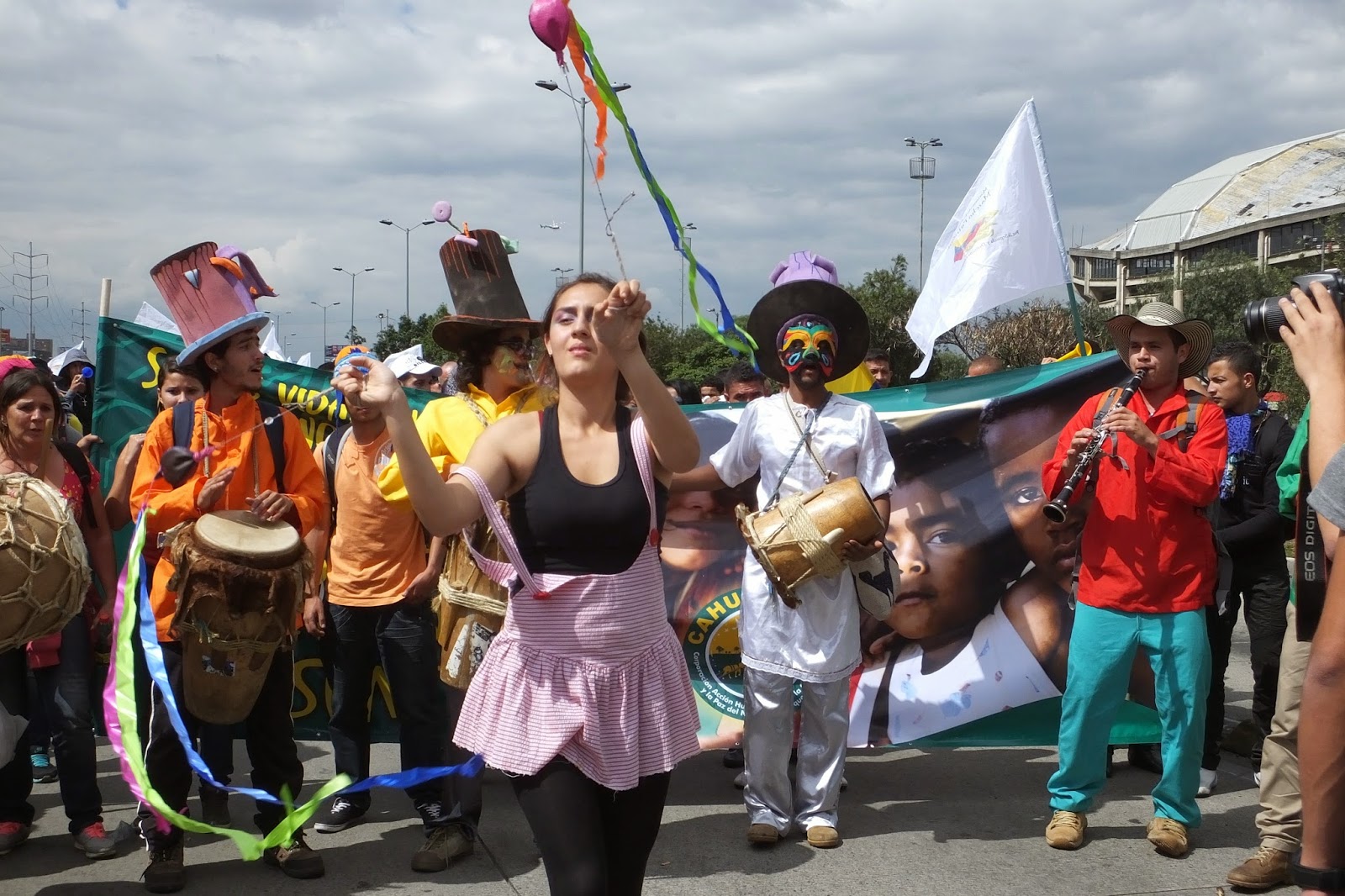
The
march was planned to end and compliment the People's Land
Summit,
also held in Bogotá. The Summit itself, in which CAHUCOPANA also
participated, was in response to the national government's
failure to live up to the commitments it had made as part of
negotiations to end a nation-wide
general
strike in August of 2013. After having first met
with and consulting their constituencies,
leaders of various social movements and organizations got
together
for a Summit in Bogotá to decide how they could collectively
best
organize an appropriate response. Participants included
indigenous,
Afro-descendant, campesino, artisanal miner federations,
students,
and others. Although the government did
consult with agro-industry and other huge stake-holders, it
failed to honour
its commitment to consult with or address the concerns of
those who
organized and took part in last year's general strike.
The Summit, therefore, came up with its own criteria and
blueprint
for an inclusive Colombian agrarian policy. After the Summit
they
presented the government with that blueprint, and an
ultimatum:
comply with our demands by the first week of May, or face the
consequences of another paralysing nation-wide civil strike.
The Land Summit managed
for the first time in the history of social movements in the
country,
to unite peasant, indigenous and Afro-Colombian
organizations. The
movement represents the economic, social, environmental,
cultural,
territorial and political demands of historically
marginalized and
excluded communities. It is a call to the national
government to
recognize the urgent need for structural reform to protect
the rights
of the rural population. The Summit also proposed a single
negotiating table, a scenario that would improve the level
of
dialogue, avoid procrastination, and promote enforceable
agreements
in the short and medium term. The unity achieved today is
also the
unity of action. We have embarked on a path of social action
that
will ensure rights that have up until now been denied us are
both
enforceable and achievable. The Summit and its proposals
constitute a
definite commitment and investment on our part in the
achievement of
peace: a peace that, to be stable and lasting, must be built
from the
bottom up, be socially inclusive, based on truth, justice,
effective
political participation, and guarantee the full enjoyment of
human
rights in rural Colombia. --Declaración
Política Cumbre Agraia
(Our Translation)
The
Summit represents a coalition of
a wide variety of social movements, from all over the country:
Antioquia, Arauca, Boyacá, Caquetá, Cauca, Cundinamarca, Eje
Cafetero (Caldas, Risaralda y Quindío), Nariño, Putumayo,
Valle del
Cauca, Tolima y Huila. Their collective demands are many and
wide-ranging. They include: sovereignty over the local
territory and
resources of native, Afro-descendant and campesino farmers;
agrarian
reform and increased access to land; environmental protection
and an
end to the ceding of territory and local resources to
multinational
mining companies; the revocation of the
US Free Trade Agreement's prohibition on (criminalization
of) the
traditional practice of saving and planting ancestral
seeds for new
crops
(dubbed “the
Monosanto Law”); prior informed consent of the local
population
before exploiting petroleum resources; viable alternatives to
coca
production before the aerial spraying or manual eradication of
coca
crops; representation and participation in peace talks; truth,
justice and reparation for victims of state and paramilitary
violence; an end to impunity and guarantees of non-repetition
for
victims of crimes; and more.
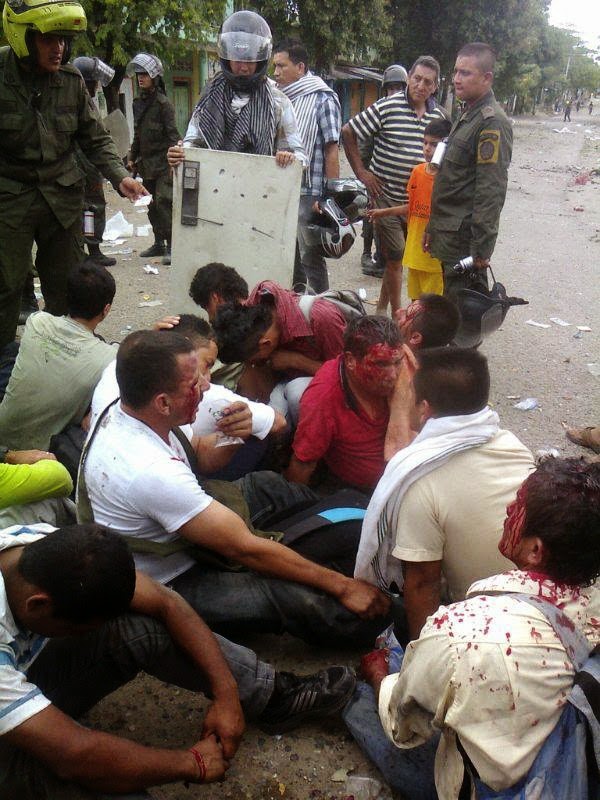 The
government has been put on
notice: it has until the first week of May to comply, or face
a
second nation-wide civil strike. The
previous
strike, which included 5 large demonstrations in Bogotá,
and 30 more in other major cities in Colombia, paralysed much
of the
country for weeks, and resulted in 19 deaths, 600 injured, and
hundreds of arrests. It ended when the government finally
agreed to
enter into dialogue and come up with a social plan in line
with the
concerns and demands of the protesters. Last December some
protesters
again took to the streets “with
the
complaint that the government of President Juan Manuel
Santos had
not followed through on 72 of the 88 agreements signed as
part of the
negotiations to lift the farmers’ month-long strike in
August”.
Unless dialogue happens and issues are resolved in the very
near
future, it seems that the general strike and protest that
ended last
August will resume some time in early May—in the middle of an
election campaign.
The
government has been put on
notice: it has until the first week of May to comply, or face
a
second nation-wide civil strike. The
previous
strike, which included 5 large demonstrations in Bogotá,
and 30 more in other major cities in Colombia, paralysed much
of the
country for weeks, and resulted in 19 deaths, 600 injured, and
hundreds of arrests. It ended when the government finally
agreed to
enter into dialogue and come up with a social plan in line
with the
concerns and demands of the protesters. Last December some
protesters
again took to the streets “with
the
complaint that the government of President Juan Manuel
Santos had
not followed through on 72 of the 88 agreements signed as
part of the
negotiations to lift the farmers’ month-long strike in
August”.
Unless dialogue happens and issues are resolved in the very
near
future, it seems that the general strike and protest that
ended last
August will resume some time in early May—in the middle of an
election campaign.
Reply all
Reply to author
Forward
0 new messages