
The Art of Making Pentagon Infrastructure Look Like Iranian Activism

Sid Shniad
The New York Times wants readers to believe that one of the most significant information warfare operations inside a U.S. adversary state is the work of a “ragtag” group of activists. To sustain this illusion, the paper relies on strategic framing, euphemism, and the systematic removal of political context.
An article published on January 15th, titled “Inside the Fight to Keep Iran Online” centers around the smuggling of tens of thousands of SpaceX Starlink terminals into Iran during the nationwide internet blackout. The framing is familiar: heroic technologists improvising under pressure and outwitting an authoritarian state. What the Times doesn’t do is situate the technology or the operation within their actual political and military contexts.
Starlink is not civilian infrastructure that wandered into geopolitics by accident. It is a core component of U.S. military communications architecture. SpaceX is one of the Pentagon’s most important contractors, providing launch services, satellite deployment, and orbital infrastructure to the Department of Defense, U.S. Space Force, and U.S. intelligence agencies. Starlink itself has been integrated into almost all modern military operations, most visibly in Ukraine, where it has functioned as the primary battlefield communications infrastructure for the U.S.-backed war effort.
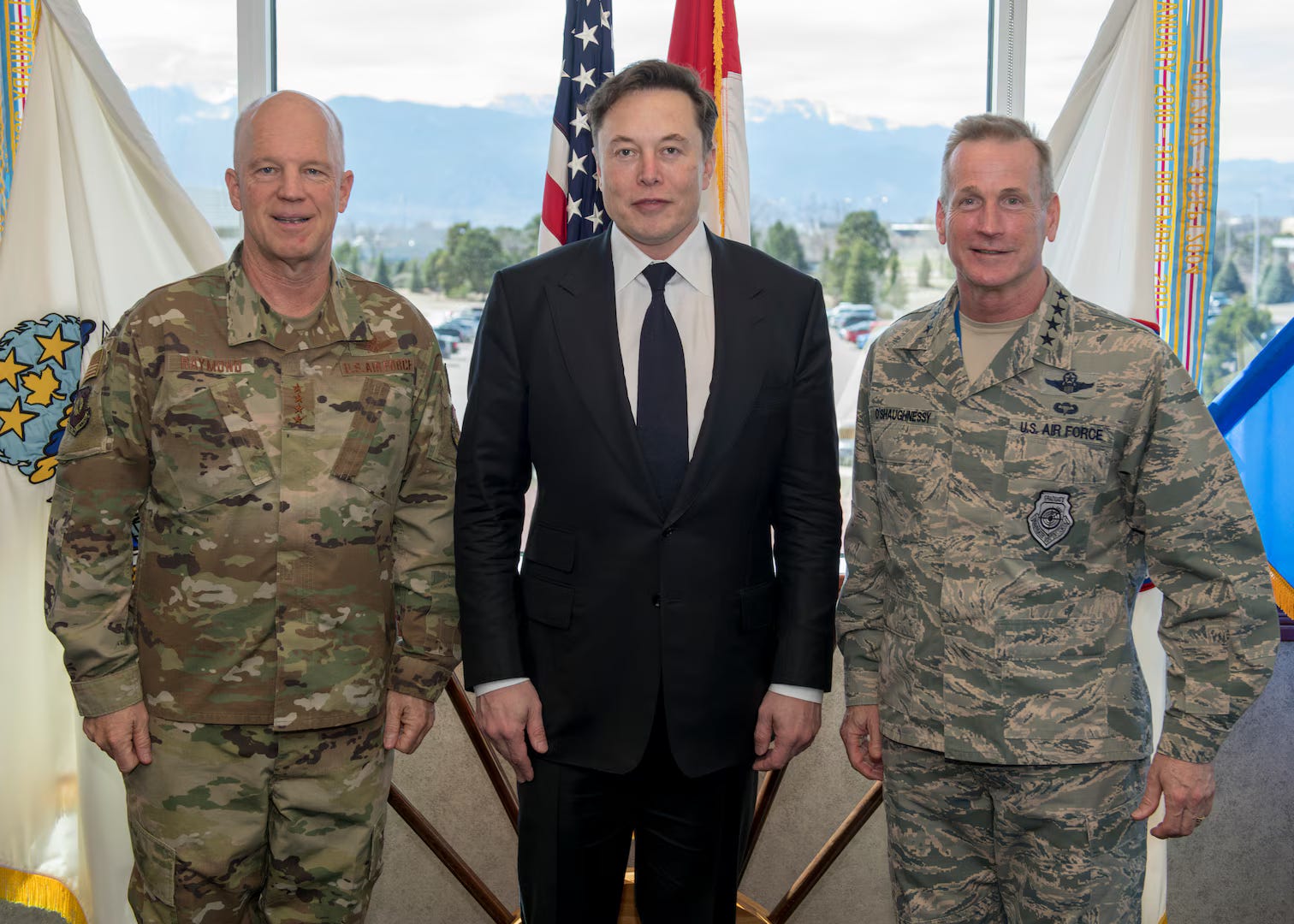
Starlink finding its way into Iran isn’t an incidental overlap. The U.S. military does not merely “partner” with SpaceX; it relies on it. SpaceX launches classified payloads, builds military satellites, and operates a privately owned entire-Earth covering global communications network that the Pentagon classifies as a “strategic asset.”
Starlink is engineered to operate in contested environments: encrypted, resilient under electronic warfare, and difficult to jam. These are not features designed for casual connectivity. They are features of a weapon. Starlink is not simply used in war; it is designed for war. Its purpose is to preserve coordination when states are trying to sever command, control, and information flow.
When introduced into Iran during mass unrest, Starlink is being used exactly as intended: to defeat state control over information space, maintain opposition coordination under repression, and shift the balance of power during a political crisis. The fact that the architects are described as “activists” rather than “soldiers” does not alter the function of the system. This is military-grade communications equipment deployed inside an adversary state to weaken government authority. In strategic terms, there is no meaningful distinction.
Yet in the Times’ telling, the presence of tens of thousands of these terminals is framed as an act of civil society. The word “ragtag” does heavy ideological work, transforming a smuggling operation that required state coordination, sanctions exemptions, logistics corridors, and substantial capital into something resembling a grassroots improvisation.
The article briefly acknowledges that the State Department coordinated with SpaceX on sanctions exemptions and advised civil society groups on how to conceal Starlink terminals from Iranian authorities. This admission is buried deep in the text, stripped of its implications. In reality, this single sentence collapses the entire “independent activism” narrative. When the State Department coordinates the deployment of encrypted military satellite infrastructure into an adversary state during mass unrest, that is not philanthropy. It’s warfare and statecraft policy.
Any remaining ambiguity is dispelled by the article’s own descriptions of Iran’s response. The Iranian government is said to have deployed “military-grade electronic weaponry” to jam Starlink signals—language that implicitly acknowledges Starlink’s military character while refusing to name it as such. The Times never asks the obvious question: why would a state deploy battlefield electronic warfare tools against what is supposedly a benign activist network?
The omissions continue in the article’s treatment of Ahmad Ahmadian, described as an exiled activist who helped build a Starlink “smuggling network”. Readers are told about his passion for democracy, his role in the operation, and his inspirational quotes that could double as Musk/ Starlink advertisements, but readers aren’t told about his funding. Ahmadian’s NGO, NetFreedom Pioneers, is backed by the National Endowment for Democracy [NED], a U.S. government-funded organization created to advance American foreign policy interests abroad. Some critics simply call it a “regime change arm” of the government. One of NED’s founders, Carl Gershman, openly stated that the NED does overtly what the CIA once did covertly.
This context isn’t journalistically optional. Without it, a U.S.-funded political actor coordinating the clandestine deployment of U.S. military-grade communications infrastructure into Iran is rebranded as a grassroots activist. This is not a failure to connect dots; it is the deliberate erasure of the dots.
The article never seriously engages with the implications of scale. Roughly 50,000 Starlink terminals inside Iran is not a workaround. It is parallel infrastructure: an alternative communications system operating beyond state control, owned by a U.S. defense contractor, enabled by U.S. sanctions policy, and activated during a political crisis. If China or Russia introduced such a system into the United States during civil unrest, it would be described accurately as hybrid warfare.
The Times article is just another example of the American media normalizing foreign intervention and meddling by laundering it through the language of technology and activism.
In the Times reporting, Silicon Valley becomes humanitarian, the Pentagon disappears and Elon Musk is only depicted as a benevolent billionaire so long as he’s helping advance U.S. interests.