
My Favorite Politician Ever

Sid Shniad
My Favorite Politician Ever
It's early, but this guy is the real thing.
MJ Rosenberg
Apr 17, 2026
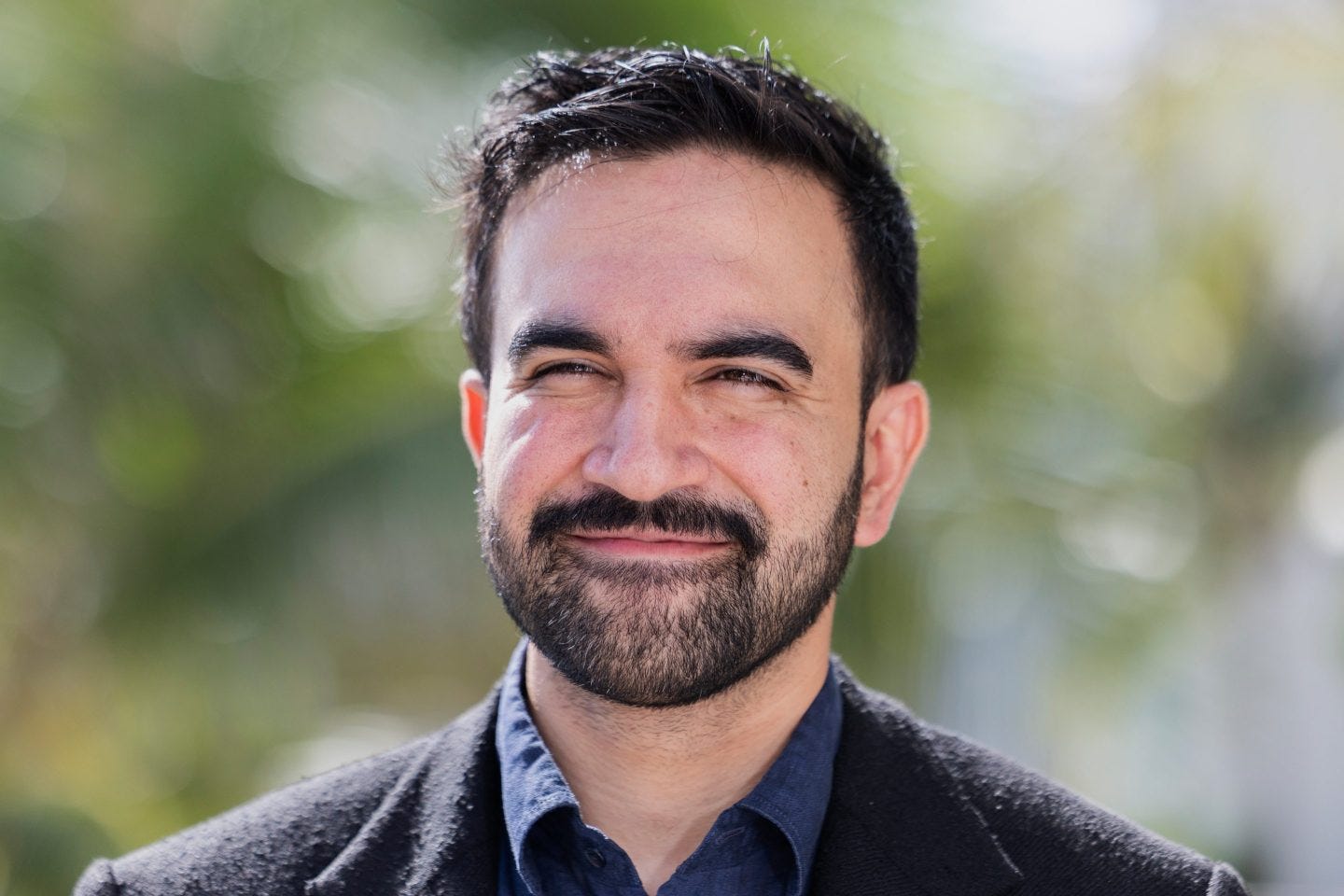
I read today that Zohran Mamdani and Rama Duwaji will not be attending the Met Gala, NYC’s ultimate parade of excess, where strutting billionaires and their celebrity courtiers compete to outdo one another in spectacle. It’s a night of engineered decadence—absurd costumes, suffocating wealth, and a red carpet that doubles as a runway for ego.
What passes for fashion is costume-pageant satire, except the money behind it is very real. For a few hours, the ultra-rich congratulate themselves on their own extravagance and call it culture surrounded by not so-wealthy political big shots and consultants who attend to bask in the glow of big money and pretend that the real money people respect or like them.
Mamdani said that while he loves the Metropolitan Museum of Art, he just watched the 1999 “Thomas Crown Affair” about a heist involving a Van Gogh stolen from the Met so he’ll stay home.
Poor Met. Finally a true celebrity mayor of New York, with a young glamorous spouse, and he has no interest hanging out with the ultra-wealthy. This from a guy whose total income in 2025 was $145,000 a year. How dare he? This beatnik twerp.
I love it.
It’s pure Mamdani. When he ran for office, he didn’t bother pretending to be something he wasn’t. He ran as a democratic socialist—explicit about taxing the rich, strengthening tenants, backing labor, and confronting inequality head-on. No hedging, no coded language, no consultant-approved blur.
The real test wasn’t the campaign. It was what came after. Would he bend the way so many do? Would he “mature” into something safer, duller, more acceptable to donors and party leadership?
So far, he hasn’t.
Mamdani has governed as someone who actually believes what he said. On housing, he hasn’t played the usual Albany game of talking affordability while protecting the real estate industry. He has backed tenant protections and rent stabilization without trying to split the difference to seem “reasonable.” He’s chosen a side—and stuck with it.
On labor, same story. He hasn’t treated unions as props. He’s shown up, taken positions, and supported workers in real fights where neutrality would have been the easy—and politically safer—choice. Most politicians call that prudence. It’s really just avoidance. Mamdani has avoided the avoidance.
And then there’s Israel, where the pressure to conform inside the Democratic Party is relentless. This is where politicians reveal who they really are. They campaign vaguely, then fall in line. Mamdani hasn’t. He has remained an anti-Zionist, supportive of equal rights for Israelis and Palestinians, and unwilling to dilute his position to satisfy donors or party gatekeepers.
No euphemisms, no retreat. I’m looking forward to him boycotting the must-attend SALUTE TO ISRAEL parade on May 31, where every mayor since Cornelius Jacobus Steenwyck had exploited the opportunity to grovel before the power of the lobby.
That alone sets him apart.
If you want to understand what Mamdani is not, look at Hakeem Jeffries. (I choose him because he is the likely next Speaker of the House, not because he is all that different than most politicians and because he is not a Likud buffoon—like a Jared Moskowitz, a Josh Gottheimer, or a John Fetterman).
Jeffries represents the polished, disciplined, message-tested version of Democratic politics—the version that never quite says anything that might upset the wrong people. On economic issues, he speaks the language of fairness while staying well within the boundaries that make major donors comfortable. On Israel, he is the model of orthodoxy: unwavering, predictable, and carefully aligned with the party’s most risk-averse instincts.
There’s a reason for that. Jeffries has mastered the system as it exists. He knows where the lines are, and he doesn’t cross them.
Mamdani seems to say: I spit on your lines. With a smile.
That’s the contrast. One approach is about managing power—navigating it, preserving it, never straying too far from what’s acceptable. The other is about challenging it, even at the cost of friction, backlash, or isolation. Jeffries operates inside the boundaries. Mamdani tests them.
And in American politics, that difference is everything.
Because the system is built to absorb people like Mamdani—to smooth them out, to teach them the limits, to reward them for becoming more like Jeffries. That’s what usually happens. The outsider wins, then adjusts, then blends in. The sharp edges disappear.
Mamdani has resisted that process so far.
That doesn’t mean he’s remade City Hall. He hasn’t yet. The machinery is too entrenched. But he hasn’t been remade by it either, and that’s the point. In a political culture where promises are routinely treated as disposable, simply holding the line counts as something.
It builds trust. Not the vague, performative kind, but the basic kind: he said this, and he’s trying to do it.
Voters aren’t looking for perfection. They understand compromise is part of the job. What they rarely see is someone who compromises without abandoning the core of what they ran on. That’s the narrow path Mamdani is walking.
Jeffries chose a different path long ago—one that prioritizes viability within the system over confrontation with it. It’s a path that leads to leadership positions, donor confidence, and institutional power. It’s also a path that requires constant calibration, constant caution, and, more often than not, a quiet retreat from anything too disruptive.
Mamdani has refused that trade.
The question is how long that lasts. The pressure doesn’t ease; it intensifies. The incentives to conform grow stronger, not weaker. That’s the real test.
But at this moment, the contrast is clear. One politician has adapted himself to the system. The other is still trying to force the system to adapt to his politics.
This famous exchange, in my opinion, sums up Zohran Mamdani and why he will keep at being Zohran Mamdani:
Once, after attending a fabulous soiree on the Hamptons, author Kurt Vonnegut (Slaughter-House-5) turned to his friend, author Joseph Heller (Catch-22) and said:
“Joe, think of it, our host made more money yesterday than all our books have earned since they were published.”
Heller replied, “But I have something he will never have.”
Vonnegut: “Yeah, what?”
Heller: “Enough.”