
2 more interesting docs and a question

Rathnakumar
hypernova http://topdocumentaryfilms.com/the-death-star/
I have a doubt about rotation curve of galaxy. The velocity does not
fall off as you go away from the centre and that is interpreted as
presence of dark matter. But that is not my question. The graph of
velocity versus distance is plotted as velocity=0 at distance=0 and
then velocity linearly rises with distance upto some point and then
becomes flat. Why this behaviour of velocity at small distances? Why
not the velocity tending to infinity as distance tends to zero?

Ramya Sethuram
for this you should understand something about keplerian curves which i got it recently only..........
i am forwarding you a video on rotation curves....hope this wil help (a youtube video !!)....
http://www.youtube.com/watch#v=Hcc0dToHf18&feature=related
regards
ramya
"It is often difficult to control our
feelings; it is still harder to subdue our will; but
it is an arduous undertaking to control the unruly and
contending will of others."

indu g
the central region, angular velocity, omega(r) = constant. because within this radius, the rotation of galaxy is solid body rotation. (A rigid body is a collection of point masses, the relative positions of which doesn't vary with time. All points in a rigid body experience the same angular velocity irrespective of the time). After this particular radius, galaxy is no longer a rigid body, and starts rotating differentially.
Since V(r) proportional to r how can we expect an infinite velocity at the centre ( r = 0 ) ? The nucleus will have a velocity equal to its systemic velocity with which it moves. This is the case of a normal spiral galaxy.
Or otherwise are you talking about the cuspy core galaxies with a central concentration of dark matter ?
--
'Life Is Too Short To Waste Time Hating Anyone'

Hema bharadwaj
There are three types of rotations involved in a galactic rotation. they are solid body rotation at the centre, keplerian rotation(disk) and galactic rotation(flat curve) .The first one is the central part , it is exactly like a solid body rotation, just same as the rotation of the earth( which is a rotation of massive black hole in galaxies), what you said is rite the velocity tends to infinity(not infinity but a very large value and finite) as the distance tends to 0. you can find the galaxy rotation curve in the fig 3 in the attached review article.
I have attached the paper which explains this.
best regards
Hema

Sasikumar Raja
As Hema Said "velocity tends to infinity (not infinity but a very large value and finite)". Will it be "c" (Is it infinite value do u mean). Directly to ask what will be the max velocity of galaxy as we know till this point?
With Regards,
K.Sasikumar Raja
indu g
I think the velocity can be a few hundreds to thousands km/sec.
Sasikumar Raja
Hema bharadwaj
By its proximity, our Galaxy provides a unique opportunity
to derive a high resolution central rotation curve
(Gilmore et al. 1990).
Proper-motion studies in the near infrared show
that the velocity dispersion of stars within the central 1 pc
increases toward the center, indicating the existence of a massive
black hole of mass 3 × 10⁶
M (Genzel et al. 1997,
2000;
Ghez et al. 1998).
(Genzel et al. 1997,
2000;
Ghez et al. 1998).
The rotation curve varies slightly depending upon the tracer. A rotation curve formed from high resolution CO and HI-line spectroscopy (Burton & Gordon 1978; Clemens 1985; Combes 1992), shows a very steep rise in the central hundred pc region, attaining a peak velocity of 250 km s-1 at R ~ 300 pc. It then decreases to a minimum at R ~ 3 kpc of about 200 km s-1, followed by a gentle maximum at 6 kpc and a flat part beyond the solar circle. Rotation velocities due to the black hole are combined with the outer velocities in Fig. 3: the curve is presented both in linear and logarithmic plots. Of course, the rotation velocity does not decline to zero at the nucleus, but increases inward, following a Keplerian law.
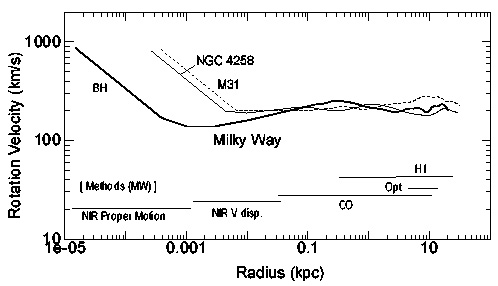 |
Figure 3. Logarithmic rotation curves of the Milky Way (thick line), NGC 4258 (thin line) and M31 (dashed line). Innermost rotation velocities are Keplerian velocities calculated for massive black holes. Observational methods for the Milky Way are shown by horizontal lines. |
Radial velocities of OH and SiO maser lines from IR stars in the Galactic
Center region are used to derive the velocity dispersion and the mass
within the observed radius, as well as the mean rotation, which
seems to take part in the Galactic rotation
(Lindqvist et al. 1992a,
b;
Sjouwerman et al. 1998).
SiO masers from IRAS sources in the central bulge
have been used to study the kinematics, and the mean rotation of the bulge
was found to be in solid body rotation of the order of 100 km s-1
(Izumiura et al. 1995;
Deguchi et al. 2000).
SiO masers in the disk region have been also used to study the structure
and kinematics of a possible bar structure and non-circular streaming motion
superposed on the disk and bulge components
(Izumiura et al. 1999).
Best regards
Hema