
Skip to first unread message

Kelton Temby
Apr 8, 2015, 8:17:06 PM4/8/15
to santa-barbar...@googlegroups.com
My colleague and I usually walk around the block here off Hollister and Robin Hill in Goleta mid afternoon to enjoy some fresh air and give our eyes a break from computer screens and robots. Yesterday, I'd been impressed by just how many bees were visiting the bottle brush flowers, and the seemingly healthy indication of spring after the bit of rain we had.
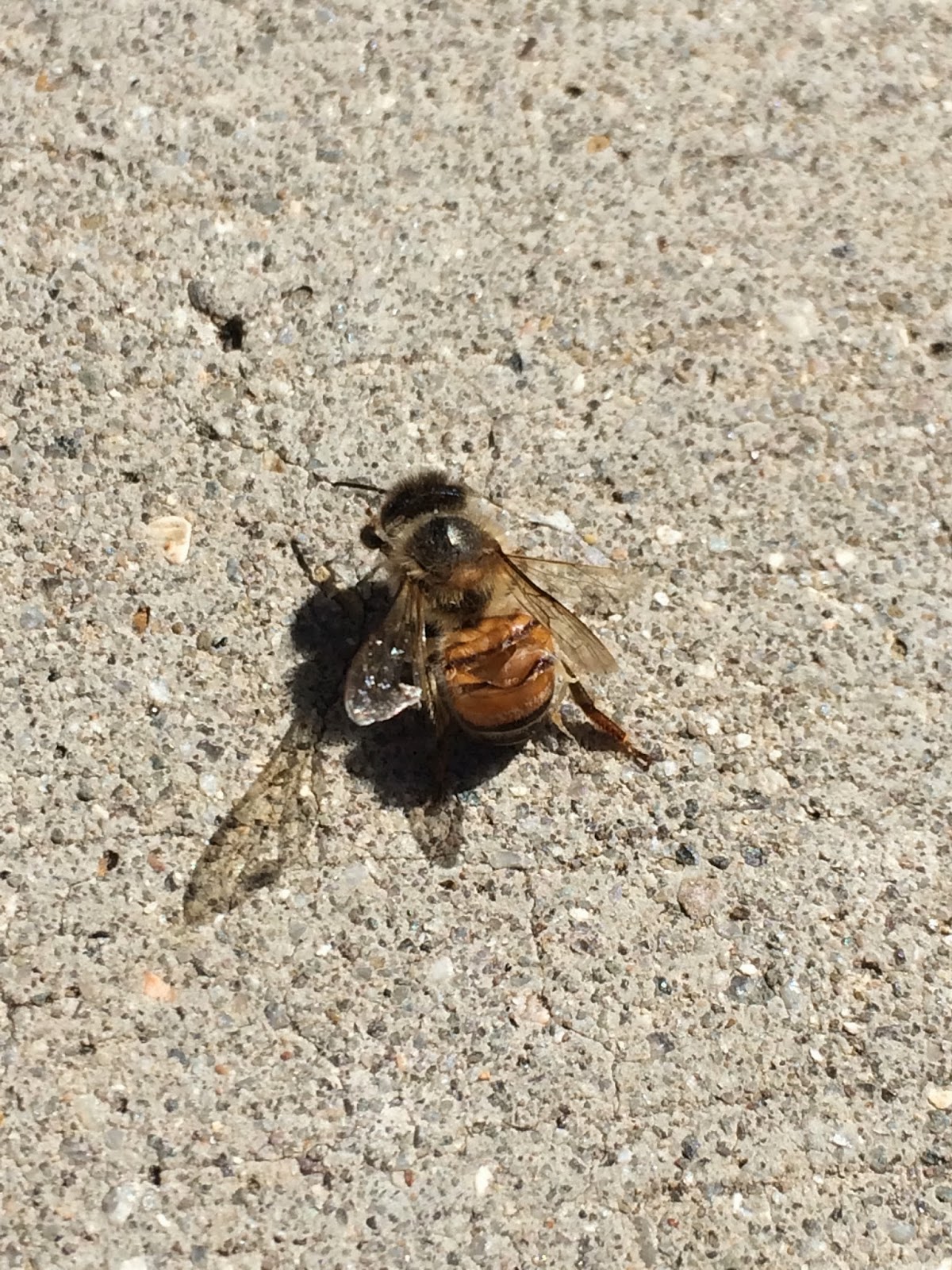
Today as we rounded the first corner of our walk we came across scores of dying, spasming, and crawling bees, some dead but none decomposed. This was all under a single tree next to a small garden/entrance to a business, in a ~30 sq-ft area on the grass and sidewalk. Some of them seemed to have burst abdomens but were otherwise intact. Pretty traumatic scene to a beekeeper. I sent a text to Paul asking what I could do - he shared the protocol for collecting dead bees for pesticide sampling -
We kept walking, seeing if other trees had similar 'bee drops' - maybe they'd all been caught out in the rain, or maybe they were all sprayed? The next bottle brush tree had a few dead bees under it, but nothing like density of the first one. We didn't see many more dead bees for the rest of our walk. My colleague also said he'd been walking through there this morning and actually been 'bopped' in the face by several bees a little further up the road, and he had never experienced that. I get bopped when I open up my hive and agitate my bees, but also not on this walk. As far as I know there are no hives in the area (Don Cole and the San Marcos Farms family is a couple of blocks up, and there's sometimes a couple colonies getting started in their migratory gear).
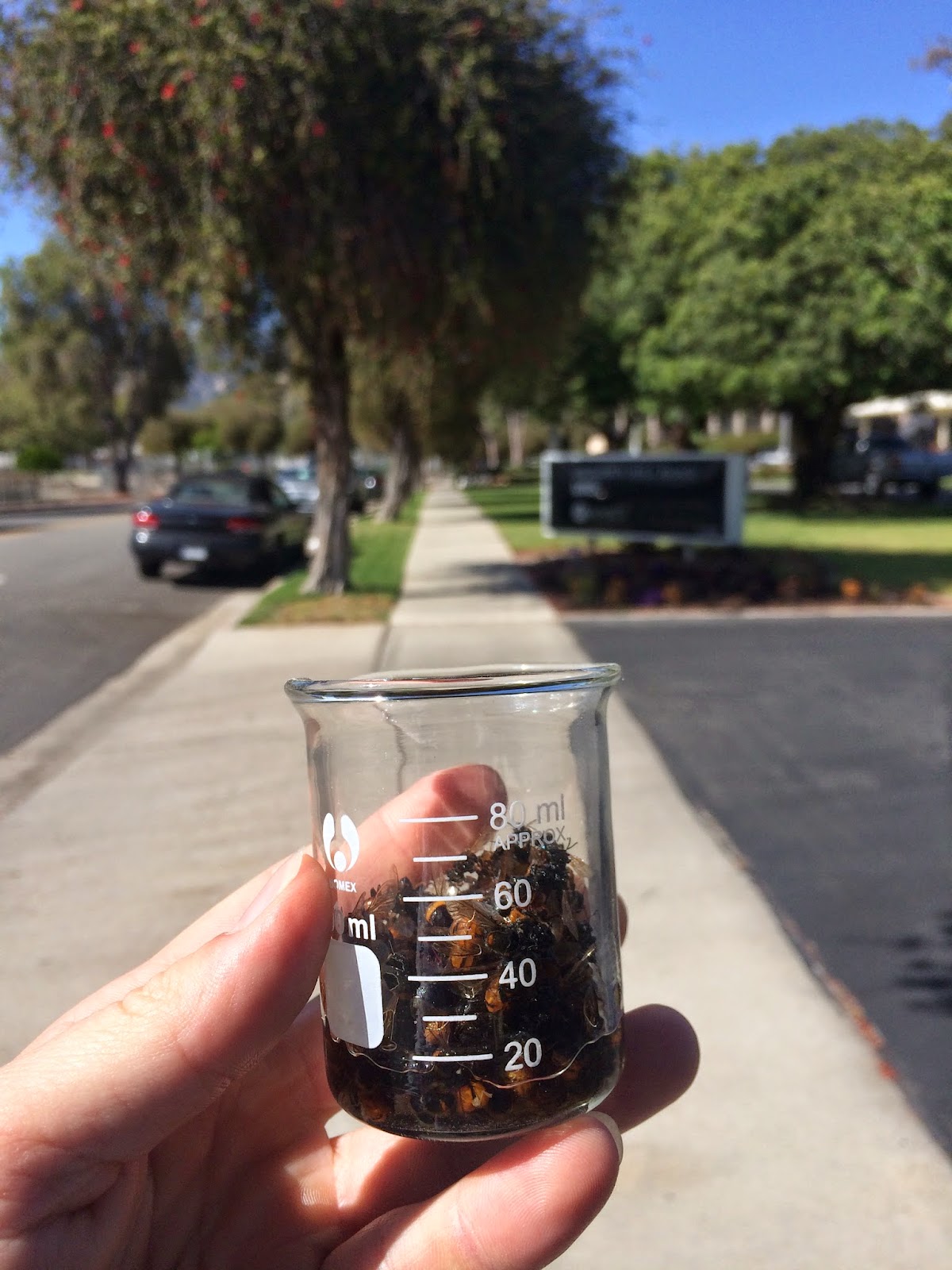
So the next step was to follow the advice of Paul and the USDA. I came back with a little beaker of isopropyl alcohol - its supposed to be diluted to 70%, and set about collecting 100 samples. It was sadly quite easy to locate 112 of the afflicted bees in such a small area after a few minutes. Some were still moving a bit, but it was pretty easy to pick them up by the wings, and not get stung.
So here I am at my desk typing a little description, and getting ready to mail the samples. One of my other colleagues from the engineering lab (who provided the Isopropyl) took an interest and said "If that's whats happening to the bees, what's it doing to us?"




Stephen Honikman
Apr 8, 2015, 10:01:13 PM4/8/15
to santa-barbar...@googlegroups.com
Thank you so much for doing this, so important!
--
You received this message because you are subscribed to the Google Groups "Santa Barbara Beekeepers" group.
To unsubscribe from this group and stop receiving emails from it, send an email to santa-barbara-beek...@googlegroups.com.
To post to this group, send email to santa-barbar...@googlegroups.com.
Visit this group at http://groups.google.com/group/santa-barbara-beekeepers.
For more options, visit https://groups.google.com/d/optout.

Marilyn
Apr 9, 2015, 1:11:23 AM4/9/15
to SB BeeKeepers SB BeeKeepers
So sad-
and thanks for information-keep us in the loop as to results, please
best
Marilyn k

Dan
Apr 10, 2015, 11:40:14 AM4/10/15
to santa-barbar...@googlegroups.com
wow, so sad to see ... thanks for sharing and for posting the info from Paul and collecting and sending the sample ... please keep us all posted on the results. If the results come back positive for pesticide poisoning, I wonder if there is anything that can be done about it, other than trying to educate the owner of the property ...
Kelton Temby
Apr 20, 2015, 3:19:35 PM4/20/15
to santa-barbar...@googlegroups.com
Thank you everybody for your interest!
It ended up just costing just $2.50 to mail off the sample to the laboratory, really great that this service is available.
My understanding from the website and Paul is that the Bee Disease Diagnosis group at the Bee Research Laboratory isn't directly testing for pesticides, but instead is testing for 'natural causes' and all the nasty Bee diseases. Once the bees have been analysed for those, we could say we've ruled out the natural causes, and can turn attention to pesticides etc.
So far I haven't heard anything back from them - I will share any results as soon as I have them.
Was fantastic to see so many people at the Earth Day Beekeepers tent! I had a great conversation with Curtis, and was really happy to recognize some faces down there.
On a personal note, I also had a very special Bee weekend - I took my first frame of honey. It came from my 3 deep boomer which had more than plenty to spare - gave me quite a sense of wonder, but that's another story!
Kelton Temby
May 20, 2015, 4:56:34 AM5/20/15
to santa-barbar...@googlegroups.com
Ah darn, reading Paul and Krista's posts reminded me I received back the results from the Bee Research Lab tests.
As we expected, they completely confirmed that these bees did not die from any of the usual biological stressors (negative results for mites, nosema). These bees were perfectly healthy, and died en masse in this one localized spot.
Apparently there is another lab which will test directly for pesticides, but unfortunately there's a significant fee involved.
I'll share the results with the businesses which are located in the area, and let them know the results point toward pesticides. Perhaps it'll raise some awareness of the impact some 'garden treatments' have on bees, and that the problems and solutions really do start local.
Attached are the results for anyone interested.
Message has been deleted

sba...@bxtc.com
Jul 21, 2015, 2:38:32 AM7/21/15
to santa-barbar...@googlegroups.com
One of my sons sent info about a CLAIMED method of pest control that doesn't involve pesticides.
Reply all
Reply to author
Forward
0 new messages