 Mysore - Bangalore Diary
- Dr. Sunil Kothari
e-mail:
sunilkot...@gmail.com
September 5, 2011
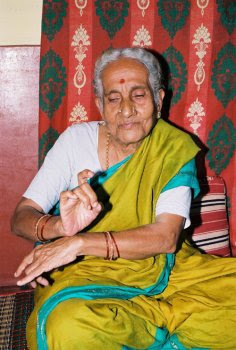
Venkatalakshamma
Photo: D Keshava |
When Dr. Mulk Raj Anand had invited me to edit the volume on
Bharatanatyam in the early seventies, I had visited Mysore
to gather more information on Mysore School of
Bharatanatyam. Kathak exponent Maya Rao had worked on this
tradition and written about it. She had requested Nirmala
Joshi, the secretary of Sangeet Natak Akademi to arrange for
documentation of this rare tradition and few exponents.
Govind Vidyarthi, the documentation officer of the Akademi,
visited the Mysore palace with Maya Rao and photographed
palace dancers - among them the most renowned one was K
Venkatalakshamma.
When many years later after that documentation, I went to
see her, she was appointed as a Professor at the Dance
department of Mysore University. She and her granddaughter
Shakuntala demonstrated for me the salient features of
Mysore school which I have documented in my Bharatanatyam
book published by Marg (1979). Later on in the eighties, I
was able to see Venkatalakshamma’s performances at Nitya
Nritya conferences and festivals organized by Lalitha
Srinivasan, one of her prominent disciples. Venkatalakshamma
was in the league of dancers like legendary Balasaraswati.
She excelled in abhinaya. Her command over Sanskrit,
Kannada, Telugu languages was amazing. Shlokas from
Amarushataka, Gita Govinda and several Javalis were a treat.
Her spontaneous improvisation was astounding. She was a
palace dancer and not a devadasi. She belonged to Banjara
community. Another palace dancer Jatti Thayamma was a
daughter of a wrestler. But their training under palace
vidwans was thorough and their knowledge praiseworthy.
Karnataka dance traditions indeed were influenced by the
Tanjore quartette, as from among them Chinnayya was for some
time in the court of Mysore. However, independent of Tanjore
parampara, Karnataka nritya parampara has in recent times
received attention from serious scholars and dancers. Since
I was attending Karnataka Nritya Parampara, a two-day dance
festival and a seminar organized by Karnataka Bharatagama
Pratishthana, Bengaluru, and Sangeet Natak Akademi, New
Delhi, I had planned to visit Mysore to see abhinaya and
dance items by Venkatalakshamma’s senior disciple
Krishnaveni. On 26th July, Badari Divya Bhushan arranged a
gathering of local Mysore based dancers at his Bhushan’s
Academy and invited Krishnaveni and D Keshava, who is
settled in Basel, Switzerland, and who had also studied
under Venkatalakshamma, to demonstrate the items they had
studied under her.
It was indeed a rare treat. Now in her sixties, Krishnaveni
dressed in a silk saree, sat on a small ‘moda’ and started
reminiscing about her early childhood in Kannada, which
Bhushan translated for me. A Brahmin, Krishnaveni’s studying
dance was looked down upon, but she was determined to study
and study she did. Venkatalakshmma trained her both in
nritta and abhinaya. Sanskrit shlokas, Javalis, Kannada
songs and various special items like Choornika, Purvaranga
and there was no looking back. D Keshava, belonging to Gowda
community also started learning under Venkatalakshamma. In
those days it was very uncommon for boys to learn dance. But
Keshava could not care less and was studying yoga under his
father and later on under Yogaraj Desikacharya.

|

|
|
Krishnaveni (Photos by Rolf Killius)
|
|
It was interesting to see how Krishnaveni and Keshava
studying common items were able to demonstrate clearly the
nritta - how hands extended horizontally, were held with
tripataka, palm downwards and different from what we see
today in Bharatanatyam of various schools. There are ‘jar
adavus’ used in abhinaya of ashtapadis from Gita Govinda,
according to the moods of the nayika, whether she is in a
happy mood, or dejected, and also avasthanusara, according
to her status, mugdha, young maiden, proudha, mature and so
on. Krishnaveni sat and showed hastas, movements of limbs;
Keshava got up and performed distinctly showing nritta as
taught by Venkatalakshamma. The introduction of movements
with speed in between the regular execution of dance was
quite interesting.
Krishnaveni recalled other dancers like Dhanalakshmi,
Nagalakshmi and Lalita Rao who were also proficient in
Mysore bani. Later on she enacted first from
Krishnakarnamritam, a shloka in which Krishna begs of mother
Yashoda to give him butter. The hastabhinaya, hand gestures,
with mukhajabhinaya, facial expressions, was performed first
on right side and then repeated on left side. Even in
Varnams, the same treatment was shown. Krishnaveni performed
Varijamukhi javali with finesse and it had old world charm.
The interactions were peppered with interesting anecdotes.
When offers came for marriage, Krishnaveni’s parents wanted
her to get married. But Venkatalakshamma did not want to
lose her prize pupil and advised her not to marry. Being a
Brahmin, there was no question of her not getting married.
Krishanveni cried and cried and indeed got married. Her
husband Ranga Rao allowed her to perform and also teach. A
gentleman, he was also present on this occasion and we all
greeted him with appreciation. Those were the days when
dance despite its inherent greatness was not considered an
art worth pursuing. And being a Brahmin, to defy the social
norms was not an easy task.
Keshava is in his early sixties and his young daughter
Sumitra, by his Swiss wife Esther Jenny, is a chip off the
old block. His elder daughter Anjali was away in Basel.
Sumitra performs with clarity and maintains the typical
Mysore school bani. Keshava danced a varnam and showed how
it differs from other schools. His agility was remarkable.
He attributes it to his early training in yoga and passion
for dance. Keshava has studied at Mysore University and won
the title Natyavisharada and Gold Medal for his degree in
Dance.
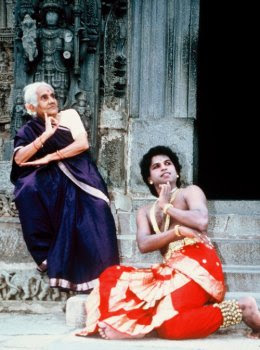
Keshava with Venkatalakshamma at Somnathpur
temple (1988)
|

Keshava with Anjali & Sumitra
|
In 1976, he established at Basel (Switzerland), Kalasri, the
first ever school of Indian dance and yoga with Esther
Jenny, who too studied Bharatanatyam in Mysore and together
the couple has been assiduously working towards creating an
interest in classical dances and Indian culture, receiving
recognition for their pioneering services from Swiss
government. The couple has been training several Swiss and
European young dancers in Bharatanatyam and yoga in Basel.
For his dedication, Keshava has received Kannada Rajyotsava
Award from the Government of Karnataka. He has authored a
book in Kannada, Bharatiya Nritya Sampradayagalu, published
by the University of Mysore. As a singer, he has brought out
two CDs - Classical South Indian Music and Daiva Stuti,
Kannada devotional songs.
He regularly visits Mysore and continues to expand his
repertoire. When in May 2007, I had visited Zurich and given
lectures on dance, he had made a special visit to see me and
invited me to Basel to see his work. Unfortunately on
account of other commitments I could not. But I was
delighted that we could meet at leisure in July at Mysore.
He has built a beautiful spacious house with studios to
conduct classes whenever they visit Mysore during his
extended stay, and rooms for guests including foreign
students.
During my two days stay, I once again met Dr. Tulasi
Ramachandra, who had during the two-day seminar in Karnataka
Nritya Parampara presented Perani. She has received training
in Bharatanatyam under Lalita Dorai, Dr. Choodamani
Nandagopal, CR Acharyalu, Surajbhan Gaur and late Tirath Ram
Azad, the Kathak exponent, and is also a trained musician.
She has established her institution Nrityalaya Trust and
trains young dancers for the past 30 years and conducts
Nartanasambramam, examinations where besides dance, she
trains them in art of makeup, singing, and stage craft. She
showed me a DVD of her reconstruction of Perani with many
other relevant elements which had references from Nritta
Ratnavali, the gharghara, sound of hundreds of ankle bells,
use of chamar, fly whisks, the evidences in sculpture of
Halebid, Jinanathpur temples and so on. I saw young dancers
learning under her direct supervision in her flat and was
pleased to learn that she has choreographed several
dance-dramas. She has evolved her own style terming it as
‘Madhurya.’ Her husband, an engineer, is retired and is a
renowned singer, having cultivated a special type of
recitation. Silently they carry on their work which speaks
of the horizontal spread of classical dance in Mysore.
After Krishnaveni gave a demonstration and Keshava and his
daughter Sumitra danced, Bhushan and Anjana also performed
displaying Pandanallur style and Ramaiah Pillai’s Vazhuvoor
bani, interweaving sequences of marriage of Rama and Sita,
using dramatically real garlands. Watching from close
quarters, I was impressed by their appropriate abhinaya. The
evening was memorable and indeed very educative. The
Bhushans are doing commendable work organizing dance
workshops, Purusha Festivals, highlighting promising, up and
coming male dancers, festivals of dance inviting artists
from other parts of India. I found that often he gets up at
4.30am in the morning and goes to nearby place to teach
students who have to appear for their regular school
studies, so that they do not miss their Bharatanatyam
classes. The dedication and commitment on his part is
praiseworthy.
--
Dr. Sunil Kothari
94, Asiad Village
New Delhi 110049


