
Why I'm skeptical that inequality erodes democracy

Levan Ramishvili
A very recent but already highly cited PNAS paper by Rau and Stokes forcefully argues that economic inequality is a key cause of “democratic erosion.” The latter is a very real and worrying phenomenon that means the gradual weakening of democratic accountability and liberal rights (as compared to an outright coup) by elected leaders like Trump and Orbán.
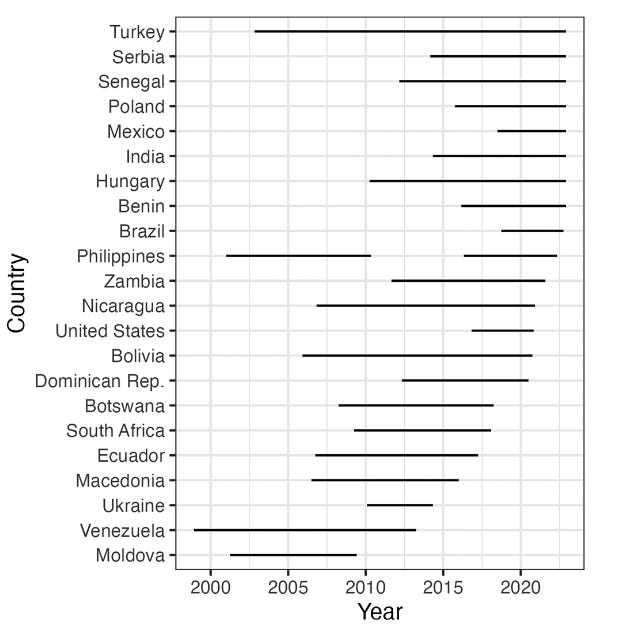
They have a dataset which spans 1995-2020 and includes 23 erosion spells in 22 countries. Here are the countries and erosion events:
Their key finding is that higher income inequality is strongly associated with a higher probability of democratic erosion. In their basic model, predicted erosion risk rises from low single digits in relatively equal democracies to above 30 percent in the most unequal democracies. They illustrate this with Sweden, the United States, and South Africa: Sweden’s relatively low inequality corresponds to a low predicted risk (4%); the United States’ higher inequality corresponds to a higher predicted risk (8%); South Africa’s very high inequality corresponds to much higher predicted risk (31%).
And, of course, they don’t leave things at associational, correlational language. They’re clear they think this is causal (emphases mine):
What are the causes of this rise in democratic erosion? Cross-national statistical analysis points toward one robust finding: The more unequal income distribution is in a democracy, the more at risk it is of electing a power-aggrandizing and norm-shredding head of government. … The inequality effect is robust across a number of statistical approaches.
They do many robustness checks. The inequality result holds when they change the erosion coding, use alternative datasets, use wealth inequality instead of income inequality, switch from country-year to election-year analysis, use rare-events logit, add country fixed effects, control for regional differences, and control for polarization, GDP, democracy age, and state capacity. They describe the inequality-erosion relationship as robust across more than 100 model specifications.
That’s all good. But I don’t think they’ve actually causally identified their result.
The usual suspects of reverse causality and omitted-variable bias are only weakly addressed, if at all. Somewhat bizarrely, they mention the first problem once in the entire paper (in the abstract, at that!) and never speak of it again, let alone methodologically address it. They include a few controls to address observed confounding, but they again leave it at that.
In any case, their study is just one the several that we have on the topic of how inequality relates to democracy. Some of the existing correlation research shows, like Rau and Stokes, that inequality increases are associated with democracy decreases. But just as many papers (of similar or higher quality) show there’s no relationship between the two variables. See my discussion here. Unfortunately, no one seems to have undertaken a more plausibly causal approach to the issue so far.
Probing their resultTo try and get around that problem as much as possible, I’ve set up a more demanding, quasi-experimental econometric design and tested whether relatively sudden and large inequality increases reduce democratic quality over time compared to a plausible counterfactual. Across many, many, many different analyses, I find virtually nothing but a null result. This is a paper I have under review currently, so I can’t talk about it too much. It also just came back from the first round of reviews, with the reviewers liking it but asking me to do additional checks and tests, so we’ll have to wait and see what they think of my revision. I’ll have a post up once it hopefully passes the process.
In the meantime, however, there is still some stuff we can do and talk about.
I downloaded the Rau and Stokes dataset because I wanted to just see, visually and perhaps only for descriptive purposes, what’s going on, over time, with cases of democratic erosion compared to non-eroding countries. Are there any increases in inequality right before the erosion, or perhaps in the years leading up to it? Is it just that countries that are on a higher inequality level are (regardless of the trend) more likely to erode compared to those with low levels of inequality?
Most importantly: if we try and create matching sets of countries, such that we are looking at eroders and non-eroders with otherwise similar traits (development, polarization, state capacity, etc.), what’s going on? On the Rau/Stokes hypothesis, I’m expecting to see non-eroding matches to be much less unequal compared to eroders, even after matching on all the other relevant characteristics.
The idea is that if high inequality really is the key difference separating democracies that end up eroding compared to democracies that don’t, then we should probably see this inequality gap between the two sets of countries (pre-erosion). Of course, we shouldn’t just naively compare eroders to non-eroders, because there are many other differences between them besides inequality. Non-eroders will naturally be less unequal.
However, if we compare eroders specifically to those non-eroders which are otherwise similar to eroders on many traits but for inequality, then we’d have something to work with. If it turns out there’s no big inequality difference, that’s a bit iffy for the thesis. But if a big inequality difference does show, such that comparable non-eroders are much less unequal than eroders, then that would go some way in corroborating the idea; namely, that it’s high inequality in particular (not just poverty or low state capacity) that matters for erosion.
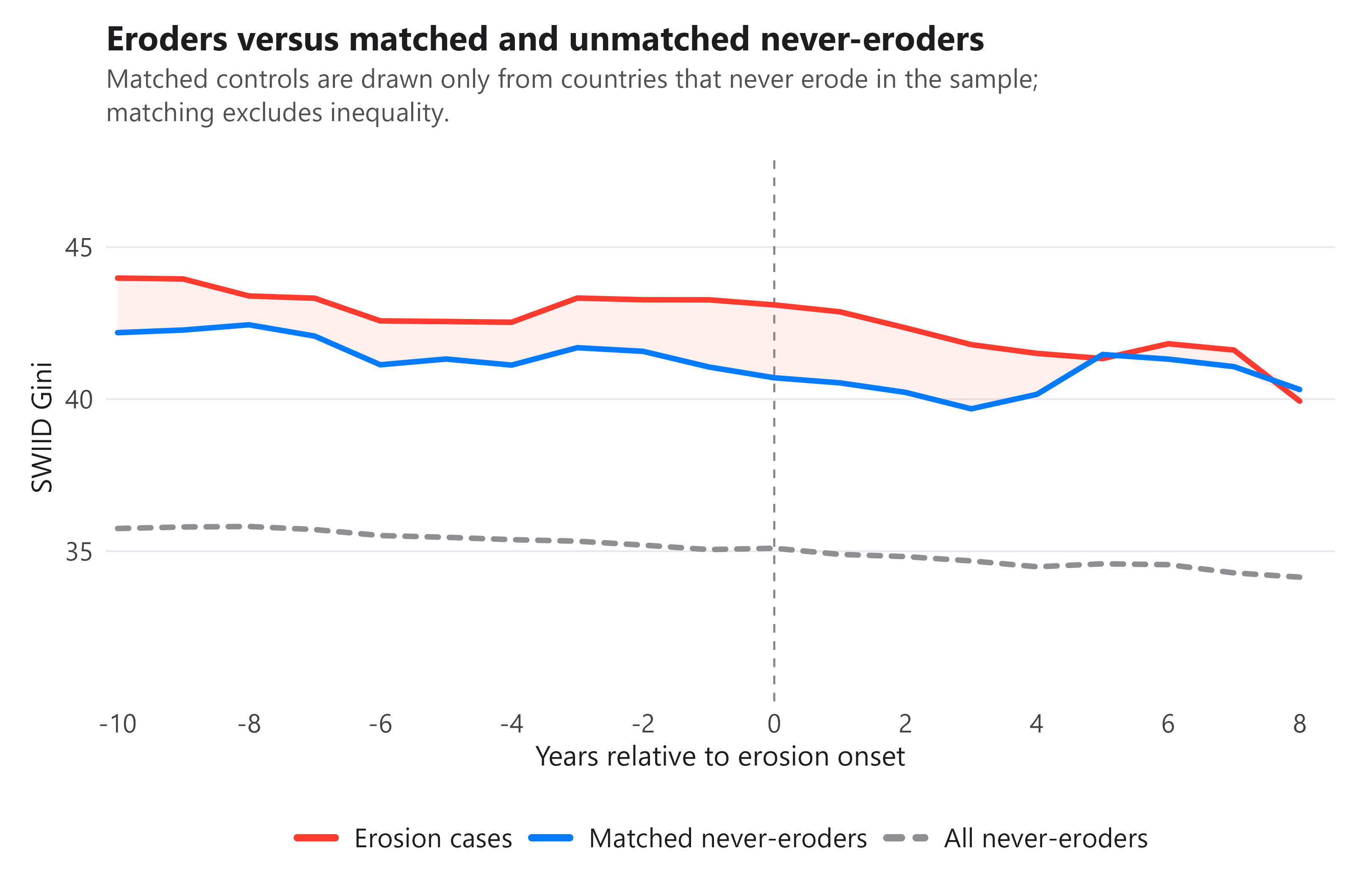
Here’s what I get. Note the scale (Gini coefficient, y axis).
What’s going on?
Eroders (in red) are much more unequal in levels than never-eroding democracies (dashed grey line). That’s as expected and tells us nothing interesting.
Eroders have a flat inequality trajectory in the decade before erosion. That’s a bit weird, but okay, perhaps inequality is just a background risk condition for erosion such that high inequality level raises the risk, while low inequality level reduces it. It could be that levels, not changes, are important, which is fair enough.
Crucially, eroders are just a bit more unequal (in level terms) than matched non-eroders (blue line). Well, that might be a problem for the thesis. In plainer terms: democracies which end up eroding have roughly the same inequality level and trend as matched democracies that don’t end up eroding.
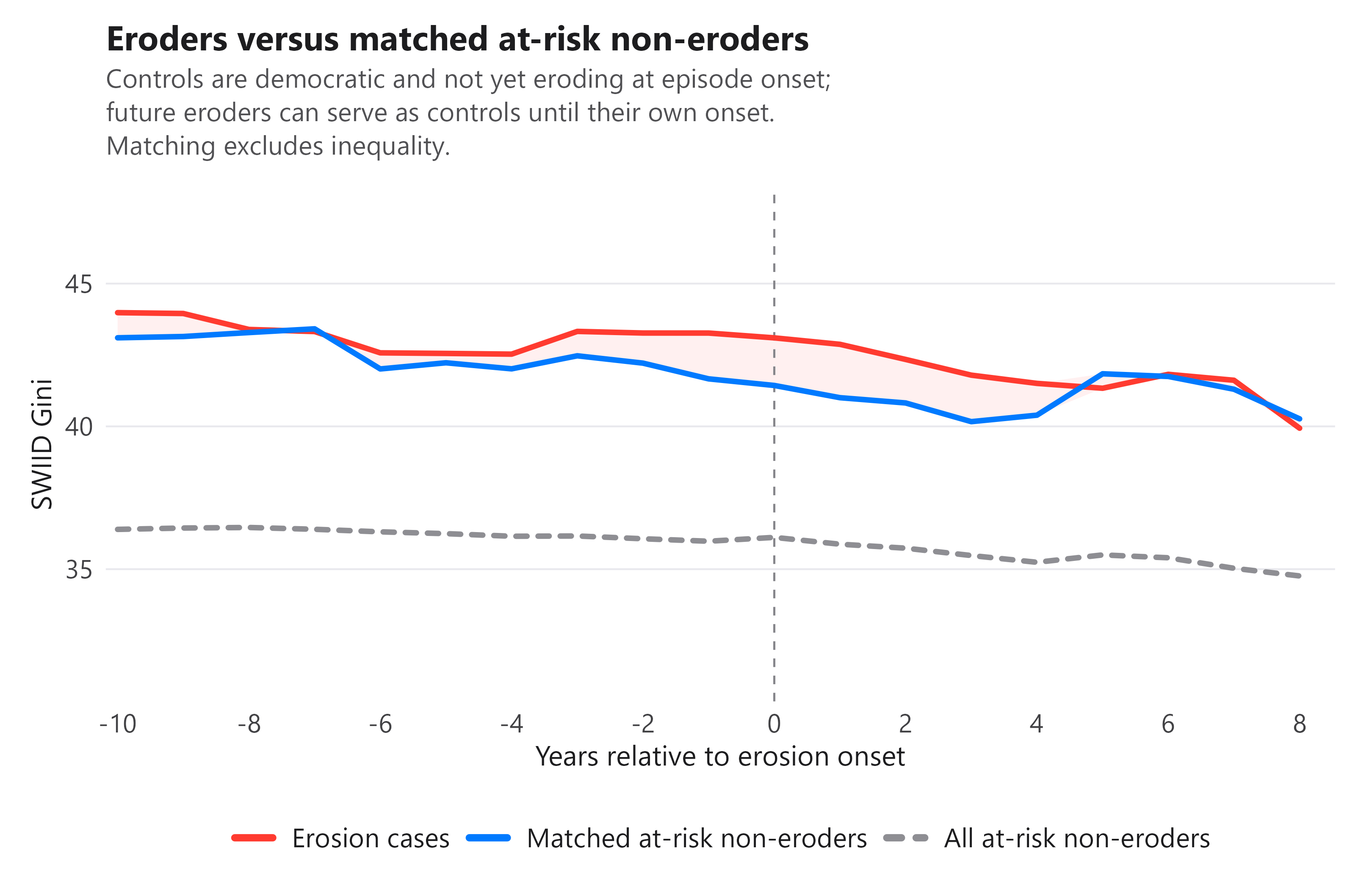
And here’s an analysis which includes both never-eroders as well as not-yet-eroders as donors for matching. This is in some ways a weaker test, but it also has some upsides. But the difference is again very small (even smaller).
Now, does this matching exercise really tell us anything? What if the matching-based procedure simply isn’t appropriate? More practically speaking, what if we carried out a falsification test and used the matching-based analysis on some variable for which we’re much more confident should matter in democratic erosion. If possible, it should be something that was also indicated as important and significant by the Rau/Stokes paper itself. One candidate could be state capacity. Clearly, democratic erosion should be easier to carry out in democracies with lower state capacity, though it actually only shows a mixed signal in the paper. An even better candidate is political polarization. It’s again theoretically very likely, but even more importantly, the Rau/Stokes paper finds it to statistically rival inequality in terms of effect size and significance.
Now, if we do this and find small gaps again, then perhaps we’re just generating false nulls. But if the expected gaps show up, then maybe the inequality “null” is onto something.
Here it is, with inequality in panel A for comparison.
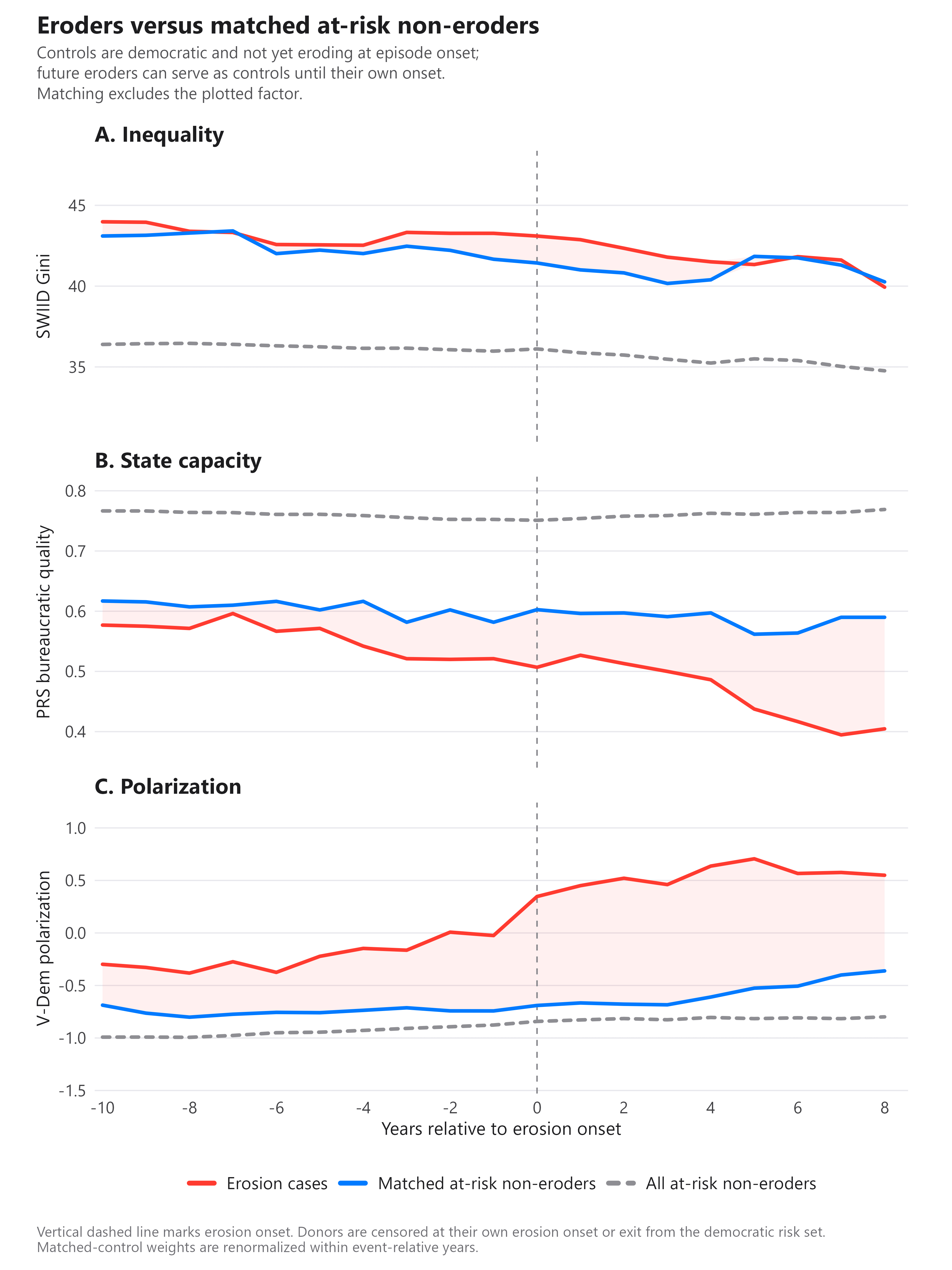
Even just eyeballing it, the difference is very stark. (To make vertical distances comparable across panels, each panel spans the same amount of variation, i.e., two full-sample country-year standard deviations for that variable.) Eroders and matched non-eroders are almost indistinguishable in terms of inequality, but they clearly moderately differ with respect to state capacity (especially in the last few years before erosion happens), and they strongly differ as far as polarization is concerned, again especially in the few years before erosion starts.1
Here are the more precise numbers so we’re not only eyeballing. The standard-deviation differences are 0.12, 0.28, and 0.49, respectively. See below. If we’re restricting matching solely to never-eroders (which is arguably more appropriate), the SDs are 0.20 (non-sig), 0.37 (non-sig), and 0.49, respectively.
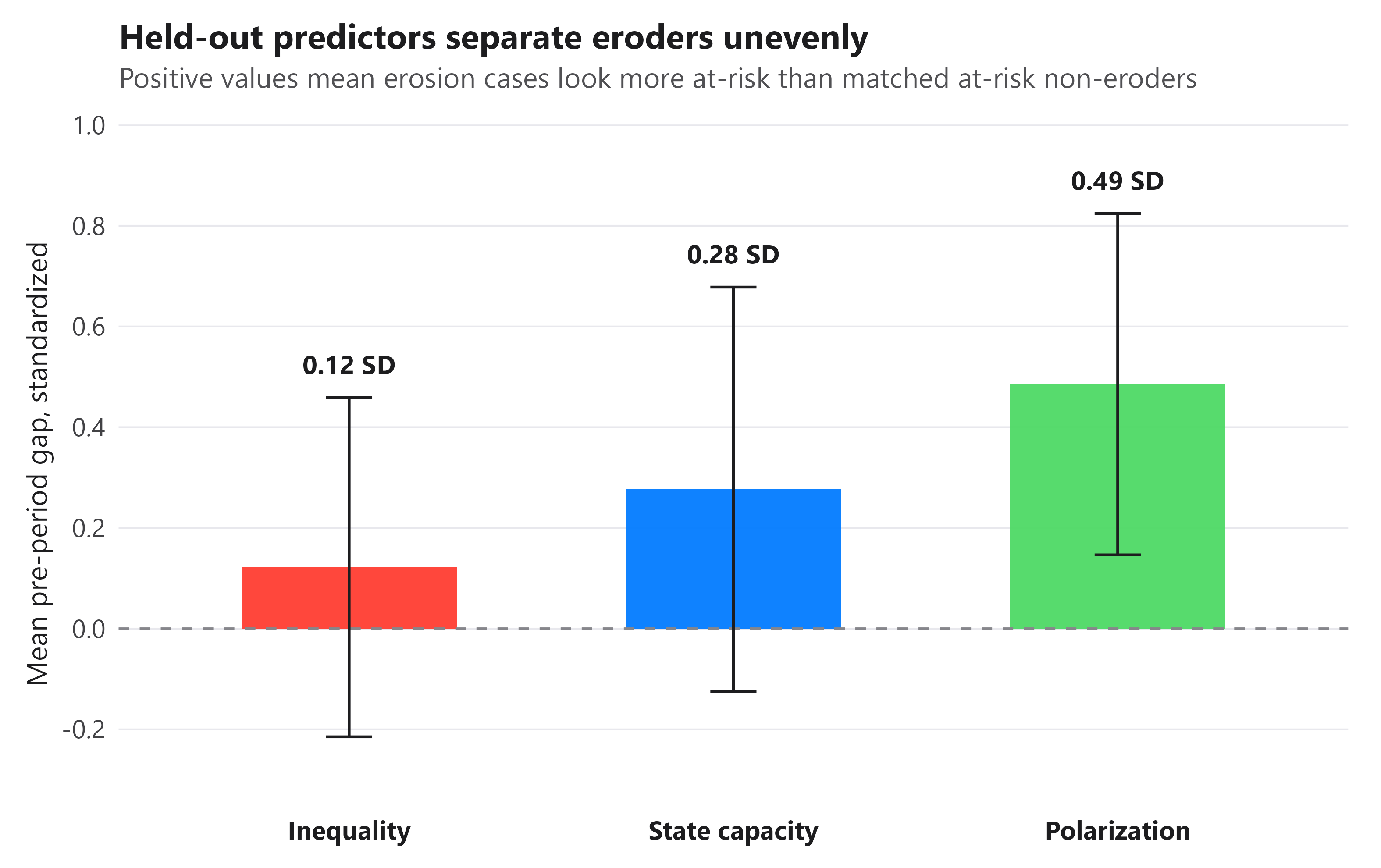
Now, I’m of course not saying this quick-and-dirty analysis of mine overturns the Rau/Stokes results. Additionally, it doesn’t provide causal evidence that inequality doesn’t matter for erosion. And it doesn’t provide causal evidence that state capacity and polarization do matter. Unobserved confounding is still a problem (though no more a problem than in the original paper). Moreover, although I was able to significantly reduce standardized differences between countries after matching, they’re nothing to write home about, so the “counterfactuals” here are really so-so.
But I would say this is some descriptive/associational evidence against the descriptive/associational evidence provided by Rau/Stokes. I’m simply not sure what to think of their results, even as associational evidence goes; let’s leave it at that.
Rau and Stokes do say that they suspect polarization to be a mediator between inequality and erosion, which means controlling for it (when focusing on inequality) would be inappropriate. However, first, their own analyses show inequality to be a strong predictor of erosion even when controlling for the supposed polarization mediator, which throws doubt on their proposition. Second, I reran my analysis by excluding polarization as a matching covariate when inequality is the focal predictor, and I get virtually the same small result (on inequality) as when controlling for polarization.