
[Refinery Pedia] Specifications of Refinery Gases part 1
25 views
Skip to first unread message

Moneer
Sep 7, 2011, 10:40:14 PM9/7/11
to refine...@googlegroups.com
Introduction
The terms of "petroleum gas" and "refinery gas" are often used to allow identifyng LPG (Liquefied Petroleum Gas) or even gas that come from the top of a refinery distillation column. "petroleum gas” not only describes LPG but also refinery gas and natural gas .In this Post, each gas is refered by its name instead of the term petroleum gas (ASTM D-4150). Also, the composition of each gas different (Table 3.1)and recognition here is very important before testing any protocols applied.
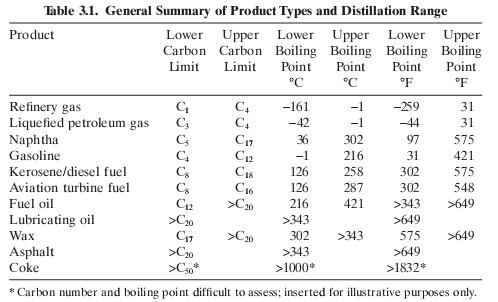
The first and most important aspect of gaseous testing is the measurement of the volume of gas (ASTM D-1071). In this test method, several techniques are described can be used for any purpose where it is necessary to know the quantity of gas fuel (ASTM D-1071). Besides, the thermophysical properties of methane (ASTM D-3956), ethane (ASTM D-3984),propane (ASTM D-4362), n-butane (ASTM D-4650), and iso-butane (ASTM D-4651) should be ready to use.
Liquefied Petroleum Gas
(LPG) is a blend of the gaseous hydrocarbons propane and butane that are produced during natural gas refining, petroleum stabilization, and petroleum refining. The propane and butane can be derived from natural gas or from refinery operations,but in the latter case substantial proportions of the corresponding olefins will be present and must be separated.The hydrocarbons are normally liquefied under pressure for transportation and storage.
The presence of propylene and butylenes in liquefied petroleum gas used as fuel gas is not critical. The vapor pressures of these olefins are slightly higher than those of propane and butane and the flame speed is substantially higher, but this may be an advantage because the flame speeds of propane and butane are slow.However,one issue that often limits the amount of olefins in liquefied petroleum gas is the propensity of the olefins to form soot.
In addition, liquefied petroleum gas is usually available in different grades (usually specified as Commercial Propane, Commercial Butane, Commercial Propane-Butane (P-B) Mixtures, and Special Duty Propane)(Rawlinson and Ward,1973). During the use of liquefied petroleum gas,the gas must vaporize completely and burn satisfactorily in the appliance without causing any corrosion or producing any deposits in the system. Commercial Propane consists predominantly of propane and/or propylene, whereas Commercial Butane is mainly composed of butanes and/or butylenes. Both must be free from harmful amounts of toxic constituents and free from mechanically entrained water (which may be further limited by specifications) (ASTM D-1835). Analysis by gas chromatography is possible.
Commercial Propane-Butane mixtures are produced to meet particular requirements such as volatility, vapor pressure, specific gravity, hydrocarbon composition, sulfur and its compounds, corrosion of copper, residues, and water content.These mixtures are used as fuels in areas and at times where low ambient temperatures are less frequently encountered.Analysis by gas chromatography is possible (ASTM D-5504,ASTM D-6228). Special Duty Propane is intended for use in spark-ignition engines, and the specification includes a minimum motor octane number to ensure satisfactory antiknock performance. Propylene CH3CHCH2 has a significantly lower octane number (ASTM D-2623) than propane, so there is a limit to the amount of this component that can be tolerated in the mixture. Analysis by gas chromatography is possible (ASTM D-5504, ASTM D6228)
Liquefied petroleum gas and liquefied natural gas can share the facility of being stored and transported as a liquid and then vaporized and used as a gas.To achieve this,liquefied petroleum gas must be maintained at a moderate pressure but at ambient temperature.The liquefied natural gas can be at ambient pressure but must be maintained at a temperature of roughly –1 to 60°C (30–140°F).In fact,in some applications it is actually economical and convenient to use liquefied petroleum gas in the liquid phase. In such cases, certain aspects of gas composition (or quality such as the ratio of propane to butane and the presence of traces of heavier hydrocarbons, water, and other extraneous materials) may be of lesser importance compared with the use of the gas in the vapor phase.
For normal (gaseous) use, the contaminants of liquefied petroleum gas are controlled at a level at which they do not corrode fittings and appliances or impede the flow of the gas. For example, hydrogen sulfide (H2S) and carbonyl sulfide (COS) should be absent. Organic sulfur to the level required for adequate odorization (ASTM D-5305), or stenching, is a normal requirement in liquefied petroleum gas; dimethyl sulfide (CH3SCH3) and ethyl mercaptan (C2H5SH) are commonly used at a concentration of up to 50 ppm.Natural gas is similarly treated,possibly with a wider range of volatile sulfur compounds. The presence of water in liquefied petroleum gas (or in natural gas) is undesirable because it can produce hydrates that will cause, for example, line blockage due to the formation of hydrates under conditions where the water dew point is attained (ASTM D-1142). If the amount of water is above acceptable levels, the addition of a small amount of methanol will counteract any such effect.
In addition to other gases,liquefied petroleum gas may also be contaminated by higher-boiling constituents such as the constituents of middle distillates to lubricating oil.These contaminants become included in the gas
In addition to other gases,liquefied petroleum gas may also be contaminated by higher-boiling constituents such as the constituents of middle distillates to lubricating oil.These contaminants become included in the gas
during handling and must be prevented from reaching unacceptable levels. Olefins and especially diolefins are prone to polymerization and should be removed.
Natural Gas
Natural gas is found in petroleum reservoirs as free gas (associated gas), in solution with petroleum in the reservoir (dissolved gas),or in reservoirs that contain only gaseous constituents and no (or little) petroleum (unassociated gas) (Austin, 1984; Speight, 1999; Cranmore and Stanton,2000).The hydrocarbon content varies from mixtures of methane and ethane with very few other constituents (dry gas) to mixtures containing all of the hydrocarbons from methane to pentane and even hexane (C6H14) And heptane (C7H16) (wet gas) In both cases, some carbon dioxide (CO2) and inert gases, including helium (He), are present together with hydrogen sulfide (H2S) and a small quantity of organic sulfur. Although the major subject of this chapter is liquefied petroleum gas,the term “petroleum gas(es)” in this context is also used to describe the gaseous phase and liquid phase mixtures comprised mainly of methane to butane (from C1 to C4 Hydrocarbons) that are dissolved in the crude oil and natural gas, as well as gases produced during thermal processes in which the crude oil is converted to other products. It is necessary, however, to acknowledge that in addition to the hydrocarbons, gases such as carbon dioxide, hydrogen sulfide, and ammonia are also produced during petroleum refining and will be constituents of refinery gas that must be removed. Olefins are also present in the gas streams of various processes and are not included in liquefied petroleum gas but are removed for use in petrochemical operations (Crawford et al.,1993).
Raw natural gas varies greatly in composition (Table 3.2), and the constituents can be several of a group of hydrocarbons (Table 3.3) and non-hydrocarbons. The treatment required to prepare natural gas for
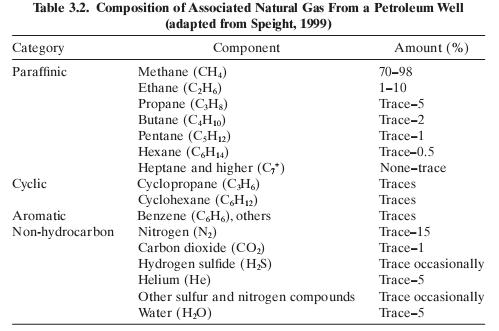

distribution as a industrial or household fuel is specified in terms of the use and environmental regulations. Carbon dioxide (ASTM D-1137, ASTM D-1945, ASTM D-4984) in excess of 3% is normally removed for reasons of corrosion prevention (ASTM D-1838).Hydrogen sulfide (ASTM D-2420,ASTM D-2385,ASTM D-2725, ASTM D-4084, ASTM D-4810) is also removed, and the odor of the gases must not be objectionable (ASTM D-6273) so mercaptan content (ASTM D-1988, ASTM D-2385) is important. A simple lead acetate test (ASTM D-2420, ASTM D-4084) is available for detecting the presence of hydrogen sulfide and is an additional safeguard that hydrogen sulfide not be present (ASTM D-1835). Methyl mercaptan, if present, produces a transitory yellow stain on the lead acetate paper that fades completely in less than 5 min. Other sulfur compounds (ASTM D-5504, ASTM D-6228) present in liquefied petroleum gas do not interfere.
In the lead acetate test (ASTM D-2420),the vaporized gas is passed over moist lead acetate paper under controlled conditions. Hydrogen sulfide reacts with lead acetate to form lead sulfide, resulting in a stain on the
paper varying in color from yellow to black depending on the amount of hydrogen sulfide present. Other pollutants can be determined by gas chromatography (ASTM D-5504,ASTM D-6228).
The total sulfur content (ASTM D-1072,ASTM D-2784,ASTM D-3031) is normally acceptably low and frequently so low that it needs augmenting by means of alkyl sulfides,mercaptans,or thiophenes to maintain an accept able safe level of odor. The hydrocarbon dew point is reduced to such a level that retrograde condensation, that is, condensation resulting from pressure drop, cannot occur under the worst conditions likely to be experienced in the gas transmission system. Similarly, the water dew point is reduced to a level suffi cient to preclude formation of C1 to C4 hydrates in the system.
The natural gas after appropriate treatment for acid gas reduction,odorization, and hydrocarbon and moisture dew point adjustment (ASTM D-1142) would then be sold within prescribed limits of pressure, calorific value,and possibly Wobbe index [cv/(sp.gr.)].
--
Posted By Moneer to Refinery Pedia at 9/07/2011 07:40:00 PM
Reply all
Reply to author
Forward
0 new messages