
White Buffalo Calf Woman Sings: Face Painting Traditions Among Native American Warriors
49 views
Skip to first unread message

White Buffalo Calf Woman, your Twin Deer Mother
Sep 30, 2010, 2:48:20 AM9/30/10
to Grandmothers of the Green Grass, Sanctuary, Educators, Travelers Hoop Five, Education Hoop Five, Hoop 4 Songs of the Heart, Hoop 4 Songs of the Heart, Hoop 4 Songs of the Heart, Hoop 3 Songs of the Heart, Red Hoop 3 Songs of the Heart, Blue Hoop 3 Songs of the Heart, Gathering, Warriors
http://spiritofthelakepeople.blogspot.com/2010/09/face-painting-traditions-among-native.html
 Every
story has a reason, to begin in such a season, to express oneself and
the galaxy. Find the perfect resonance calling, that I may paint my
rawling * (the soul is golden, dream wisdom of the fierce
warrior, who stands their ground together, like a dog soldiers), the
expression of my devotion to God (oneness of all life, relatives). I
come to you dressed in fashion, my face makes a statement to speak of
heavenly beings again. Gifting what my treasures, to dance and measure,
the greatness of divine of all things.
Every
story has a reason, to begin in such a season, to express oneself and
the galaxy. Find the perfect resonance calling, that I may paint my
rawling * (the soul is golden, dream wisdom of the fierce
warrior, who stands their ground together, like a dog soldiers), the
expression of my devotion to God (oneness of all life, relatives). I
come to you dressed in fashion, my face makes a statement to speak of
heavenly beings again. Gifting what my treasures, to dance and measure,
the greatness of divine of all things.
I fly with the eagle (holy morning star) and run with the buffalo (four sacred directions), where green grass flows over rolling hills (spiritual embrace of rainbow colors). And if I paint my shadow (soul), then all will be known, the paddles (guide my journey), will be used on the ocean floor, to drive back home, to adore. Heaven gift me spirit, I bring my soul near it. I express my heavenly virtues under the sun. Watch me dance now, with my face and brow, there will be actions, when the night falls. I am the painted skill of all (display God's glory).
Heaven gather in me. Bring the dance and song, together. I shall shine this glory, with my ability. And if my face is chosen, to represent the golden, then the rays of God's blinding light shall sea, bringing me back to harmony. The places I seek, is the heart of the meek, to bless the star of the divine. But if I must trouble, then I will surely stumble around the rock, and glide freely. For my dance, will set me twirling around thee. And relatives be sure, that when you fumble, get up and make a tumble, because it's part of your dance, don't you sea. Bring spirit to action (ascending flesh, liberty), make embraces mere impaction (descending soul, increases density), toward the living life of eternity.
Sung by White Buffalo Calf Woman, your Twin Deer Mother
* Rawlings, Raw, Ralph: someone who lived at a row (a hedgerow or a row of houses), from northern Middle English raw ‘row’, Old English rāw. Germanic rad ‘counsel’, ‘advice’ + wolf ‘wolf’. To read more about Brother Wolf and his fierceness! http://peacefulwisdomprayer.blogspot.com/2009/05/brother-wolf-speaks-warrior-freedom.html
This was first introduced into England by Scandinavian settlers in the Old Norse form Ráðulfr. This interesting name is of early medieval English origin, and is one of the patronymic forms of the surname Rawling, developed from the Middle English given name "Rawlin". The personal name was adopted from the Old French "Raulin", itself a double diminutive of "Raw", with the Anglo-Norman French suffixes "-el" and "-in". Raw "someone who lived at a row" (a hedgerow or a row of houses) was one of the many variant forms of the male personal name Ralph, in origin an Old Norse name composed of the Germanic elements "rad", counsel, advice, with "wolf", wolf. This was first introduced into England by Scandinavian settlers in the Old Norse form "Rathulfr", and was reinforced after the Conquest of 1066 by the Norman forms "Raulf, Radulf".
A Coat of Arms granted to the Rawlings family is per pale white and black on a chevron between three martlets as many crescents all counterchanged. The Crest is a black ram passant attired gold. Throughout the centuries, surnames in every country have continued to "develop" often leading to astonishing variants of the original spelling. Thank you http://www.surnamedb.com/Surname/Rawlings
Face Painting Traditions Among Men of the Plains
by Jonathan Holmes
 While
many of the traditions concerning face painting has been taught to me
by northern and southern tribal elders, I prefer to maintain their
privacy. Therefore, I have only used literary sources for references.
While
many of the traditions concerning face painting has been taught to me
by northern and southern tribal elders, I prefer to maintain their
privacy. Therefore, I have only used literary sources for references.
For years I have heard different generations ask about the practice of face painting by men dancing at Inter-tribal Pow-Wows or Formal Southern War Dances. So, in this article I will try to answer some of these questions. However, since this is sometimes a very complex topic, I would still suggest the reader do further study on their own, including talking with recognized elders within the tribal tradition the dance style and dance clothes in question may represent.
Obtaining Paint
The oldest materials used in paint were derived from animal, vegetable and mineral sources, with earth or mineral paint being the most common. White and yellow paint was obtained from white and yellow clays along river beds, and buffalo gallstones produced a different kind of yellow. Green paint was obtained from copper ores. One type of blue paint came from drying a certain type of duck manure, and some tribes would combine a bluish mud and yellow clay to make green paint. Powdered charred wood and black earth was used in making black paint.
The base for red paints, probably the most commonly used color, were crimson colored clay.
A brownish red paint could be obtained by baking yellow clay over ashes until it turned red.
A description of this is described by Frances Densmore in her work titled Teton Sioux Music,
“On the Standing Rock Reservation is found a yellow ocherous substance which, after being reduced to a fine powder, is used by the Indians in making yellow paint. This substance, when treated by means of heat, yields the vermilion used on all ceremonial articles as well as in painting the bodies of the Indians. The baking of this ocherous substance – a process which requires skill – is done by the women. First, the substance mixed with water is formed into a ball. A hole is dug in the ground in which a fire of oak bark is made. When the ground is baked the coals are removed, the ball is placed in the hole, and a fire is built above it. This fire is maintained at a gentle, even heat for about an hour, which is sufficient for the amount of the substance usually prepared at a time. The action of the heat changes the color of the substance to red. When the ball is cold, it is pounded to powder. In the old days this red powder was mixed with buffalo fat in making the paint, but at present time it is mixed with water. White, black and blue paints were obtained by mixing colored earthy substances with buffalo fat. The blue was found in southern Minnesota and required no treatment by heat, and the white and black in North Dakota.” (Densmore, 1918, p. 116)
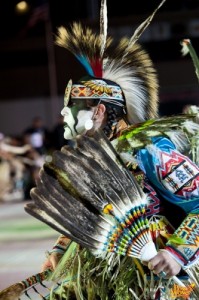 To
prepare them for use, most of the raw colored earth or clay deposits
were baked and then ground into a powder. The powder was kept in a small
buckskin bundle and would have been put into a larger decorated paint
bag with other bundles of different colors, perhaps a bone or wooden
applicator and a small mirror. When used they would either apply the
paint dry or mix it with bear grease, buffalo tallow, or water to
achieve the desired effect.
To
prepare them for use, most of the raw colored earth or clay deposits
were baked and then ground into a powder. The powder was kept in a small
buckskin bundle and would have been put into a larger decorated paint
bag with other bundles of different colors, perhaps a bone or wooden
applicator and a small mirror. When used they would either apply the
paint dry or mix it with bear grease, buffalo tallow, or water to
achieve the desired effect.
Because of the religious significance and the ceremonial uses many tribes had for red paint, the bright vermilion red paint offered to tribes by European Fur Traders was highly sought after at a very early date. According to J. Frederick Fausz, Ph.D., in his published curriculum for the 2004 course titled The Louisiana Expansion at the University of Missouri – St. Louis, he states that long before French explorers met them in 1673, the Osage had moved onto the central plains along with the related, neighboring tribes of Kansa (aka Kaw), Omaha, Ponca, and Quapaw. When St. Louis was founded in 1764, it is said that the Osage used their talents and knowledge to make the fur trade profitable because they were considered the best fur producers south of Canada. Therefore, the Osage received many European items in trade including Chinese vermilion (aka mercury sulfide face-paint).
Even among the Omaha, there is evidence that paint was obtained at a very early stage from traders, as evidenced by the following,
“Another saving of labor in comparison with old methods was involved in buying paints from the traders. The paint was sold in small packages not much larger than a paper of darning needles.” (Fletcher-LaFlesche, 1911, p. 615)
Older Uses of Face Paint
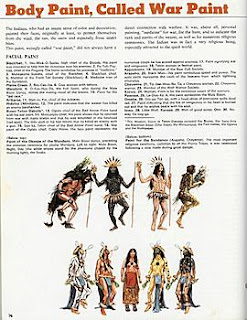
The painting of a man’s face and body among the Plains tribes during the buffalo days was said to be a form of mental conditioning. Warriors would paint themselves with personal protective designs and colors before they engaged in battle with an enemy. Hence the stereotypical term “war paint”.
This paint would have been prayed over. It was believed that prayers were put into the paint, and when applied, the power of the prayers were conveyed upon the wearer. Other times there might even be special songs sung when paint was applied. Some warriors applied the paint themselves, others preferred to be painted by a holy person or medicine man.
Frances Densmore in Teton Sioux Music again states that among the Teton Lakota,
“Little Buffalo (Tatanka-Cikala) was a man who ‘made medicine’ for the warriors. Using blue clay mixed with ‘medicine’, he painted a band across the man’s forehead with a branching end on each cheek bone, the painting being done only in war. Bear Eagle (Mato-Wanbli), who had been painted in this manner by Little Buffalo, recorded the two following songs. He said that the first one was sung by Little Buffalo alone as he painted them, and the second by the warriors after the painting was finished.” (Densmore, 1918, p. 350)
Face painting was, at other times, not connected with war preparation, as designs of various kinds were used to designate membership in societies; used when participating in ceremonies; used as marks of achievement; and used in morning for the dead.
According to Oglala Lakota holy man, Nicholas Black Elk in Joseph Brown’s work titled, The Sacred Pipe: Black Elk’s Account of the Seven Rites of the Oglala Sioux,
“By being painted, the people have been changed. They have undergone a new birth, and with this they have new responsibilities, new obligations, and a new relationship.” (Brown, 1953, p. 111)
Returning warriors of many Plains tribes, who had taken scalps of their enemies, often painted their faces black before returning to their camp. It has been said that the Crow believed that a blackened face symbolically represented the fires of revenge that had burned out after vanquishing their enemy.
The Pawnee scouts would paint their faces white to symbolize the wolf, whose spiritual power was considered to be of great help for a scout. According to Fletcher; LaFlesche in their work titled The Omaha Tribe, among the Omaha,
“Men generally painted their faces and bodies in accordance with dreams or in representation of some achievement or accorded honor”…”Before the advent of the looking glass a young man was painted by his friend”…When going into battle, on the surround at the tribal buffalo hunt, when taking part in the Hedewachi ceremony, at the Hethushka society, and the Pebble society, the painting on their faces and bodies had a serious significance partaking of the nature of an appeal or prayer.” (Fletcher-LaFlesche, 1911, p. 350)
Further in this same work, in a chapter on the Omaha men’s warrior society called Hethushka, it states, “Each man painted himself in accordance with the directions given him at the public ceremony when he received his grade of war honors.” (Fletcher-LaFlesche, 1911, p. 461)
At one time it is said, the Omaha and the Ponca were one tribe. After separating they retained similar societies such as the Hethuska society, and had similar ceremonies for conferring war honors. An example of the war honors among the Ponca includes reference to painting in Fletcher; LaFlesche’s work,
“First Honor: To strike an unwounded man. The sign of this honor was an eagle feather worn upright in the scalp lock; moccasin strings made of the skin of a gray wolf; the upper part of the body painted black”…”Second Honor: To be the first to strike a fallen enemy”…”the sign of this honor was an eagle feather worn horizontal in the scalp lock; painting the body irregularly in black stripes”…”Fifth Honor: To take a scalp. The sign of this honor was to paint the face with a slight tinge of red and put black stripes across it.”…”Sixth Honor: Capturing horses from the enemy. The badge of this honor was to wear at the dances a coil of rope around the body and to paint on the body figures shaped like the impression of a horses hoof.”
(Fletcher-LaFlesche, 1911, p. 440)
 Modern Uses of Face Paint
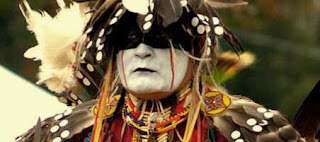
Today face paint is still used by many Plains tribes for a variety of reasons. Many ceremonies, such as Sun Dance ceremonies, Naming ceremonies, Society ceremonies, Healing ceremonies, and ceremonies for returning Veterans may involve the painting of faces in one form or another.
Some designs and color patterns may be “owned” by individuals, families, clans or societies. In some tribes the rite to wear a design and color pattern may be handed down from one individual to a younger relative. For example, an old combat veteran, too feeble to dance at Pow-Wows anymore, could give his young grandson the rite to use his face paint pattern and colors when he dances.
In some tribes, face paint patterns, face paint colors, the paint itself, and a possible set of protective prayers or songs, could be purchased from one individual by another. A young man might come up to an older man saying something like, “I remember you used to wear a particular pattern of paint when you danced. I would like to give you these gifts in exchange for the right to honor you by wearing your design when I dance.” It would then be said that he paid for the rite to wear a particular design and color pattern.
Some modern traditional dancers are combat veterans who wear face paint that they wore while in combat, or in a dream related to their combat experience, or as a result of their combat experience.
In both Ponca and the Osage men’s warrior societies, it is common to see men wearing protective red paint at the corner of their eyes.
For the Ponca Hethuska,
“The common face paint design for a straight dancer is a red line extending back from the corner of each eye for about 2 inches.” (Howard, 1965, p. 65)
Among the Osage Inlonschka,
“In modern times Osages use very little face paint in the Inlonschka. Usually only a streak of red one finger wide is used from the edge of the eye to the earlobe, a pinch of red is placed on each earlobe.” (Callahan, 1990, p. 112)
Often times among the Ponca and Osage, a boy or young man is usually painted for the first time by a relative when they are given their “Indian Name”, or when they are brought into the dance circle for the first time. Depending upon their age, the individual applies it themselves from then on. This red protection paint, is said to protect the straight dancers from harm while in the dance circle.
Other southern plains tribes have similar variations of eye paint in different colors and different patterns such as in a “V” shape coming out from the corner of the eye, in a “V” shape with a center line or also known as a “crows foot” design, or a series of small dots.
Lastly, whether you are a northern traditional dancer, a southern straight dancer, a fancy feather dancer, a chicken dancer or a grass dancer, and you are considering wearing face paint, the first question you should ask yourself is “why”. Why should you be wearing it? For protection; to honor someone else; to be part of your personal experiences as a veteran; or to follow the dictates of a dream or visionary experience; or to show family, clan or society ties. Once you have answered the why, then you can move on to the how and when.
 References:
Brown, Joseph Epes.
1953. The Sacred Pipe: Black Elk’s Account of the Seven Rites of the Oglala Sioux, University of Oklahoma Press, Norman, OK.
Callahan, Alice A.
1990. The Osage Ceremonial Dance, Inlonschka, University of Oklahoma Press, Norman, OK.
Densmore, Frances.
1918. Teton Sioux Music, Bureau of American Ethnology, Bulletin No. 61, U.S. Government Printing Office, Smithsonian Institution, Washington, D.C.
Fletcher, Alice C. And Joseph LaFlesche.
1911. The Omaha Tribe, Bureau of American Ethnology, 27th Annual Report 1905-06, U.S. Government Printing Office, Smithsonian Institution, Washington D.C.
Howard, Dr. James H.
1965. The Ponca Tribe, Bureau of American Ethnology, Bulletin No. 195, U.S. Government Printing Office, Smithsonian Institution, Washington, D.C.
Mails, Thomas E.
1972. Mystic Warriors of the Plains, Doubleday, New York, NY.
http://www.powwows.com/articles/?p=621&utm_source=PowWows.com+Newsletter

 Rainbow Warriors of Prophecy


There is a place where the Buffalo (flesh of earth, the light that grows, the four sacred directions, where we do) roam, and my heart does know how to roam, to be across the rolling hills, to eat of the green grass and know my fills. I am nourished by this love, the place, where I live inside the dark, the heaven calling, to fill me up. We the Rainbow Clan do know (how to drink from this spiritual cup), that we are part of this sacred show, where the Horse (soul of heaven, the heart that knows) runs wild and free, to be with Warriors, the Dog (rainbow warrior of prophecy who stands their ground) who bleeds (follows the red road, the law of love, where the fighting is for the unification of the broken heart, to bring the warrior up).
Wednesday, September 29, 2010
Face Painting Traditions Among Native American Warriors

I fly with the eagle (holy morning star) and run with the buffalo (four sacred directions), where green grass flows over rolling hills (spiritual embrace of rainbow colors). And if I paint my shadow (soul), then all will be known, the paddles (guide my journey), will be used on the ocean floor, to drive back home, to adore. Heaven gift me spirit, I bring my soul near it. I express my heavenly virtues under the sun. Watch me dance now, with my face and brow, there will be actions, when the night falls. I am the painted skill of all (display God's glory).
Heaven gather in me. Bring the dance and song, together. I shall shine this glory, with my ability. And if my face is chosen, to represent the golden, then the rays of God's blinding light shall sea, bringing me back to harmony. The places I seek, is the heart of the meek, to bless the star of the divine. But if I must trouble, then I will surely stumble around the rock, and glide freely. For my dance, will set me twirling around thee. And relatives be sure, that when you fumble, get up and make a tumble, because it's part of your dance, don't you sea. Bring spirit to action (ascending flesh, liberty), make embraces mere impaction (descending soul, increases density), toward the living life of eternity.
Sung by White Buffalo Calf Woman, your Twin Deer Mother
* Rawlings, Raw, Ralph: someone who lived at a row (a hedgerow or a row of houses), from northern Middle English raw ‘row’, Old English rāw. Germanic rad ‘counsel’, ‘advice’ + wolf ‘wolf’. To read more about Brother Wolf and his fierceness! http://peacefulwisdomprayer.blogspot.com/2009/05/brother-wolf-speaks-warrior-freedom.html
This was first introduced into England by Scandinavian settlers in the Old Norse form Ráðulfr. This interesting name is of early medieval English origin, and is one of the patronymic forms of the surname Rawling, developed from the Middle English given name "Rawlin". The personal name was adopted from the Old French "Raulin", itself a double diminutive of "Raw", with the Anglo-Norman French suffixes "-el" and "-in". Raw "someone who lived at a row" (a hedgerow or a row of houses) was one of the many variant forms of the male personal name Ralph, in origin an Old Norse name composed of the Germanic elements "rad", counsel, advice, with "wolf", wolf. This was first introduced into England by Scandinavian settlers in the Old Norse form "Rathulfr", and was reinforced after the Conquest of 1066 by the Norman forms "Raulf, Radulf".
A Coat of Arms granted to the Rawlings family is per pale white and black on a chevron between three martlets as many crescents all counterchanged. The Crest is a black ram passant attired gold. Throughout the centuries, surnames in every country have continued to "develop" often leading to astonishing variants of the original spelling. Thank you http://www.surnamedb.com/Surname/Rawlings
Face Painting Traditions Among Men of the Plains
by Jonathan Holmes

For years I have heard different generations ask about the practice of face painting by men dancing at Inter-tribal Pow-Wows or Formal Southern War Dances. So, in this article I will try to answer some of these questions. However, since this is sometimes a very complex topic, I would still suggest the reader do further study on their own, including talking with recognized elders within the tribal tradition the dance style and dance clothes in question may represent.
Obtaining Paint
The oldest materials used in paint were derived from animal, vegetable and mineral sources, with earth or mineral paint being the most common. White and yellow paint was obtained from white and yellow clays along river beds, and buffalo gallstones produced a different kind of yellow. Green paint was obtained from copper ores. One type of blue paint came from drying a certain type of duck manure, and some tribes would combine a bluish mud and yellow clay to make green paint. Powdered charred wood and black earth was used in making black paint.
The base for red paints, probably the most commonly used color, were crimson colored clay.
A brownish red paint could be obtained by baking yellow clay over ashes until it turned red.
A description of this is described by Frances Densmore in her work titled Teton Sioux Music,
“On the Standing Rock Reservation is found a yellow ocherous substance which, after being reduced to a fine powder, is used by the Indians in making yellow paint. This substance, when treated by means of heat, yields the vermilion used on all ceremonial articles as well as in painting the bodies of the Indians. The baking of this ocherous substance – a process which requires skill – is done by the women. First, the substance mixed with water is formed into a ball. A hole is dug in the ground in which a fire of oak bark is made. When the ground is baked the coals are removed, the ball is placed in the hole, and a fire is built above it. This fire is maintained at a gentle, even heat for about an hour, which is sufficient for the amount of the substance usually prepared at a time. The action of the heat changes the color of the substance to red. When the ball is cold, it is pounded to powder. In the old days this red powder was mixed with buffalo fat in making the paint, but at present time it is mixed with water. White, black and blue paints were obtained by mixing colored earthy substances with buffalo fat. The blue was found in southern Minnesota and required no treatment by heat, and the white and black in North Dakota.” (Densmore, 1918, p. 116)
 To
prepare them for use, most of the raw colored earth or clay deposits
were baked and then ground into a powder. The powder was kept in a small
buckskin bundle and would have been put into a larger decorated paint
bag with other bundles of different colors, perhaps a bone or wooden
applicator and a small mirror. When used they would either apply the
paint dry or mix it with bear grease, buffalo tallow, or water to
achieve the desired effect.
To
prepare them for use, most of the raw colored earth or clay deposits
were baked and then ground into a powder. The powder was kept in a small
buckskin bundle and would have been put into a larger decorated paint
bag with other bundles of different colors, perhaps a bone or wooden
applicator and a small mirror. When used they would either apply the
paint dry or mix it with bear grease, buffalo tallow, or water to
achieve the desired effect.Because of the religious significance and the ceremonial uses many tribes had for red paint, the bright vermilion red paint offered to tribes by European Fur Traders was highly sought after at a very early date. According to J. Frederick Fausz, Ph.D., in his published curriculum for the 2004 course titled The Louisiana Expansion at the University of Missouri – St. Louis, he states that long before French explorers met them in 1673, the Osage had moved onto the central plains along with the related, neighboring tribes of Kansa (aka Kaw), Omaha, Ponca, and Quapaw. When St. Louis was founded in 1764, it is said that the Osage used their talents and knowledge to make the fur trade profitable because they were considered the best fur producers south of Canada. Therefore, the Osage received many European items in trade including Chinese vermilion (aka mercury sulfide face-paint).
Even among the Omaha, there is evidence that paint was obtained at a very early stage from traders, as evidenced by the following,
“Another saving of labor in comparison with old methods was involved in buying paints from the traders. The paint was sold in small packages not much larger than a paper of darning needles.” (Fletcher-LaFlesche, 1911, p. 615)
Older Uses of Face Paint
The painting of a man’s face and body among the Plains tribes during the buffalo days was said to be a form of mental conditioning. Warriors would paint themselves with personal protective designs and colors before they engaged in battle with an enemy. Hence the stereotypical term “war paint”.
This paint would have been prayed over. It was believed that prayers were put into the paint, and when applied, the power of the prayers were conveyed upon the wearer. Other times there might even be special songs sung when paint was applied. Some warriors applied the paint themselves, others preferred to be painted by a holy person or medicine man.
Frances Densmore in Teton Sioux Music again states that among the Teton Lakota,
“Little Buffalo (Tatanka-Cikala) was a man who ‘made medicine’ for the warriors. Using blue clay mixed with ‘medicine’, he painted a band across the man’s forehead with a branching end on each cheek bone, the painting being done only in war. Bear Eagle (Mato-Wanbli), who had been painted in this manner by Little Buffalo, recorded the two following songs. He said that the first one was sung by Little Buffalo alone as he painted them, and the second by the warriors after the painting was finished.” (Densmore, 1918, p. 350)
Face painting was, at other times, not connected with war preparation, as designs of various kinds were used to designate membership in societies; used when participating in ceremonies; used as marks of achievement; and used in morning for the dead.
According to Oglala Lakota holy man, Nicholas Black Elk in Joseph Brown’s work titled, The Sacred Pipe: Black Elk’s Account of the Seven Rites of the Oglala Sioux,
“By being painted, the people have been changed. They have undergone a new birth, and with this they have new responsibilities, new obligations, and a new relationship.” (Brown, 1953, p. 111)
Returning warriors of many Plains tribes, who had taken scalps of their enemies, often painted their faces black before returning to their camp. It has been said that the Crow believed that a blackened face symbolically represented the fires of revenge that had burned out after vanquishing their enemy.
The Pawnee scouts would paint their faces white to symbolize the wolf, whose spiritual power was considered to be of great help for a scout. According to Fletcher; LaFlesche in their work titled The Omaha Tribe, among the Omaha,
“Men generally painted their faces and bodies in accordance with dreams or in representation of some achievement or accorded honor”…”Before the advent of the looking glass a young man was painted by his friend”…When going into battle, on the surround at the tribal buffalo hunt, when taking part in the Hedewachi ceremony, at the Hethushka society, and the Pebble society, the painting on their faces and bodies had a serious significance partaking of the nature of an appeal or prayer.” (Fletcher-LaFlesche, 1911, p. 350)
Further in this same work, in a chapter on the Omaha men’s warrior society called Hethushka, it states, “Each man painted himself in accordance with the directions given him at the public ceremony when he received his grade of war honors.” (Fletcher-LaFlesche, 1911, p. 461)
At one time it is said, the Omaha and the Ponca were one tribe. After separating they retained similar societies such as the Hethuska society, and had similar ceremonies for conferring war honors. An example of the war honors among the Ponca includes reference to painting in Fletcher; LaFlesche’s work,
“First Honor: To strike an unwounded man. The sign of this honor was an eagle feather worn upright in the scalp lock; moccasin strings made of the skin of a gray wolf; the upper part of the body painted black”…”Second Honor: To be the first to strike a fallen enemy”…”the sign of this honor was an eagle feather worn horizontal in the scalp lock; painting the body irregularly in black stripes”…”Fifth Honor: To take a scalp. The sign of this honor was to paint the face with a slight tinge of red and put black stripes across it.”…”Sixth Honor: Capturing horses from the enemy. The badge of this honor was to wear at the dances a coil of rope around the body and to paint on the body figures shaped like the impression of a horses hoof.”
(Fletcher-LaFlesche, 1911, p. 440)

Today face paint is still used by many Plains tribes for a variety of reasons. Many ceremonies, such as Sun Dance ceremonies, Naming ceremonies, Society ceremonies, Healing ceremonies, and ceremonies for returning Veterans may involve the painting of faces in one form or another.
Some designs and color patterns may be “owned” by individuals, families, clans or societies. In some tribes the rite to wear a design and color pattern may be handed down from one individual to a younger relative. For example, an old combat veteran, too feeble to dance at Pow-Wows anymore, could give his young grandson the rite to use his face paint pattern and colors when he dances.
In some tribes, face paint patterns, face paint colors, the paint itself, and a possible set of protective prayers or songs, could be purchased from one individual by another. A young man might come up to an older man saying something like, “I remember you used to wear a particular pattern of paint when you danced. I would like to give you these gifts in exchange for the right to honor you by wearing your design when I dance.” It would then be said that he paid for the rite to wear a particular design and color pattern.
Some modern traditional dancers are combat veterans who wear face paint that they wore while in combat, or in a dream related to their combat experience, or as a result of their combat experience.
In both Ponca and the Osage men’s warrior societies, it is common to see men wearing protective red paint at the corner of their eyes.
For the Ponca Hethuska,
“The common face paint design for a straight dancer is a red line extending back from the corner of each eye for about 2 inches.” (Howard, 1965, p. 65)
Among the Osage Inlonschka,
“In modern times Osages use very little face paint in the Inlonschka. Usually only a streak of red one finger wide is used from the edge of the eye to the earlobe, a pinch of red is placed on each earlobe.” (Callahan, 1990, p. 112)
Often times among the Ponca and Osage, a boy or young man is usually painted for the first time by a relative when they are given their “Indian Name”, or when they are brought into the dance circle for the first time. Depending upon their age, the individual applies it themselves from then on. This red protection paint, is said to protect the straight dancers from harm while in the dance circle.
Other southern plains tribes have similar variations of eye paint in different colors and different patterns such as in a “V” shape coming out from the corner of the eye, in a “V” shape with a center line or also known as a “crows foot” design, or a series of small dots.
Lastly, whether you are a northern traditional dancer, a southern straight dancer, a fancy feather dancer, a chicken dancer or a grass dancer, and you are considering wearing face paint, the first question you should ask yourself is “why”. Why should you be wearing it? For protection; to honor someone else; to be part of your personal experiences as a veteran; or to follow the dictates of a dream or visionary experience; or to show family, clan or society ties. Once you have answered the why, then you can move on to the how and when.

Brown, Joseph Epes.
1953. The Sacred Pipe: Black Elk’s Account of the Seven Rites of the Oglala Sioux, University of Oklahoma Press, Norman, OK.
Callahan, Alice A.
1990. The Osage Ceremonial Dance, Inlonschka, University of Oklahoma Press, Norman, OK.
Densmore, Frances.
1918. Teton Sioux Music, Bureau of American Ethnology, Bulletin No. 61, U.S. Government Printing Office, Smithsonian Institution, Washington, D.C.
Fletcher, Alice C. And Joseph LaFlesche.
1911. The Omaha Tribe, Bureau of American Ethnology, 27th Annual Report 1905-06, U.S. Government Printing Office, Smithsonian Institution, Washington D.C.
Howard, Dr. James H.
1965. The Ponca Tribe, Bureau of American Ethnology, Bulletin No. 195, U.S. Government Printing Office, Smithsonian Institution, Washington, D.C.
Mails, Thomas E.
1972. Mystic Warriors of the Plains, Doubleday, New York, NY.
http://www.powwows.com/articles/?p=621&utm_source=PowWows.com+Newsletter
Rainbow Warriors of ProphecyPray With Elders around the World

There is a place where the Buffalo (flesh of earth, the light that grows, the four sacred directions, where we do) roam, and my heart does know how to roam, to be across the rolling hills, to eat of the green grass and know my fills. I am nourished by this love, the place, where I live inside the dark, the heaven calling, to fill me up. We the Rainbow Clan do know (how to drink from this spiritual cup), that we are part of this sacred show, where the Horse (soul of heaven, the heart that knows) runs wild and free, to be with Warriors, the Dog (rainbow warrior of prophecy who stands their ground) who bleeds (follows the red road, the law of love, where the fighting is for the unification of the broken heart, to bring the warrior up).
Labels:
dog soldiers,
face painting,
Native Americans,
Oglala Sioux,
rainbow warriors,
war paint,
White Buffalo Calf Woman Sings
Reply all
Reply to author
Forward
0 new messages