


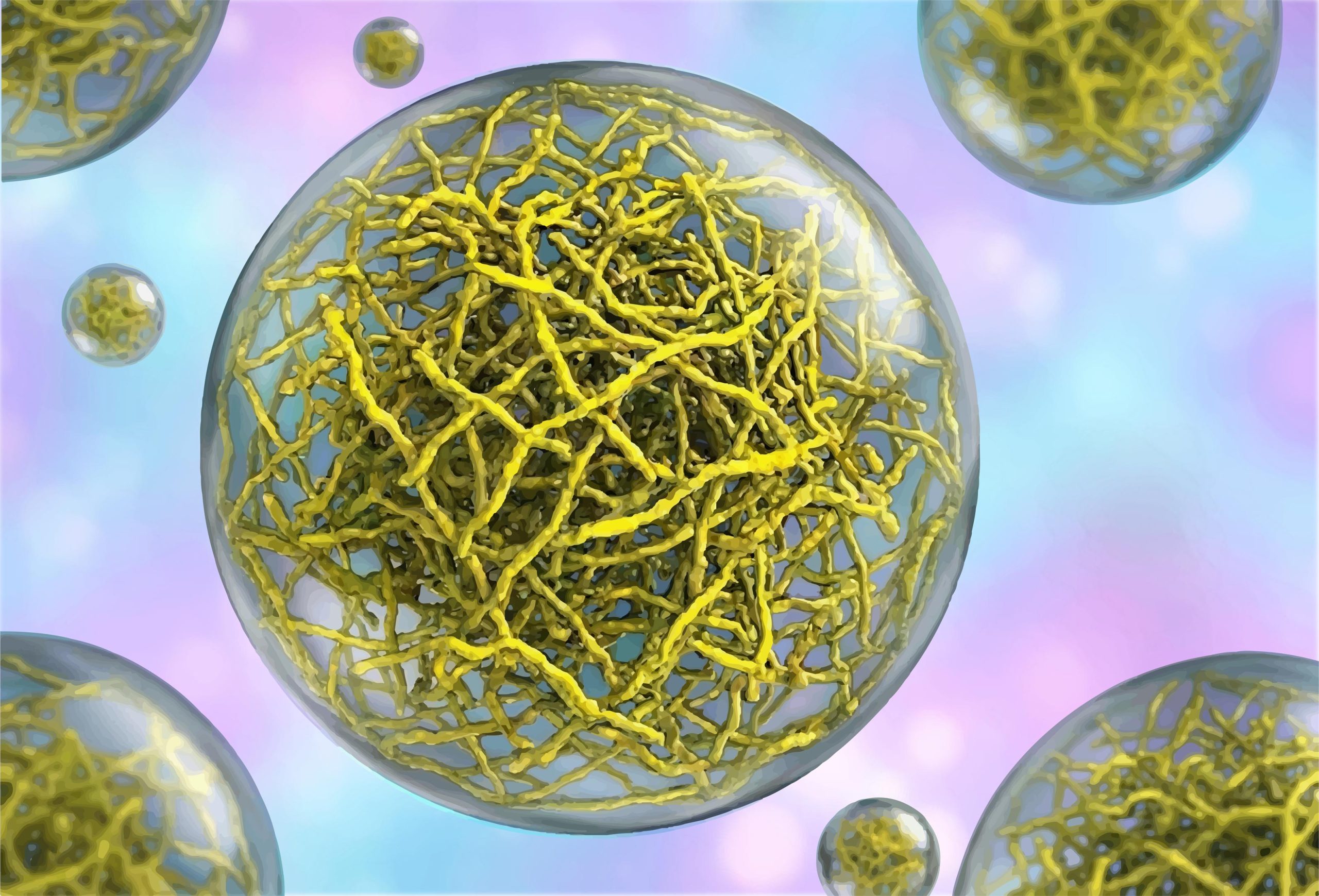
For years, biomolecular condensates were thought to be simple, liquid-like droplets with little internal organization. New research overturns that view, revealing that some condensates are built from ordered networks of protein filaments that define their physical properties and function.
Cells organize many of their most important activities using biomolecular condensates, even though these structures are not enclosed by membranes. These droplet-like assemblies help control how genetic instructions in DNA are converted into proteins. They also assist in clearing away cellular waste to reduce toxicity and disease risk, and they can play a role in suppressing tumor development.
Because condensates behave much like liquids, merging together, flowing, and quickly exchanging their contents, scientists long believed they were uniform inside and functioned as simple liquid droplets without internal structure.
Research published in Nature Structural and Molecular Biology on February 2, 2026, challenges that long-standing view. Investigators at Scripps Research found that some condensates are built from complex networks of thread-like protein filaments. Instead of being featureless blobs, these condensates contain an organized internal framework that is crucial for their role in the cell. The discovery points to new strategies for treating diseases such as cancer and neurodegenerative disorders.
Revealing Hidden Structure Inside “Liquid” Condensates
“Ever since we realized that disruptions in condensate formation are at the heart of many diseases, it has been challenging to target them therapeutically because they appeared to lack structure—there were no specific features for a drug to latch onto,” says Keren Lasker, associate professor at Scripps Research and senior author of the study. “This work changes that. We can now see that some condensates have an internal architecture, and that, importantly, this structure is required for function, opening the door to targeting these membrane-less assemblies much like we target individual proteins.”
To explore how condensates can act like compartments without being wrapped in membranes, the Lasker laboratory examined a bacterial protein known as PopZ. In certain rod-shaped bacteria, PopZ gathers into condensates at the cell poles (the rounded ends of the cell). At these locations, the condensates help organize other proteins needed for cell division.
Working with Scripps Research professor Ashok Deniz and assistant professor Raphael Park, who served as co-corresponding authors, the team used cryo-electron tomography (cryo-ET). This imaging approach, similar in concept to a CT scan but designed for molecular detail, allowed the scientists to observe PopZ condensates at exceptionally high resolution. They found that PopZ proteins assemble into filaments through a controlled, step-by-step process. These filaments create scaffold-like networks that determine the condensate’s physical characteristics.
The researchers then looked more closely at how individual PopZ molecules behave. Using single-molecule Förster resonance energy transfer (FRET), which detects very small changes in distance within a protein by measuring energy transfer between fluorescent tags, they discovered that PopZ adopts different shapes depending on whether it is located inside or outside a condensate.
“Realizing that protein conformation depends on location gives us multiple ways to engineer cellular function,” says Daniel Scholl, first author and former postdoctoral researcher in the Lasker and Deniz labs.
Structure Is Essential for Life
To test whether the filaments were simply structural features or truly necessary for function, the researchers created a mutant version of PopZ that could not form filaments. The altered condensates became much more fluid and showed lower surface tension. When these changes were examined in living bacteria, the effects were dramatic. The cells stopped growing, and DNA segregation failed, demonstrating that the condensate’s physical structure, not just its molecular ingredients, is essential for normal cellular activity.
Although the experiments were conducted in bacteria, the findings have important implications for human health. In human cells, comparable filament-based condensates are involved in clearing damaged or toxic proteins and in restraining uncontrolled cell division. If the protein-clearing condensates do not function properly, harmful proteins can accumulate, which is a defining feature of neurodegenerative diseases such as ALS. If the growth-regulating condensates fail, protective mechanisms against tumor formation can collapse, contributing to cancers including prostate, breast, and endometrial.
“By demonstrating that condensate architecture is both definable and functionally critical, the work raises the possibility of designing therapies that act directly on condensate structure and correct the underlying disorganization that allows disease to take hold,” says Lasker.
Reference: “The filamentous ultrastructure of the PopZ condensate is required for its cellular function” by Daniel Scholl, Tumara Boyd, Andrew P. Latham, Alexandra Salazar, Asma M. A. M. Khan, Steven Boeynaems, Alex S. Holehouse, Gabriel C. Lander, Andrej Sali, Donghyun Park, Ashok A. Deniz and Keren Lasker, 2 February 2026, Nature Structural & Molecular Biology.
DOI: 10.1038/s41594-025-01742-y
The work was supported by the