
Slower Speed Limits Move More Traffic

Asija, Navdeep
Slower Speed Limits Move More Traffic

Car Mileage Increased but Deaths Dropped
Helsinki originally reduced speed limits on their highways in 1973. In 1987 they reduced speed limits to 40 km/hr (25mph) on suburban residential streets. In 1992 they reduced the city centre to 40km/hr too. Finally in 2004 the city reduced all 50 & 40 km/hr speed limits to 40 & 30 km/hr respectively.
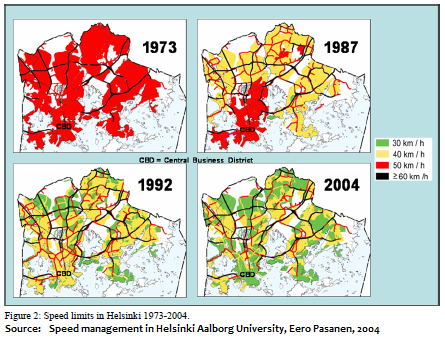
Evolution of Helsinki Speed Limit Reductions
We are well aware of the effect slowing down traffic has for the safety of people walking and cycling that are involved in collisions with vehicles.

While walking or cycling the chance of death from a vehicular collision increases with speed

As vehicles slow down they can safely follow other cars more closely
What few cities and business owners realize is that slowing down cars can actually move more people driving. Of course like any city in the world, there were fears that this would lead to congestion and traffic hell. The usual critics were business owners. At first this seems contradictory, but Dr. Pasenen explains:
Both in 1992 and in 2004, the suggestions of speed limit reductions met hard resistance especially from the business circles. It was claimed that the reduction of speed limits would jam the whole traffic-system and ruin conditions for commercial activities in the city centre. It was also claimed that the amount of exhaust emission would increase dramatically.
There was a rather embarrassing false reasoning behind these claims. Everybody knows that congestion causes slow speeds. However, this does not mean that low speed limits cause traffic jams.
The capacity of a given lane depends on the time-intervals between successive vehicles. The slower the leading car drives in front of a queue, the closer follows the next car. From the point of view of capacity, it looks like the optimal speed level in urban street network is somewhere between 30 and 40 kilometers per hour (figure 5).
So there you have it slowing down vehicles can reduce unnecessary fatalities and move more people at the same time. For businesses that think slow speeds will be a death knell, consider that vehicles travelling slower means they are on your street longer and it is more likely they will see your business. Additionally reducing vehicular speeds also reduces the noise made by vehicles, this would also help reinforce a pleasant sidewalk shopping environment. It seems that slower speed limits are the panacea for creating livelier cities, so why are we not embracing this as much?
Speed reductions from 50 to 30 kph typically reduce noise levels by 4-5 decibels,66 or more in some circumstances.
Source: Victoria Transport Policy Institute, Traffic Calming Benefits, Costs and Equity Impacts, 1999

ArriveSAFE India
Harman S Sidhu
Email: har...@arrivesafe.org
Web: http://www.arrivesafe.org
Line: +91-172-462-3232 Mob: +91-904-130-0000


--
--
You received this message because you are subscribed to the Google
Groups "punjabroadsafety" group.
To post to this group, send email to punjabro...@googlegroups.com
To unsubscribe from this group, send email to
punjabroadsafe...@googlegroups.com
For more options, visit this group at
http://groups.google.com/group/punjabroadsafety?hl=en?hl=en
Follow us on Facebook : http://www.facebook.com/punjabroadsafety
---
You received this message because you are subscribed to the Google Groups "Punjab Road Safety" group.
To unsubscribe from this group and stop receiving emails from it, send an email to punjabroadsafe...@googlegroups.com.
For more options, visit https://groups.google.com/d/optout.
