
Performance issue when creating multiple copies of a custom element (ShadowDOM-polyfill)

Ümit Seren
I have been working a port of markerclusterer-plus to polymer (see other thread in the mailing list) and so far it works fine.
I tried to compare performance between the original library and the my port and somehow realized that the polymer port with the ShadowDOM polyfill is almost 10 times slower (147ms vs 21ms).
If I activate native ShadowDOM it is nearly as fast as the original library (around 30ms).
I tried to profile it by using the timeline and it seems that most of the time is spent in the boot.js script (Polymer library).
So I decided to do some CPU profiling (see attached profiles and screenshots):

Original library
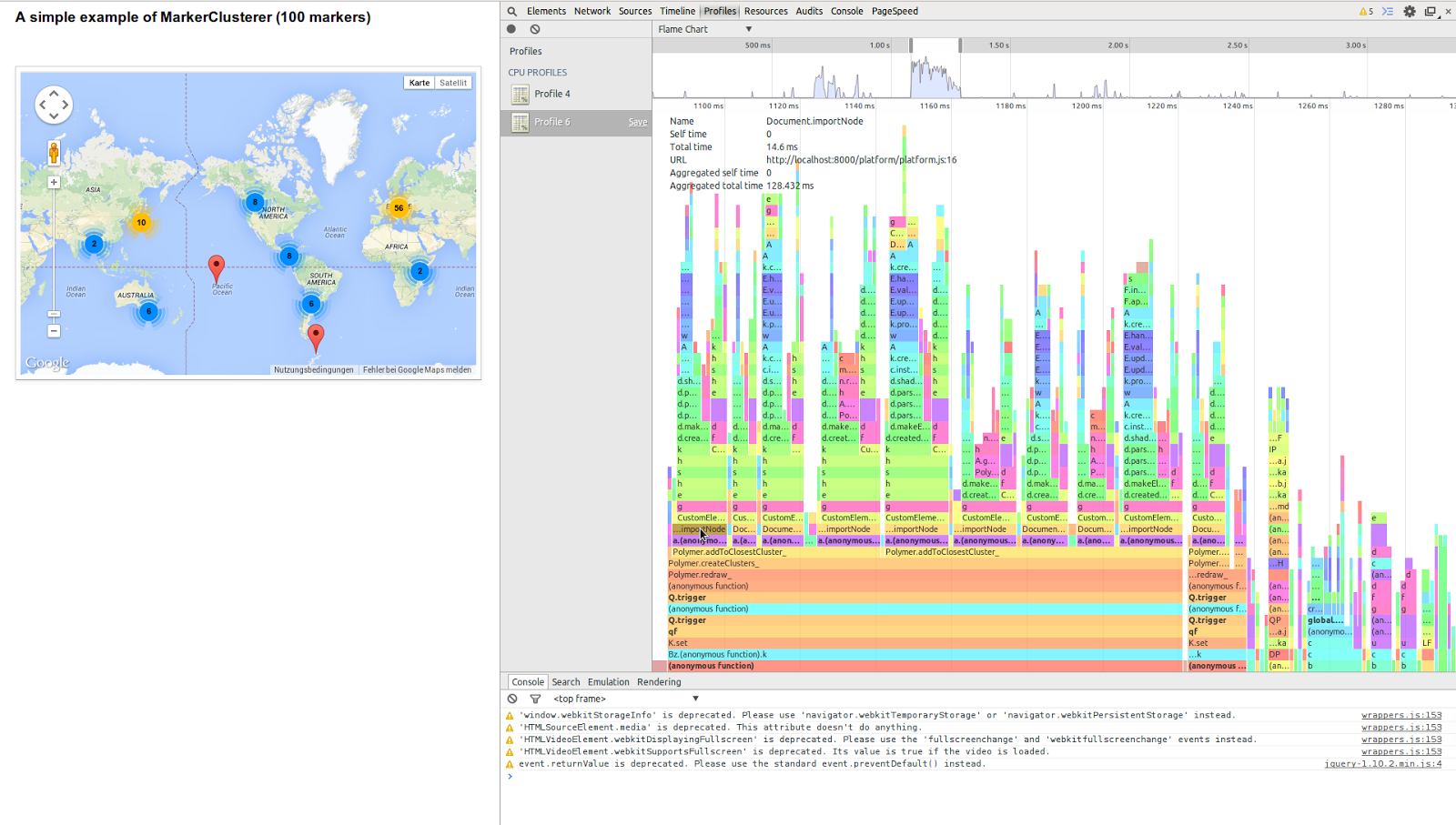
Polymer with ShadowDOM polyfill

Polymer with native ShadowDOM
The interesting part is the addToClosestCluster_ function. This function is called for each marker (100 markers in total) and the function loops through
all existing clusters to find the nearest. if a cluster is found the marker is added, if it isn’t it will create a new cluster and add the marker to it.
The main difference between the two libraries is that the non-polymer version creates a simple DIV element for the clustericon but in my polymer port I clone a polymer-element which the user can specify during runtime
clusterIcon = document.importNode(this.clusterIconTemplate_,true);
As you can see in the flame chart each document.import call will take around 13ms with most of the time being spent in the ShadowDOM polyfill.
With native ShadowDOM it only takes around 2 ms per import call.
I must say that I am impressed with the native ShadowDOM performance considering that the original library only uses a simple DIV for a ClusterIcon whereas the Polymer port uses an entire polymer-element.
Are there any best-practices regarding stamping/cloning or instantiating (potentially) many polymer-elements ?
Of course I could just use a simple DIV as in the original library but the one of the goals was to allow for custom cluster icons that themselves are polymer-elements.

Eric Bidelman
Follow Polymer on Google+: plus.google.com/107187849809354688692
---
You received this message because you are subscribed to the Google Groups "Polymer" group.
To unsubscribe from this group and stop receiving emails from it, send an email to polymer-dev...@googlegroups.com.
To view this discussion on the web visit https://groups.google.com/d/msgid/polymer-dev/473806b4-48d4-4b63-9a8d-1e1f9c190c21%40googlegroups.com.
For more options, visit https://groups.google.com/d/optout.
Ümit Seren
Eric Bidelman
Hi Eric,Thanks for the suggestions.Do you think that using <template repeat> instead of manually looping and calling importNode would improve performance ?
Can I use dynamic polymer elements that are specified during runtime by the user together with <template-repeat>?
To view this discussion on the web visit https://groups.google.com/d/msgid/polymer-dev/7b86d859-3bf8-40a2-a060-5bce1f6d494a%40googlegroups.com.