Which Raspberry Pi?

1,302 views
Skip to first unread message

Tom Hunter

unread,
Aug 16, 2020, 4:31:16 AM8/16/20
to pid...@googlegroups.com
Hi,

Sorry if this has been discussed before, but I couldn't find anything about this subject.

I would like to buy and build Oscar's amazing PiDP-8/I and the PiDP-11/70 when he ships his next batch.

I have not had any exposure to Raspberry Pis, but have been working with Beagleboard Blacks and other small embedded micros.
I would like to order two suitable Raspberry Pis for the two kits, but unfortunately there are too many Raspberry Pi variants to choose from.
Oscar seems to say on his website that any Pi Zero to 4 will do, but I assume there are trade-offs for each model.
I also read in this forum that there are problems with the GPIO on the Raspberry Pi 4 B.

Could someone please describe the various options and recommend the "right" Pi to choose.

Oscar told me that he sold hundreds of kits to Australia so hopefully someone will be on this forum to suggest a good supplier.

Finally Oscar writes on his website at "https://obsolescence.wixsite.com/obsolescence/pidp-8-details":

"the 1.8K pull-up resistors R23 and R24 must be removed from the Raspberry Pi" if you want to be able to use the serial port.

I assume this comment applies to a specific version of the Pi and even if true for all Pis likely the resistor numbers change?

Thanks and best regards from Perth in Western Australia
Tom Hunter

Steven A. Falco

unread,
Aug 16, 2020, 9:13:17 AM8/16/20
to pid...@googlegroups.com
I would recommend the Pi 3B+. It has ample capacity to run the simulation. I think the Pi Zero is way too small for this job. A 4B should also be good, but I haven't personally tried it. I know the software does support the 4B, so it should work.

Afraid I can't help as to a supplier in Australia. I'm in the US and have bought through Adafruit and through Amazon.

Steve


On 8/16/20 4:31 AM, Tom Hunter wrote:
> Hi,
>
> Sorry if this has been discussed before, but I couldn't find anything about this subject.
>
> I would like to buy and build Oscar's amazing PiDP-8/I and the PiDP-11/70 when he ships his next batch.
>
> I have not had any exposure to Raspberry Pis, but have been working with Beagleboard Blacks and other small embedded micros.
> I would like to order two suitable Raspberry Pis for the two kits, but unfortunately there are too many Raspberry Pi variants to choose from.
> Oscar seems to say on his website that any Pi Zero to 4 will do, but I assume there are trade-offs for each model.
> I also read in this forum that there are problems with the GPIO on the Raspberry Pi 4 B.
>
> Could someone please describe the various options and recommend the "right" Pi including a supplier in Australia.
>
> Oscar told me that he sold hundreds of kits to Australia so hopefully someone will be on this forum to suggest a supplier.
>
> Thanks and best regards from Perth in Western Australia
> Tom Hunter
>
> --
> You received this message because you are subscribed to the Google Groups "[PiDP-11]" group.
> To unsubscribe from this group and stop receiving emails from it, send an email to pidp-11+u...@googlegroups.com <mailto:pidp-11+u...@googlegroups.com>.
> To view this discussion on the web visit https://groups.google.com/d/msgid/pidp-11/39a57df9-41c0-43cc-ba76-a055dc8bbfb4o%40googlegroups.com <https://groups.google.com/d/msgid/pidp-11/39a57df9-41c0-43cc-ba76-a055dc8bbfb4o%40googlegroups.com?utm_medium=email&utm_source=footer>.

AndyW58
unread,
Aug 16, 2020, 10:34:03 AM8/16/20
to [PiDP-11]
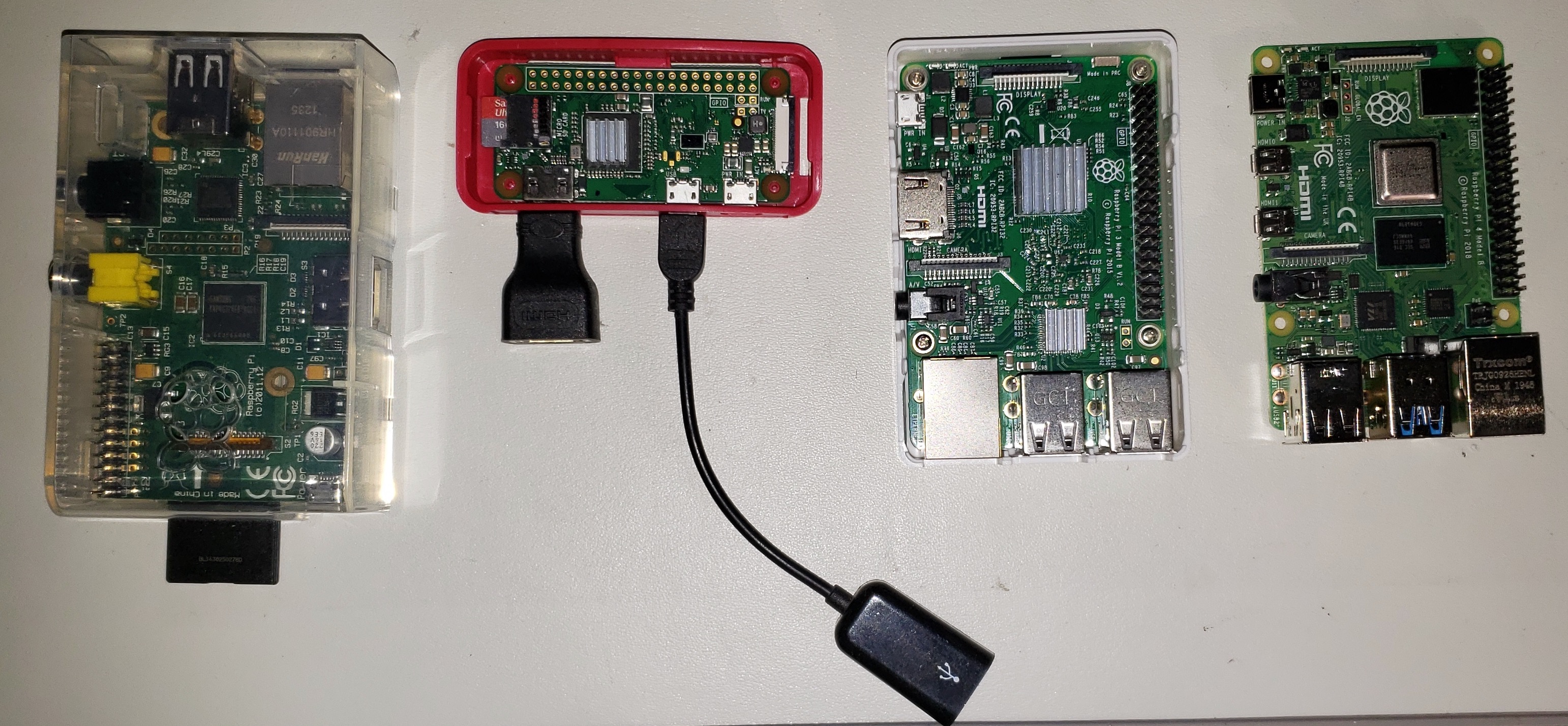
I built a PiDP and used the Raspberry Pi 3 Model B and I'm very satisfied with the performance.

This Wikipedia article does a very good job of describing the differences between the RPi models, there's a nice table with details of each model.


I bought my first Raspberry Pi, model B, in early 2013 just after retiring to help me refresh my computer administration and programming skills. Key things to consider when deciding which one you might use for any application are interface options and RAM. The new Model 4 is a significant boost in performance.

MagPi is the official magazine for the Raspberry Pi and all issues are available for free download. This issue discusses in detail the newest version:


I have used the Raspberry Pi to build a webcam, perform a variety of experiments to expand my understanding of programming and currently designing a new timing system for Whitewater Kayak/Canoe Slalom Racing that will use the Raspberry Pi as the Critical Timing Device, using Bluetooth LE to transmit timing events to a laptop for race management and real-time results publication via Mobile App on both Android and iOS.

If you'd like to discuss, please send a direct message with your telephone number and I would be happy to call you.

20200816_090643.jpeg

Mark Matlock

unread,
Aug 16, 2020, 11:54:36 AM8/16/20
to [PiDP-11]
Tom,
    I have a couple PiDP-11s, one with the RPi2 (a beta PiDP-11), and one with a RPi3+. I also have a couple Rpi4’s running 24/7. In my opinion the RPi3+ is ideal for the PiDP-11. The RPi4 takes more thought about how to supply power and cooling which are not significant issues with the RPi3+. I still have an unbuilt kit that I may try a RPi4 in for fun, but a RPi3+ can deliver 10-20 times the performance of a PDP-11/83 so everything works great.

Best,
Mark


On Sunday, August 16, 2020 at 3:31:16 AM UTC-5 Tom Hunter wrote:
Hi,

Sorry if this has been discussed before, but I couldn't find anything about this subject.

I would like to buy and build Oscar's amazing PiDP-8/I and the PiDP-11/70 when he ships his next batch.

I have not had any exposure to Raspberry Pis, but have been working with Beagleboard Blacks and other small embedded micros.
I would like to order two suitable Raspberry Pis for the two kits, but unfortunately there are too many Raspberry Pi variants to choose from.
Oscar seems to say on his website that any Pi Zero to 4 will do, but I assume there are trade-offs for each model.
I also read in this forum that there are problems with the GPIO on the Raspberry Pi 4 B.

Could someone please describe the various options and recommend the "right" Pi to choose.

Oscar told me that he sold hundreds of kits to Australia so hopefully someone will be on this forum to suggest a good supplier.

Finally Oscar writes on his website at "https://obsolescence.wixsite.com/obsolescence/pidp-8-details":

"the 1.8K pull-up resistors R23 and R24 must be removed from the Raspberry Pi" if you want to be able to use the serial port.

I assume this comment applies to a specific version of the Pi and even if true for all Pis likely the resistor numbers change?

Thanks and best regards from Perth in Western Australia
Tom Hunter

--
You received this message because you are subscribed to the Google Groups "[PiDP-11]" group.
To unsubscribe from this group and stop receiving emails from it, send an email to pidp-11+u...@googlegroups.com.
To view this discussion on the web visit https://groups.google.com/d/msgid/pidp-11/97b3f86b-afb2-4c8c-baf3-42527bfd1c6bn%40googlegroups.com.
<20200816_090643.jpeg>

John Reinhardt

unread,
Aug 16, 2020, 12:02:20 PM8/16/20
to [PiDP-11]

Hi Tom.

I'll confess I haven't yet build my PiDP-8 but I have one of my PiDP-11's done.  A Raspberry Pi Model 3B+ is more than adequate for the 11 and from what I've heard people say it is for the 8 also.  The 4+, of course, will work but is way overpowered and unless you're running other things there will be quite a bit of unused capacity.  The 1GB memory of the 3B+ is also plenty for emulating systems which have 4MB of memory or less.  In addition, the 4+ runs a little hotter than the 3B+ though recent firmware upgrades have cut that down a bit. 

I am in Texas in the US so like the others I have no experience ordering a Raspberry Pi in Australia. I have bought mine through Amazon occasionally, Adafruit a couple times and some other places (that don't deliver to Australia, unfortunately).

Regards,

   John H. Reinhardt

On 8/16/2020 3:31 AM, Tom Hunter wrote:
Hi,

Sorry if this has been discussed before, but I couldn't find anything about this subject.

I would like to buy and build Oscar's amazing PiDP-8/I and the PiDP-11/70 when he ships his next batch.

I have not had any exposure to Raspberry Pis, but have been working with Beagleboard Blacks and other small embedded micros.
I would like to order two suitable Raspberry Pis for the two kits, but unfortunately there are too many Raspberry Pi variants to choose from.
Oscar seems to say on his website that any Pi Zero to 4 will do, but I assume there are trade-offs for each model.
I also read in this forum that there are problems with the GPIO on the Raspberry Pi 4 B.

Could someone please describe the various options and recommend the "right" Pi including a supplier in Australia.

Oscar told me that he sold hundreds of kits to Australia so hopefully someone will be on this forum to suggest a supplier.

Adam Thornton

unread,
Aug 16, 2020, 1:15:28 PM8/16/20
to [PiDP-11]
3B+ seems to currently be the sweet spot.  It's what I have in my PiDP-11, but even that has grossly more power than you need.

I'm running simh on a 2B+ that runs v7, 211BSD, and two VAXen (OpenVMS and 43BSD) simultaneously and when the host systems are idle, the load average stays a little under 1.

I have another 3B+ that is, without breaking a sweat, running dps8M and Multics, three PDP-10 emulators running ITS, TOPS-10, and TOPS-20, and two IBM 370s running VM/370 and MVS, all at the same time.  The nice thing about the 3B+ is that you can install 64-bit Ubuntu on it so if you want to play with machines with wordlengths longer than 32 bits, the guest machine word still fits into a single host word, which is helpful from a performance standpoint.  You'd want a 3B+ or later for the PiDP-10, for instance.

Adam

justme1968

unread,
Aug 16, 2020, 1:46:10 PM8/16/20
to [PiDP-11]
on the other hand a raspberry 4 with 2gb will cost you basically the same as a 3 with 1gb. and the 4 will have better specs in other areas as well. even if you will not need the headroom now you basically won't pay for it. 

Tom Hunter

unread,
Aug 16, 2020, 9:47:18 PM8/16/20
to [PiDP-11]
Thanks to all who have replied.

The consensus seems to be that the Pi 3 B+ is most suitable. I read on other forums that the Pi 4 has thermal issues and people complained about the micro-HDMI being troublesome plus various reliability issues. Maybe the Pi 4 needs to go through another revision before it reaches the stability of the Pi 3 B+.

The price of the Pi 3 B+ here in Australia from Element14 is only A$52.80 and the Pi 4 B 2 GB is $A60.32 so almost the same price. On the surface the Pi 4 B 2 GB is the better deal but armed with the information above and your comments I decided for the Pi 3 B+.

I have now ordered two Pi 3 B+ and two 5.1V 2.5A power supplys. They should be here in 5 working days.

I can't wait for Oscar's next batch of PiDP 8/I and PiDP-11/70 kits getting ready.    :-)

Thanks again!

Best regards
Tom Hunter

Jonathan Morton

unread,
Aug 16, 2020, 11:29:14 PM8/16/20
to thunt...@gmail.com, pid...@googlegroups.com
> The consensus seems to be that the Pi 3 B+ is most suitable. I read on
> other forums that the Pi 4 has thermal issues and people complained about
> the micro-HDMI being troublesome plus various reliability issues. Maybe the
> Pi 4 needs to go through another revision before it reaches the stability
> of the Pi 3 B+.

On the thermal thing, the Pi 4 has received a number of firmware and driver updates since release, focused firmly on improving the thermal performance. They do make a definite difference. I think there are also some reliability improvements. So check the dates on those reports, at least.

But the Pi 3B+ is also a good choice and very much a known quantity.

Tom Hunter

unread,
Aug 16, 2020, 11:52:06 PM8/16/20
to Jonathan Morton, pid...@googlegroups.com
Thanks Jonathan,

I am retired now but over a 40+ year career I learned that it pays to stay a notch behind the bleeding edge until all the bugs and mis-features have been fixed.

I am sure that the Pi 4 will be an amazing choice eventually, but maybe not for the PiDP-8/I with the bamboo case where I suspect that the thermal issues are amplified unless you add a small fan and ventilation holes (which means dust, noise and other issues).

I am getting both the PiDP-8/I and the PiDP-11/70 so it makes sense to have one common processor platform.

Best regards
Tom Hunter

Todd Goodman

unread,
Aug 17, 2020, 6:49:58 AM8/17/20
to pid...@googlegroups.com
FWIW, I run a Pi 4 in my PiDP-11 and have no holes or fans and have the
back lid on the PiDP-11 and my temps stay within range, no problem. 
Never have any thermal throttling.

Though I don't run HDMI or USB to it, I did when I first set it up and
didn't have any HDMI issues.

Todd

Bob Dunlop

unread,
Aug 18, 2020, 2:03:05 AM8/18/20
to [PiDP-11]
I'm planning on using a RPi 3A+, got as far as the LED test.

If you don't want wired Ethernet or lots of USB peripherals the lower profile connector mean you can skip insulating shims.
Possibly better air flow for cooling as well but that's a really marginal excuse, as is the 10 quid saving on a 3B+.

Paul Duncan

unread,
Aug 19, 2020, 2:38:13 PM8/19/20
to Tom Hunter, [PiDP-11]
Hi Tom,

Good luck with the build, I have both and used a Pi Zero (not zero W) for the PiDP-8 and Pi3B+ for the PiDP-11. Just another data point for you. I think element 14 would probably be your best bet for getting a Pi on Oz.


Best Regards,

Paul.

On Sun, Aug 16, 2020 at 9:31 AM Tom Hunter <thunt...@gmail.com> wrote:
Hi,

Sorry if this has been discussed before, but I couldn't find anything about this subject.

I would like to buy and build Oscar's amazing PiDP-8/I and the PiDP-11/70 when he ships his next batch.

I have not had any exposure to Raspberry Pis, but have been working with Beagleboard Blacks and other small embedded micros.
I would like to order two suitable Raspberry Pis for the two kits, but unfortunately there are too many Raspberry Pi variants to choose from.
Oscar seems to say on his website that any Pi Zero to 4 will do, but I assume there are trade-offs for each model.
I also read in this forum that there are problems with the GPIO on the Raspberry Pi 4 B.

Could someone please describe the various options and recommend the "right" Pi including a supplier in Australia.

Oscar told me that he sold hundreds of kits to Australia so hopefully someone will be on this forum to suggest a supplier.

Thanks and best regards from Perth in Western Australia
Tom Hunter

--
You received this message because you are subscribed to the Google Groups "[PiDP-11]" group.
To unsubscribe from this group and stop receiving emails from it, send an email to pidp-11+u...@googlegroups.com.

Digby R.S. Tarvin

unread,
Aug 20, 2020, 1:31:23 AM8/20/20
to Paul Duncan, Tom Hunter, [PiDP-11]
Probably a bit late coming into this discussion, but for what is worth - I am using  Pi3B+ for the PiDP-11 and find it entirely adequate.

I wanted to be able to use my PiDP-11 as an 'always on' machine (which is something I wouldn't be able to justify with a real PDP11 both due to wear and tear on hard to get parts and also power consumption) so it made sense to use the less power hungry board. As a bonus, Lower power also reduces cooling requirements. It also provided a good use for my existing Pi3's after upgrading other systems to Pi4's for more general uses.

If you were planning to buy a single Raspberry Pi for multiple uses, with driving the PiDP11 being only one of its tasks, then the Pi4 might be better, mainly because the extra memory is a big win. The worst limitation of earlier Pi's for general server applications was the lack of fast disk or secondary storage (USB and Ethernet were both slow, and 1GB ram was not generous enough to spare for a large memfs). Plus I flash media is not something that stands up well to frequent writing.  For earlier Pi's I went as far as seeking out USB based ram disks so that I could have a tmp filesystem that didn't waste memory or wear out my flash. I have a large external rotating media drive which takes over when I am using it interactively, but I wouldn't want it spinning up every time a log is written to /var..  None of these things are really issues when emulating a PDP-11/70 though.

Both the Pi3 and Pi4 have some issues, for example if you plan to use the integrated serial interface - but that is fixable with a configuration adjustment. I only use wired connections (no WiFi or bluetooth) so an easy fix for me.

Regards,
DigbyT

jeff.t...@gmail.com

unread,
Aug 23, 2020, 6:34:38 PM8/23/20
to [PiDP-11]
I recently bought a RPi 4 2GB model for use as a retro gaming system and decided to try it out in my PiDP-11 case in place of the previous 3B+.  It is noticeably faster (14245 dhrystones/sec vs. 6500 vs. 1000-ish on a real PDP-11/70) and even running the PiDP-11 software, RetroPie, and OctoPrint it doesn't exceed 60 C in typical use, even sealed in the case with nothing more than the cheap little heat sinks that you typically get with kits. 

You might have to get the micro HDMI cable which is annoying, but my existing 5.1v/3A power supply wired in via the panel power switch is sufficient for the RPi 4.  I actually get fewer "Under-voltage" messages now.

The common wisdom is that the RPi 4 is too hot to use without a fan, but I think after the newer firmware updates, it is the easy choice for a new system.

Tim Halloran

unread,
Oct 7, 2020, 9:32:13 PM10/7/20
to [PiDP-11]
  • I have a PiDP-8 using a Pi Zero W
  • I have a PiDP-11 using a Pi 3 B

Both work fine. However the Pi Zero W is not super if you want to hook up serial terminals and such. I find it testy with USB hookups. But in the box, connecting to the PiDP-8 with wireless -- it works. Many a spacewar game has been run from it.

The PiDP-11 is hooked up to real Dec terminals -- the Pi 3 is recommended here as it has all the connections.

I can run the Pi Zero just off a USB power supply, the Pi 3 (as many others have noted) really wants its special power supply (or you get the dreaded undervoltage warnings or worse).

See System load of the two below
pis.png

Mike Katz

unread,
Oct 7, 2020, 10:01:14 PM10/7/20
to Tim Halloran, [PiDP-11]
I have a 4GB Pi4 that I will be upgrading to an 8GB model on my PDP11/70, a 4GB 3b on my PiDP-8/I, i use Pi Zero W as a Tektronix Terminal/VT100 emulator.
I will be using the old  4gb Pi4 as 2 terminal emulators (2 keyboards, 2 monitors.
--
You received this message because you are subscribed to the Google Groups "[PiDP-11]" group.
To unsubscribe from this group and stop receiving emails from it, send an email to pidp-11+u...@googlegroups.com.

Andrew Yeomans

unread,
Oct 8, 2020, 6:02:51 AM10/8/20
to [PiDP-11]
Currently my PiDP-8 uses a Pi Zero configured in USB Gadget mode, so it just connects over a single micro-USB cable to a PC/Laptop. The laptop easily supplies the power to just drive it as a console via minicom or whatever. That's somewhat close to the experience of a real console teletype next to the computer front panel.
[I've been trying to get the composite USB gadget serial + ethernet working, so far without success. Another story...]
I sometimes use a powered USB hub instead, to get keyboard, mouse and wi-fi adaptor connected. It can be a bit picky to get it all working and not exceed power limits, not all USB hubs work with all devices.

Using a Pi Zero W should make it easy to also connect via wi-fi to give multi-terminal support, without needing that hub. I might switch.

My PiDP-11 has a Pi 4 as it seemed best to buy the latest and most powerful pi. I plan to use if for other background functions - maybe data logger, syslog, network monitor, pihole - to help it earn it's keep!
In the meantime it's my experimental Pi 4, though I have ordered a CrowPi2 to take on that function.


Oscar Vermeulen

unread,
Oct 12, 2020, 2:37:49 PM10/12/20
to pid...@googlegroups.com, andrew....@gmail.com
Andrew,

On Thu, 8 Oct 2020 at 12:02, Andrew Yeomans wrote:
Using a Pi Zero W should make it easy to also connect via wi-fi to give multi-terminal support, without needing that hub. I might switch.

I agree - for the PiDP-8, a Zero W in gadget mode is the most elegant solution if you don't want wifi access. Power and terminal data in just 1 cable. It's a bit of an effort to configure the Zero W that way but well worth googling.
For the PiDP-11, generally you want the extra power of a Pi 2/3/4 and those do not work in gadget mode AFAIK.


Kind regards,

Oscar.

D Gillies

unread,
Oct 13, 2021, 1:36:13 AM10/13/21
to [PiDP-11]
The original PDP-11/70 is considered to be 0.7 Dhrystone MIPS, so 70% of the speed of a VAX 11/780 which is the touchstone 1 Dhrystone MIP machine.
The Hackaday Blog indicates that a Pi 3B+ is 6x faster (7241 Dhrystones) than the original PDP-11/70 (1250) in terms of Dhrystone 1.1 benchmarks (4.2 Dhrystone MIPS)
Different videos indicate the the 1.5 Ghz Pi 4B+ is about 50% faster, so maybe 9x faster than a PDP-11/70 in Dhrystone 1.1 benchmarks (6.3 Dhrystone MIPS).
You might be able to overclock a Pi 4 up to 2.1 Ghz, for maybe another 25% increase, maybe 12x faster than an 11/70, (8.4 Dhrystone MIPS).
Frankly, If I'm going to invest $300 in a PiDP-11 kit, I want mine to run 8x faster than a Vax 11/780, a PDP-11/580, thank you very much!  LOL ...

The standard benchmark applied to UNIX systems is the time to compile the kernel, in minutes and seconds.  I don't own a PiDP-11 yet, but when I get one, I'll report my configuration and the time to compile the kernel.

- Don Gillies
Palo Alto, CA, USA

jeff.t...@gmail.com

unread,
Oct 13, 2021, 2:01:05 AM10/13/21
to [PiDP-11]
FWIW, my Raspberry Pi 4 Model B Rev 1.1 with a generic $20 M.2 SSD scores:

Dhrystone(1.1) time for 250000 passes = 16
This machine benchmarks at 14801 dhrystones/second

time make
372.4u 74.6s 7:32.13 98.0% 42730+26857io 13ov 0sw

Johnny Billquist

unread,
Oct 13, 2021, 2:59:52 AM10/13/21
to pid...@googlegroups.com
And just to remind people of the obvious.
The Dhrystone test is close to worthless, since it is very much affected
by which compiler you use. A VAX-11/780 will clock in at way more than 1
MIPS according to Dhrystone, if you use a good, modern compiler.

The VAX-11/780 was only 1 Dhrystone MIP when using a specific compiler
at a specific version.

Which is why DEC used VUPS instead. And yes, a PDP-11/70 is roughly 70%
of a VAX-11/780. But it does depend on what you do.

Johnny

On 2021-10-13 08:01, jeff.t...@gmail.com wrote:
> FWIW, my Raspberry Pi 4 Model B Rev 1.1 with a generic $20 M.2 SSD scores:
>
> Dhrystone(1.1) time for 250000 passes = 16
> This machine benchmarks at 14801 dhrystones/second
>
> time make
> 372.4u 74.6s 7:32.13 98.0% 42730+26857io 13ov 0sw
> On Wednesday, October 13, 2021 at 12:36:13 AM UTC-5 dwgi...@gmail.com wrote:
>
> The original PDP-11/70 is considered to be 0.7 Dhrystone MIPS, so
> 70% of the speed of a VAX 11/780 which is the touchstone 1 Dhrystone
> MIP machine.
> The Hackaday Blog
> <https://hackaday.io/project/8069-pidp-11/log/167311-supporting-the-pi-4>
> --
> You received this message because you are subscribed to the Google
> Groups "[PiDP-11]" group.
> To unsubscribe from this group and stop receiving emails from it, send
> an email to pidp-11+u...@googlegroups.com
> <mailto:pidp-11+u...@googlegroups.com>.
> To view this discussion on the web visit
> https://groups.google.com/d/msgid/pidp-11/1b0f41d6-1c6e-46c4-a2f0-ded97d0055d1n%40googlegroups.com
> <https://groups.google.com/d/msgid/pidp-11/1b0f41d6-1c6e-46c4-a2f0-ded97d0055d1n%40googlegroups.com?utm_medium=email&utm_source=footer>.

--
Johnny Billquist || "I'm on a bus
|| on a psychedelic trip
email: b...@softjar.se || Reading murder books
pdp is alive! || tryin' to stay hip" - B. Idol

jeff.t...@gmail.com

unread,
Oct 13, 2021, 3:31:45 AM10/13/21
to [PiDP-11]
What?!?  The first time in history that a benchmark isn't 100% reliable and reproducible?  I'm shocked, SHOCKED!

The kernel build time is equally as sketchy and unrealistic on era hardware.  But we're talking about comparing Raspberry Pi variants and comparing the relative speeds here.

Johnny Billquist

unread,
Oct 13, 2021, 4:35:45 AM10/13/21
to pid...@googlegroups.com
On 2021-10-13 09:31, jeff.t...@gmail.com wrote:
> What?!?  The first time in history that a benchmark isn't 100% reliable
> and reproducible?  I'm shocked, SHOCKED!

:-)

> The kernel build time is equally as sketchy and unrealistic on era
> hardware.  But we're talking about comparing Raspberry Pi variants and
> comparing the relative speeds here.

Well, noting that a rPI comes in at 14801 Dhrystones/second is not
usable to compare to some PDP-11/70 run at 1250 Dhrystones/second...

Basically all comparisons between the rPI and a PDP-11/70 or VAX-11/780
using Dhrystones is totally misleading, as with a more modern compiler
on those old machines, you'll get different numbers. So how could one
claim that a rPI 3B+ is 6 times faster than an 11/70.

Or, hmm, is those numbers actually from running something like 2.11BSD
inside the rPI? Maybe that is so, as otherwise I would have expected the
rPI itself to be a bit faster than that.

If so, then I guess you can at least somewhat compare the results, but
still, the historical numbers you'll find for the 11/70 are not with the
same toolchain you are compiling on 2.11BSD now, so it's still very dubious.

Johnny
> <https://groups.google.com/d/msgid/pidp-11/1b0f41d6-1c6e-46c4-a2f0-ded97d0055d1n%40googlegroups.com?utm_medium=email&utm_source=footer
> <https://groups.google.com/d/msgid/pidp-11/1b0f41d6-1c6e-46c4-a2f0-ded97d0055d1n%40googlegroups.com?utm_medium=email&utm_source=footer>>.
>
>
> --
> Johnny Billquist || "I'm on a bus
> || on a psychedelic trip
> email: b...@softjar.se || Reading murder books
> pdp is alive! || tryin' to stay hip" - B. Idol
>
> --
> You received this message because you are subscribed to the Google
> Groups "[PiDP-11]" group.
> To unsubscribe from this group and stop receiving emails from it, send
> an email to pidp-11+u...@googlegroups.com
> <mailto:pidp-11+u...@googlegroups.com>.
> To view this discussion on the web visit
> https://groups.google.com/d/msgid/pidp-11/f30119b0-c893-48d2-9510-9073b8b68156n%40googlegroups.com
> <https://groups.google.com/d/msgid/pidp-11/f30119b0-c893-48d2-9510-9073b8b68156n%40googlegroups.com?utm_medium=email&utm_source=footer>.

Heinz-Bernd Eggenstein

unread,
Oct 13, 2021, 5:53:59 AM10/13/21
to [PiDP-11]
Wait, let's get some things straight:

Whenever people claim that the Rpi is faster than a PDP 11/70  by a factor of x , where x is only a single digit or low double digit number, this refers to comparing a benchmark run on a real PDP-11/70 compared to running the same benchmark (whithout throttling) inside SIMH on a simulated 11/70 on a Raspi. So this does not involve any modern compilers as far as compiling the benchmark is concerned, that would be done inside SIMH with historic compilers. So that comparison is apples to apples comparing native platform to emulation on a 50$ computer using the byte-identical benchmark.  

If on the other hand you are comparing the performance of a historic benchmark compiled and run natively under modern Linux on a Raspi, with benchmarks run natively on a real PDP-11/70, the speed-up factor will be orders of magnitude higher, we are talking a speed-up of 1000 to 10000!

And it must be, remember Moore's law and its many different pop-culture variations, which captured the observation that for many decades computers got faster, cheaper, smaller, [you name it], by a factor or 2 every 2 or 3  years or so. A Raspberry Pi 4 and a PDP-11/70 are separated by 45 years, so we would be expecting , order-of-magnitude-wise, a factor of (say) 2^15 in performance, but Raspi's being on the cheap end of today's computers we allow them to be somewhat slower, also considering that things like Dhrystone were not meant to capture multi-core performance...... but anyway a factor of 1000+ is to be expected from Moore's law. Same for RAM  (>4 GB vs 4 MB),  typical "disc" sizes (hundreds of GB to single digit TB vs 100s of MB) , internal I/O throughput (GB/s vs MB/s) , and 1/(unit price)   (100 US$ vs  some 100k US$ in todays currency), 1/power consumption (W vs kW), 1/volume (rack space) , 1/weight,.... The Raspi is 1000+ times ["better", you name it] than a PDP-11/70 in almost any technical discipline, but of course it's not 1000 times more fun to play a text adventure on it, and it sure doesn't look 1000 times more impressive :-).

Cheers
HB

Johnny Billquist

unread,
Oct 13, 2021, 8:55:12 AM10/13/21
to pid...@googlegroups.com
On 2021-10-13 11:53, 'Heinz-Bernd Eggenstein' via [PiDP-11] wrote:
> Wait, let's get some things straight:
>
> Whenever people claim that the Rpi is faster than a PDP 11/70  by a
> factor of x , where x is only a single digit or low double digit number,
> this refers to comparing a benchmark run on a real PDP-11/70 compared to
> running the same benchmark (whithout throttling) inside SIMH on a
> simulated 11/70 on a Raspi. So this does not involve any modern
> compilers as far as compiling the benchmark is concerned, that would be
> done inside SIMH with historic compilers. So that comparison is apples
> to apples comparing native platform to emulation on a 50$ computer using
> the byte-identical benchmark.

Fair enough then. We're at least trying to compare something inside an
11/70 (simulated) with an 11/70 (real).

But the fact still remains that you will not be doing comparisons using
the same compiled code, on something that is byte-identical. It's likely
not even close.

Dhrystone has been understood for at least 30 years to be a very flawed
benchmark since it depends so much on the toolchain.

Even back in the 80s, even the VAX-11/780, which supposedly is the
reference machine for 1 MIPS according to Dhrystone, was clocking in at
significantly more than 1 MIPS with newer versions of compilers.

Johnny

Richard Reiner

unread,
May 13, 2022, 7:08:03 PM5/13/22
to [PiDP-11]
Just adding a quick note because I haven't seen it mentioned before: the Pi Zero 2 W works nicely as the brain of a PiDP-11.  This has about the same performance as a Pi 3B (i.e. about six times that of the previous-gen Pi Zero) and has Wi-fi on board.

I wouldn't pick it if you intend to run the Pi graphical desktop and apps such as Chromium much, as the 512 MB of RAM is tight for that; but otherwise, it's perfect for the PiDP-11. And it runs cool without any fan, unlike a Pi 4.

The Zero 2 W is USD $15 in the US,  CAD 19 in Canada -- https://www.pishop.us/product/raspberry-pi-zero-2-w.  If you can find one :-)


hush

unread,
May 14, 2022, 12:58:50 AM5/14/22
to [PiDP-11]
anecdotal, but i've had decent results running lightweight desktops and apps (i3 or dwm, rxvt for terminal, etc) on zero2s. it won't be the snappiest desktop you've ever used, but if you just want to drop into a graphical session for a bit from time to time it can pull that weight fairly well.

Fabrizio Furnari

unread,
May 14, 2022, 3:37:08 AM5/14/22
to hush, [PiDP-11]
Anyone tried a Raspberry Zero W instead (not the "2" one...)?
I've one unused that I could try...

F
--

You received this message because you are subscribed to the Google Groups "[PiDP-11]" group.
To unsubscribe from this group and stop receiving emails from it, send an email to pidp-11+u...@googlegroups.com.
To view this discussion on the web visit https://groups.google.com/d/msgid/pidp-11/87557db3-75f1-4bf5-80d4-291feaccdf8fn%40googlegroups.com.


Bob Alexander

unread,
May 14, 2022, 8:31:42 AM5/14/22
to [PiDP-11]
I used a Zero W at first. It worked, but it was very slow. I'm using a Pi 4B now, and I'm much happier.

emt377

unread,
May 16, 2022, 9:40:30 PM5/16/22
to [PiDP-11]
I too tried a Zero W; it took RSX-11M-Plus half an hour to start up.

My unscientific conclusion was that the simulator and the blinking-lights process were fighting each other for CPU; I therefore think that you need a couple of cores at least.   The Zero 2 W seems promising (if you can actually get one).

Marco

unread,
May 17, 2022, 2:24:20 AM5/17/22
to [PiDP-11]
It is very easy to check whether your Pi is sufficiently capable of performing the tasks you ask from it, by checking the load average. You can use the top command for this, but htop is much better. The "Load average" line will tell you if the Pi can manage the load or not. The first number is the load average of the last 1 minute, the second of the last 5 minutes, and the third of the last 15 minutes. Basically, a load of 1.0 is the limit for a single core processor, above it means the processor can't keep up with the requested load and you will have a slow Pi which eventually even might grind to a halt. Now, a temporary "overload" is not a big problem, but if your load averages are constantly over the limit then the Pi is obviously not suited for what you ask from it. For a two core processor, the load average limit is 2.0, for a four core it's 4.0.   

Op dinsdag 17 mei 2022 om 03:40:30 UTC+2 schreef emt377:

timr...@gmail.com

unread,
May 17, 2022, 2:36:10 PM5/17/22
to [PiDP-11]
Interesting.  Never heard of HTOP.  Quite useful.  Thanks.
Reply all
Reply to author
Forward
0 new messages