
1984 Steinway D

Regi Hedahl
In terms of the action, what are the anomalies that I should look for on a 1984 NY Steinway D? I'm thinking on the lines of flexible key sticks, short hammer tails, incorrect geometry, too much lead, etc. I checked to see if this had a Teflon action but it didn't. The piano was not heavily used and was recently purchased by a concert pianist. The pianist is having buyers remorse because it's not like the new Steinway D that he is used to playing. He had other techs work on the action but got mixed results. When I got there, the voicing was uneven and the action was only partially regulated. I was able to make a notable improvement both with the voicing and the touch in the short time I was there. The customer is happy with the improvement so is now having me return to see what else I can do. There are a few more things to regulate on the action but I don't think that this will magically transform this piano to a new Steinway D. When I sat down and played the piano, I found the action to be on the light side which the pianist agreed with.
Regi Hedahl

Ed Foote
This is the year that Steinway went back to cloth bushings, and I would suspect that the entire action has pinning that is wildly erratic. In order of importance, I would check the hammer shanks, repetitions, jacks, whippens. In terms of tone, firmness of hammershank pinning matters. In terms of repetition speed, the repetition pinning is critical. Jacks will move faster than humans can play them, even at 4 grams of resistance, if the spring is properly strong, (which depends on the shank pinning). Erratic pinning means not only erratic resistance, but also erratic springs, which means erratic thresholds to pp escapement.
You are also listening to a 30 year old soundboard. Sometimes this begins to show as weakness in tone and sustain in the fifth octave. The lack can be ameliorated by balancing the piano's bass to whatever you can get the fifth octave to do, so don't be scared of reducing the power of the lower half of the keyboard. With stock Steinway hammers, this often entails putting a couple of needles in from the 10:00 o'clock and 3:00 o'clock positions, going straight horizontally into the core of the hammer. It has little effect on the attack, but will reduce the power.
Also critical, and often the source of dramatic improvement is to insure that the sole plates of the keys, where the balance rail hole is located, are no more that 4 mm thick.
There is a long list of other things, but without taking the action out and apart, the above will give you some place to start.
Regards,
Ed Foote RPT
Regi Hedahl
There indeed was a bunch of loose hammer flange pins so I went through and re-pinned those. However, the action is still very light and all the bass notes will bottom out even with a 48 gram weight. That said, I suspect that these hammers are not original and probably lighter weight than what was originally on the piano. Are these Ronsen hammers? They are quite bright sounding and the piano is in a small 15' x 15' room.


Here' a photo of some of the keysticks taken out to see the lead weights.

Here's a close up photo of a keystick. It doesn't seem like these keysticks have hardwood sole plates.

Regi Hedahl

Ron Nossaman
> There indeed was a bunch of loose hammer flange pins so I went
> through and re-pinned those. However, the action is still very light
> and all the bass notes will bottom out even with a 48 gram weight.
> That said, I suspect that these hammers are not original and probably
> lighter weight than what was originally on the piano. Are these
> Ronsen hammers? They are quite bright sounding and the piano is in a
> small 15' x 15' room.
doped. Why people insist on doping good hammers, I've never understood,
since rocks are available from other sources right out of the box.
Looks like the Scarlet Pimperleader has ridden through too. A lot of
highly creative alternative thinking key leading experts have
spontaneously emerged in the last five years or so, so this is getting
to be more common.
No, there's no shoe, but there is a good top plate, and the key stick
looks deep enough to not be overly flexible. What Ed was referring to, I
trust, was the contact area with the pin in the balance hole of the key.
This should be reamed to proper height if it's too tall, as is more
common than seems likely. See page D-27, item KCS-1B balance hole reamer
in Pianotek's catalog. A must have tool.
Ron N
Ed Foote
Bottoming out at 48 grams? That is excessive, to be sure. I would be interested in three things.
1. what is the knuckle distance from the center pin.
2. What is the SW and FW of C3 and or C5
3. what ratio is this action? By that, I mean, for 1 7/8" blow, how much dip is required to leave .040 after touch with the let-off set at 1/16"?
Ed Foote RPT
-----Original Message-----
From: Regi Hedahl <piano...@gmail.com>
To: pianotech <pian...@googlegroups.com>
Subject: Re: [pianotech] 1984 Steinway D
There indeed was a bunch of loose hammer flange pins so I went through and re-pinned those. However, the action is still very light and all the bass notes will bottom out even with a 48 gram weight. That said, I suspect that these hammers are not original and probably lighter weight than what was originally on the piano. Are these Ronsen hammers? They are quite bright sounding and the piano is in a small 15' x 15' room.

John Rhodes
Regi Hedahl
Regi Hedahl
On Thursday, March 19, 2015 at 11:05:15 AM UTC-5, ed foote wrote:
Greetings,
Regi Hedahl
Ron Nossaman
> Ron,
> The story is that the previous owner had a bunch of work done to this
> piano but was sorely disappointed. They ended up selling the piano to a
> dealer who then sold it sight unseen to some very fine pianists. Long
> story short, the deeper I dig into this piano, the more strange things /
> (hack work) I find.
>
> So far here's a partial list.
> 1. Top octave completely dead. Improved by adjusting the treble
> section of the action deeper into the keybed but now the action sits
> cockeyed in the action cavity
improve all of the strike point, jack alignment, and DW problems at
once. I expect Murphy is salivating at that prospect, but it's possible
to get lucky. Makes me wonder what reference the perpetrator was working
from.
> 2. Drops of glue all over the frontscale. This was a futile attempt to
> correct a very dirty sounding killer octave.
plenty of beating strings from the bridge pins.
> 3. Dampers not lifting until the end of keystroke. Some hammers were
walked away from it anyway.
> 4. Variable keydip. Keydip is about 12 mm for the bass notes and 10 mm
> for the rest of the keyboard.
> 5. Capsizing action with quick repeated notes.
> 6. Very light touch
> 7. Strange key leading and excessive leads
> 8. Huge stack of front rail punchings.
>
> 9. Jack does not run parallel with knuckle core.
look to be original.
> 10. Balance rail pins are nearly touch the forward end of the key
> mortise with key at rest.
That one's easy.
> 11. Bass hammer shanks sitting on wippen rebound felts.
> This action is so screwed up but I'm afraid that the customer is not
> going to be willing to pay much to undue the screwup after spending a
> fortune on this piano.
people as I showed them what they had just bought, this is exactly why
you have a tech inspect a piano before purchasing it, NO MATTER the
source of the purchase. Also, if the seller won't allow an inspection,
you don't want the piano.
It's all so sad, and all so common. Good luck.
Ron N

David Love
Ron Nossaman
> I think they're Abels. That concentric ring pattern is not typical of
> Ronsen.
Ronsens I've used looked just like that.
Ron N


David Weiss
I looked at this tool in the Pianotek catalogue. I'm not familiar with it. What are the indications for it's use? Thanks
David Weiss
-----Original Message-----
From: pian...@googlegroups.com [mailto:pian...@googlegroups.com] On Behalf Of Ron Nossaman
Sent: Thursday, March 19, 2015 11:01 AM
To: pian...@googlegroups.com
Subject: Re: [pianotech] 1984 Steinway D
Ron Nossaman
>
> I looked at this tool in the Pianotek catalogue. I'm not familiar
> with it. What are the indications for it's use? Thanks
it. Reaming that hole to the proper height frees it up so the key moves
easily through the full range of travel. It's a good thing to check as a
matter of course whenever you're diagnosing action problems. Just like
you would check key bushing fit, check the balance hole while you're
there and fix the whole set if it's not right. I've seen key buttons
crushed to total destruction by someone trying to free up the key
travel, when the problem was the balance hole depth.
There are plenty of useless and even destructive tools for sale in the
catalogs, but you really do need to have this one in your "regulation" box.
Ron N
Ed Foote
-----Original Message-----
From: David Weiss <david...@embarqmail.com>
To: pianotech <pian...@googlegroups.com>
Sent: Sat, Mar 21, 2015 1:21 pm
Subject: RE: [pianotech] 1984 Steinway D-tool question
From Ron; "This should be reamed to proper height if it's too tall, as is morecommon than seems likely. See page D-27, item KCS-1B balance hole reamer inPianotek's catalog. A must have tool."I looked at this tool in the Pianotekcatalogue. I'm not familiar with it. What are the indications for it's use? ThanksDavid Weiss---
Greetings,
The excessive thickness in the sole plate is sometimes hard to identify without removing the key and measuring. If the thickness exceeds 4 mm, you will have a problem that easing the hole will not fix until the key becomes "pulley". Dropping the key and seeing it bounce will not tell you if thickness is a problem because it is bouncing on the pin as well as impacting the punching. If you have a sensitive touch, (and don't we all?), you can gently lower the key while the whippen is removed,and sense a slight resistance just before it bottoms out. Another approach is to remove the punching, lift the whippen, and see if the key will actually drop past the adjacent one.
With the cordless screwdrivers of today making screws an easy-remove, I have just made it a practice to pull the stack on any regulation job and check these things with the tool. I want to see what shape the surface of the capstans look like, get a good vacuuming of the frame and felts, examine the pins, swing the action to watch the hammer and whippen pinning, etc. so it is the simplest insurance available.
The tool is worth its weight in gold when you find an action that suffers from sole thickness problems, (stp). I found a Yamaha S=400 B that no one wanted to play because it felt so "thick". I was surprised to find about 6 mm in the sole plates. Cutting them down to 4 made a PROFOUND difference, and the guy that had donated it to the school said he never would have parted with it had he known how fast the action could actually be.
I consider the tool to be essential.
Regards,
Ed Foote RPT

David Skolnik
Ed Foote wrote:
I have just made it a practice to pull the stack on any regulation job ... [and]
get a good vacuuming of the frame and felts
If the job is intended to include key leveling, then vacuuming is an essential step. If not and the level is deemed acceptable as-is, vacuuming (especially back rail cloth and balance rail) could (possibly) disrupt the existing surfaces enough to then require that the keyboard be leveled. Also, watch for shims under action frame feet. Judgement is called for, but clean is nicer to work with.
David Skolnik
Hastings on Hudson, NY
David Weiss
David Weiss
-----Original Message-----
From: pian...@googlegroups.com [mailto:pian...@googlegroups.com] On Behalf Of Ron Nossaman
Ron Nossaman
> Thanks for the info. Sounds like I should have had this tool in my kit all along.
Ron N
Regi Hedahl
If you get really lucky, your proposed repositioning of the stack will
improve all of the strike point, jack alignment, and DW problems at
once. I expect Murphy is salivating at that prospect, but it's possible
to get lucky.
Another thing that it will improve is the capstans will be centered on the whippen heel. However, I hope it doesn't introduce a host of other problems doing this but at this point, I feel it's worth a try unless someone else suggests something else.
Makes me wonder what reference the perpetrator was working
from.
Well, that only helps tuned duplex noises. There are probably still
plenty of beating strings from the bridge pins.
> 3. Dampers not lifting until the end of keystroke. Some hammers were
> actually hitting the wedge dampers.
I don't understand this sort of thing. It obviously didn't work, but he
walked away from it anyway.
> This action is so screwed up but I'm afraid that the customer is not
> going to be willing to pay much to undue the screwup after spending a
> fortune on this piano.
Gee, what a unique situation. As I've told what seems like hundreds of
people as I showed them what they had just bought, this is exactly why
you have a tech inspect a piano before purchasing it, NO MATTER the
source of the purchase. Also, if the seller won't allow an inspection,
you don't want the piano.
It's all so sad, and all so common. Good luck.
Ron N
David Weiss
How can you measure sole thickness?
Also, I'm looking at the tool in the Pianotek catalogue. It looks like you insert in the balance rail hole from the bottom of the key and spin it to remove some wood. Is that correct?
David Weiss
-----Original Message-----
From: pian...@googlegroups.com [mailto:pian...@googlegroups.com]

Debra Legg
Ron Nossaman
> Another thing that it will improve is the capstans will be centered on
> the whippen heel. However, I hope it doesn't introduce a host of other
> problems doing this but at this point, I feel it's worth a try unless
> someone else suggests something else.
figuring ratios and such will tell if it's worth a try.
> Is it possible that this action left the factory messed up like this? It
> doesn't appear like the action stack has been repositioned.
replaced, so knuckle placement and hammer positioning could be
considerably different. The wippens are darker in color, and look to be
original, and the key bushings are visibly worn. Then, there's the
leading...
> Well, that only helps tuned duplex noises. There are probably still
> plenty of beating strings from the bridge pins.
>
>
That's still pretty standard, sadly.
> The real losers here are
> us techs who are expected to fix this by waiving our magic wand at it.
a piano much like this one as a result.
> That's assuming that the tech would have caught the issues on this
> piano. To the casual player, the action worked fine but to the jack
> hammer pianist or very sensitive pianist, there was something strange
> about the action just by the feel of it.
has no business selling the "service". A pre purchase inspection should
involve lifting the lid, pulling the action, and actually looking the
thing over. But maybe that's unrealistic expectation.
Ron N
---
David Weiss
Got it. Thanks
Regi Hedahl
Update:
The action for the most part is fixed. I started off with confirming which shanks and flanges were used on this piano. They were the type 1 (23.5 x 16 x 9) which would give the highest numerical action ratio. The touch was on the light side so I ruled out the wrong type of shanks and flanges being used as the problem. I then measured the action ratio. With a 47 mm blow, the action regulated out well at 10 mm (4.7 ratio). Long story short, the main issue with the action was the variable blow distance and variable key dip. The blow distance and key dip was the greatest in the bass and tapered down in the treble. This is the first time I have ever seen anything regulated this way. Whatever the reason, it sure didn't work out well.
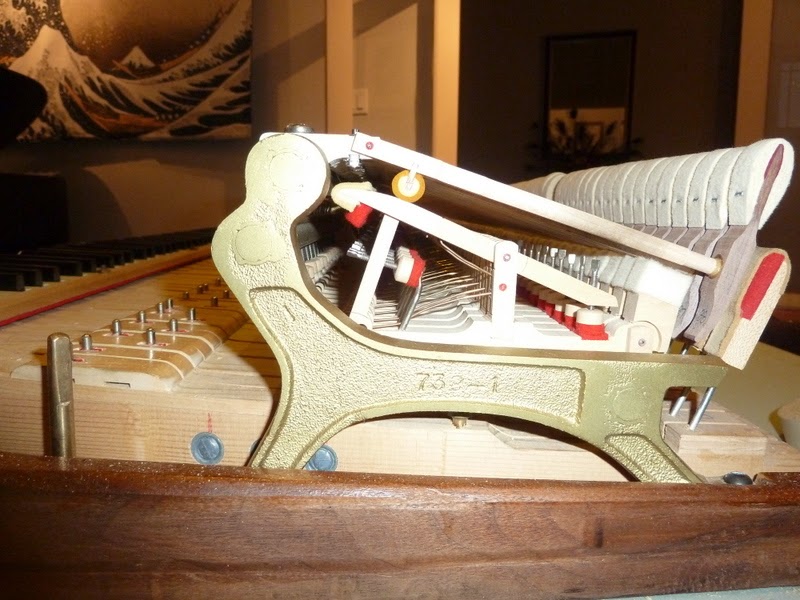
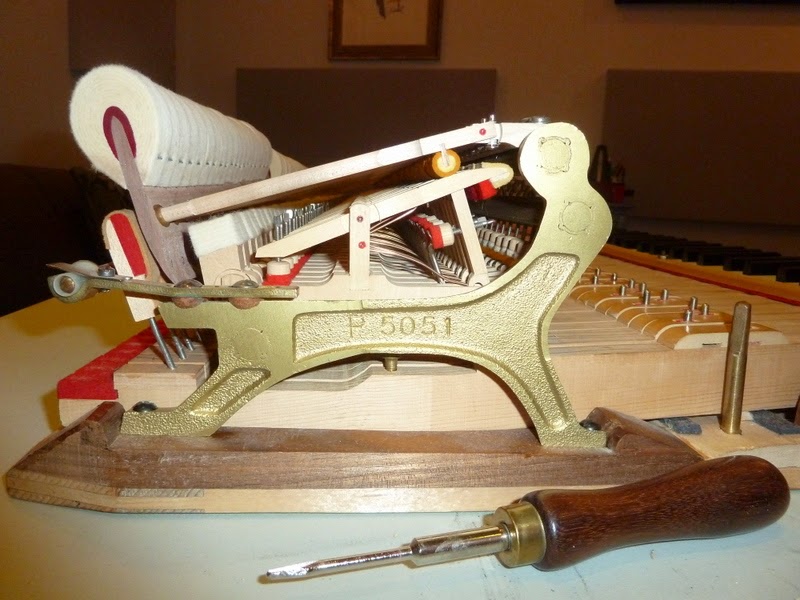
I also reamed the contact area in the balance holes to 4 mm. They were about 7-8 mm thick to start off with. For those who are wondering, the picture above shows this reamer.
The remaining issues are:
Light touch weight
Capsizing notes in the bass with extremely forceful and fast repeating notes. The checking is poor on this piano. I might be able to regulate this out but it may eventually need a new set of backchecks or raising the backchecks.
Regi Hedahl
Ed Foote
The 4.7 ratio is your problem, I think. I can't see the capstans but it looks like they are too far proximal from the center of their cushions. It also looks like they are as far distal on the key as possible, judging from how close they are to the key's coving. This would occur if the guys in the fore finishing department needed to place them as far distal as possible. This could explain your capsizing, since the leverage of an excessively long moment arm from whippen pin to capstan lacks sufficient force to raise the key fast enough to reset. An action will only repeat as fast as the key returns,and this leverage is working against that.
The fact that you had 7 or 8 mm of sole plate thickness means that quality control was lacking on this action, so it is entirely possible that with hammers hung at a standard 130 mm, the stack position, (determined by the plate casting), was poorly mated with the keyframe, whose position is determined by the piano's case. Steinway is alone, I think, in allowing their action geometry to be a result of these two separate assemblies' accuracy. All the cumulative error shows up in the geometry when somebody decides where to put the capstan. I consider it to be the major shortcoming of their build philosophy.
It would require longer shanks, but it is possible that you could make it play as it should by positioning the stack on the keyfram to give you a 5.5 ratio, and THEN hang the hammers farther out to meet the strike points.
Some diagnostic questions: Are all the bass shanks to the right of whippen centerlines, and/or the treble shanks in the low tenor all off to the left? How far is the proximal edge of the plate to the cross-piece?
-----Original Message-----
From: Regi Hedahl <piano...@gmail.com>
To: pianotech <pian...@googlegroups.com>
Subject: Re: [pianotech] 1984 Steinway D-tool question
The action for the most part is fixed. I started off with confirming which shanks and flanges were used on this piano. They were the type 1 (23.5 x 16 x 9) which would give the highest numerical action ratio. The touch was on the light side so I ruled out the wrong type of shanks and flanges being used as the problem. I then measured the action ratio. With a 47 mm blow, the action regulated out well at 10 mm (4.7 ratio). Long story short, the main issue with the action was the variable blow distance and variable key dip. The blow distance and key dip was the greatest in the bass and tapered down in the treble. This is the first time I have ever seen anything regulated this way. Whatever the reason, it sure didn't work out well.

Jurgen G
The ratio for those numbers is probably closer to 5.5.
On Wednesday, March 25, 2015 at 3:14:22 PM UTC-7, ed foote wrote:
Greetings,
The 4.7 ratio is your problem, I think. ...
Ed Foote RPT
-----Original Message-----
From: Regi Hedahl <piano...@gmail.com>
Update:
.. I then measured the action ratio. With a 47 mm blow, the action regulated out well at 10 mm (4.7 ratio)....
Regi Hedahl
Ed Foote
Action ratios are dependent on the manner in which they are measured, so here is my reasoning: if comparing distances traveled, I ignore the let-off distance and the aftertouch distance, since they are not germane to the relationship between hammer travel/key travel.
Thus, assuming a let-off of 1 mm, and 1.27 mm aftertouch, (.050"), we have a hammer travel of 46mm caused by a key travel of 8.73, which gives an effective ratio of 5.26. If we assume an aftertouch of 1.0 mm (.040"), the ratio is 5.1. That was for the treble. When Regi mentioned that the bass dip was 12 mm, a 1.27mm aftertouch would give a ratio of 4.28. The same blow with an aftertouch of 1mm would equate to a ratio of 4.18.
I think the important clue here is that when the strike point was optimum, they keyboard was askew in the case. The factory would rather send a piano out, (even a D), with the keys parallel to the keyslip rather than one that sounded its best and felt its best. This is normal, as in the case of non-perpendicular hammer travel, which is required to make all the hammers equally spaced at rest and still hit the erratically installed strings. It seems to be a case of appearance before performance.
I am not a mathematician or physicist, nor engineer, so I am totally open to other interpretations of action ratio.
Regards,
Ed Foote RPT
-----Original Message-----
Subject: Re: [pianotech] 1984 Steinway D-tool question
Al Guecia/Allied PianoCraft
Ed Foote
Ed Foote RPT
-----Original Message-----
From: Al Guecia/Allied PianoCraft <alliedpi...@outlook.com>
It’s simply the ratio of key travel to hammer travel. It has nothing to do with let off or after touch. The hammer should travel about 5.5 times the travel of the key.
Al -
I agree, the ratio has nothing to do with let-off or aftertouch. However, the only dimensions given in Regi's example were blow and key dip, which includes them both. If you define the "travel of the key" as key dip, (which includes aftertouch), then adding another .100" key dip to that action,(which would change only the aftertouch), would greatly change the ratio. In that case, you would have a radically different ratio, but the DW would remain the same. How can the same SW and FW yield the same DW if the ratio is radically changed? This is a contradiction, and that is why I remove them from the equation.
And why "should" the ratio be 5.5? Are you proposing that that is the only AR that is proper for a Steinway?
Regards,


Terry Farrell
Terry Farrell
Al Guecia/Allied PianoCraft
Jurgen G
This is an incorrect way of trying to calculate the action ratio, and the resultant number will be inaccurate.
Reason: Once the key has been depressed to the point where the jack tender contacts the let-off button, (about 7mm) everything changes. The jack is now moving in a proximal arc, scuffing along the surface of the round knuckle, not lifting the hammer in the same way as before.
If you want to measure action ratio using key dip and hammer rise, you must only consider the hammer rise up to the point of jack tender/letoff button contact. A safe way is to limit key dip to 6.5 mm and measure hammer rise in mm, then divide that measurement by 6.5.
As I said, there is no way you will arrive at an action ratio of 4.7 with the 10/47mm measurements given in this instance.
jg
David Love
David Skolnik
http://www.pianosinsideout.com/Bonus.html#PracticalTouch
David Skolnik
Hastings on Hudson, NY
There are different ways and there are different targets. The ratio with respect to distance is not quite the same as the ratio with respect to weight. Also, knowing the action ratio without knowing the amount of weight that's being lifted (strike weight or hammer weight) won't tell you anything. There is no such thing as a bad (or good) action ratio. It depends on the the amount of weight you are trying to lift. If the hammers are very light then a higher action ratio will be required to get the action performing well dynamically. Similarly if the hammers are heavy a lower ratio will be required. The old Steinways with very light hammers perform quite well with a ratio of 6.0 or higher. If you keep those same hammers and alter the AR down to something like 5.5 or lower you will have an inertia value that is too low and the action will not perform well.
Action ratio relationships to hammers can be deduced in other ways besides trying to figure out the correct way to measure the AR (though that would be best). A report on the balance weight of some target notes and the number and location of the weights (measured from the front of the key along with the measurement of the distance from the front of the key to the balance rail) on that note can clue you in to what's going on. Better would be a measure of the strike weight, or hammer weight, the balance weight and the front weight of the key. From that action ratio with respect to weight can be deduced, you can figure out what the strike weights or hammers need to be and see if you are deviating too far from that.
The methods reported on measuring the relationship between key travel and hammer rise are fine but need to be done very carefully and accurately (not easy) and also need to be done in the part of the keystroke that does not allow the jack to come into play. Typically that's about 6 mm of key travel, or you can turn the let-off button up. Once the jack tender contacts the let-off button then the relationship between key travel and hammer rise is disrupted. It should also be noted that this particular AR will not be the same as the one which describes the weight relationships between the hammer and the key.

|
This email has been checked for viruses by Avast antivirus software.
|
David Love
Regi Hedahl
I revisited the piano the other day because of a few notes in the bass were capsizing when played forcefully with repeated notes. I was able to alleviate the issue by adjusting the backchecks as close as possible without dragging. However with any wear, the issue will return. That said, I believe the root of the issue is either the backchecks are not high enough or tails are too short. At letoff, the bottom of the tails are 1/2” above the top of the backchecks.
The action is skewed (with the treble side pushed all the way in) because the hammers were not installed far enough back on the shanks in the treble. This is seen by running a straight edge along the strike point of the hammers. This piano has a new set of hammers so I believe that it was not like this from the factory. When I first visited the piano, the action was straight in the action cavity but it had little tone in the upper treble.
Other than that, the action now plays quite nicely (although somewhat light) once all adjusted out and the owners who are very good pianists are happy with the big improvement.
Regi Hedahl
Ed Foote
Greetings,
Inre Regi's statement that he got a 4.7 ratio with 47 mm blow and 10 mm key dip, I wrote:
" if comparing distances traveled, I ignore the
let-off distance and the aftertouch distance, since they are not germane to the relationship between hammer travel/key travel.
Jurgen replies:
>>As I understand
it, there are different ways to
measure or calculate action ratio, but what Ed
proposes is not one of them.
This is an incorrect way of trying to calculate
the action ratio, and the resultant number will be inaccurate.
to measure action ratio using key dip and hammer rise, you must only consider
the hammer rise up to the
point of jack tender/letoff button contact. A safe
way is to limit key dip to
6.5 mm and measure hammer rise in mm, then divide
that measurement by 6.5.
As I said, there is no way you will arrive at an
action ratio of 4.7 with the
10/47mm measurements given in this instance.
jg <<
So, I went back to the bench and set up two test rigs. This allows me to compare,(every .025") the ratio of key travel to hammer travel. I created an action
ratio of 4.8 on a Steinway frame, with the action regulated
for 47 mm blow and 12 mm dip. This ratio was arrived at by use of a 18 mm knuckle distance, though
the same can be created with a 17 mm distance and a shorter key ratio via capstan placement,(which is the factor in question with this particular example from Regi). With a 2mm let-off, (minimum normal in the bass of a D),the action regulated with approx..5 mm aftertouch. This is not to my liking, but possible.
I contend that one can regulate a D action with this ratio and 47 mm blow, 12 mm dip. It will have minimal aftertouch with a let-off of 2 mm, but with 3 mm (1/8") let-off, one can gain another .5mm in the aftertouch, which
is not a completely uncommon state I have seen on concert
pianos. That this action is so light, even with a capstan possibly too far out on the key, makes a ratio of 4.7 a plausible result of incorrect stack placement.
What is also evident, when measuring the ratio, is that the ratio changes as the action goes through the stroke. This change is sensitive to the capstan's relationship to the "magic line". On this particular test rig,the capstan's contact point was just slightly under the magic line to begin with, and ended up slightly beyond.
I recorded the ratio from beginning of the stroke to a "safe" key dip of 6.35mm. The following figures are for the action ratios measured every .025",(.635mm). As you can
see, they describe an arc with the ration increasing during the early part of the stroke and decreasing as escapement is approached.
4.6- 4.9- 5.0- 5.1- 5.1- 5.2- 5.2- 5.15- 5.1- 5.1
What is more interesting is what happens to this variability when the capstan begins far enough below the magic line so that it reaches it at the beginning of
escapement. Motorcycle suspension engineers would recognize the "gain geometry" aspect of this arrangement, and pianists always like my actions that use it.
I will let anyone still interested do their own measurement to see what that arc looks like.
Some considerations not spelled out: The hammer is
moving in an arc, so the axis of measurement was chosen to split the differences, and, since the key is also moving in an arc, I think the differences in measuring the chord vs straight-line are below the threshold of the rest of the measurements. The difference in ratio between capstan placement and knuckle distance could not be found on my set-up. I removed the springs from the dial indicators and lubed them with Pro-tek for sensitivity. I don't shy away from peer review, I think it makes all of us better educated. I have tried to post a non-dogmatic approach here, and will welcome any contentions.
If I was asked to regulate this action, I could not leave the hammers that high off the rest cushions, they will capsize. I would not use a 13 mm key dip, which would be required for the longer blow required to lower them. I wouldn't want this light of an action, either. So, I would either change the capstans to increase the ratio, or use taller cushions. I think what it needs is longer hammershanks so the stack can be brought back to a more correct geometry with the key and hammers with a longer bore to match the string height.
Regards,
Ed Foote RPT