Increasing Upright Touchweight

618 views
Skip to first unread message

Terry Farrell

unread,
Nov 25, 2014, 8:29:43 AM11/25/14
to pian...@googlegroups.com
I have a client who is a professional classical pianist. His home piano is a Yamaha P2E studio upright. Good sounding little piano (well, relatively speaking....). However, the touchweight is on the light side - 40 to 50 grams DW. Overall key/action friction is very low - on the few keys I measured, it was between 5 and 9 grams.

The pianist does not like the light touchweight. The thing he dislikes most about it is the contrast between his home piano and most grand pianos he plays on.

He prefers to not repin the entire action, etc., etc., as those approaches cost more $$ than he'd prefer to spend - looking for an easy fix if available. Keys are factory pattern leaded with one big lead at the back end of the keys. I'm thinking this might be a reasonable application of Jiffy-Leads. I've never installed those critters on any piano previously, nor have I ever added lead to increase upright touchweight. I'm hoping someone with some experience doing this can provide some helpful input.

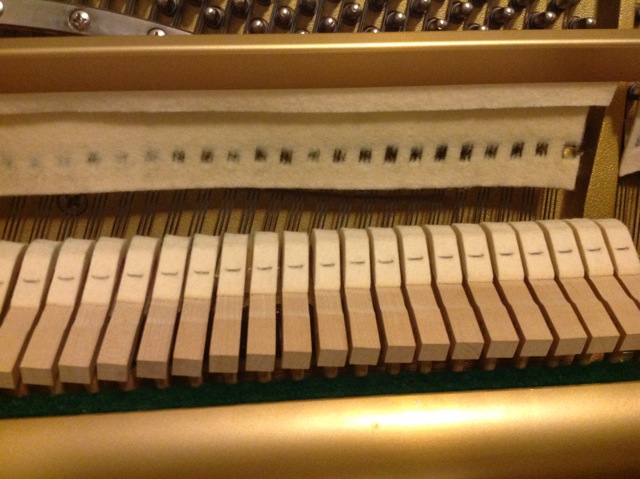
Oh, BTW, he practices at night a lot.  When he called to schedule a tuning (new client to me - he is new to the area), he said his mute rail was not working. I told him that often it is just an adjustment. I took one look at the mute rail and figured that you'd never adjust the holes out of it!  I was ready to take the mute rail back to my shop to replace the felt when the pianist ask whether I could just adjust the rail downward to position good felt between the hammers and strings. I thought for a second with an embarrassed look on my face and said if there was enough adjustment range that might work. Well, we couldn't adjust it enough downward, but and upward adjustment placed the zone below the worn spots perfectly. Now he is back in business for the next few years until he wears that through. I had never seen a mute rail worn out like that.

Oh, and BTW (last time!), I offered him a job as my diagnostics assistant!  I really was embarrassed that I had not thought of the adjustment option.   :-0

Terry Farrell

IMG_0069.jpeg

Douglas Gregg

unread,
Nov 25, 2014, 10:26:14 AM11/25/14
to pian...@googlegroups.com
Terry,
I had exactly the same issue with a friend who has a Victorian
restored S&S B that was on the heavy side and a Sohmer console with
about 40 grams downweight. It needed 15 grams on all keys. It did not
have much room for Jiffy weights and I wanted to keep the inertia
problem to a minimum by using the least amount of lead. I thought it
would be best to hang the weight on the end of the keystick where it
would do the most good and keep the mass to a minimum. I used egg
sinkers purchased by the 100 on e-bay. I put a thin nail through the
hole and squeezed the sinker onto the nail. that also made them
narrower and gave enough clearance so they would not interfere with
each other. Since this guy was a heavy handed player, I used the
strongest glue known to man to glue them so they would not come loose.
That is 3M 5200. It took two days to dry but they wont come off or
rattle. The result was perfect and easy.
I am pretty sure they were 1/2 oz. sinkers. If you want to cut them,
get a PVC pipe cutter from Home depot. It looks like a small pruning
shear but it has a lot of mechanical advantage and cuts lead very
nicely using a few squeezes-much better than a hacksaw.

Egg sinkers on e-bay:
http://www.ebay.com/itm/100-COUNT-BAG-OF-1-2-OZ-LEAD-EGG-SINKERS-FREE-SHIPPING-/261673142194?pt=LH_DefaultDomain_0&hash=item3cecef47b2

Doug Gregg
Classic Piano Doc
IMG_6749.JPG

Don

unread,
Nov 25, 2014, 10:31:45 AM11/25/14
to pian...@googlegroups.com
Hi,

You might try adding 1 gram to the hammer shank via a piece of plastic tubing. If he doesn't like it it is easy to reverse the process.
 
Regards,
Don Rose, 


From: Terry Farrell <farrellpi...@gmail.com>

I have a client who is a professional classical pianist. His home piano is a Yamaha P2E studio upright. Good sounding little piano (well, relatively speaking....). However, the touchweight is on the light side - 40 to 50 grams DW. Overall key/action friction is very low - on the few keys I measured, it was between 5 and 9 grams.

The pianist does not like the light touchweight. The thing he dislikes most about it is the contrast between his home piano and most grand pianos he plays on.
Terry Farrell


Joseph Garrett

unread,
Nov 25, 2014, 11:39:39 AM11/25/14
to pian...@googlegroups.com
Terry,
Since the action/keys is designed for backweighting, it wouldn't take much to increase that down weight to a higher number like 55grams - 60grams. It can be done fairly quickly in the shop. I would not use jiffy leads because they don't give you much wiggle room. They also work loose with heavy playing. I'd drill and plug a slug. Of course you are between a rock and a hard place with this customer because he's looking for a "cheap" way around his problem. He really needs to have a grand piano, but you've laid it out that that's not going to happen.<G>
Also, being a Yamamama the action pinning is definitely needed. Heavier keys is not going to give him more control, which is really what he's talking about. If you can convince him that pinning should come first and then try it. After all, I'll assume he bought the piano new and I'll have to assume he liked the touch at that time. What has changed? The action centers and regulation!
Your call, but I'd approach it firmly in that direction. Then, if he needed a bit more down weight, I'd plug a slug the damned thing. At that point if he still wanted more, I'd tell him to get an old Steinway with vertigris!<G>
Best,
Joe


Captain of the Tool Police
Squares R I
gpianoworks.com


-----Original Message-----
>From: Terry Farrell <farrellpi...@gmail.com>
>Sent: Nov 25, 2014 5:29 AM
>To: pian...@googlegroups.com
>Subject: [pianotech] Increasing Upright Touchweight
>
>I have a client who is a professional classical pianist. His home piano is a Yamaha P2E studio upright. Good sounding little piano (well, relatively speaking....). However, the touchweight is on the light side - 40 to 50 grams DW. Overall key/action friction is very low - on the few keys I measured, it was between 5 and 9 grams.
>
>The pianist does not like the light touchweight. The thing he dislikes most about it is the contrast between his home piano and most grand pianos he plays on.
>

Christopher Storch

unread,
Nov 25, 2014, 12:15:53 PM11/25/14
to pian...@googlegroups.com
Adjusting the spoons such that the damper timing occurs sooner in the key stroke can give the player the feeling of a heavier downweight.

Joseph Garrett

unread,
Nov 25, 2014, 12:42:53 PM11/25/14
to pian...@googlegroups.com

But it won't do anything for dynamics control. <G>

Joe

-----Original Message-----
From: Christopher Storch
Sent: Nov 25, 2014 9:15 AM
To: pian...@googlegroups.com

tnr...@aol.com

unread,
Nov 25, 2014, 12:51:00 PM11/25/14
to pian...@googlegroups.com
Terry  In a nut shell, this pianist needs a reality check. He wants a grand piano in an upright body. He wants a heavier touch like a grand piano and he wants it to be quiet. In short, he needs a keyboard with a heavy touch and ear phones. I'm sure if he visited a music store that sells good quality keyboards, he can find what he's looking for. You will never be able to satisfy his unrealistic demands.
 
Wim


-----Original Message-----
From: Terry Farrell <farrellpi...@gmail.com>
To: pianotech <pian...@googlegroups.com>
Sent: Tue, Nov 25, 2014 3:29 am
Subject: [pianotech] Increasing Upright Touchweight

Terry Farrell

unread,
Nov 25, 2014, 2:25:58 PM11/25/14
to pian...@googlegroups.com
He wants a grand piano in an upright body.

No, he wishes to have the touchweight on his upright piano improved.

He wants a heavier touch like a grand piano and he wants it to be quiet.

Quiet?

You will never be able to satisfy his unrealistic demands.

He hasn't made any demands. He has simply asked whether it is possible to increase the touchweight of his piano. I described some possible routes to get there and he indicated a preference for low $$ expenditure if possible. 

he needs a keyboard with a heavy touch and ear phones. 

And he also told me that he does not like keyboards.

Terry Farrell

David Kroenlein

unread,
Nov 25, 2014, 2:29:00 PM11/25/14
to pian...@googlegroups.com
That is unique!

Sent from my iPhone
<IMG_0069.jpeg>

Terry Farrell

unread,
Nov 25, 2014, 2:32:24 PM11/25/14
to pian...@googlegroups.com
Thanks for the input Joe. Your suggestion about repinning is excellent. I was considering that from the limited view of increasing friction and hence touchweight - but we also had a conversation about difficulties he is having controlling the action - especially when trying to play softly. I did talk to him about regulating that erratic and up to half-inch letoff, et. al. to improve soft play, but I didn't put two-and-two together and describe how action center friction can affect control issues. I do think of that when working on a grand piano, but apparently less-so with uprights. I'll have to correct that! Thanks for getting my mind right (well, at least less scrambled.....).

Terry Farrell

Mark Potter

unread,
Nov 25, 2014, 4:52:12 PM11/25/14
to pian...@googlegroups.com
Another cheap, easy, effective weapon in the arsenal of touchweight in a situation like this is the addition of mini-binder clips to the hammer shank just under the hammer head.  For $5 and 30 minutes of your time you can add 4-5 grams of touchweight at the key.  Certainly friction is always an issue, so that should be addressed, but sometimes this is the perfect way to accomplish increased "touchweight on a budget".  It does tend to darken the tone ever so slightly, but in a Yamaha upright, that can only be considered a plus ;)

Mark Potter

tnr...@aol.com

unread,
Nov 25, 2014, 6:35:03 PM11/25/14
to pian...@googlegroups.com
Terry
 
Maybe he's not demanding, but he wants something from his piano that might not be possible, or at most, not practical to do. Changing the touch on an upright is not going to be easy. Touch weight on an upright mostly has to do with the geometry of the action. Increasing the pinning, or adjusting spoons, will make a little difference. But the geometry will still be there. You might want to look at capstan to wippen alignment, but even changing that might not increase touch weight.
 
But no matter what you do, if he's not satisfied, you're the bad guy. You will either have to do it again, at no cost, or make sure he understands from the get go that any changes you make after the initial change will need to be paid for.
 
He uses the mute rail, A LOT. That means he wants the piano to be quiet. That alone changes the way the piano feels.
 
Terry. I'm merely trying to point out that sometimes pianists expectations of their instrument are beyond what the piano is capable of. Trying to satisfy those expectation might not be possible. I just hope he understands that you get paid to make any changes, no matter what you do, or how long it takes you. And that sometimes, making changes will be permanent. And then he's stuck with an instrument he doesn't like.
 
My advice to pianists like this is to go find a piano that they like.

Douglas Gregg

unread,
Nov 25, 2014, 10:32:53 PM11/25/14
to pian...@googlegroups.com
Terry,
I think the method I used in this same kind of situation will work for
your client. The touch came out feeling quite good and control seemed
better to my guy. This was 3 years ago and the piano is still the same
with no rattles or loose weights. I don't think adding weight to the
hammer shanks on a upright will do much but might make the hammer
return sluggish. Increasing friction will only be temporary if he
plays it all the time as it seems. I agree with Wim that changing
geometry is unlikely to do much in this piano.

With the egg weights, the whole job will will take about 2 hours. Wait
for the glue to dry thoroughly and put the keys back in. Done. I think
he will be satisfied.

Doug Gregg

Ryan Sowers

unread,
Nov 26, 2014, 12:01:40 AM11/26/14
to pian...@googlegroups.com
Actually Jiffy weights will add LESS inertia to the key not more. A small weight at the back of will add more inertia because  inertia increases according to the mass times the square of the distance from the object’s center of mass. I'm not really a math person - but I picked this up hanging around Darrel Fandrich's shop years ago. 

Its the reason why the Steinway "Accelerated Action" used a greater number of weights near the fulcrum of the key and avoided leads further out. 

If you weigh and upright key and compare it to grand, upright keys are much lighter. I think many uprights can benefit from heavier keys. 
--
Ryan Sowers, RPT
Puget Sound Chapter
Olympia, WA
www.pianova.net

Ron Nossaman

unread,
Nov 26, 2014, 12:21:53 AM11/26/14
to pian...@googlegroups.com
On 11/25/2014 11:01 PM, Ryan Sowers wrote:
> Actually Jiffy weights will add LESS inertia to the key not more. A
> small weight at the back of will add more inertia because inertia
> increases according to the mass times the square of the distance from
> the object’s center of mass. I'm not really a math person - but I
> picked this up hanging around Darrel Fandrich's shop years ago.

I think some added inertial resistance might help. Weight the keys for
static touch weight, and the hammers for dynamic inertia. Find the right
combination and you'll make his day, or his evenings anyway.

Ron N

Joseph Garrett

unread,
Nov 26, 2014, 2:00:06 AM11/26/14
to pian...@googlegroups.com
Pretty much disagree with that whole idea. The action friction has to be to specs or all that static and active inertia doesn't mean squat, imo. The fishing weights will give the illusion of a firmer touch, but the control will still be in the toilet!
Best,
Joe


Captain of the Tool Police
Squares R I
gpianoworks.com


-----Original Message-----

tnr...@aol.com

unread,
Nov 26, 2014, 2:38:53 AM11/26/14
to pian...@googlegroups.com
Terry
 
You've gotten contradictory advice. Which is the right one? 
 
Perhaps another piano, one that he knows has the right touch, will be the best option.
 
Just sayin'
 
Wim

richa...@comcast.net

unread,
Nov 26, 2014, 8:17:11 AM11/26/14
to pian...@googlegroups.com
Vs Profelt on the action centers ?

Rick Ucci

Joseph Garrett

unread,
Nov 26, 2014, 10:00:35 AM11/26/14
to pian...@googlegroups.com

And that does what?

Joe

-----Original Message-----
From: richa...@comcast.net
Sent: Nov 26, 2014 5:17 AM
To: "pian...@googlegroups.com"
Subject: Re: [pianotech] Increasing Upright Touchweight

Vs Profelt on the action centers ?

Rick Ucci
Uccipiano.com
609-677-0444

John Rhodes

unread,
Nov 26, 2014, 10:49:51 AM11/26/14
to pian...@googlegroups.com
There is no single magic bullet!  Key bushing friction, center pin friction, downweight, key back weighting, hammer return spring, hammer strikeweight, action ratio, damper timing, damper spring strength, voicing, let off, checking, action wear, room acoustics, hearing loss, performer's training & expectations (did I forget anything?) ALL affect the pianist's perception of playability and responsiveness.  

Yuri

unread,
Nov 26, 2014, 12:07:20 PM11/26/14
to pian...@googlegroups.com
My solution of a similar problem in an Essex EUP-108 four years ago.
From 43gm D/W to 50gm in 30 minutes: squeeze good, put a drop of thick CA glue just above the installed split shot sinker (size 3 or 2, depending on the situation and objective) to run down the wire.
 
Feel free to critique.
- Yuri Melekh


Date: Wed, 26 Nov 2014 07:00:33 -0800
From: joega...@earthlink.net
IMG_1530.JPG

David Boyce

unread,
Nov 26, 2014, 2:23:29 PM11/26/14
to pian...@googlegroups.com
Indeed. Customers seem to imagine sometimes that there is a touchweight
regulation screw of some sort which just needs half a turn to fix things!

I'm with Wim on suggesting that customers thing about a different piano.

Best regards,

David.

Joseph Garrett

unread,
Nov 26, 2014, 8:56:28 PM11/26/14
to pian...@googlegroups.com

Yuri,

That's one way to make the piano feel heavier, (because it is<G>), but I doubt that it would address the repetition/regulation problem that probably existed. Just my take on that.

While I'm at it, I'd like to say that because the upright is not taken seriously enough, most technicians fail to study Upright action geometry. That is a shame and a disservice to our clients that own uprights, imo.

Best,

Joe

-----Original Message-----
From: Yuri
Sent: Nov 26, 2014 9:07 AM
To: "pian...@googlegroups.com"
Subject: RE: [pianotech] Increasing Upright Touchweight

My solution of a similar problem in an Essex EUP-108 four years ago.
From 43gm D/W to 50gm in 30 minutes: squeeze good, put a drop of thick CA glue just above the installed split shot sinker (size 3 or 2, depending on the situation and objective) to run down the wire.

Feel free to critique.
- Yuri Melekh


Bruce Dornfeld, RPT

unread,
Nov 26, 2014, 10:14:57 PM11/26/14
to pian...@googlegroups.com
While the suggestions you have gotten are good, there are a couple of things I would add.  I have seen some felt mute rails worn through too.  For my clients, I found out that it means the piano is too bright for them.  If you voice it down a lot, it will also make the action feel heavier.  Win, win.  Thing two: Regulating the let off is the most important adjustment for control at a soft volume.  If you set it closer, you have even better control.  But with the felt muffler, you have to be careful not to set it too close.  If you do, hammers will block when the middle pedal is down. 

Yuri

unread,
Nov 26, 2014, 11:16:09 PM11/26/14
to pian...@googlegroups.com
Joe,
 
You're absolutely right about the upright actions not taken seriously enough by a lot of technicians out there. I find them 'differently complex' and more delicate than those of grands in quite a few ways.
In this particular instance that we were discussing, my input addressed only that one aspect of weigh-off. Once the hammer butt and damper lever springs tension is set right, the "repetition/regulation problem" may become easier to solve.
 
Best regards,
Yuri
 

Date: Wed, 26 Nov 2014 17:56:26 -0800
From: joega...@earthlink.net
To: pian...@googlegroups.com

Joseph Garrett

unread,
Nov 26, 2014, 11:59:34 PM11/26/14
to pian...@googlegroups.com


I agree.

Best,

Joe

-----Original Message-----
From: Yuri
Sent: Nov 26, 2014 8:16 PM
To: "pian...@googlegroups.com"
Subject: RE: [pianotech] Increasing Upright Touchweight

Joe,

You're absolutely right about the upright actions not taken seriously enough by a lot of technicians out there. I find them 'differently complex' and more delicate than those of grands in quite a few ways.
In this particular instance that we were discussing, my input addressed only that one aspect of weigh-off. Once the hammer butt and damper lever springs tension is set right, the "repetition/regulation problem" may become easier to solve.

Best regards,
Yuri

Date: Wed, 26 Nov 2014 17:56:26 -0800
From: joega...@earthlink.net
To: pian...@googlegroups.com
Subject: RE: [pianotech] Increasing Upright Touchweight

Yuri,

That's one way to make the piano feel heavier, (because it is), but I doubt that it would address the repetition/regulation problem that probably existed. Just my take on that.

Joe Goss

unread,
Nov 27, 2014, 10:13:38 PM11/27/14
to pian...@googlegroups.com
Hi,
Anyone out there have good numbers for a school model upright Everett?
I have a church that has a bunch and so far nothing seems to work with my two SAT lll's other than tuning totally by ear.
Also is the Kawai UST6 and UST7 with a cedar sound board a laminated board?
Joe Goss BSMusEd MMusEd RPT
ima...@gmail.com
www.mothergoosetools.com

Wim Blees

unread,
Nov 27, 2014, 10:20:23 PM11/27/14
to pian...@googlegroups.com
Joe

Don't you do a FAC on pianos you're not familiar with?  That usually gives me a very clean tuning.  I do follow up with a aural tuning, but I hardly have to make any adjustments. 

Wim

Sent from my iPhone

Joseph Garrett

unread,
Nov 28, 2014, 1:32:21 AM11/28/14
to pian...@googlegroups.com

Ah yes, the one of the other Joe G's. You are definately worse than me about trimming your posts dude!

As to the original question: I think you need to learn how to use the machine, (SATs) IF I were doing institutional pianos that is the way I'd go: scope that sucker and start cranking. Two days later, after major temperature and humidity spikes the damned things will be out of tune any way!<G>

As for the cedar soundboard? Yes it is laminated, but it is a good board. Better than the mahogany balsa wood combos of Kimball and such.<G>

I'm going to trim all the miles of emails you posted and hopefully make a few people happy on this Turkey Day.

Best,

Joe G aka Curmudge

David Love

unread,
Nov 28, 2014, 1:56:21 AM11/28/14
to pian...@googlegroups.com
There might not be one magic bullet, or one solution if that's what you meant, but one can also get lost in a myriad of non issues that are probably just confusing something which is relatively simple to address.  The paralysis of analysis and classic over thinking of the problem.  I certainly would not go artificially increasing friction as you can introduce a whole new set of problems.  Neither would I look to anything with the damper timing or damper spring strength as that will be ineffective and useless when the damper pedal is engaged and create a greater disparity between touch dynamics with and without the pedal.  Voicing, checking, action wear, room acoustics, hearing loss, etc, etc., won't do anything about the relatively simple request to increase the touchweight which I take to mean they want more resistance when they press the keys down.  An upright won't ever have the same dynamics as a grand and one should spare oneself the problem of analyzing it that way. Adding lead anywhere in the key will increase the inertia even if it increases or decreases the touchweight.  A key made of solid lead will have a higher MOI than one made of wood no matter what the static touchweight is.  Adding mass to the hammers will increase the inertia because you're moving more mass but the touchweight will be impacted less directly on an upright than a grand because the hammer is not being lifted in the same way but rather rotated forward.  I've never heard of jiffy leads coming loose if they are properly installed and they should be tacked with something like PVC-E even if they are screwed in. I don't think it really matters whether you screw on jiffy leads or drill holes in the keys and insert lead weights and undoing or changing lead weights drilled into the keys is more of a problem. Since this is an experiment to determine what the customer wants I would opt for the least invasive procedure.

If you add lead to the back of the key you will increase the static touchweight and that would be the simplest solution and the easiest to undo or change and would have the least effect on inertia.  The amount of increase in the inertia from that will depend on where lead is placed relative to the balance point.  Since the key contributes a relatively small amount in the entire inertia package I wouldn't probably worry too much about where exactly it goes but rather target a uniform pattern through the scale.  So that's what I would do.  Once I checked the action for proper regulation and friction, as anyone should before changing the touchweight, then I would add lead weights behind the balance rail in the simplest manner so that you could easily reverse it.  I wouldn't get paralyzed by a long list of non issues.   

D. Love

Terry Farrell

unread,
Nov 28, 2014, 9:26:02 AM11/28/14
to pian...@googlegroups.com
Cedar? Really? I've not ever seen one.

Terry Farrell

Ryan Sowers

unread,
Nov 28, 2014, 12:17:18 PM11/28/14
to pian...@googlegroups.com
I think Yuri's solution seemed even less invasive than the Jiffy leads. I would think the added benefit of putting the weight at the bass of the catcher wire is that it could keep a more connected feel between the parts. Steinway weighted the front of the keys in their small uprights with the weight of the wippen and the strength of the jack spring to counter it. This can work really well (until the jack springs get weak like I have seen in some of those pianos).

Del Fandrich has also showed me an action model he was playing with when redesigning the Young Chang pianos that had a weight in the catcher. 

Barrie Heaton

unread,
Nov 30, 2014, 7:14:18 AM11/30/14
to pian...@googlegroups.com
In message
<3227697.141705338...@elwamui-rubis.atl.sa.earthlink.net>,
Joseph Garrett <joega...@earthlink.net> writes
>
>Yuri,
>
>That's one way to make the piano feel heavier, (because it is<G>), but
>I doubt that it would address the repetition/regulation problem that
>probably existed. Just my take on that.
>
>While I'm at it, I'd like to say that because the upright is not taken
>seriously enough, most technicians fail to study Upright action
>geometry. That is a shame and a disservice to our clients that own
>uprights, imo.
>
>Best,
>
>Joe


Why not put in bigger / stronger spiral springs that will increase the
touch and improve the repetition on most uprights


Barrie
--
Barrie Heaton PGP key on request http://www.a440.co.uk/
AcryliKey Ivory Repair System UK © http://www.acrylikey.co.uk/
Piano Castors http://www.piano-safety-
castors.co.uk/

Joseph Garrett

unread,
Nov 30, 2014, 12:22:59 PM11/30/14
to pian...@googlegroups.com
Barrie,
If you are referring to Jack Springs, no that will not help. That sort of spring is not adjustable in any way. The idea of increasing the Touchweight is to do it in a controllable and predictable way. A spring has been proven to NOT be the answer in so many ways imo.
Best,
Joe


Captain of the Tool Police
Squares R I
gpianoworks.com


-----Original Message-----
>From: Barrie Heaton <pi...@a440.co.uk>
>Sent: Nov 30, 2014 4:13 AM
>To: pian...@googlegroups.com
>Subject: Re: [pianotech] Increasing Upright Touchweight
>

Barrie Heaton

unread,
Nov 30, 2014, 1:13:48 PM11/30/14
to pian...@googlegroups.com
In message
<12178489.141736817...@elwamui-little.atl.sa.earthlink.net
>, Joseph Garrett <joega...@earthlink.net> writes
>Barrie,
>If you are referring to Jack Springs, no that will not help. That sort
>of spring is not adjustable in any way. The idea of increasing the
>Touchweight is to do it in a controllable and predictable way. A spring
>has been proven to NOT be the answer in so many ways imo.
>Best,
>Joe

Hi Joe

its worked for me on the Langer 80 action where the repetition is bad
common on the Kemble classic

Joseph Garrett

unread,
Nov 30, 2014, 1:56:08 PM11/30/14
to pian...@googlegroups.com
Barrie,
My olde Mentor used to say: "Don't argue with success"!<G> If it worked for you, it's o.k. with me. The Langer 80 was a bit weird in it's lay out, so anything to improve it was a plus.<G>
Still say "springs" in general are not the way to increase an action's touch weight and maintain good repetition.<G> Other ways have been discussed and I think that considering all ways may be the best approach.
Best,
Joe


Captain of the Tool Police
Squares R I
gpianoworks.com


-----Original Message-----
>From: Barrie Heaton <pi...@a440.co.uk>
>Sent: Nov 30, 2014 10:13 AM
>To: pian...@googlegroups.com
>Subject: Re: [pianotech] Increasing Upright Touchweight
>

Joe Goss

unread,
Dec 2, 2014, 11:42:51 AM12/2/14
to pian...@googlegroups.com
Hi Wim,
Double checked and it is the machine. Not the FAC numbers.Having Inventronics check it out.

Ron Nossaman

unread,
Dec 2, 2014, 12:08:35 PM12/2/14
to pian...@googlegroups.com
On 12/2/2014 10:42 AM, Joe Goss wrote:
> Hi Wim,
> Double checked and it is the machine. Not the FAC numbers.Having
> Inventronics check it out.

Both machines? You said you had two SAT IIIs and neither one was working
for you.

Your junk trimmer still needs fixed too.
Ron N

Joe Goss

unread,
Dec 3, 2014, 3:02:55 PM12/3/14
to pian...@googlegroups.com
Actually 2 llls and a V. Having them all into the shop for a checkup.
My newest lll give these numbers starting at A0 and ascending.
10.0
9.4
7.4
7.5
7.1
6.6
10.8
9.6
6.3
7.1
8.9
3.9
8.0 That is the first octave and it gets worse.
Reply all
Reply to author
Forward
0 new messages