
Spring & Loop overdamper
125 views
Skip to first unread message

David Boyce
Nov 25, 2015, 7:28:24 PM11/25/15
to pian...@googlegroups.com
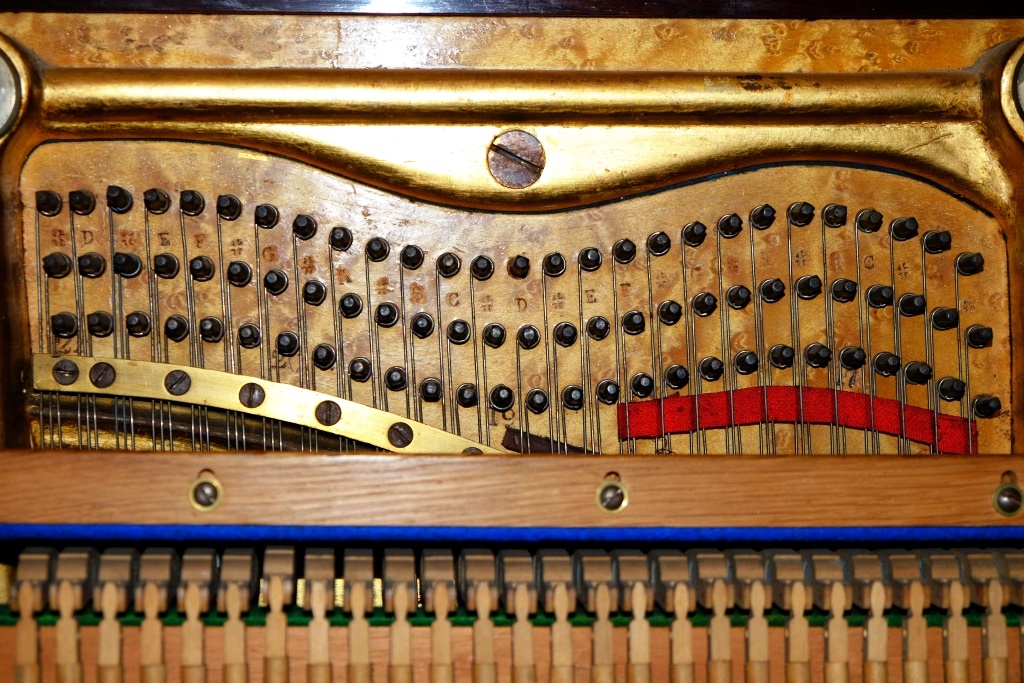
Visited a new customer today whose piano turned out to be a spring &
loop straight strung birdcage. I have pretty much given up on Spring &
Loop action pianos nowadays, as they have little solid structure and are
very old, and trying to tune them is like trying to mold a bath sponge
into The Three Graces.
However, I tried a few pins and they were quite tight, so I went ahead
and did a tuning. Nearly got seasick with the undulating billowy waves
of tuning pins. Nice idea I had not seen before - the rod to operate
the overdamper rod lifts it at the middle, not the normal left-hand end.
What do you think was the reason for the extra-long tuning pins at each
end? Am at a loss with that....
I stressed that the family needs to start looking for another piano for
thier daughter immediately.
Best regards,
David.
loop straight strung birdcage. I have pretty much given up on Spring &
Loop action pianos nowadays, as they have little solid structure and are
very old, and trying to tune them is like trying to mold a bath sponge
into The Three Graces.
However, I tried a few pins and they were quite tight, so I went ahead
and did a tuning. Nearly got seasick with the undulating billowy waves
of tuning pins. Nice idea I had not seen before - the rod to operate
the overdamper rod lifts it at the middle, not the normal left-hand end.
What do you think was the reason for the extra-long tuning pins at each
end? Am at a loss with that....
I stressed that the family needs to start looking for another piano for
thier daughter immediately.
Best regards,
David.

Joseph Garrett
Nov 25, 2015, 8:12:37 PM11/25/15
to pian...@googlegroups.com
David,
I have run into that long tuning pin thing a long time ago. At the time I wondered "what the heck?" And then just went on with my day. I'm not a fan of the Spring & Loop type of Overdamper pianos either. This one looks rather pristine. I do see a smattering of coal dust on the hammers, but the action parts look really nice! Go figger. <G> That looks to be rather tall for an overdamper piano. Interesting that they put felt on the front of the hammer rest rail to keep the wire damper stickers from clanking on it. I've not seen that one. Suspect a good piano maker of the time.
Best,
Joe
Captain of the Tool Police
Squares R I
gpianoworks.com
I have run into that long tuning pin thing a long time ago. At the time I wondered "what the heck?" And then just went on with my day. I'm not a fan of the Spring & Loop type of Overdamper pianos either. This one looks rather pristine. I do see a smattering of coal dust on the hammers, but the action parts look really nice! Go figger. <G> That looks to be rather tall for an overdamper piano. Interesting that they put felt on the front of the hammer rest rail to keep the wire damper stickers from clanking on it. I've not seen that one. Suspect a good piano maker of the time.
Best,
Joe
Captain of the Tool Police
Squares R I
gpianoworks.com
David Boyce
Nov 26, 2015, 3:43:00 AM11/26/15
to pian...@googlegroups.com
On 26/11/2015 01:12, Joseph Garrett wrote:
> David,
> I have run into that long tuning pin thing a long time ago. At the time I wondered "what the heck?" And then just went on with my day. I'm not a fan of the Spring & Loop type of Overdamper pianos either. This one looks rather pristine. I do see a smattering of coal dust on the hammers, but the action parts look really nice! Go figger. <G> That looks to be rather tall for an overdamper piano. Interesting that they put felt on the front of the hammer rest rail to keep the wire damper stickers from clanking on it. I've not seen that one. Suspect a good piano maker of the time.
> Best,
> Joe
>
>
> Captain of the Tool Police
> Squares R I
> gpianoworks.com
one in Euston Road, central London. I hadn't seen the felt on the front
of the hammer rest rail either. Another nice touch - overkill - is the
adjustable damper lever upstop rail.
I had to be a little severe with the lady - she spoke of finding a newer
piano 'in a few years' for her daughter. I stressed that it should be
months, not years. This one was 149 cents low, and I advised against
attempting a pitch raise.
Best regards,
David.
Joseph Garrett
Nov 26, 2015, 10:24:35 AM11/26/15
to pian...@googlegroups.com
David,
I would have done the pitch raise! It's worthless at that pitch imo. If strings broke, that would have driven home the need for an immediate replacement. If they didn't, (which I suspect would be the case), then the poor kid would, at least, have the correct pitch to listen too. Just my take on the situation.
Since we in the U.S. have gotten most of the absolute garbage Over damper pianos, you are left with the better ones. One in that condition would not have been given a second thought, (by me), to raise the pitch. After all, that is a late model spring & loop that has a 7/8 plate, of substantial mass. And, it has, apparently, good solid construction.
Next time, .... go for it!<G>

Regi Hedahl
Nov 26, 2015, 1:35:20 PM11/26/15
to pianotech
David,
The string coils don't appear to be that badly rusted. They're actually less rusty than 95% of the pianos of this age that I come across in my area. Like Joe, I would have brought this piano back to pitch. For older pianos I often don't overpull, just tune to pitch several times real quickly then fine tune.
Regi Hedahl
David Boyce
Nov 26, 2015, 1:44:11 PM11/26/15
to pian...@googlegroups.com
On 26/11/2015 15:24, Joseph Garrett wrote:
> David,
> David,
> I would have done the pitch raise! It's worthless at that pitch imo. If strings broke, that would have driven home the need for an immediate replacement. If they didn't, (which I suspect would be the case), then the poor kid would, at least, have the correct pitch to listen too. Just my take on the situation.
> Since we in the U.S. have gotten most of the absolute garbage Over damper pianos, you are left with the better ones. One in that condition would not have been given a second thought, (by me), to raise the pitch. After all, that is a late model spring & loop that has a 7/8 plate, of substantial mass. And, it has, apparently, good solid construction.
> Next time, .... go for it!<G>
> Best,
> Joe
I didn't make it clear that the tuning pins are on the absolute
> Since we in the U.S. have gotten most of the absolute garbage Over damper pianos, you are left with the better ones. One in that condition would not have been given a second thought, (by me), to raise the pitch. After all, that is a late model spring & loop that has a 7/8 plate, of substantial mass. And, it has, apparently, good solid construction.
> Next time, .... go for it!<G>
> Best,
> Joe
borderline of what will hold without CA treatment.
Would it be worth carrying out a CA treatment on a piano of zero
monetary value?
This is a family who own an expensive large house in a very good area. I
tried to nudge the lady towards a decent instrument for their daughter.
I accept that this spring & loop is better than most, but I really have
more-or-less had it witn the breed. The last several I tried had a
peculiar phenomenon, where the pins felt tight, but the whole structure
was spongey and the pianos just about untunatble, due to the lack of
solid structure. As I said, like trying to shape a bath sponge into a
delicate sculpture!
Although this is a better example of a spring & loop birdcage (and I
must be one of the few tuners here who actually carry, and have fitted,
new springs for these), its about 130 years old and was a lower-end
model when brand new. TIme to move on. I'd happily carry out a pitch
raise on a 1910 solid English overstrung upright in otherwise fair
condition. But not an 1880s spring & loop parallel-strung birdcage with
loose pins.
Best regards,
David.
David Boyce
Nov 26, 2015, 1:45:45 PM11/26/15
to pian...@googlegroups.com
fearless, generally, about pitch raises.
Best regards,
David.
Joseph Garrett
Nov 26, 2015, 2:29:23 PM11/26/15
to pian...@googlegroups.com
David,
Ooooooo! You used the "b" word! Tsk! Tsk!<G>
On a more serious side. The loose tuning pin issue is one that many have given as a reason to NOT raise the pitch. It is quite the opposite of general thinking. As you increase the tension, the tuning pin will bind MORE in the hole, making it easier to set the pin. Of course, if the pins are so loose that they immediately unwind, then that is a different story. Having taken the "dive" into Overdamper pianos in the 70's, when they were all over the place from greedy antique dealers buying entire estates in the U.K., I continue to work on them. The higher the pitch the tighter those pins are going to be.<G>
Best,
Joe
P.S.
To Regi, I've found that rust don't mean squat! Unless the termination point is also rusty or there is a lot of understringing felt.
Ooooooo! You used the "b" word! Tsk! Tsk!<G>
On a more serious side. The loose tuning pin issue is one that many have given as a reason to NOT raise the pitch. It is quite the opposite of general thinking. As you increase the tension, the tuning pin will bind MORE in the hole, making it easier to set the pin. Of course, if the pins are so loose that they immediately unwind, then that is a different story. Having taken the "dive" into Overdamper pianos in the 70's, when they were all over the place from greedy antique dealers buying entire estates in the U.K., I continue to work on them. The higher the pitch the tighter those pins are going to be.<G>
Best,
Joe
P.S.
To Regi, I've found that rust don't mean squat! Unless the termination point is also rusty or there is a lot of understringing felt.
Joe
Captain of the Tool Police
Squares R I
gpianoworks.com
-----Original Message-----
>From: David Boyce <Da...@piano.plus.com>
>Sent: Nov 26, 2015 10:44 AM
>To: pian...@googlegroups.com
>Subject: Re: [pianotech] Spring & Loop overdamper
>
Captain of the Tool Police
Squares R I
gpianoworks.com
-----Original Message-----
>From: David Boyce <Da...@piano.plus.com>
>Sent: Nov 26, 2015 10:44 AM
>To: pian...@googlegroups.com
>Subject: Re: [pianotech] Spring & Loop overdamper
>
Regi Hedahl
Nov 26, 2015, 3:52:59 PM11/26/15
to pianotech
Joe,
With the humidity in my area so high, strings become so rusty that it's more than surface rust. I'm convinced that it actually weakens the strings sometimes to the point that they even snap on their own. The strings also snap as I'm pulling them up and often just before I reach the target pitch.
Regi

Ron Nossaman
Nov 26, 2015, 3:55:29 PM11/26/15
to pian...@googlegroups.com
On 11/26/2015 12:44 PM, David Boyce wrote:
> I didn't make it clear that the tuning pins are on the absolute
> borderline of what will hold without CA treatment.
>
> Would it be worth carrying out a CA treatment on a piano of zero
> monetary value?
I agree with what you did. Sure, you could have sold them a CA treatment
> I didn't make it clear that the tuning pins are on the absolute
> borderline of what will hold without CA treatment.
>
> Would it be worth carrying out a CA treatment on a piano of zero
> monetary value?
and then done a pitch raise. The pitch raise might have even worked and
you would have a poor piano of a type you dearly hate under your
perpetual care to try to nurse into adequate function to be worthy of
the kid taking lessons on. Wow what a bargain! If the PR didn't work, of
course you would have charged them to "fix" it without being able to
tune it afterward. What an opportunity! In either case, a kid learning
to play ought to be treated better and this wasn't the piano for the
job. Techs go on and on about educating their customers, mostly to
justify selling them something like cleaning when the piano isn't
playable, or the old standby of filing the hammers and replacing bridle
straps. Passing up easy income in the long term interest of the customer
and explaining why doesn't seem to be on the curriculum.
> This is a family who own an expensive large house in a very good area. I
> tried to nudge the lady towards a decent instrument for their daughter.
the existing piano, however poor the outcome. Ungrateful child! We paid
good money to fix up this beautiful piano for her and she didn't stick
with it. Now where are we going to put all these pictures?
I think you did fine.
Ron N
Ron Nossaman
Nov 26, 2015, 3:59:08 PM11/26/15
to pian...@googlegroups.com
On 11/26/2015 2:52 PM, Regi Hedahl wrote:
> Joe,
>
> With the humidity in my area so high, strings become so rusty that
> it's more than surface rust. I'm convinced that it actually weakens
> the strings sometimes to the point that they even snap on their own.
Of course it does. Those rust pits effectively reduce the cross
> Joe,
>
> With the humidity in my area so high, strings become so rusty that
> it's more than surface rust. I'm convinced that it actually weakens
> the strings sometimes to the point that they even snap on their own.
sectional area of the string, thus the breaking tension.
> The strings also snap as I'm pulling them up and often just before I
> reach the target pitch.
Ron N
David Boyce
Nov 26, 2015, 4:15:34 PM11/26/15
to pian...@googlegroups.com
hours trying to tune the middle two octaves of a Spring & Loop
overdamper piano whose tuning pins felt perfectly tight. But the rest
of the structure was so unstable that I could not get it in tune - by
the time I got to the outer ends of the middle two octaves, the middle
notes were out again. I gave up, and the guy gave me a call-out fee,
and I crept quietly away.... I told the lady the other night that
the options were 1) Do nothing and creep quietly away or 2) Tune at
existing pitch as a stopgap until a better piano comes along; worth it
in this piano as the action was adequate with all notes playing.
I did attept to ameliorate the blow by saying kindly that it was very
difficult for non piano specialists to tell the difference between the
cheapo English pianos of the late 19th century and the high end ones,
since the low cost of beautiful hardwood veneers and the skills to work
with them, meant that even the cheap pianos looked nice.
Couldn't agree more about bridle tapes - have seen so many actions which
needed lots of work, but got bridle tapes. The larger-scale instance of
that phenomenon is the restringing job, where everything else needed
doing, but nothing got done except the strings. ANd in consequence the
pianos was very little different from before. But the owner much poorer.
Best regards,
David.

Phil Manning
Nov 26, 2015, 8:36:39 PM11/26/15
to pian...@googlegroups.com
I tuned my first one of these yesterday - never seen one up close before - got home and googled for images and noticed the non-speaking length between the aliquot bridge and hitch pins all had muting felt but the one I worked on (1880-1885) didn't
did the early versions omit the felt by design or should I offer to install some? - I was going to suggest to the client that it might be a good idea as I thought they were providing unneeded (unwelcome) weird harmonics...
Phil
did the early versions omit the felt by design or should I offer to install some? - I was going to suggest to the client that it might be a good idea as I thought they were providing unneeded (unwelcome) weird harmonics...
Phil
Regi Hedahl
Nov 26, 2015, 8:47:11 PM11/26/15
to pianotech
Thanks for the clarification David. I have never tuned one of these types of pianos since moving to Texas. Every time I suspect it's one of these, I ask the owner to email pictures of the insides. All of them have been in beyond atrocious condition. Also just a few days ago, someone called wanting me to appraise one of these. They told me that the previous appraiser had appraised the piano for 10 million. Since that was a while back, they believed that the piano was worth even more. I told them that I have never heard of a piano selling for that much.
Regi
Ron Nossaman
Nov 26, 2015, 9:46:45 PM11/26/15
to pian...@googlegroups.com
appraisal service - cash. The piano can be worth 20 million if they
like. We aim to serve, and volley.
Ron N
David Boyce
Nov 27, 2015, 3:56:36 AM11/27/15
to pian...@googlegroups.com
On 27/11/2015 02:46, Ron Nossaman wrote:
> No sweat. Tell them you charge 10% of the appraised value for your
> appraisal service - cash. The piano can be worth 20 million if they
> like. We aim to serve, and volley.
> Ron N
David B.
David Boyce
Nov 27, 2015, 7:14:30 AM11/27/15
to pian...@googlegroups.com
Here is the spring & loop overdamper piano before and after a
single-pass tuning. In the 'before' video, I had already tuned the
unisons C4 and C5 just to test the pins. Same two tunes - Chopin
Prelude 15 and Kern "Smoke Gets In Your Eyes" on each. As you can
hear, it ain't great after, but it represents an honest single-pass
tuning, and the recommendation to get a newer piano!
Before https://www.youtube.com/watch?v=cr3uvjoz0Bk
After https://www.youtube.com/watch?v=QIKGWvpecIo
Best regards,
David.
single-pass tuning. In the 'before' video, I had already tuned the
unisons C4 and C5 just to test the pins. Same two tunes - Chopin
Prelude 15 and Kern "Smoke Gets In Your Eyes" on each. As you can
hear, it ain't great after, but it represents an honest single-pass
tuning, and the recommendation to get a newer piano!
Before https://www.youtube.com/watch?v=cr3uvjoz0Bk
After https://www.youtube.com/watch?v=QIKGWvpecIo
Best regards,
David.




David Kroenlein
Nov 27, 2015, 9:20:51 AM11/27/15
to pian...@googlegroups.com
A slight improvement!
Sent from my iPhone
Sent from my iPhone
Regi Hedahl
Nov 27, 2015, 9:36:23 AM11/27/15
to pianotech
Now lets hope that they don't do like what most people and churches do these days and go buy an electronic keyboard.
What recording device are you using for these videos? The sound quality is much better than the typical smartphone.
Regi
David Boyce
Nov 27, 2015, 11:59:25 AM11/27/15
to pian...@googlegroups.com
On 27/11/2015 14:36, Regi Hedahl wrote:
> What recording device are you using for these videos? The sound quality is much better than the typical smartphone.
>
> Regi
It's a Huawei Mediapad 1, an 8" pad, branded as an EE Eagle (which is
> What recording device are you using for these videos? The sound quality is much better than the typical smartphone.
>
> Regi
hard to say). I have not yet gotten used to using it, so I'm sure the
quality could be better.
Best regards,
David.
Reply all
Reply to author
Forward
0 new messages