
questions about an old piano

David Weiss
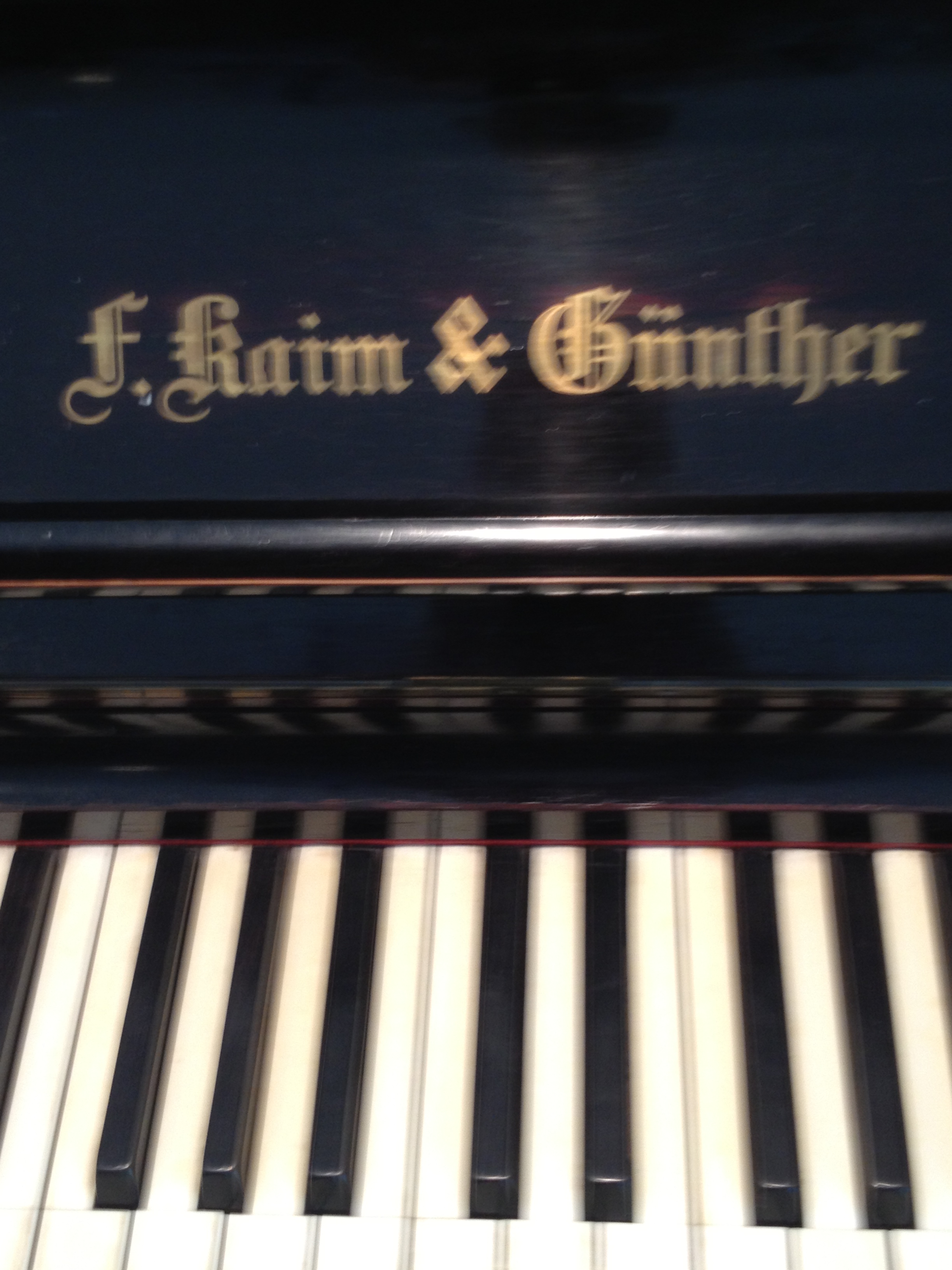
My questions are about an 1880 piano, built by F. Kaim and Gunther, which I believe was German. Photos are attached.
Does anyone know what the original pitch was of this piano? It's in pretty good condition, hammers, bridges, soundboard, etc. are all decent. I'm wondering at what pitch I should tune it. Currently it's 60 cents flat. The owner would like it at A440 if possible.
The tuning pins are loose but not terrible, but I would want to tighten them up. I'm either going to pound them further in, or apply CA glue. What would be the preferred method in this case?
Thanks,
David Weiss

Joseph Garrett
David,
I don't know how many times I've said these two things: 1. To find the accepted pitches of pianos, look in the back of "On the Sensations of Tone". 2. Germany was way ahead of the rest of the world by the 1880's in making the strongest piano wire.
My atlas lists that make as "Germany 1919". Since that publication has all of these dumb listings, I'll have to assume that that company made pianos in just that year. So, if it's a 1919 piano or an "about 1880..." as you state, either way it's a safe bet to tune it to 440cps imo. That is taking into consideration that the strings look reasonable and there is no evidence of string breakage. Also, German pianos during that period of time had a pitch much higher than 440. (go figger<G>)
Joe
Captain of the Tool Police
Squares R I
gpianoworks.com
David Weiss
Thanks for the reply. There's no evidence of previous string breakage, and the strings look decent, so I'll go for A440.
A Google search says F. Kaim and Gunther started making pianos in 1819.
Joseph Garrett
I'd consider that info dubious at best.
Joe
-----Original Message-----
From: David Weiss
Sent: May 8, 2014 5:18 PM
To: pian...@googlegroups.com
Subject: RE: [pianotech] questions about an old piano
Thanks for the reply. There's no evidence of previous string breakage, and the strings look decent, so I'll go for A440.
A Google search says F. Kaim and Gunther started making pianos in 1819.
From: pian...@googlegroups.com [mailto:pian...@googlegroups.com] On Behalf Of Joseph Garrett
Sent: Thursday, May 08, 2014 7:45 PM
To: pian...@googlegroups.com
Subject: Re: [pianotech] questions about an old piano
David,
I don't know how many times I've said these two things: 1. To find the accepted pitches of pianos, look in the back of "On the Sensations of Tone". 2. Germany was way ahead of the rest of the world by the 1880's in making the strongest piano wire.
My atlas lists that make as "Germany 1919". Since that publication has all of these dumb listings, I'll have to assume that that company made pianos in just that year. So, if it's a 1919 piano or an "about 1880..." as you state, either way it's a safe bet to tune it to 440cps imo. That is taking into consideration that the strings look reasonable and there is no evidence of string breakage. Also, German pianos during that period of time had a pitch much higher than 440. (go figger)
Joe
-----Original Message-----
From: David Weiss
Sent: May 8, 2014 4:23 PM
To: pian...@googlegroups.com
Subject: [pianotech] questions about an old piano
My questions are about an 1880 piano, built by F. Kaim and Gunther, which I
believe was German. Photos are attached.
Does anyone know what the original pitch was of this piano? It's in pretty
good condition, hammers, bridges, soundboard, etc. are all decent. I'm
wondering at what pitch I should tune it. Currently it's 60 cents flat.
The owner would like it at A440 if possible.
The tuning pins are loose but not terrible, but I would want to tighten them
up. I'm either going to pound them further in, or apply CA glue. What
would be the preferred method in this case?
Thanks,
David Weiss
Captain of the Tool Police
Squares R I
gpianoworks.com


Jurgen G
Kaim & Günther was founded in 1845 and produced under that name until 1883.
Prior to 1845, the name was Franz Anton Kaim (est. 1819.)
In 1883 the company split into two, and the names changed to F. Kaim & Sohn and C. Günther.
Interesting piano, with the additional overdampers in the bass. This goes to show that already back in the 1880s, builders were not happy with, and went to great lengths, to eliminate leaky bass dampers which sympathetically affected the entire range of the piano.