
Any appreciation for Chickering's?

Regi Hedahl
I picked up this 1901 Chickering 119
7'6” a few days ago. Today, I tipped it back on it's legs and
snapped a few pictures.


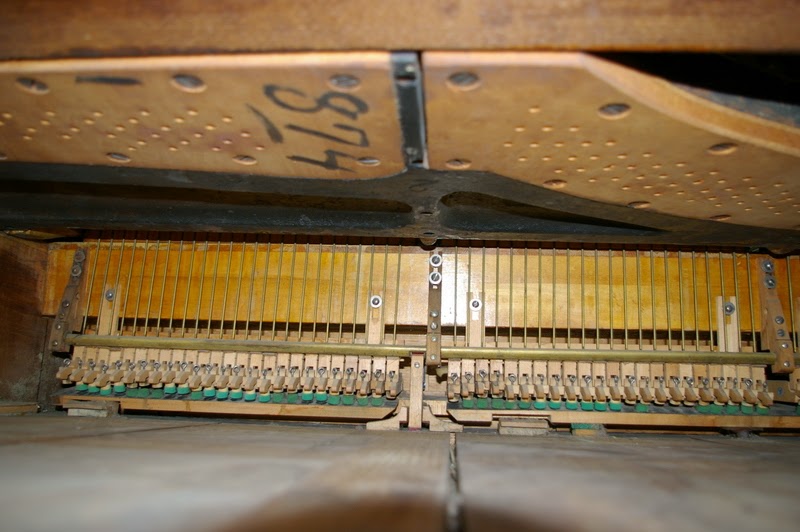
Inside the action cavity. Of course,
it has the famous stepped flange pinblock. It also has threaded
damper wires.

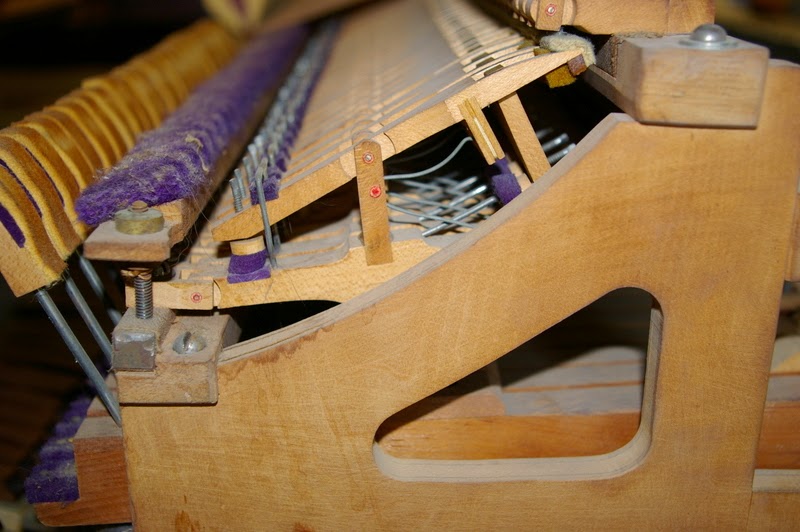
Here's a few photos of the action. I
was expecting to find copper flanges but not on this action. The
wood appears relatively light in color so perhaps the action parts
were replaced in the past. There is steel fixed to the wooden action
rails for the flanges to screw into.
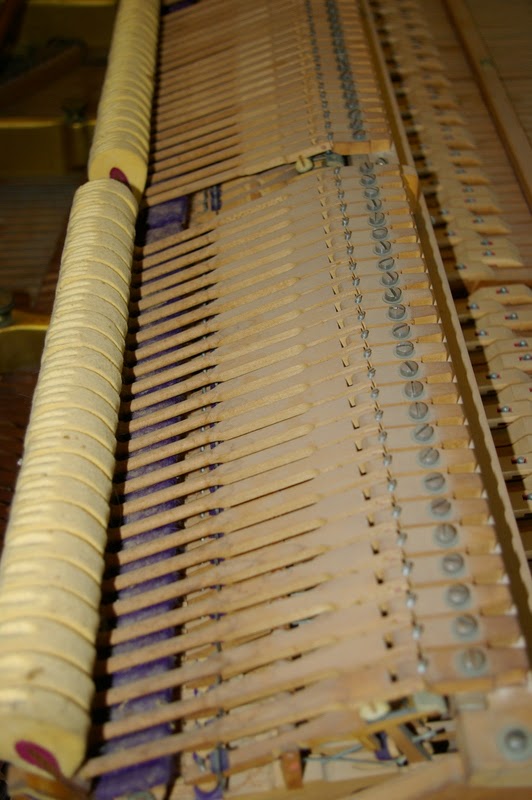
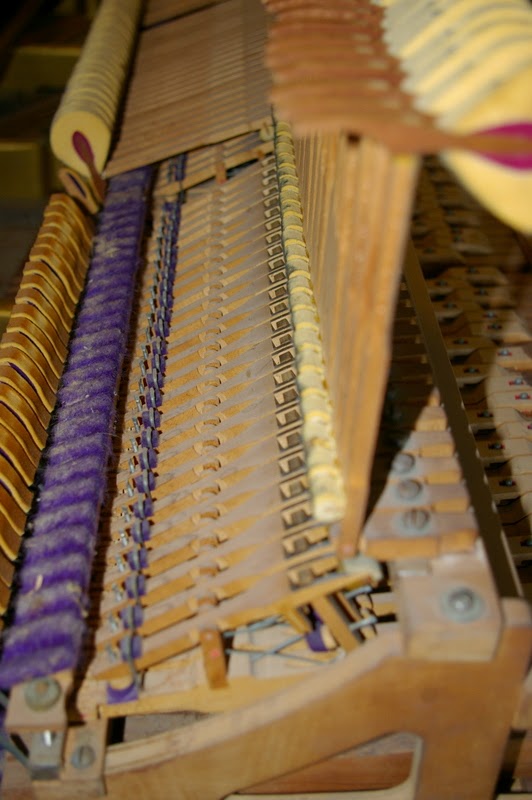
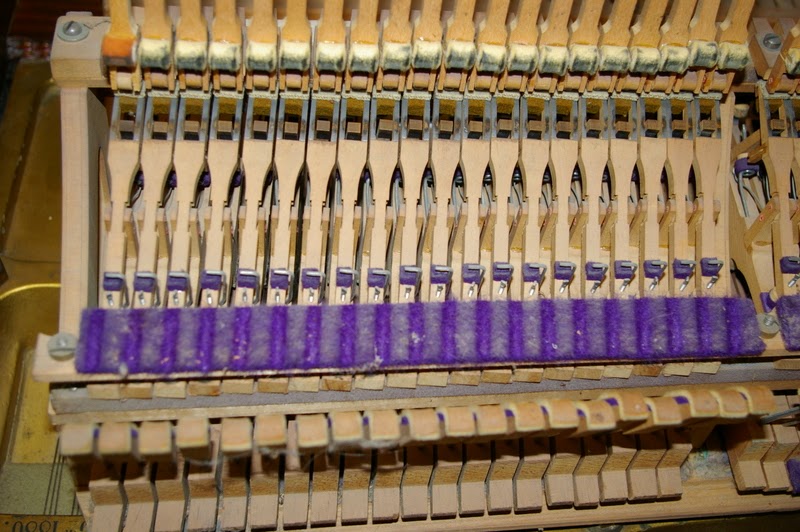

Laminated wooden action brackets. The repetition lever spring rests on a silk cord so there is no rubbing friction at the spring end. I'm surprised at how good these whippens look for such an old piano.
Action has few weights in the keys.
There are up to 4 weights in the bass and it tapers down to 0 weights
from C6 and up. Key C8 has wood removed from the keystick and is
back weighted.

Bridges look good for the age. I
suspect the speaking length in the high treble may be a bit short though.
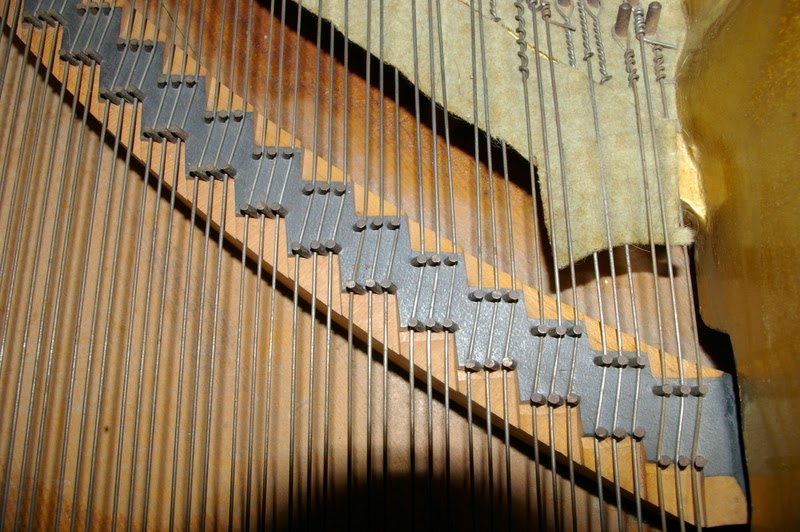
Inverted half agraffes and rather short
string segment.
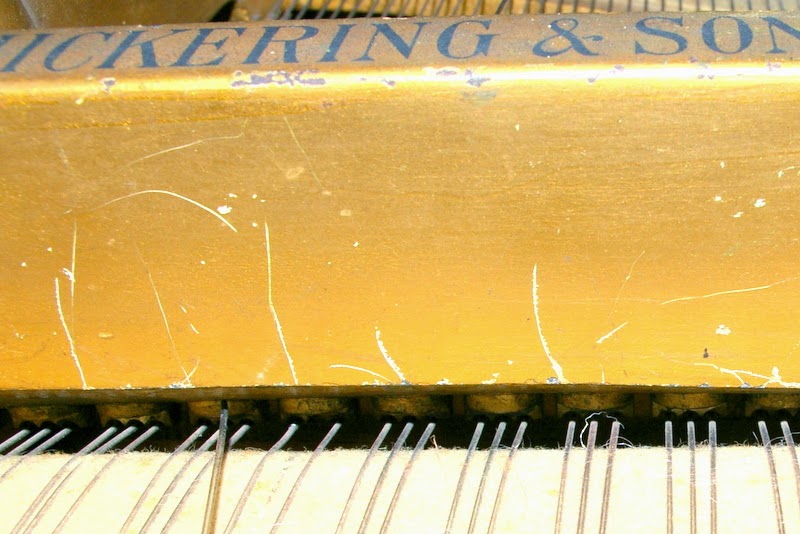
International pitch A-435 printed on
the plate. Looks like this piano could benefit from rescaling.

All wound strings are placed on the
bass bridge. There are 25 notes on the bass bridge and . The bass
bridge is also not cantilevered and no nasty sounding hockey stick
long bridge.
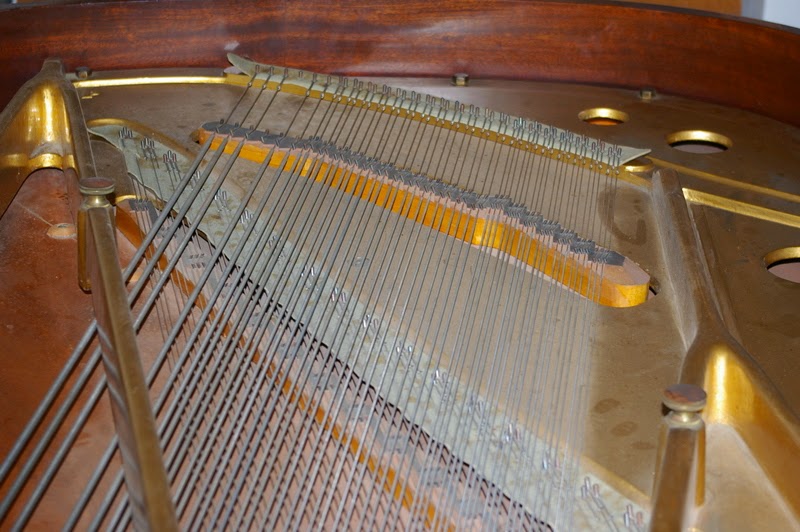
The view from underneath.
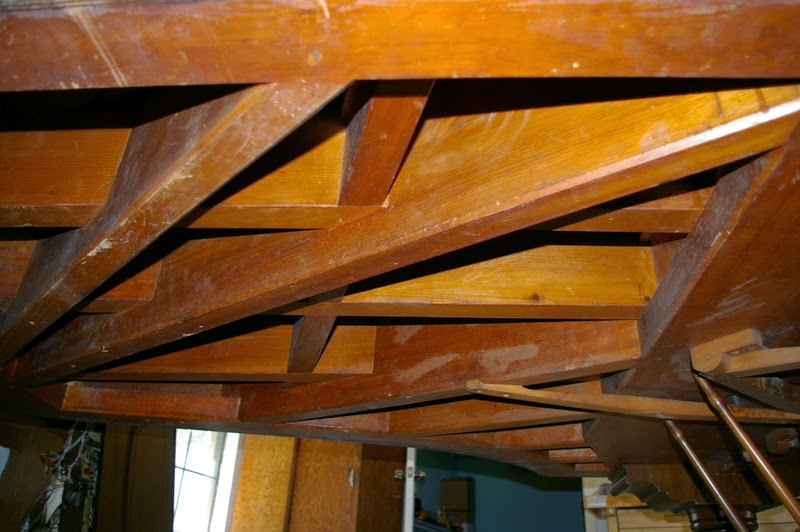
Small treble cutoff?

Regi Hedahl

David Kroenlein
Sent from Gmail Mobile

Terry Farrell

Isaac Sadigursky
Terry Farrell
2] Silk cords might be ready for replacement, too

lim hock seng
Wonderful! Thanks for sharing. I have not seen a Chickering yet....
Lim

Joseph Garrett
Terry,
Have you ever replaced an action in a Chickering? It is extremely difficult. I've done two. One, in a "1/4 Grand" and one in an 1867 8' flat strung. Both were total mind benders to get new parts to work. Not for the feint of heart dude.
Best,
joe
-----Original Message-----
From: Terry Farrell
Sent: Oct 1, 2014 5:06 AM
To: pian...@googlegroups.com
Subject: Re: [pianotech] Any appreciation for Chickering's?
> 2] Silk cords might be ready for replacement, too
Hmmm - 112 year old - perhaps we a ready for a new action, new back action and a new belly!
Terry Farrell
On Sep 30, 2014, at 9:00 PM, Isaac Sadigursky wrote:
> Hi, Regi !
> Thank you for great pictures..
> Great sounding pianos, INMO
> i had worked on a few of those..
> I am sure, you know warnings,based on experience:
>
> 1] Beware of Brass Flanges and ANGLED Whippens..
> 2] Silk cords might be ready for replacement, too
> 3] As for International Pitch A-435 :
> I had no problems Pitch Raising them and tuning to A-440.
> Isaac Sadigursky, RPT
> Los Angeles Chapter PTG
> On Sep 30, 2014, at 2:18 PM, Regi Hedahl wrote:
>
>> I picked up this 1901 Chickering 119 7'6” a few days ago. Today, I tipped it back on it's legs and snapped a few pictures.
Terry Farrell
Joseph Garrett
Terry,
It's obvious you haven't attempted such, since the damned things are so tightly engineered and constructed that there is NO ROOM for a modern action! Clue: The angled hammershanks and wippens is absolutely necessary!
Or,.....to put it another way: Good luck with that Dude!
Best,
joe
-----Original Message-----
From: Terry Farrell
Sent: Oct 1, 2014 8:28 AM
To: pian...@googlegroups.com
Subject: Re: [pianotech] Any appreciation for Chickering's?
Build new rails and make it a standard type.
Terry Farrell
On Oct 1, 2014, at 11:22 AM, Joseph Garrett wrote:
> Terry,
>
> Have you ever replaced an action in a Chickering? It is extremely difficult. I've done two. One, in a "1/4 Grand" and one in an 1867 8' flat strung. Both were total mind benders to get new parts to work. Not for the feint of heart dude.
>
> Best,
>
> joe
>
>
> -----Original Message-----
> From: Terry Farrell
> Sent: Oct 1, 2014 5:06 AM
> To: pian...@googlegroups.com
> Subject: Re: [pianotech] Any appreciation for Chickering's?
>
> > 2] Silk cords might be ready for replacement, too
>
>
> Hmmm - 112 year old - perhaps we a ready for a new action, new back action and a new belly!
>
> Terry Farrell

Euphonious Thumpe
| The action in this one seems fairly "standard". (Not one of the many permutations of the dreaded "Brown action" that Chickering used.) So I wouldn't see the point in trying to replace it. It is what it is. Probably sufficient for whoever would be interested in buying this thing. Thumpe Sent from Yahoo Mail for iPad |
Joseph Garrett
Thumpe(r),
The key word there is "fairly" standard. Yes it has wippens that resemble the norm, but they aren't! Yes it has hammers, shanks and flanges that appear normal, but....they are not. Take a closer look at the overall layout! As for it being a "thing" to be sold, etc., you need to know that most Chickerings are, Musically, really great. It's just the engineering and mechanics that are so daunting.<G>
Best,
Joe
-----Original Message-----
From: 'Euphonious Thumpe' via pianotech
Sent: Oct 1, 2014 9:27 AM
To: "pian...@googlegroups.com"
Subject: Re: [pianotech] Any appreciation for Chickering's?
The action in this one seems fairly "standard". (Not one of the many permutations of the dreaded "Brown action" that Chickering used.) So I wouldn't see the point in trying to replace it. It is what it is. Probably sufficient for whoever would be interested in buying this thing.
Thumpe
Sent from Yahoo Mail for iPad
Regi Hedahl



Ron Nossaman
> Terry,
>
> Have you ever replaced an action in a Chickering? It is extremely
> difficult. I've done two. One, in a "1/4 Grand" and one in an 1867 8'
> flat strung. Both were total mind benders to get new parts to work. Not
> for the feint of heart dude.
decide if you're up to it. Then either pass, or price as necessary for
the hair transplant. Definitely not an easy ride at best, and no two
seem to be the same. It's an adventure, but declining the job is quite
understandable for some of them.
Ron N
Joseph Garrett
Regi,
Thanks for taking the time to show the wippen comparisons. They are not even close. Action geometry is far more exacting than most think. That plastic abomination will not work! (period) It was not designed for this Chickering abomination action.<G> It is possible to replace the old for "new", but far more "modifications" are necessary than the WN&G is capable of, imo.
Most of you would say to just put in a new rail and install standard wippens that match new shanks, flanges & hammers on a new rail as well. Sounds easy, right? Nope. In order to do that you would have to design a new action frame and completely new key set with a new key frame and appropriate action geometry to coincide with the other new parts. Here's the zinger: the action cavity would have to be redesigned and modified too! Good luck with that one, because you'd literally have to build a new carcass!
In this particular Chickering, you are very fortunate that the tuning pins are still tight in the pin block. One of the other weak points of Chickerings was the pin block material. Usually very soft minimal lamination maple that has to be replaced when it gets below minimum torque standards. Just doing that can be a real head banger. That process was covered in an article in the PTJ recently. All fun and games to be sure.<G>
Just so's ya know.
Best,
Joe
-----Original Message-----
From: Regi Hedahl
Sent: Oct 1, 2014 10:02 AM
To: pian...@googlegroups.com
Subject: Re: [pianotech] Any appreciation for Chickering's?
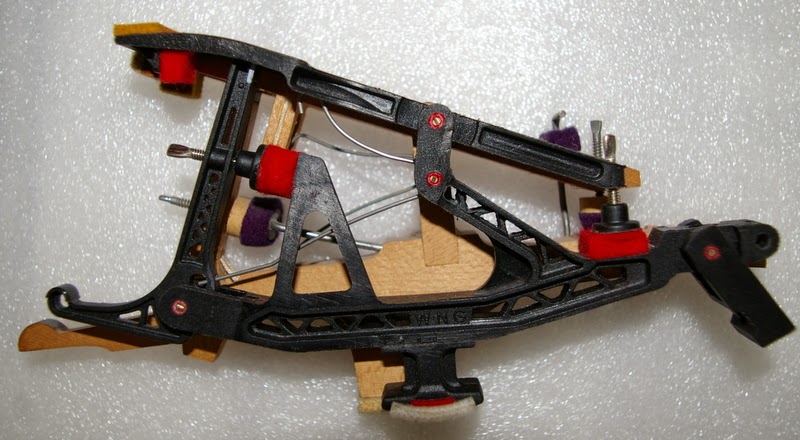
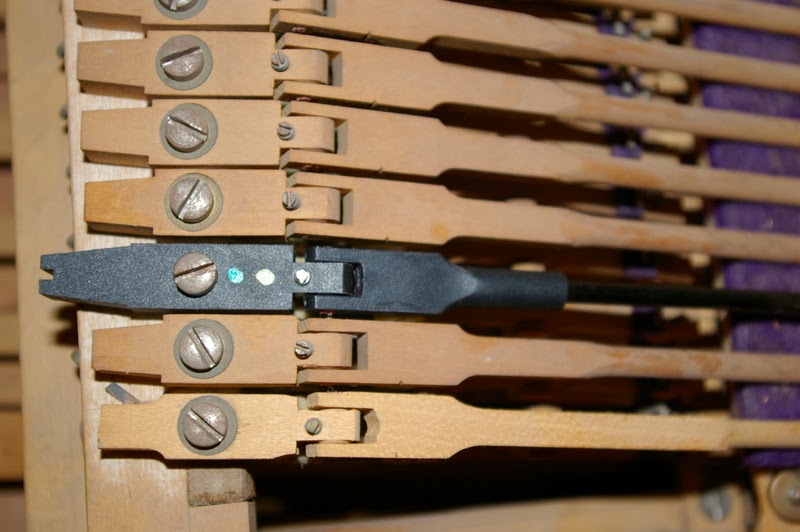
Here's a photo of the angles whippens and hammershanks as Joe pointed out.
The hammers are bored at an angle for these top notes. This is obviously
not an action that you can buy parts and screw / glue it on. But that's OK
because that has never been the way I do it.
I then went to my WNG sample parts and found a whippen that's the closest
match. Some obvious differences is the jack tender is a different size and
the WNG whippen flange doesn't extend out to the same orientation to simply
screw onto the rail. That said, the whippen and hammer flanges are the
same standard width (unlike on the quarter grands). Also the whippens on
this piano are in remarkable condition so I don't see much need to replace
them.
Regi Hedahl
Terry Farrell
Terry,
It's obvious you haven't attempted such, since the damned things are so tightly engineered and constructed that there is NO ROOM for a modern action! Clue: The angled hammershanks and wippens is absolutely necessary!
Isaac Sadigursky
Regi Hedahl

Patrick Draine
Joseph Garrett
Patrick,
And I can do the same with Renner parts, which are easier to deal with imo. Cost-wise probably the same, but I like a real piano sound as opposed to a plastic clanky thingee.<G> Again, just me and my love of wood and rich piano tone.<G>
Best Regards,
Joe
-----Original Message-----
From: Patrick Draine
Sent: Oct 2, 2014 7:03 PM
To: "pian...@googlegroups.com"
Subject: Re: [pianotech] Any appreciation for Chickering's?
Jude Reveley converted a couple Chickering models to WNG parts and action
rails, including new redesigned keyboards (hmm, I think Jim Ialeggio has as
well). T'was a lot of work, certainly not something to do on spec, but it
can be done!
Best,
Patrick
On Wed, Oct 1, 2014 at 11:07 PM, Regi Hedahl wrote:
> Joe,
>
> Thanks for the information. Looks like I'm also fortunate that the
> whippens on this piano are in good shape. I'll just rebuild and reuse them.
>
> Not sure if I'll be able to use WNG shanks & flanges.
>
>
>
> Regi Hedahl
>
> On Wednesday, October 1, 2014 1:00:13 PM UTC-5, Joseph Garrett wrote:
>>
>> Regi,
>>
>> Thanks for taking the time to show the wippen comparisons. They are not
>> even close. Action geometry is far more exacting than most think. That
>> plastic abomination will not work! (period) It was not designed for this
>> Chickering abomination action. It is possible to replace the old for
>> "new", but far more "modifications" are necessary than the WN&G is capable
>> of, imo.
>>
>> Most of you would say to just put in a new rail and install standard
>> wippens that match new shanks, flanges & hammers on a new rail as well.
>> Sounds easy, right? Nope. In order to do that you would have to design a
>> new action frame and completely new key set with a new key frame and
>> appropriate action geometry to coincide with the other new parts. Here's
>> the zinger: the action cavity would have to be redesigned and modified too!
>> Good luck with that one, because you'd literally have to build a new
>> carcass!
>>
>> In this particular Chickering, you are very fortunate that the tuning
>> pins are still tight in the pin block. One of the other weak points of
>> Chickerings was the pin block material. Usually very soft minimal
>> lamination maple that has to be replaced when it gets below minimum torque
>> standards. Just doing that can be a real head banger. That process was
>> covered in an article in the PTJ recently. All fun and games to be sure.
>>
>> Just so's ya know.
>>
>> Best,
>>
>> Joe
>>
>>
>>
David Kroenlein
On Sunday, October 5, 2014, Regi Hedahl <piano...@gmail.com> wrote:
I recorded a few sound samples of this Chickering after tuning it and filing off the very deep string grooves. The piano sounds pretty tired but that is to be expected on a piano that has lasted over a century.
Chromatic Scale
http://www.datafilehost.com/d/48fce7f1
Claire de Lune http://www.datafilehost.com/d/ffd10f85
Regi Hedahl

Will Truitt
Will Truitt
-----Original Message-----
From: pian...@googlegroups.com [mailto:pian...@googlegroups.com] On Behalf Of Regi Hedahl
Sent: Monday, October 06, 2014 7:21 AM
To: pian...@googlegroups.com
Subject: Re: [pianotech] Any appreciation for Chickering's?
Regi
Regi Hedahl
Chromatic scale
http://www.tinyupload.org/jyb4we9ynsd
Clair de Lune
http://www.tinyupload.org/azkwfpn53wg
Regi Hedahl
David Kroenlein
Regi Hedahl
Regi Hedahl