
Kessel Piano
831 views
Skip to first unread message

Terry Farrell
Mar 4, 2015, 9:26:23 PM3/4/15
to pian...@googlegroups.com
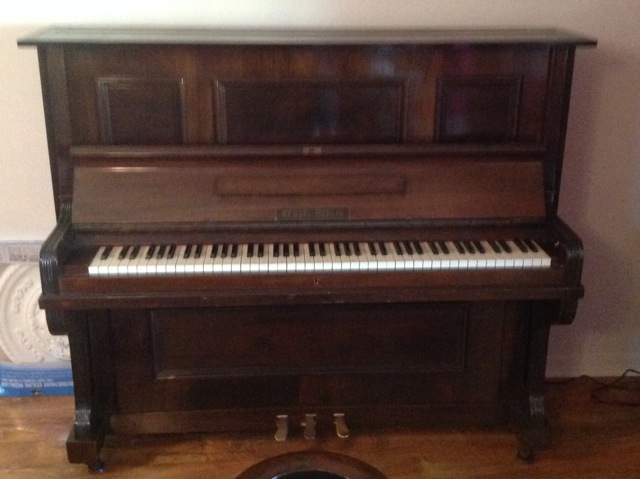
Tuned a Kessel upright piano the other day. Owner didn't know much about it other than he bought it in Chile twenty years or so ago. The piano was made in Berlin, Germany (I presume). Nothing in Pierce Atlas about it. Couldn't find a serial number anyway.
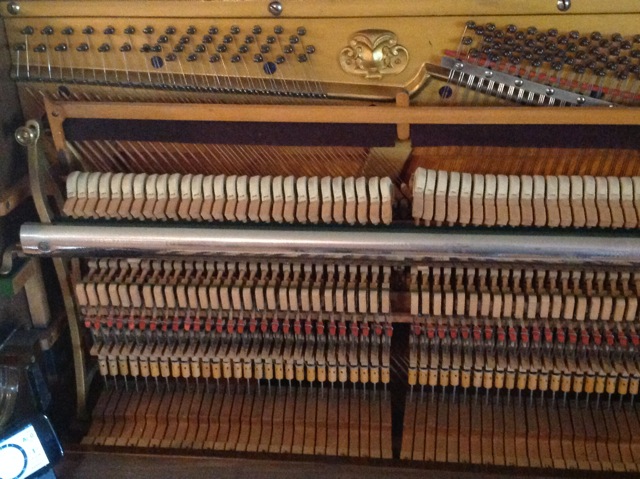
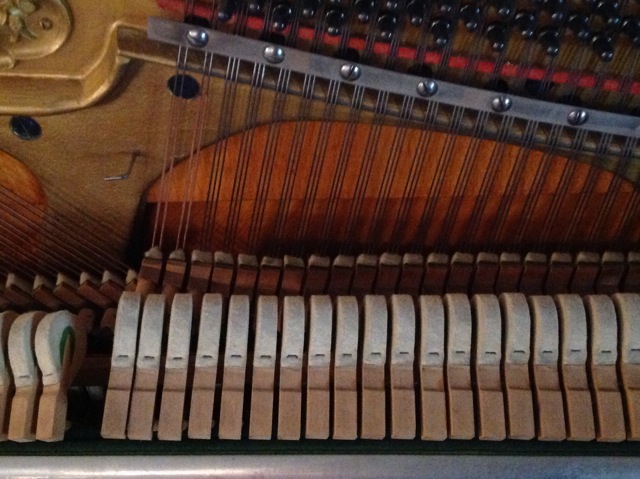
I seem to be able to usually accurately estimate an American piano's age to within ten years or so by the furniture style and technical aspects of the design. Not so much with European pianos. I know in general they tend to lag behind American pianos in their evolution. Much about this piano says early 20th Century - but then other things suggest more recent manufacture. The cabinet says old upright (before I opened the lid I wondered if it might be a birdcage action!). The shiny strings and general very good condition of the piano say younger. It has 1/0 tuning pins, so I don't think it has been restrung - bass still sounds like new. It has 85 notes. Plastic keytops, so I'm guessing those have been replaced. It really is a very nice piano - nicer than 90+ % of pianos I see made in the 40s through 70s. This piano has very nice tone and no killer octave at all.
Left unguided, I have to guess that it is of a pre-1929 manufacture. You?
Anyone more familiar with European pianos than I? Any thoughts or info would be appreciated. Below are a few pictures.
Terry Farrell

tnr...@aol.com
Mar 4, 2015, 9:52:06 PM3/4/15
to pian...@googlegroups.com
Terry
Just guessing, but I wonder if this is a stencil piano made by either Yamaha or Kawai for a store or tuner in Berlin. I've seen a similar design piano here in Hawaii that came from Japan. From the condition of the piano, it appears to be less than 30 years old.
Wim
And just for fun - apparently it was tuned by Miguel when it resided in Chile.

da...@piano.plus.com
Mar 5, 2015, 4:17:22 AM3/5/15
to pian...@googlegroups.com
From the outward appearance of the case I'd have said just pre first world
war, but the interior looks more 1920s or 1930s to me. I forget if
Kessels are listed in the Musicians Piano Atlas (Pierce doesn't do much
European, and The Musicans Piano Atlas doesn't do much American, by
gentlemen's agreement). One of my clients bought a Kessels in a charity
shop.
It looks like a very nice clean example that your customer has, especially
inside.
There were so many small but high quality German makes that just survived
past the first world war, but didn't make it past the second, like my own
beloved 1937 Weissbrod, photos of whose remarkable plate I've posted here
before.
Best regards,
David.
war, but the interior looks more 1920s or 1930s to me. I forget if
Kessels are listed in the Musicians Piano Atlas (Pierce doesn't do much
European, and The Musicans Piano Atlas doesn't do much American, by
gentlemen's agreement). One of my clients bought a Kessels in a charity
shop.
It looks like a very nice clean example that your customer has, especially
inside.
There were so many small but high quality German makes that just survived
past the first world war, but didn't make it past the second, like my own
beloved 1937 Weissbrod, photos of whose remarkable plate I've posted here
before.
Best regards,
David.
Terry Farrell
Mar 5, 2015, 7:38:33 AM3/5/15
to pian...@googlegroups.com
The upper portion of the plate area almost makes that plausable. But too many old-time features. The piano has been refinished. If I were a betting man - and I'm not - I would put my money on 1900 to 1930.
Apparently I left a mute in the action somewhere. :-( I'll be stopping back there next week and will be taking a closer look. It's just got me real curious.
Terry Farrell

Stephen Grattan
Mar 5, 2015, 7:45:29 AM3/5/15
to pian...@googlegroups.com
My Atlas der Pianonummern, Edition Bochinsky indicates a Kessels Ltd. from London and the company was known to exist in 1926. Other than that, I've no idea.
Steve Grattan
Terry Farrell
Mar 5, 2015, 7:55:09 AM3/5/15
to pian...@googlegroups.com
On Mar 5, 2015, at 4:17 AM, Da...@piano.plus.com wrote:
> From the outward appearance of the case I'd have said just pre first world
> war, but the interior looks more 1920s or 1930s to me.
> I forget if
> Kessels are listed in the Musicians Piano Atlas (Pierce doesn't do much
> European, and The Musicans Piano Atlas doesn't do much American, by
> gentlemen's agreement). One of my clients bought a Kessels in a charity
> shop.
>
> It looks like a very nice clean example that your customer has, especially
> inside.
> There were so many small but high quality German makes that just survived
> past the first world war, but didn't make it past the second, like my own
> beloved 1937 Weissbrod, photos of whose remarkable plate I've posted here
> before.
>
> Best regards,
Terry Farrell
Terry Farrell
Mar 5, 2015, 8:08:14 AM3/5/15
to pian...@googlegroups.com
Thanks, but this is a Kessel (with no "s" on the end) and it clearly is from Berlin.
Wait just one minute! This piano WAS refinished - the owner said so and I did notice some of the finish stripping marks that you most often see at the edges of the interior - so it was definitely refinished. But if it were refinished - and I would presume in excess of 30 years ago - how was that decal "Kessel, Berlin" put on the fallboard? I didn't look closely when I was there, but from the photo it looks like the decal was redone at the time of refinishing. I'll look more closely when I see it again next week.
The owner did say that the guy he bought it from in Chile told him that a lot of work was done to the piano - new "felt", etc. After looking at the action and strings, I told the owner that I saw no indication that anything inside the action looked anything but original - very clean condition, but original. All wood (hammer mouldings, shanks, butts) were the same color. Hammers and dampers look good, but more than 30 years old. Original 1/0 tuning pins? Surely they would have gone up a size. Pins were not real tight, but adequate. String coils were very neat. What kind of string coils would you expect from a German manufacturer? Very neat, of course. What kind of coils would you expect from a piano restrung in Chile in 1952 or 70s? I love people in and from Chile - and have all the respect in the world for them - but believe me, I wouldn't expect 240 perfect string coils placed on the original tuning pins!
Maybe I'll find something when I see it again next week. Perhaps it will remain a mystery!
Thanks for all the input so far.
Terry Farrell
David Boyce
Mar 5, 2015, 8:35:22 AM3/5/15
to pian...@googlegroups.com
Ah yes indeed, Kessels not to be confused with Kessel. Silly me. From
memory, my customer's piano that he got in a charity shop was a London
Kessels, not a German Kessel.
As for the decal "Kessel, Berlin", I suspect it's original. If the
banding and letters are inlaid brass, careful refinishing would preserve
them. Or are you certain they are gold paint or gold leaf transfers?
Even so, perhaps a skilled french polisher could have preserved them by
being very careful over that area of the original finish. Or indeed
they could have been re-applied by a skilled worker.
The piano is most certainly either just pre world war one, or between
the wars. By no stretch of the imagination is it a 30 year old stencil
piano. (Look, for just one example, at the big chunky toe-blocks). From
the interior, including the action, I'd say between the wars, 1920s or
1930s.
In the photo, as far as I can see, the tuning pins do look rather dark
and pristine, to be original. Still, it might have existed all its life
in good conditions.
It was a high-end piano, to have the middle practice pedal. Very unusual
in European pianos of that period.
Maybe when you see it again you can check the action maker and see if
there is an action serial number?
Best regards,
David.
memory, my customer's piano that he got in a charity shop was a London
Kessels, not a German Kessel.
As for the decal "Kessel, Berlin", I suspect it's original. If the
banding and letters are inlaid brass, careful refinishing would preserve
them. Or are you certain they are gold paint or gold leaf transfers?
Even so, perhaps a skilled french polisher could have preserved them by
being very careful over that area of the original finish. Or indeed
they could have been re-applied by a skilled worker.
The piano is most certainly either just pre world war one, or between
the wars. By no stretch of the imagination is it a 30 year old stencil
piano. (Look, for just one example, at the big chunky toe-blocks). From
the interior, including the action, I'd say between the wars, 1920s or
1930s.
In the photo, as far as I can see, the tuning pins do look rather dark
and pristine, to be original. Still, it might have existed all its life
in good conditions.
It was a high-end piano, to have the middle practice pedal. Very unusual
in European pianos of that period.
Maybe when you see it again you can check the action maker and see if
there is an action serial number?
Best regards,
David.
Terry Farrell
Mar 5, 2015, 9:03:18 AM3/5/15
to pian...@googlegroups.com
On Mar 5, 2015, at 8:35 AM, David Boyce wrote:
> Ah yes indeed, Kessels not to be confused with Kessel. Silly me. From memory, my customer's piano that he got in a charity shop was a London Kessels, not a German Kessel.
>
> As for the decal "Kessel, Berlin", I suspect it's original. If the banding and letters are inlaid brass, careful refinishing would preserve them. Or are you certain they are gold paint or gold leaf transfers? Even so, perhaps a skilled french polisher could have preserved them by being very careful over that area of the original finish. Or indeed they could have been re-applied by a skilled worker.
>
> The piano is most certainly either just pre world war one, or between the wars. By no stretch of the imagination is it a 30 year old stencil piano. (Look, for just one example, at the big chunky toe-blocks). From the interior, including the action, I'd say between the wars, 1920s or 1930s.
> In the photo, as far as I can see, the tuning pins do look rather dark and pristine, to be original. Still, it might have existed all its life in good conditions.
>
> It was a high-end piano, to have the middle practice pedal. Very unusual in European pianos of that period.
>
> Maybe when you see it again you can check the action maker and see if there is an action serial number?
Terry Farrell

Joseph Garrett
Mar 5, 2015, 10:16:27 AM3/5/15
to pian...@googlegroups.com
Terry,
The 1/0 tuning pins aren't necessarily an indicator. I'm doing an off brand German Upright now. It's original tuning pins were 0-1/2, i.e.: .272" w/a funky thread of the turn of the century thing. Oh, 2" long also.
Best,
joe
-----Original Message-----
From: Terry Farrell
Sent: Mar 5, 2015 5:08 AM
To: pian...@googlegroups.com
Subject: Re: [pianotech] Kessel Piano
Thanks, but this is a Kessel (with no "s" on the end) and it clearly is from Berlin.
Wait just one minute! This piano WAS refinished - the owner said so and I did notice some of the finish stripping marks that you most often see at the edges of the interior - so it was definitely refinished. But if it were refinished - and I would presume in excess of 30 years ago - how was that decal "Kessel, Berlin" put on the fallboard? I didn't look closely when I was there, but from the photo it looks like the decal was redone at the time of refinishing. I'll look more closely when I see it again next week.
The owner did say that the guy he bought it from in Chile told him that a lot of work was done to the piano - new "felt", etc. After looking at the action and strings, I told the owner that I saw no indication that anything inside the action looked anything but original - very clean condition, but original. All wood (hammer mouldings, shanks, butts) were the same color. Hammers and dampers look good, but more than 30 years old. Original 1/0 tuning pins? Surely they would have gone up a size. Pins were not real tight, but adequate. String coils were very neat. What kind of string coils would you expect from a German manufacturer? Very neat, of course. What kind of coils would you expect from a piano restrung in Chile in 1952 or 70s? I love people in and from Chile - and have all the respect in the world for them - but believe me, I wouldn't expect 240 perfect string coils placed on the original tuning pins!
Maybe I'll find something when I see it again next week. Perhaps it will remain a mystery!
Thanks for all the input so far.
Terry Farrell
On Mar 5, 2015, at 7:45 AM, Stephen Grattan wrote:
> My Atlas der Pianonummern, Edition Bochinsky indicates a Kessels Ltd. from London and the company was known to exist in 1926. Other than that, I've no idea.
>
> Steve Grattan
>



Jurgen G
Mar 5, 2015, 5:19:57 PM3/5/15
to pian...@googlegroups.com
Having cut my teeth on this type of piano, I can say a few things for certain and I am willing to venture out on a limb to make a few assumptions.
First off, this looks like a pretty typical German piano from between 80-90 years ago: the plate design, the action with only two brackets, dampers, hammers, strings, everything look pretty typical for a German piano of that era.
How the decal survived the re-finishing? Very simple: it is not a decal. It is brass inlaid into the veneer.
1/0 pins? German pianos usually had pins as small as 6.75mm when new. That is .266" So it could have been restrung with 1/0 pins.
Regarding the name: Kessel, Berlin does not show up in the European piano atlas, as Steve Gratan stated. This reference book is very well researched (as opposed to a certain common US one). The editors went though decades of early music trade journals with a fine tooth comb, searching out any reference to a piano company. So if it is not listed as a German piano manufacturer in that atlas, it almost certainly did not exist. What did exist though, quite commonly in fact, was that musical instrument dealers would get their name inlaid in brass in the fallboard veneer.
So this is what we probably have: a German stencil piano from the 20s or so, (perhaps a bit later, but not much, judging by the case design), originally sold through the firm of Kessel, located in Berlin. The piano hs been refinished, preserving its brass inlay, and possibly the instrument was restrung at the same time.
There should be serial # somewhere, but it would probably give no further information because we cannot cross-reference it to a manufacturer.
However, there should be a maker and a serial number on the action. If you can provide this, I may be able to date the piano.
Jurgen Goering
First off, this looks like a pretty typical German piano from between 80-90 years ago: the plate design, the action with only two brackets, dampers, hammers, strings, everything look pretty typical for a German piano of that era.
How the decal survived the re-finishing? Very simple: it is not a decal. It is brass inlaid into the veneer.
1/0 pins? German pianos usually had pins as small as 6.75mm when new. That is .266" So it could have been restrung with 1/0 pins.
Regarding the name: Kessel, Berlin does not show up in the European piano atlas, as Steve Gratan stated. This reference book is very well researched (as opposed to a certain common US one). The editors went though decades of early music trade journals with a fine tooth comb, searching out any reference to a piano company. So if it is not listed as a German piano manufacturer in that atlas, it almost certainly did not exist. What did exist though, quite commonly in fact, was that musical instrument dealers would get their name inlaid in brass in the fallboard veneer.
So this is what we probably have: a German stencil piano from the 20s or so, (perhaps a bit later, but not much, judging by the case design), originally sold through the firm of Kessel, located in Berlin. The piano hs been refinished, preserving its brass inlay, and possibly the instrument was restrung at the same time.
There should be serial # somewhere, but it would probably give no further information because we cannot cross-reference it to a manufacturer.
However, there should be a maker and a serial number on the action. If you can provide this, I may be able to date the piano.
Jurgen Goering
Terry Farrell
Mar 5, 2015, 7:31:08 PM3/5/15
to pian...@googlegroups.com
Thanks Jurgen. I will be visiting the piano next week and will look for whatever info I can.
Terry Farrell
David Boyce
Mar 6, 2015, 6:28:48 AM3/6/15
to pian...@googlegroups.com
Jurgen your sapient comments re decal and time period and action serial
number echo what I wrote a few posts ago in this thread.
Have you come across many three-pedal German pianos of this period
though? Of German pianos of the period found in the UK, there are
virtually none with three pedals. If you have found a lot of them, it
would tend to show, I guess, that customer demands were different in
different export markets. Since English pianos also had only two pedals
in that period, while American ones had three, perhaps German production
styles varies according to intended market.
Best regards,
David Boyce.
number echo what I wrote a few posts ago in this thread.
Have you come across many three-pedal German pianos of this period
though? Of German pianos of the period found in the UK, there are
virtually none with three pedals. If you have found a lot of them, it
would tend to show, I guess, that customer demands were different in
different export markets. Since English pianos also had only two pedals
in that period, while American ones had three, perhaps German production
styles varies according to intended market.
Best regards,
David Boyce.
Reply all
Reply to author
Forward
0 new messages