POP TIPS: May Orchard Care!

Phil Forsyth
Spring Orchard Planting
POP's preferred spring planting period is April through May, so plants have some time to get established before the heat of summer hits. Remember that fall is also great for planting most orchard plants, and fall plantings actually have better survival rates!
Looking for orchard plants? We welcome you to POP's annual Plant Sale & Open Orchard event at the Learning Orchard at The Woodlands on Saturday, May 16. The event will also feature Let's Go 123, True Love Seeds, Star Apple Nursery, Lunaria Gardens, and the Philly Beekeepers Guild!

We are excited to share our newest resource, the POP Orchard Care Basics guide! This was developed in conjunction with our new POPCORE Zero workshop and includes information on orchard observation & monitoring, weed management, irrigation recommendations, as well as our monthly orchard task list and harvest tracking sheet.

Pest and Disease Monitoring & Identification
Spring is when many pest and disease challenges show their first signs! Some of the most common insect pests that are likely to emerge in May include Oriental Fruit Moth, Plum Curculio, Aphids, Codling Moth, and Pear Psylla.
Spring Orchard Sprays
Apply holistic orchard sprays. Holistic sprays are composed of compost tea, liquid fish/seaweed, neem oil, and/or effective microbes. For best tree health and resistance to disease, apply up to 4 times in the spring (after bud break, at first pink of flowers, after petal fall, and two weeks after petal fall). For many fruit trees, the last of these applications is due in early May.
Depending on specific pest or disease problems, some orchardists might also consider other organic sprays including the ones listed below.
Check out POP’s guides to orchard applications of:
• Compost Tea Sprays for Orchards
• Biofungicides: Serenade and Regalia
• Sulfur Sprays and Early Spring Management Techniques
• Bt: Bacillus thuringiensis Orchard Sprays
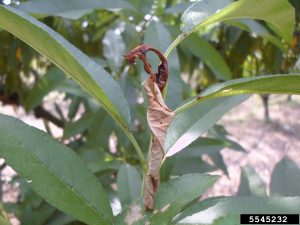
 Peach Leaf Curl is another extremely common disease in our humid climate. By the time it appears in May, it is too late to do much about it! You can remove the affected leaves, but the most effective control measure is a copper or Serenade spray applied in late fall and/or early spring.
 Spring Weeding and Compost/Mulch Application
With the wet weather and warming temperatures, early season weeds are growing rapidly. Time to get out there and begin editing the plant palette! POP's weed identification guide is available for sale on our website and we always have free copies to distribute to community orchard partners. And check out our new weed management resource (on pages 7-9 of our new Orchard Care Basics guide).
Building healthy soil is key to supporting trees’ health, resilience and yields. Weed around the base of trees, and spread at least one or two inches of chipped winter prunings, shredded leaves, and/or mulch or compost in the early spring. Check out POP’s guide to Ramial Wood Chips and Weeding in Place.
Fireblight Removal and Emergency Pruning
With dormant season well behind us, most pruning should be limited to emergency pruning only. A secondary season of summer pruning is possible after spring growth, typically in June and July (see page 16 of our expanded POP Pruning Guide).
Keep an eye out for any diseased, damaged, or dead wood that should be pruned away no matter the season. Pay special attention to the base of trees - especially of the stone fruit varieties: apricots, peaches, plums, nectarines - and prune away root suckers, the quick upright growth that can be a cover for dreaded borers, which make a home beneath trunk wood.
_of_pear.png?part=0.0.1&view=1)
Remember: use sharp, rust-free hand tools and sanitize between trees at the very least, and between every cut if the tree you’re tending has had previous conditions. For easy disinfecting, we recommend carrying a spray bottle with you of rubbing (isopropyl) alcohol or a bleach solution (1 part bleach: 10 parts water) to wipe down tools.