
POLSON, MT. - Seems like every vintage stagecoach...
14 views
Skip to first unread message

Ronald Mastrogiuseppe
Sep 5, 2011, 2:27:32 PM9/5/11
Reply to author
Sign in to reply to author
Forward
Sign in to forward
Delete
You do not have permission to delete messages in this group
Copy link
Report message
Show original message
Either email addresses are anonymous for this group or you need the view member email addresses permission to view the original message
to parklands
Iconic wagon stands out alongside other artifacts at museum
Iconic wagon stands out alongside other artifacts at museum

By KIM BRIGGEMAN of the Missoulian missoulian.com | Posted: Sunday, September 4, 2011 9:45 pm | Font Size:
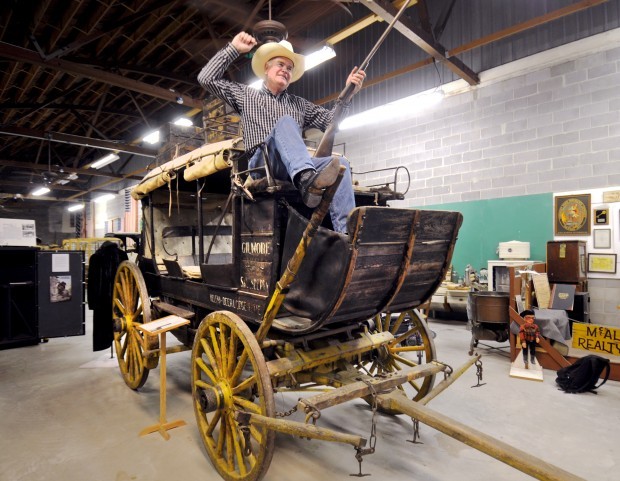


POLSON - Seems like every vintage stagecoach has a story to tell these days. Chances are, few in Montana can hold a candle to Imogene.
She holds the place of honor at the Polson-Flathead Historical Museum, which was established to house Imogene in the 1970s. She sits among hundreds of enticing artifacts, including a sailboat, antique firetrucks and Granville Stuart's Studebaker buggy.
"Needless to say, the stagecoach is the most valuable asset in our museum collection," said treasurer Bill Olson, who is documenting Imogene's remarkable history.
If he's correct - and Olson believes "beyond a doubt" that he is - this is the 14-passenger stagecoach that the famous and powerful Gilmer and Salisbury Stage Co. once commissioned for the daily passenger and mail runs between Deer Lodge and Helena.
Those runs ended in September 1883 when the Northern Pacific railroad was completed, a fact noted in a Montana History Almanac item in the Missoulian a couple of Sundays ago.
"Thought you might be interested in seeing where the Imogene ran out of gas," Olson e-mailed the next day.
*****
The Polson-Flathead museum was the brainchild of Ethel Montgomery's father, J. Fay McAlear. Montgomery, who lives in Missoula and has a cabin on Flathead Lake, shares her late dad's keen interest in Flathead history and the museum. She sat, proud-motherlike, beside Imogene last week and with Olson's help traced the coach's past.
At some point after the Helena-Deer Lodge runs ended, Imogene wound up in the hands of Conrad Kohrs, the Deer Lodge Valley pioneer and cattle king. It's unclear what use Kohrs put the coach to, but Montgomery speculated, "He ran it between Kohrs ranch and wherever the railroad wasn't in yet. He ran it any place down the line where it was profitable."
The stagecoach first came to the Flathead in 1908 when Joe Allard added it to his line. Allard had helped his late father, Charles Sr., operate a mail and passenger stage service since 1887. He employed the new coach - technically a less-romantic sounding "mud wagon" manufactured by M.P. Henderson and Son of Stockton, Calif. - to run from the NP station at Ravalli to Polson.
It was a 32-mile jaunt over Ravalli Hill, along the base of the months-old National Bison Range, up Post Creek Hill to Ronan and Pablo, and entered Polson along the Flathead River on what's now Kerr Dam Road. Travelers going further caught a steamboat up Flathead Lake to Dayton or Somers.
"Joe Allard, the stage driver, left Ravalli at 6:30 a.m. driving four horses in good weather and six horses when the roads were bad," Fay McAlear wrote in his 1962 book, "The Fabulous Flathead."
"He changed horses at Post Creek and again at Ronan, arriving in Polson at noon. The return trip began at 12:30, and the horses were headed for the barn at Ravalli around 4:30 p.m."
The Allard Line operated from July 1908 until November 1909, McAlear wrote. Then Allard lost the lucrative U.S. mail contract. Motor coaches and, as usual, a railroad ended the stagecoach era in the Flathead.
But Imogene rolled on. Cornelius Kelley, an executive of the Anaconda Copper Mining Co. for more than half a century, obtained it for his fabulous Kootenai Lodge on Swan Lake.
Montgomery said Kelley used the coach to bring his guests to the lodge from the railroad station in Whitefish. Over the years those guests reportedly included Charles Lindbergh, Will Rogers, Charles Russell, Jane Wyatt and J.D. Rockefeller.
"I'm sure they were thrilled to death," she said. "He entertained royally. He had huge parties."
Kelley died in 1957, long after the coach had been relegated to storage in a barn at Kootenai Lodge.
*****
McAlear himself helped revive Imogene's career in 1960, for the Golden Jubilee celebration of the 1910 opening of the Flathead Reservation to homesteaders. The proud stage, still in good shape, rolled through parades in Hot Springs, Ronan and Polson.
McAlear, president of the Reservation Pioneers, was in the process of writing his book, which has since gone through several reprints and updates. A real estate and insurance agent, mayor and full-time promoter of Polson, he'd arrived in the valley with his family as a teenager in 1910, the year the reservation opened to settlement.
McAlear was in the brakeman's seat on July 31, 1960, for a leg of the fabled stagecoach's last long run. Its destination was Missoula, which was celebrating its centennial year. The coach started from Polson at 8 a.m. that Sunday behind two mules, last-minute replacements after Bob Schall's four-horse team went missing.
By Ronan the steeds had been found, and they were hitched to the coach to be driven the rest of the way by George Piedalue. The party overnighted at Ravalli, and made it to Missoula the next day in time for the afternoon parade.
The coach was in pristine shape, Montgomery recalled.
"My dad decided that he had to have it," she said.
McAlear opened negotiations with heirs of the Kelley estate, who agreed to give it to McAlear on one provision: that he'd form a museum where the stagecoach could be housed.
"So Dad said, yes, we'll have a museum - and here we are," Montgomery said.
McAlear received the deed to the coach, which was appraised at $4,500, in December 1966, on behalf of the newly incorporated Polson-Flathead Historical Museum.
Montgomery recalled the day Imogene came to Polson to stay. McAlear and an employee brought it from the Swan on a flatbed truck, and called Montgomery and her sister, Ina - both grown women with families by then - to help unload it at Ferguson's vacant machine shop.
"So here we are, dad's got the truck backed up, he's got planks down, and he said to my sister and I, ‘I'll take care of the wheels, you get hold of the tongue.'
"We said, ‘Dad, if you want to raise our five children, OK.' So he went out on the street and yelled, as he could, at four high school kids in their car. And they came in and unloaded it."
Imogene remained in the vacant machine shop for a few years, until the museum found a home - a large building a block away, on the 700 block of Main Street, which had been built to house a bowling alley but never did.
The museum opened in mid-1973. McAlear died six months later.
"He got it and said: That's it. I'm gone," Montgomery said.
Posted in Hometowns on Sunday, September 4, 2011 9:45 pm Updated: 6:46 am. | Tags: Flathead Lake, Lake County Montana, Polson, Flathead, Flathead River, Conrad Kohrs, Flathead County Montana, Polson-flathead Historical Museum, Stagecoach, Missoula, Deer Lodge Valley, Flathead Indian Reservation, Deer Lodge, Salisbury Stage Co.
Read more: http://missoulian.com/lifestyles/hometowns/article_af1e8d7c-d778-11e0-9d90-001cc4c03286.html#ixzz1X6V2HYM9
Reply all
Reply to author
Forward
0 new messages