
Non-site - Grinding Grooves in Basalt

Gary Vines
A regular walk along the creek noted this cage around a block of stone in the creek bed. This is because a CHMP identified this as an Aboriginal grinding groove and the footbridge is to be replaced. There is a shallow oblong curved depression in a piece of basalt. The rock is attached to other rock and eventually bedrock, by concrete. The rock was placed here around the 1970s, when the current bridge was constructed. Its original source is most likely the basalt outcrops in the creek immediately upstream. This area was quarried by Pentridge convicts from the mid to late nineteenth century, both to provide building stone for the gaol, and to clear a natural blockage in the creek that caused upstream flooding.

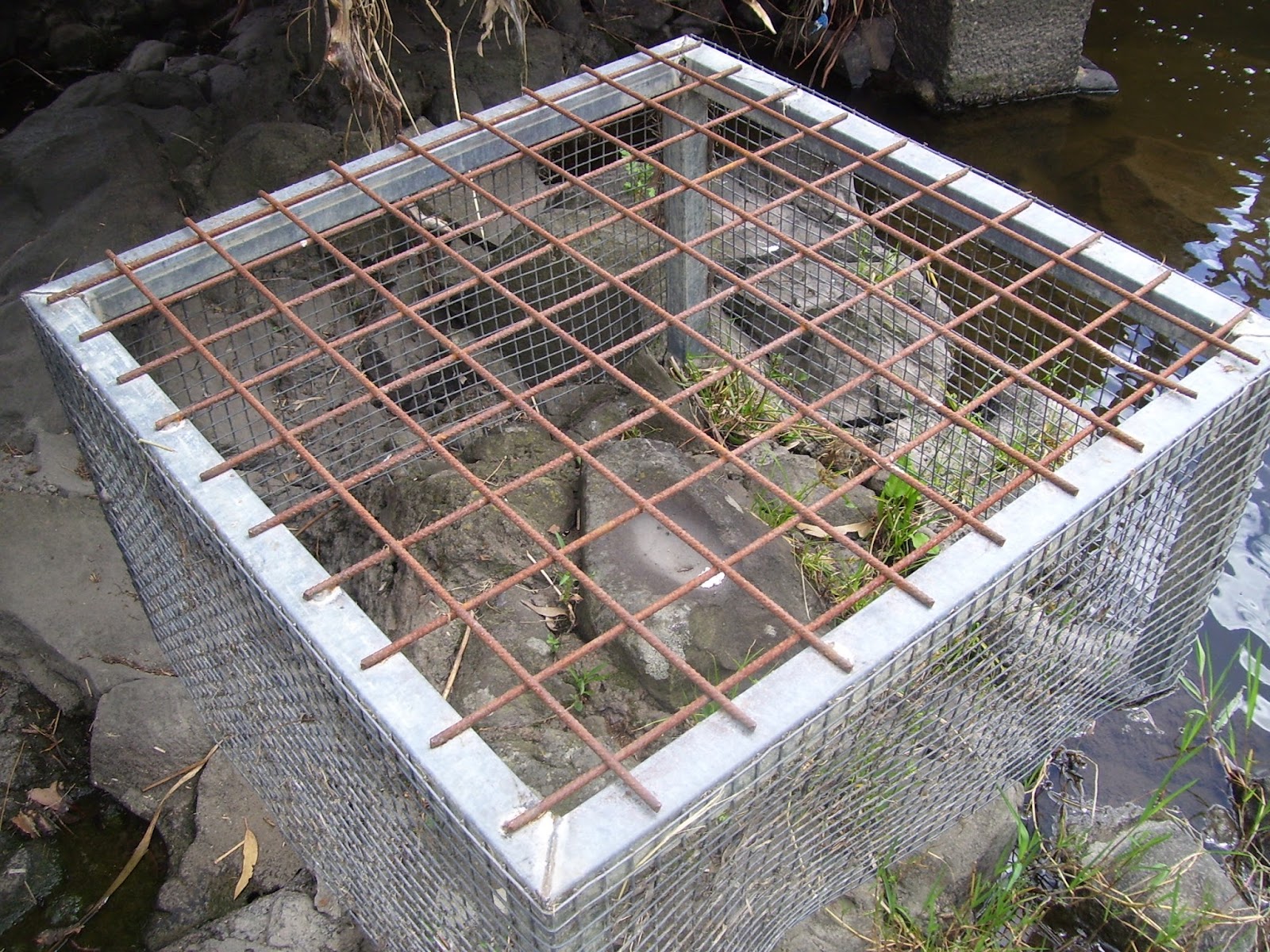
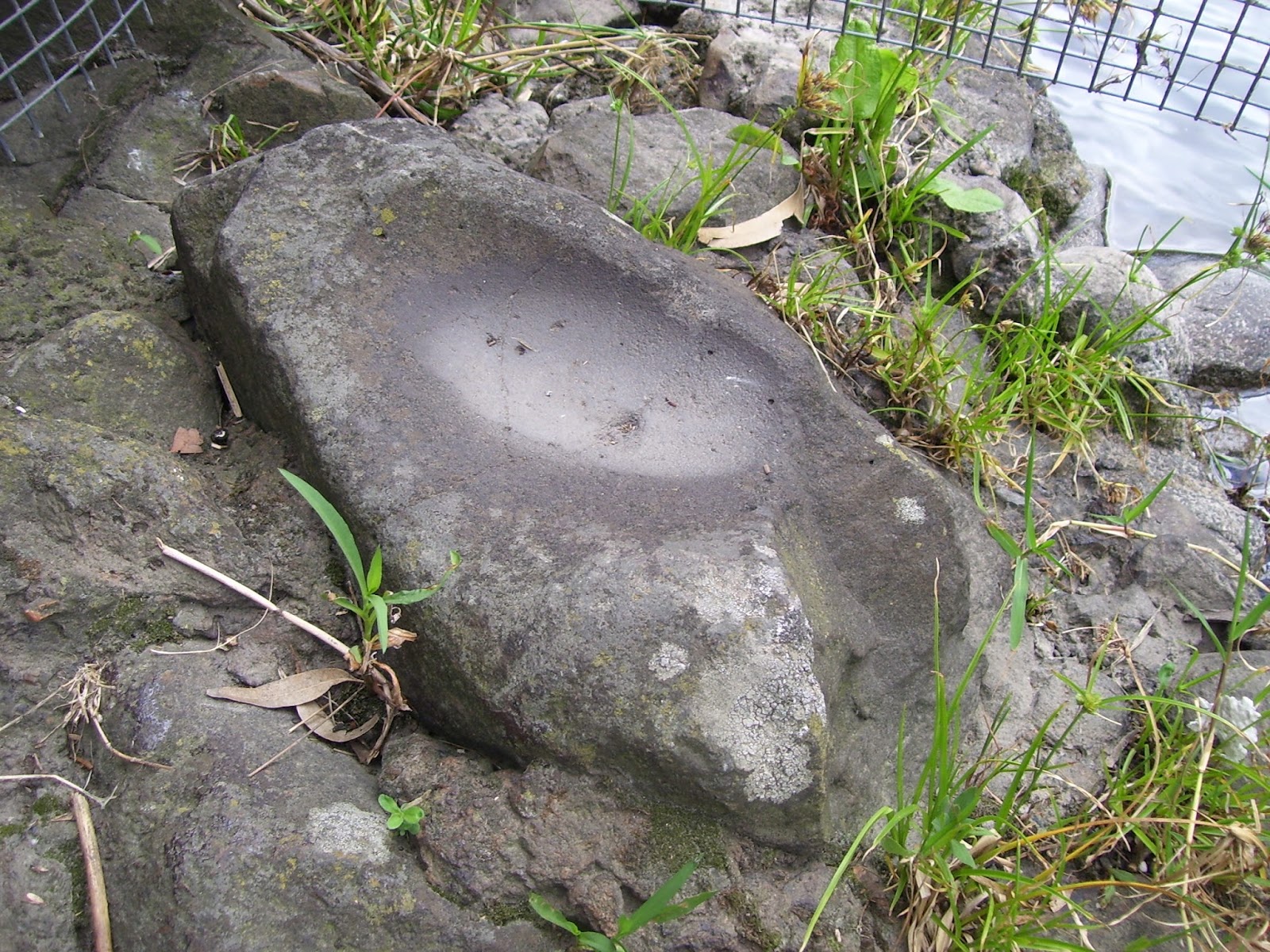
Here is the problem:
The stone in this area was historically quarried. Sledgehammer breakage produces concave and convex surfaces on the stone similar in some respects to Aboriginal flaking. There are numerous flake scars on both bedrock and detached broken blocks in the area. The particular stone has been cemented in place with the concave depression facing up so that water sits in it leaving a salt/sediment stain. This gives the impression of a grinding groove. Bluestone is very hard. Other stone is unlikely to make an impression on it through grinding, apart from bluestone itself, or greenstone. Ground bluestone artefacts have not been reported, while a greenstone grinding groove seems unlikely as no other greenstone has been reported in the region.
Given the limited evidence for this being an Aboriginal artefact (basically it looks a bit like a grinding groove) and the reasonably strong contextual evidence that suggests it is not Aboriginal, It seems inappropriate that it should be recorded on the Aboriginal Heritage Register and require such elaborate management processes.

Steve Corsini
Has anyone done a microscopic examination of the supposed grinding surface?
Once things like this are registered it’s very hard to convince people that it’s not a grinding patch.
It’s a similar thing with marked or scarred trees.
SJC
--
You received this message because you are subscribed to the Google Groups "OzArch" group.
To unsubscribe from this group and stop receiving emails from it, send an email to ozarch+un...@googlegroups.com.
To post to this group, send email to oza...@googlegroups.com.
Visit this group at https://groups.google.com/group/ozarch.
For more options, visit https://groups.google.com/d/optout.
Gary Vines

john...@ozemail.com.au
Hello,
Re "recorded on the Aboriginal Heritage Register", who recorded it so, and when?
Kind Regards,
John
----- Original Message -----From:oza...@googlegroups.comTo:<oza...@googlegroups.com>Cc:Sent:Sun, 14 Feb 2016 14:53:50 +0800Subject:RE: {OzArch} Non-site - Grinding Grooves in Basalt
Has anyone done a microscopic examination of the supposed grinding surface?
Once things like this are registered it’s very hard to convince people that it’s not a grinding patch.
It’s a similar thing with marked or scarred trees.
SJC
From: oza...@googlegroups.com [mailto:oza...@googlegroups.com] On Behalf Of Gary Vines
Sent: Sunday, 14 February 2016 2:17 PM
To: OzArch
Subject: {OzArch} Non-site - Grinding Grooves in Basalt
A regular walk along the creek noted this cage around a block of stone in the creek bed. This is because a CHMP identified this as an Aboriginal grinding groove and the footbridge is to be replaced. There is a shallow oblong curved depression in a piece of basalt. The rock is attached to other rock and eventually bedrock, by concrete. The rock was placed here around the 1970s, when the current bridge was constructed. Its original source is most likely the basalt outcrops in the creek immediately upstream. This area was quarried by Pentridge convicts from the mid to late nineteenth century, both to provide building stone for the gaol, and to clear a natural blockage in the creek that caused upstream flooding.
Here is the problem:
The stone in this area was historically quarried. Sledgehammer breakage produces concave and convex surfaces on the stone similar in some respects to Aboriginal flaking. There are numerous flake scars on both bedrock and detached broken blocks in the area. The particular stone has been cemented in place with the concave depression facing up so that water sits in it leaving a salt/sediment stain. This gives the impression of a grinding groove. Bluestone is very hard. Other stone is unlikely to make an impression on it through grinding, apart from bluestone itself, or greenstone. Ground bluestone artefacts have not been reported, while a greenstone grinding groove seems unlikely as no other greenstone has been reported in the region.
Given the limited evidence for this being an Aboriginal artefact (basically it looks a bit like a grinding groove) and the reasonably strong contextual evidence that suggests it is not Aboriginal, It seems inappropriate that it should be recorded on the Aboriginal Heritage Register and require such elaborate management processes.
--
You received this message because you are subscribed to the Google Groups "OzArch" group.
To unsubscribe from this group and stop receiving emails from it, send an email to ozarch+un...@googlegroups.com.
To post to this group, send email to oza...@googlegroups.com.
Visit this group at https://groups.google.com/group/ozarch.
For more options, visit https://groups.google.com/d/optout.
john...@ozemail.com.au
Hello,
Compared with this most unlikely basaltic grinding bowl the item/site photographed below sitting in front of Eugene Stockton (which Eugene called a "pebble chopper") would seem much more likely artefactural (but still could be natural) than the basaltic grinding bowl.
However, although this "pebble chopper" was at the time very thoroughly brought to the attention of NPWS (and the site also was nominated as locally significant heritage to Penrith Council), as best I know NPWS never recorded it in any way.
Thus you could suspect some very 'uneven' treatment of things has happened from time to time.
At the moment, where the new Badgerys Creek Sydney Second International Airport is to go there are some marks recorded as "Aboriginal grooves on Minchinbury Sandstone" which I have strong doubts about the identification of.
Cheers, John Byrnes

The Blue Mountains Gazette, 2 September 2009
Eugene
A regular walk along the creek noted this cage around a block of stone in the creek bed. This is because a CHMP identified this as an Aboriginal grinding groove and the footbridge is to be replaced. There is a shallow oblong curved depression in a piece of basalt. The rock is attached to other rock and eventually bedrock, by concrete. The rock was placed here around the 1970s, when the current bridge was constructed. Its original source is most likely the basalt outcrops in the creek immediately upstream. This area was quarried by Pentridge convicts from the mid to late nineteenth century, both to provide building stone for the gaol, and to clear a natural blockage in the creek that caused upstream flooding.
Here is the problem:

Shaun Canning
Regards,
Dr Shaun Canning
Managing Director & Principal Heritage Advisor
0400 204 536 shaun....@achm.com.au
Australian Cultural Heritage Management
Brisbane | Melbourne | Sydney
Find me at LinkedIn
Steve Corsini
You need a microscope that has been modified for the purpose –
For an introduction on the utility of field microscopy methods see Bednarik, R. 2007 Rock Art Science: The scientific study of palaeoart Ch9 Page 170
sjc
From: oza...@googlegroups.com [mailto:oza...@googlegroups.com] On Behalf Of Gary Vines
Sent: Sunday, 14 February 2016 3:43 PM
To: OzArch
--

tessa corkill
--