[Fwd: Mary K. Greer's Tarot Blog] Papess Maifreda Visconti of the Guglielmites—new evidence

msesheta
Mary K. Greer's Tarot Blog
|
|

|
Papess Maifreda Visconti of the Guglielmitesnew evidence Posted: 07 Nov 2009 03:14 PM PST
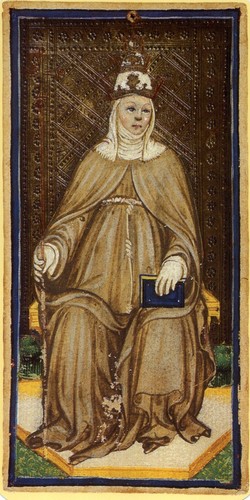
Gertrude Moakley (The Tarot Cards Painted by Bonifacio Bembo, 1966) introduced the Tarot world to a possible source of the Papess card in the earliest Tarot decks. Maifreda (or Manfreda) Visconti da Pirovano was to be declared Pope in Milan on Easter 1300 in a new age of the Holy Spirit. Instead, Maifreda and others in the sect were, that year, burned at the stake, along with the disinterred body of Guglielma. Maifreda was an Abbess in
the Umiliate Order and first cousin to Matteo Visconti, the Ghibelline
(anti-pope) ruler of Milan. Maifreda believed the Holy Spirit had
manifested on earth in the form of Guglielma (d. 1281), a middle-aged
woman with a grown son who claimed to be a daughter of Premysl Otakar, King
of Bohemia, and, who on arriving in Milan in 1260, donned a “simple
brown habit†and lived the life of a saint. To the Guglielmites, her
arrival fulfilled a prophecy of St. Joachim de Fiore, that a new age of
the Holy Spirit would begin in 1260, "€œheralding the inauguration of an ecclesia
spiritualis in which grace, spiritual knowledge and contemplative
gifts would be diffused to all." Although she vehemently denied
it, "€œrumors of divinity
already swirled around Guglielma during her lifetime. And, Her words about "€˜the body of the
Holy Spirit", together with her mysterious royal origins, Pentecostal
birth, imputed healings and stigmata, coalesced to create a
more-than-human mystique in the minds of her friends." (Visconti-Sforza card on the right.)
Barbara Newman (aka Mona Alice Jean Newman) presented the most complete account in English of the Guglielmites in her From Virile Woman to WomanChrist: Studies in Medieval Religion and Literature, but it is in her more recent paper, “The Heretic Saint: Guglielma of Bohemia, Milan and Brunate,†that we learn important details that make an attribution to Maifreda as Papess much stronger than previously thought (all quotes not otherwise attributed are from this article). Many tarot scholars since
Moakley have doubted Maifreda as source, nor do they give much credance
to an older assumption that the card depicted Pope Joan. Instead,
modern thinking proposes that it was always an allegorical image of Sapientia
(Wisdom), Fides (Faith,
see Giotto image to right), Holy Mother Church or the Papacy
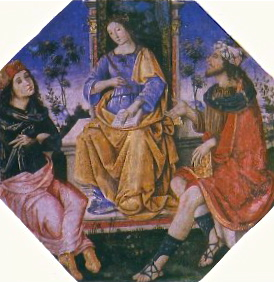
itself. Alternately, she could be Isis (see below with Hermes Trismegistus
& Moses by Pinturicchio in the Vatican), the Blessed Virgin
Mary or a priestess of Venus (below),
€”see especially Bob O'€™Neill's Iconology of the Early Papess Cards and Andrea
Vitali’s essay on The High Priestess. Even Paul Huson in Mystical Origins of the Tarot finds it
difficult to believe the Visconti family would memorialize a family
member burned at the stake
as a heretic .
Certainly Faith€ and "Holy Mother Church may be referenced in the Tarot image, but they were probably of a more heretical sort than the orthodox church has ever sanctioned. Andrea Vitali recounts a summary of the trial of Guglielma and her followers in which we find:
"€œAs Christ was true God and true Man, in the same manner, she [Guglielma] claimed herself to be true God and true Man in the female sex, come to save the Jews, the Saracens and the false Christians, in the same way as the true Christians are saved by means of Christ." [Tying her story in with the final cards of Judgment and the World, we find,] "€œShe too claimed she would arise again with a human body in the female sex before the final resurrection, in order to rise to heaven before the eyes of her disciples, friends and devotees." O'Neill's objection is that "€œbeyond the deck specifically produced for the Visconti about 1450, the local Milanese phenomenon of Guglielmites is unlikely to be the source for the image on earlier decks, for example, the 1442 deck mentioned in an inventory of the Este estate in Ferrara." But, as Newman has shown in her recent paper, Guglielma’s story and veneration had been popularized in Ferrara through a 1425 hagiography (saint’s life) by Antonio Bonfadini and in Florence through a popular late 15th century religious play by Antonia Pulci—although they told a garbled version of her history. (15th century deck on the right is known as a Lombardy II.) Matteo Visconti’s son,
Galeazzo, married the sister of the Duke of Ferrara in 1300, and they
lived there from 1302-1310, so that Ferrara had its own early
connection to this saint. Matteo From Newman’s article, we
learn that Maifreda’s convent was in Biassono, but she fails to note
that Biassono is only five miles from the small town of Concorezzo that
in 1299 was home to 1,500 Cathars! It seems that following the
Albigensian crusade many small towns around Milan became refugee
outposts of this faith, of which Concorezzo was the center, and
probably inspired the order of nuns who called themselves the
“humble†(umiliate). The most compelling bit of data that makes the attribution of the Papess card almost certain is that between 1440 and 1460 Bianca Maria Visconti, wife of Francesco Sforza and duchess of Milan, frequently visited Maddalena Albrizzi, Abbess of monasteries in Como and Brunate, and gave aid and gifts to the Order. (Brunate is just north of Milan with Biassono between them). Even the stones for the Como monastery were donated by Francesco Sforza. The Visconti-Sforza deck (first picture in post) was probably commissioned by or for Bianca Maria. Around 1450 (the same period as the deck) a cycle of frescos were painted in the church of San Andrea at Brunate that recorded the story of Guglielma: "how she left the house of her husband, came to Brunate, and lived a solitary life here, wearing a hairshirt and ordinary dress . . . in the company of a crucifix and an image of Our Lady." Only one of these frescos, ornately framed, remains today near the original chapel that had been dedicated to Saint Guglielma (see above). It depicts Guglielma with two figures kneeling before her. She appears to be giving a special blessing to the nun. Newman identifies them as Maifreda and Andrea Saramita (he was the main promulgator of her sainthood), although others claim them as Maddalena Albrizzi (a candidate for sainthood) and her cousin Pietro Albrici who renovated the church. Even as late as the nineteenth century, Sir Richard Burton, author of The Arabian Nights, noted that "€œSanta Guglielma, worshipped at Brunate, works many miracles, chiefly healing aches of head." It is not unreasonable to
conclude that Bianca Maria Visconti may have had a special devotion to
the woman whom so many Lombards venerated as a saint even in the 15th
century, nor that she honored an earlier family member, Maifreda, who
served as Guglielmas Vicar, hidden in plain sight under an image of
Faith. Note: Huck Meyer pointed
out this picture and Newmans article at Aeclectics tarotforum last
year see discussion here.       |
|
Posted: 06 Nov 2009 06:50 PM PST
I will be one of the three featured speakers, along with Robert Place and Elinor Greenberg, at the 2010 Readers Studio in New York. The website is now updated with all the information about this fabulous event. Hosted by Ruth Ann and Wald Amberstone from The Tarot School, Readers Studio is a unique event, geared to those who want practical techniques that will improve their reading skills. As a result, the 200+ attendees experience a community of tarot enthusiasts who share ideas, resources and connections. For instance, just the give-away table alone has hundreds of gems to swap, to say nothing of the seemingly never-ending raffle. The vendors tables offer books and decks that would be hard to find elsewhere and give you the opportunity to meet a deck artist or book author in person. Publishers send representatives to scout new book and deck possibilities and to give away freebies. Besides the main speakers you can choose among a variety of shorter evening lectures, the breakfast roundtables or get a reading from one of the luminaries. Several of the online tarot forums have found it a great place to meet other members. Come one, come all to a great event. Posted in Uncategorized      |