Bluetooth fun

84 views
Skip to first unread message

Andre Eisenbach

unread,
May 10, 2015, 11:39:23 PM5/10/15
to open...@googlegroups.com
Thought I'd share some fun I've been having with the Bluetooth module in my OpenEVSE:

As I had hoped, it was very easy to write an Android app for it.

When you first open the application, it will automatically look for the OpenEVSE and automatically connect to it.
Since the phone always has an accurate time, the "Send time" command lets me set the clock on the OpenEVSE by simply selecting the menu option.

Yes, the UI isn't great yet and a bunch of the features aren't implemented yet, but hey, it connects, reads the data etc. and allows me to set the time/date instantly.

Chris,

Maybe you should think about selling these little HC-06 modules in your store. Maybe offer a custom cable that makes it plug and play and pre-configure the device name and baud rate.
With a nice app, the out-of-the-box experience could be really nice here. No router setup, no Wifi required etc. Just use your phone...

Anyway, fun!

Danny ter Haar

unread,
May 11, 2015, 9:05:23 AM5/11/15
to open...@googlegroups.com
Wow that looks nice!
Will order a few of the bt units.
mind sharing the apk with us?

chris1howell .

unread,
May 11, 2015, 11:24:29 AM5/11/15
to open...@googlegroups.com

I am up for bluetooth... I found HC-06 modules that can be powered at 5v but it looks like the serial input is only 3.3v. Is the input 5v tolerant or does it need to be level shifted?

--
You received this message because you are subscribed to the Google Groups "OpenEVSE" group.
To unsubscribe from this group and stop receiving emails from it, send an email to openevse+u...@googlegroups.com.
For more options, visit https://groups.google.com/d/optout.

lincomatic

unread,
May 11, 2015, 11:26:58 AM5/11/15
to open...@googlegroups.com

That app is slick! Did you draw the EVSE yourself? If so, you’re quite a talented artist as well as programmer.

I set the clock the same way in my WebApp .. just hit a button to copy the time from the phone.

Unfortunately, iOS devices don’t support SPP, so the HC-06 is only compatible w/ Android.

If we could find a cheap BTLE module, then both platforms could be supported at once.

--

Alan Kirk

unread,
May 11, 2015, 12:16:18 PM5/11/15
to open...@googlegroups.com
I like it! 

A few weeks back Andre posted about a interface board he built to take care of the voltage problem.  I can't find the string nor can I find the sub-group Andre has posted this message into.  What am I doing wrong?  There was a suggestion in that  string from Nick regarding the use of a diode and resistor to accomplish the voltage shift, I'm looking for that string but can't seem to find it now.
And while I am at it, when I post in say Firmware under Craig's Wattmeter topic, the whole string with his original pictures seems to get added into my post. This doesn't seem right, again what am I doing wrong? 

Edit: OK I found this topic and the other I asked about under All Topics label, why doesn't it appear under the OpenEVSE group that includes General, Firmware Networking etc.?

lincomatic

unread,
May 11, 2015, 12:37:34 PM5/11/15
to open...@googlegroups.com

It isn’t 5V tolerant

Andre Eisenbach

unread,
May 11, 2015, 2:39:18 PM5/11/15
to open...@googlegroups.com
To answer some questions:

- Yes, I made the artwork

- Yes, it's technically 3.3V, but if you look around the web, many use this module directly on 5V without problems. I had problems with the 3.3V signal coming out of the module actually and made the level trigger board I posted about a few weeks ago. I think technically all that's needed dis a pull-up resistor though as I think Nick (?) suggested.

- Correct on the iOS SPP issue. Though an official app with the "Made for iOS" logo (or whatever they call it) can get SPP access. But yes, Bluetooth LE would be better.

I'll also try WiFi again. Just ordered some ESP8266 modules to play with.

It's a big trade off I'm trying to figure out right now...
Bluetooth is great out of the box and for initial configuration. Since it could be built into the box and be very hands-off, not requiring an access point etc.
But WiFi directly built-in would be nice since you can do cloud sync without any script/app to poll the data etc. Anyway, will try to see how well the ESP8266 modules work in comparison.

The Bluetooth app was fun this weekend already though. Would be nice to add graphing etc. to it.
So much to do, so little time :D

Alan Kirk

unread,
May 11, 2015, 3:04:26 PM5/11/15
to open...@googlegroups.com
I'm looking for a FTDI pin out for the V 3 board.  Cole put out a nice pin.pdf for the 2.5 board.  I'm going to plug my Chinese BT module in after lunch, well at least the 5V's and see what is to be seen on my new smart phone.
Hope Andre publishes his Android app soon!


On Sunday, May 10, 2015 at 8:39:23 PM UTC-7, Andre Eisenbach wrote:

lincomatic

unread,
May 11, 2015, 3:09:07 PM5/11/15
to open...@googlegroups.com

I’ve been wrestling with the same issues.


My current workaround with the WiFi is to have the EVSE use a standard SSID in AP mode out of the box.

The user connects to it to configure the WiFi. After the user configures the WiFi the local SSID & security, it switches to client mode. Then the app needs to scan the network to find its IP number.


If the user needs to reconfigure it for access point or messes up the configuration, a very long press on the button puts it back into AP mode.


Alternatively, AP mode also lets the user use the WiFi easily in a portable unit.


Messy, I know, but somewhat usable. It’s more difficult than BT, but not *that much* bad. What I like about BTLE is that the user doesn’t have to even pair it initially, but then there’s no cloud access.


From: open...@googlegroups.com [mailto:open...@googlegroups.com] On Behalf Of Andre Eisenbach
Sent: Monday, May 11, 2015 11:39 AM
To: open...@googlegroups.com
Subject: Re: Bluetooth fun


It's a big trade off I'm trying to figure out right now...

chris1howell .

unread,
May 11, 2015, 3:10:47 PM5/11/15
to open...@googlegroups.com

Pinout for FTDI is the same for all versions.

Craig Kirkpatrick

unread,
May 11, 2015, 3:33:51 PM5/11/15
to open...@googlegroups.com
Whenever Adafruit has these back in stock I'd like to try it.
https://www.adafruit.com/products/2471
It seems to solve a lot of problems with the ESP8266 and not much more expensive at $9.95

So far a bunch of us have had good luck with the GL.iNet pocket router at about $29 (the price has gone up since November 2014). I use a USB FTDI cable from the USB port on the tiny router to the FTDI header on the OpenEVSE and a Python script that Chris published here. I will say that I had some trouble copying and pasting his script but I got it working. Remind me and I'll put the script onto something like DropBox or Github. The Python script logs amperage readings to the cloud or you could setup your own Emoncms sever.

The pocket router is handy enough I bought a few more for using as a home wifi repeater to cover some weak spots. And I use another one when I travel frequently on business.

Alan Kirk

unread,
May 11, 2015, 4:00:44 PM5/11/15
to open...@googlegroups.com
Chris,  Hmm! The V 2.5 PIN.pdf Cole posted earlier shows Gnd on pin 1 and Vcc on pin 3 but my V 3 board has Vcc on pin 5.  I'm looking for Rx and Tx pin numbers. 
Thanks


On Sunday, May 10, 2015 at 8:39:23 PM UTC-7, Andre Eisenbach wrote:

Craig Kirkpatrick
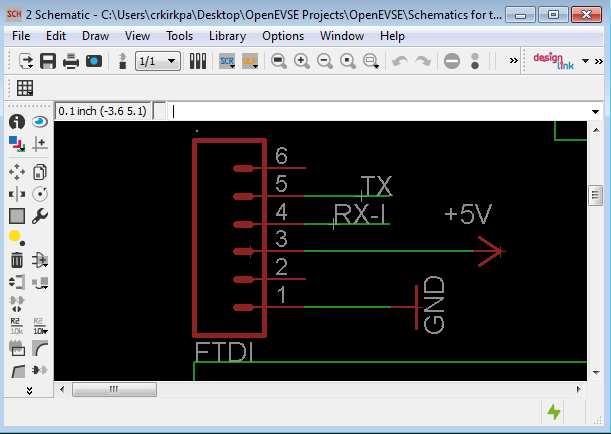
unread,
May 11, 2015, 4:41:22 PM5/11/15
to open...@googlegroups.com

Alan Kirk

unread,
May 11, 2015, 4:57:55 PM5/11/15
to open...@googlegroups.com
Andre, Saw this web page and thought of you and the fun you will have.

Got the FTDI pin-out straighten out, thanks Chris.  Who would have thought the HC-06 modules could run and pair off the Tx signal line! 
I put a signal diode in the BT Tx line for testing.  Left BT Rx wired to the FTDI Tx pin, hope this works.
Now off to turn on the RAPI in the code.


On Sunday, May 10, 2015 at 8:39:23 PM UTC-7, Andre Eisenbach wrote:
Reply all
Reply to author
Forward
0 new messages