
Polar alignment with PHD2
699 views
Skip to first unread message

James
Jul 8, 2013, 1:04:45 AM7/8/13
to open-phd...@googlegroups.com
Hello? all,
I have just moved from the Yahoo Groups, Starks-Labs. Andy introduced this to me.
I have been tried to align polar exactly, easily and shortly.
Recently, I realized there are 3 kinds of methods to get a fine polar alignment(1. very fine polar scope, 2. drift method, 3. polar alignment based on goto accuracy). As far as I know, all kinds of fine polar alignment tools can be categorized above.
I also realized polar alignment is consist of two processes- measurement and correction.
I have used PHD for CCD-drift method. Nowadays, I seeked for some quantitive analysis for drift in PHD. Any told me the PHDLab(log analyzer) would help me.
I used the PHDLab and could get a 10 arecsec accuracy in one time polar alignment.
I would suggest and discuss about this(fine, easy, exact polar alignment with PHD2) with others and developers.
= James =

Andy Galasso
Jul 12, 2013, 5:34:30 PM7/12/13
to open-phd...@googlegroups.com
Hi James,
I had a chance last night to try polar alignment with the latest PHD2 (r409) which now includes the display of PA error in arc-minutes based on the dec drift rate (based on your suggestion). It also displays the error in units of pixels, so I was able to use that number to see how far I needed to move the guide star when adjusting alt and az. Having this measurement helped me align in fewer iterations than I would have needed when just qualitatively looking at the slope of dec on the graph.
Here's a picture (using the simulator):
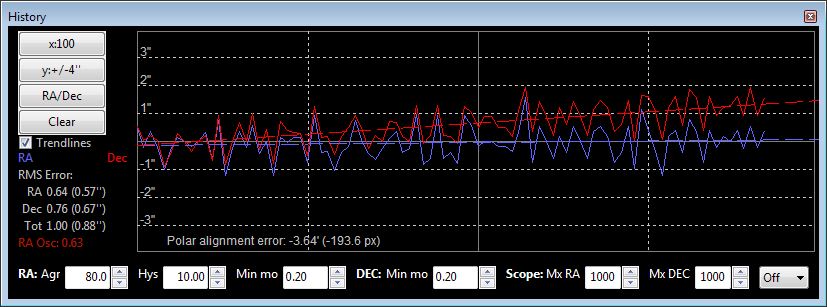
I think a further improvement would be to draw a circle around the guide star with the radius of the PA error. That would allow you to see exactly how far to move the guide star when correcting alt & az. I'll try adding this over the next couple of days.
Andy
Message has been deleted
Andy Galasso
Jul 14, 2013, 4:06:10 AM7/14/13
to open-phd...@googlegroups.com
I added the polar alignment circle mentioned in the last post. It's available in r412. Here's a Windows PHD2 executable if anyone wants to try it (copy it into your PHD2 install folder and run it from there.)
It's been too cloudy for me to test it in the field, so please let me know if it works for you.
Andy Galasso

Bret McKee
Jul 14, 2013, 11:21:56 AM7/14/13
to open-phd...@googlegroups.com
I haven't had a chance to try this, so maybe it will be obvious when I do, but what is the workflow?
I assume it is something like this:
- calibrate PHD
- enable the guiding helpers
- point the mount to a "good place to align" -- the celestial equator either up or to the horizon
- Start capuring images (do I guide here, or just loop?)
- let it drift until the error stabilizes
- (here is where I get fuzzy) Turn a mount knob to move the star to the circle? I assume I need to adjust the mount while looping so that I can see where I've moved the star to? Do I have to do it quickly so the circle doesn't change size, or is there a long enough running average that if I only take a few seconds I'm OK?
- repeat for the other axis
- repeat the whole process until I'm satisfied
Bret

Kevin S
Jul 14, 2013, 11:41:54 AM7/14/13
to open-phd...@googlegroups.com
Curious about the same thing my self and anxious to try this...thanks for asking.
Also was curious about this possibility....
I've been using astrotortilla to quantitate my PA offset. It works quite nice in that it essentially advances RA about 30 min (? exact amount) then plate solves to calculate the offset. an instant drift so to speak. Would there be any way to do a similar RA advance w/ PHD2 then see what the offset is? Have the circle represent this offset then adjust mount to center star?...thus eliminate the need to wait/watch the drift.
just thinking out loud....
thanks,
Kevin
Andy Galasso
Jul 15, 2013, 2:34:51 AM7/15/13
to open-phd...@googlegroups.com
Andy Galasso
Jul 15, 2013, 3:16:34 AM7/15/13
to open-phd...@googlegroups.com
Kevin,
Advancing RA only gives us information about the angle between the mount axis and the camera, but does not provide any information about the angle between the mount axis and the pole; we rely on drift to get that information.
The plate solver gets the angle between the camera and the sky, then advances RA to get the angle between the mount and the camera, so it can deduce the angle between mount and sky.
So we would need to have plate solving to do what they do, I believe Sequence Generator Pro will soon have a plate solve-based alignment routine... I'm looking forward to trying that out.
Andy
James
Jul 17, 2013, 3:42:09 AM7/17/13
to open-phd...@googlegroups.com
Hello Bret.
Polar alignment with drift using PHD is a established method. but quantitive analysis is not yet.
1. Calibrate PHD in celestrial equator(south).
2. guiding signal output off to drift...
3. repeat 1-2 to east/west star.
3. analyze the log file in PHDLab - this might say somthing like DEC +1.2arcmin, RA 0.64arcmin
4. go to the polaris(because polaris doesn't move fast)
5. turn fine grid in PHD(you should calculate your angle of view of guidescope, PHD fine grid = 32, course = 16, In my case, a fine grid means 1.98arcmin)
6. magnify the polaris with the window magnifier.
7. I can adjust PA looking the grid.
= James =
James
Jul 17, 2013, 4:22:00 AM7/17/13
to open-phd...@googlegroups.com
Hello? Kelvin.
I also use plate solve - MaximDL pinpoint... I tried the astrotortilla but the 4200 series index map were broken on the web.
Anyway, there are some basic problems. As far as I know, all fine PA is based on following two.
1. Drift method.
2. Alignment based on goto accuracy.
Plate solve might reveal the polar axis deviation quantitively(the axis difference between scope target and mount target).
However, this type of PA is maily depends on "goto accuracy". If mount goto error is too big, the PA can be fail, even if it
looks good.
In other aspect, How do you correct the PA errors obtained from astrotortilla? Turning the alignment knob and plate solving
repeatedly again and again?
PA with PHD is based on the Drift method. To gain the offset, the program must have any kind of star map. The PHD can
only detect the stars but never know what the star is.
= James =
James
Jul 17, 2013, 8:44:29 AM7/17/13
to open-phd...@googlegroups.com
Hello Andy...
I just downloaded yours. But I cannot find polar alignment circle(on simulator mode). It's been rainy these days for me. I'll test yours.
Thanks.
= James =
Andy Galasso
Jul 17, 2013, 10:05:23 AM7/17/13
to open-phd...@googlegroups.com
Hi James,
First, make sure that you have entered guide scope focal length and camera pixel size in the Brain Global and Camera tabs since the drift calculations require those and will not show anything unless they are entered. After calibrating, set Dec Guide Mode to None to allow the star to drift in Dec.
The simulator has a drift rate set very high, so depending on your focal length and pixel size the alignment circle may be too big to be visible on the screen. The drift rate for the simulator is set at compile-time (SimCamParams::dec_drift_rate in cam_simulator.cpp.) so if you are using the r412 executable I provided, you won't be able to change this yourself since there is no UI to change it.
But you can adjust the focal length and pixel size to be able to see it. These values work:
focal len = 2000 mm
pixel size = 1.0 um
Andy
Kevin S
Jul 17, 2013, 10:27:31 AM7/17/13
to open-phd...@googlegroups.com
Hi James,
I have had fairly good luck w/ astrotortilla. I cannot comment on it's
accuracy. One should be able to overcome goto accuracy by solve/sync in the
areas where the PA measurements are taken.
The most difficult part is translating the PA error into actual Alt/Azm
mount movements. I wrote a very simple app to help with this. It can be used
w/ anything that quantitates PA error. It's based on Frank Barrett's paper here Enter PA error, sync to a reference star then it slews to where the star
should be w/ good PA. While in frame/focus, move the mount to re-center the
star. details/download at scopefocus.info/polar-alignment
if interested.
Thanks,
Kevin
Reply all
Reply to author
Forward
0 new messages