
Periodic Errors in RA - PHD2 settings?

aeg
Hi Group.
I have been struggling with my mount, a CGEM, for a year now. It's seldom I get good results of my photo sessions.
I think my problems are large Periodic Errors in RA and not so much DEC backlash, even though there is a lot of that as well.
Last night I tried to use PECTool -“Batch Training” to record five worm gear-runs, but I think every single run was largely different from the others. And the average of five very different runs isn’t likely to result in a correction that works, is it? Do you think my suspicions of Periodic Error are correct?
In my PHD2 guiding graphs I think my RA seems very chaotic with large fluctuations. The RMS Error is high.
Is there anything in the PHD-settings I can do to improve the situation?
If anyone have the time to help I’m very grateful.
My equipment: Celestron Nexstar 8SE-tube on a CGEM, f/6.3 reducer, Lodestar X2 in an Orion TOAG.
https://www.dropbox.com/sh/2u4y2c5gsxaef34/AABkDjAP3bVSkmCfbMr0Oogda?dl=0
Below is a screenshot from PHD Guiding Assistant.
/anders


bw_msgboard
Hi Anders, sorry you’re have so much trouble and thanks for sending the logs so we can see what’s going on. Unfortunately, it looks like the problem is with the mount, this isn’t the sort of thing that can be fixed by adjusting guide parameters. I’m not entirely clear on what you were doing with all these short guiding sequences – some of them have Dec guiding disabled altogether for example. It’s hard to judge performance with such short runs. But there are definitely some things that point to problems in the RA tracking of your mount, as you suggested. Here’s one that’s particularly interesting:

These graphs show only the RA, in red. Look at the repetitive big impulses in RA that happen at just over 2-minute intervals. Because they are so large and happen so abruptly, guiding is not going to be able to handle them well. I think this is probably coming from the RA gear train. This is from the session on 10/18 at 20:11. And yet, this doesn’t seem to always be present. There are some of the short sequences where I don’t see this sort of behavior – and I don’t know why it would be different. There’s another suggestion of this later in the same evening:

There is certainly periodic error in the mount over longer time periods as shown below:
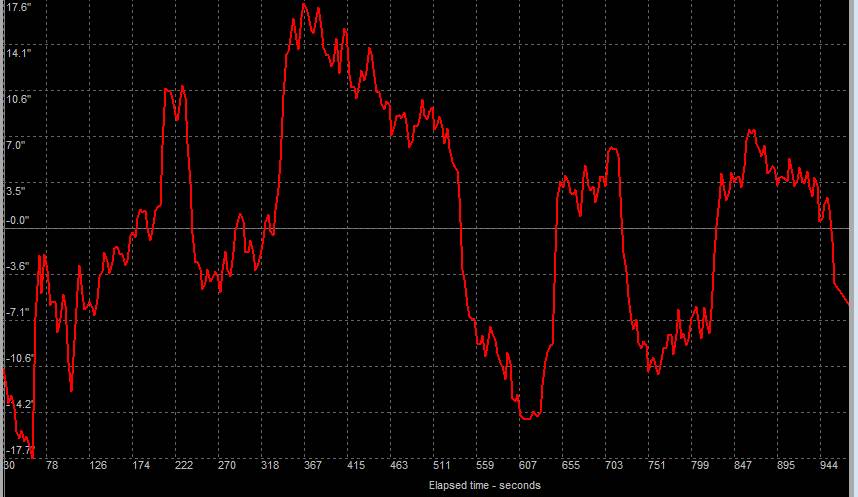
This is not alarming in terms of the overall amplitude, it’s pretty typical for mass-produced mounts. The problem is with the steepness and abruptness of some of the graph sections. You’re seeing 10-15 arc-sec excursions that happen in less than 15 seconds of time. This is not the sort of thing that will be easy for a PEC solution to handle.
Bottom line, I think you’ll have to get some help from Celestron or other forum experts about what might be done to improve the mount’s RA performance.
Good luck,
Bruce
--
You received this message because you are subscribed to the Google Groups
"Open PHD Guiding" group.
To unsubscribe from this group and stop receiving emails from it, send an email
to open-phd-guidi...@googlegroups.com.
For more options, visit https://groups.google.com/d/optout.
aeg
bw_msgboard
Hi Anders. Based on what we’ve seen here on the forum, some Celestron mounts have been prone to slipping, “cogging”, or other erratic movements, sometimes because of a missing firmware update. If you talk to Celestron or to a Celestron-specific support group, you may get some pretty specific help.