Problems with my Guiding..

225 views
Skip to first unread message

Raoul van Eijndhoven

unread,
Oct 3, 2015, 4:19:30 PM10/3/15
to Open PHD Guiding
All,

I am looking for some advice on a problem I have with my guiding.
I do not think PHD is the problem but something else in my setup.

My setup:
* Motorised EQ5 mount. (RA & DEC motors bought from Skywatcher) to motorise by EQ5.
* Shoestring GPUSB interface to my laptop.
* Using a standard Skywatcher Finder scope with a Phillips SPC 900n modded webcam.

I have replaced my computer, replaced USB cables, re-calibrated the worm gears on my mount to ensure no slack.

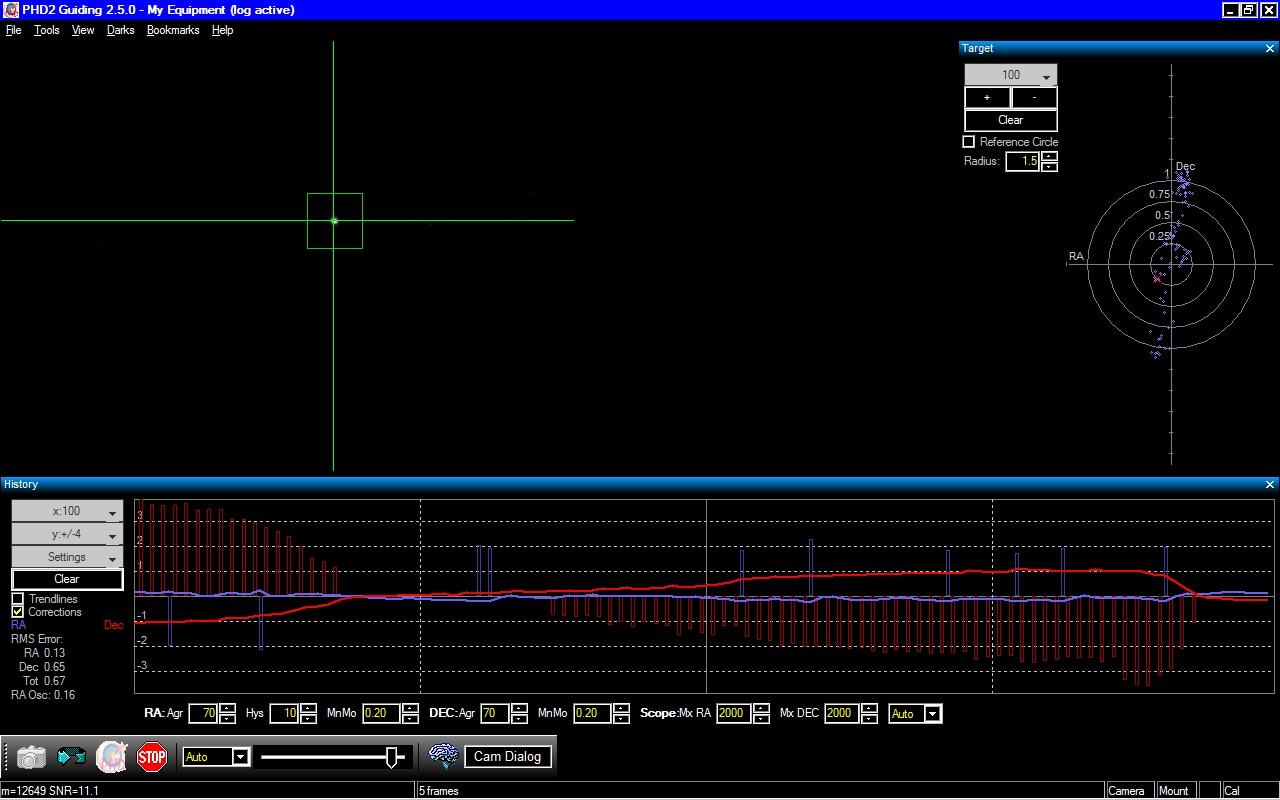
Attached 2 photos of PHD 2.5 which shows my guiding. 
The guiding can go fine for 2 minutes or so and then all of a sudden the guiding goes haywire (as per to screenshots).

Can anybody give me some ideas on what the problem might be?

Raoul

PHD Guiding issue XI.jpg
PHD Guiding issue XII.jpg

bw_msgboard

unread,
Oct 3, 2015, 4:43:41 PM10/3/15
to Raoul van Eijndhoven, Open PHD Guiding

Hi Raoul, sorry you’re having problems.  We can’t do much with screen snapshots, so you should send us your guiding logs.  It would be best to include a guide log that includes your most recent calibration.  It also looks like you haven’t run the new-profile wizard or otherwise set the focal length parameter of your guide scope.  Looking at pixel displacements, which is what your graph shows, it not very useful.  We’ll need to know that information to help you out.  Just from a cursory glance, it looks like you might have a lot of backlash in declination, a fairly common problem.  If you want to upgrade to a dev release of PHD2, you can use the Guiding Assistant to directly measure the declination backlash.  


http://openphdguiding.org/getting-help/

http://openphdguiding.org/manual/?section=Basic_use.htm#Equipment_Connection

http://openphdguiding.org/development-snapshots/


Good luck,

Bruce


--
You received this message because you are subscribed to the Google Groups "Open PHD Guiding" group.
To unsubscribe from this group and stop receiving emails from it, send an email to open-phd-guidi...@googlegroups.com.
For more options, visit https://groups.google.com/d/optout.

peter wolsley

unread,
Oct 3, 2015, 5:15:29 PM10/3/15
to Open PHD Guiding
Raoul,
Your problem appears to be DEC backlash.  DEC backlash always looks like a drifting away from zero on the DEC axis that persists even though there are lots of DEC guiding corrections issued to the mount.  After a while, the DEC corrections start working and the guidestar's DEC value quickly returns to zero.  This can repeat over and over and can be up or down DEC movements.   The better your polar alignment the more troublesome DEC backlash becomes...some people deliberately try to have their guiding slowly adjust DEC in one direction as a method for reducing DEC backlash problems of this kind.   It's almost impossible to eliminate DEC backlash but PHD2 does have  a DEC backlash compensation scheme that you should investigate.  Can you reply with your guiding logs.  They contain lots of details that can help investigate further.  It also helps if you can enter values in PHD2 for guider focal length and pixel size so that we can relate pixel movements to arc-second values...I can't tell if you have done so.

Try positioning you telescope on a bright star and while looking thru a high power eyepiece use your hand control to move the mount in DEC using a slow speed.  If you notice the star doesn't move right away then you are probable dealing with DEC backlash.  Your mount may also have a DEC backlash compensation feature that you should investigate.  Ideally you want pressing the DEC buttons on the hand controller to move the star almost immediately.  If you use too much compensation you will cause DEC to oscillate when you try to guide.  Post your guiding log and we can look further.

Peter

Raoul van Eijndhoven

unread,
Oct 3, 2015, 6:07:52 PM10/3/15
to Open PHD Guiding, ra...@quidne-it.com, bw_m...@earthlink.net
Bruce, Peter,

Thank you for the quick feedback. Attached the latest log.
I will have been using PHD for the last couple of years and so far always been able to let it do the calibration and the guiding works. 
As I use a Phillips SPC900nc PHD uses the Windows WDM driver.
I never set the pixel and focal length, but will do this for my next session.

According to somebody else I might have my scope balanced to well and polar alignment is too accurate. Besides using the Guiding Assistant, proper pixel and focal length setup for guidescope, I will also setup my mount slightly out of balance so the motors have pressure on them all the time.

Any additional feedback is welcome.

Raoul
PHD2_GuideLog_2015-10-03_202849.txt

bw_msgboard

unread,
Oct 3, 2015, 7:52:25 PM10/3/15
to Raoul van Eijndhoven, Open PHD Guiding

The initial impression about Dec backlash may still be correct, but there’s an element of “snap-back” that needs to be understood.  In most areas of the guide log, once we are finally able to get the mount moving in the right Dec direction, it over-shoots by a substantial amount and keeps going in that direction.  I think it would be good start fresh and get a clean set of data:


  1. Upgrade to the last dev release, 2.5.0dev5.  You don’t need to un-install anything, just install the dev build.
  2. Use the new-profile wizard to construct a new profile including the pixel size and focal length parameters.  This will also establish baseline settings for guiding, although that doesn’t appear to be the problem.  Unless you are running on a Mac, consider using the ASCOM driver for your mount – it will potentially give us better insight into what’s going on.  Even if you ultimately decide to use the GP-USB guiding interface, you should use the ASCOM driver to establish an ‘Aux’ connection.
  3. Be sure any backlash compensation in the mount is set to zero and run a fresh calibration.  The latest dev release should do a better of clearing the Dec backlash, and I can see there is a lot present in your mount.  Use the guide-step calculator tool to set the length of the calibration guide pulses.  For this testing, don’t use the auto-exposure setting – just choose an exposure that’s well over 1 second and a guide star that isn’t saturated.
  4. Run the guiding assistant for a couple of worm cycles – we need to get a sense of how much Dec drift is present independent of the guiding.  Then run the backlash measurement test in the Guiding Assistant so we can see how bad that is.


If this is a new problem for you, it’s likely something has happened with the mount, perhaps something getting loose.  But it looks to me like you’ve been running in “PHD1 mode” which is fine so far as it goes but doesn’t begin to take advantage of the new capabilities in PHD2.  If you can do these things, send us the guide logs again and we should be able to help you figure out what’s going on.   People will often make suggestions about what to “fix” (e.g. re-balancing), and these may be useful or not.  But I find it’s better to collect the data, analyze it carefully, and then proceed to change things.


Good luck.

Bruce


peter wolsley

unread,
Oct 4, 2015, 10:42:55 PM10/4/15
to Open PHD Guiding

Raoul,
My study of your Guiding log is that your problem is a combination of DEC axis backlash and too high a value for DEC resist switch aggression.  Your polar alignment was not "perfect"...We all struggle with this issue...there is significant DEC drift which is why the DEC sawtooth oscillations were occurring so frequently.    The aggressiveness value you chose caused the DEC corrections to overshoot on many occasions.  It would have been better if the correction brought the DEC axis back to within the min move threshold and not all the way to zero.  I suspect that the best you could have achieved would have been to reduce the DEC resist switch aggression and tolerated a DEC position that would have always been a little bit positive.
This graph is displays two signals.  The thin red line is the DEC guide star deviation that we see on the PHD guiding graph.  The thick red line is the calculated DEC axis movement of your mount in response to the PHD pulse guiding.  If you look at this thick line you can see two things:
1) At the beginning and end you can see there was an overall trend of the DEC axis steadily moving more and more negative.  This is the overall DEC drift that your mount is performing as it responds to  PHD.  In the center there is a big movement where the axis moved roughly 20 counts upwards and then back down again.  This represents the full amount of backlash in your DEC axis.  The units of measure for this 20 counts is in pixels.  Once you identify your guider cameras' pixel size and the focal length of your guider you can convert this 20 pixels to Arc Seconds.

-Question about PHD-
Another detail unrelated to your problem is a polarity issue within PHD2...it may even have persisted since the beginnings of PHD.  If you look at the screen captures your provided and then study the guide log using PHD Guide Log Viewer you will notice that the screen capture DEC movements are in the opposite direction as shown in PHD Guide Log Viewer.  I don't believe this is a problem with PHD Guide Log Viewer...I think it's a problem in the Guide Log itself.  The values seem to be multiplied by -1.  Maybe someone could speak to this. 

Peter


On Saturday, October 3, 2015 at 4:19:30 PM UTC-4, Raoul van Eijndhoven wrote:
Auto Generated Inline Image 1
Reply all
Reply to author
Forward
0 new messages